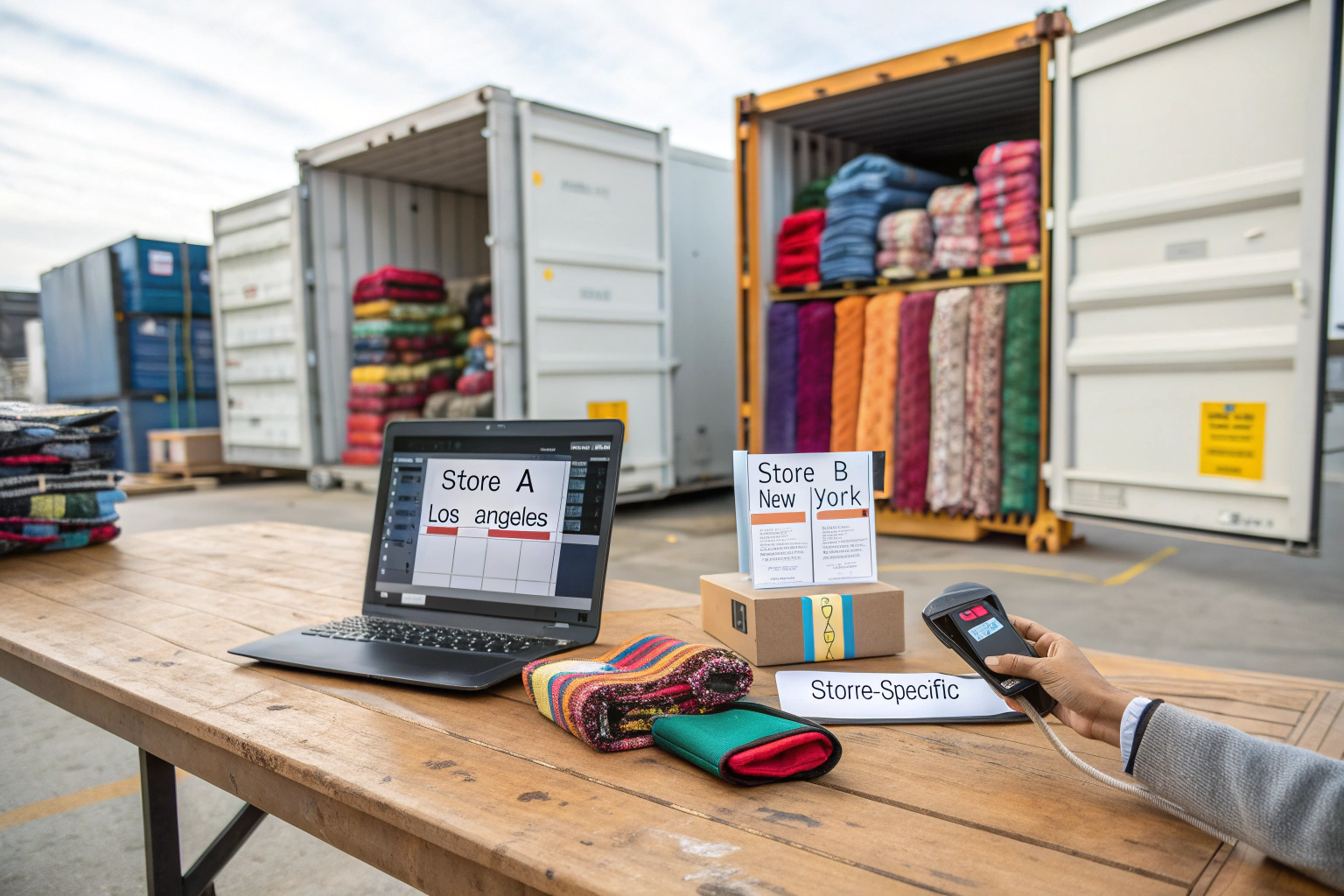
Two years ago, a boutique chain owner called me in a state of despair. She had a single container of our winter accessories—beanies, gloves, and scarves—docked in Long Beach, but the goods inside were destined for two different stores. Half had to go to her flagship in San Francisco, and the other half to her pop-up in Chicago. The container was packed by style, not by store. Unpacking it, sorting it manually at a third-party warehouse, and repacking it for the two final destinations ended up costing her an extra $3,500 in labor and delayed the delivery by ten days. That winter, she swore she would never waste that kind of money again.
The best way to split a container of mixed accessories for two US stores is to have the factory pre-sort and palletize the goods by the final destination during the packing stage. This method, known as "multi-stop container loading" or "retail-ready split packing," ensures that when the container doors open at the first store’s receiving dock, their cartons are already labeled, isolated, and ready to be unloaded without disturbing the second store’s shipment. This eliminates the need for costly transloading, manual sorting, and cross-docking at a US warehouse.
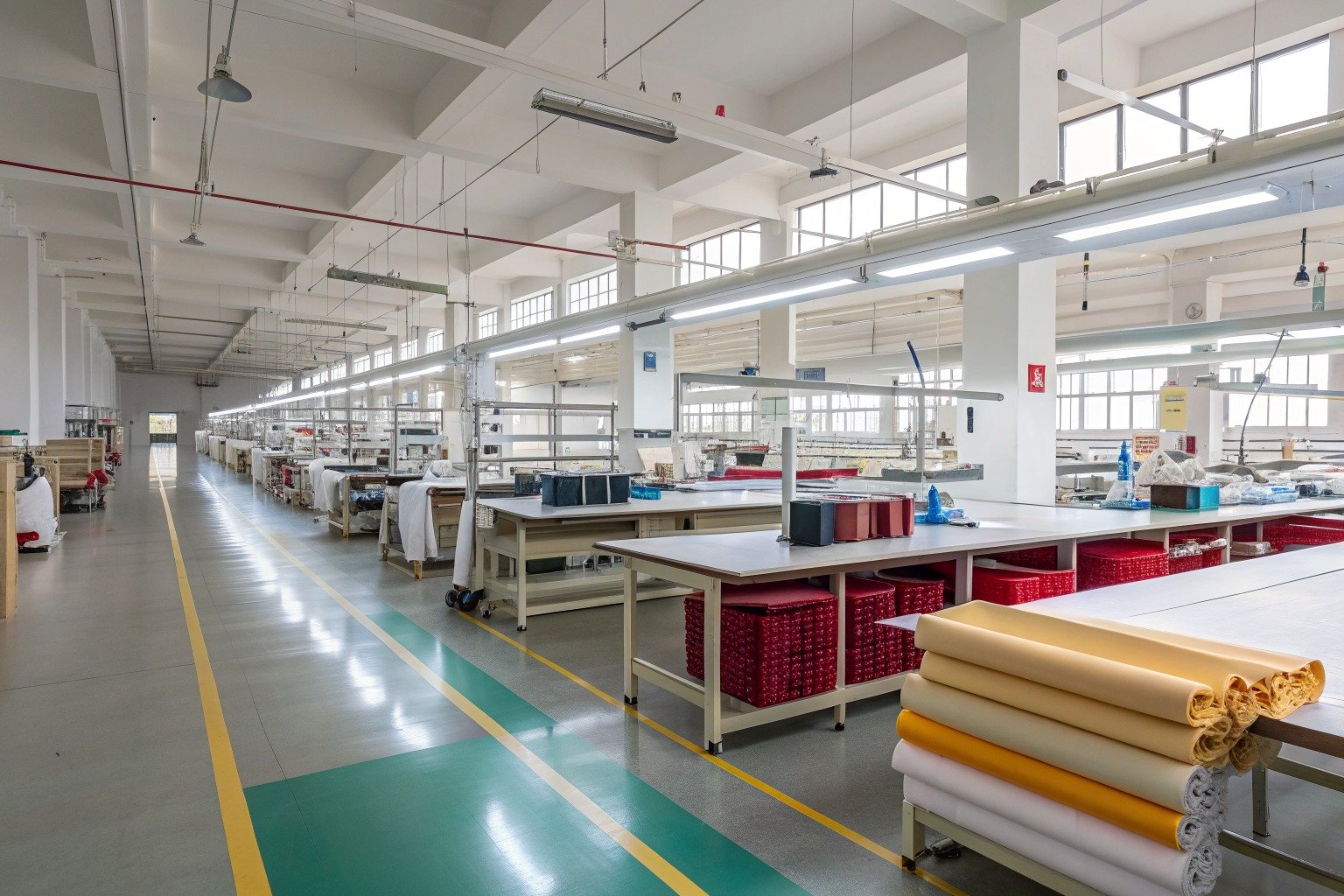
At our factory in Zhejiang, we handle complex split shipments regularly. I want to walk you through the loading methods that work, the documentation that keeps customs and your stores organized, and the financial math that usually proves that pre-sorting at the factory is far cheaper than sorting on US soil.
What Are the Most Common Methods for Splitting a Container Between Two Destinations?
There are three viable strategies for getting mixed goods to two stores in a single container, and one universally bad strategy that usually costs more than it saves. The right choice depends on the relative volume of the two orders, the distance between the two stores, and whether the stores require strict floor-ready compliance labeling.
The first strategy, pre-palletizing by store at the factory, is the most efficient and the gold standard. The second strategy, the "tailgate split," involves loading the container sequentially by store so that the first stop’s goods are at the back near the doors. The third strategy involves using a US-based cross-docking facility, but this introduces significant handling costs. The strategy to avoid is stuffing the cartons randomly into the container with no separation, which forces a costly manual sort in the US. I will explain why pre-palletizing is almost always superior.
How does a pre-palletized store-specific load work at the factory level?
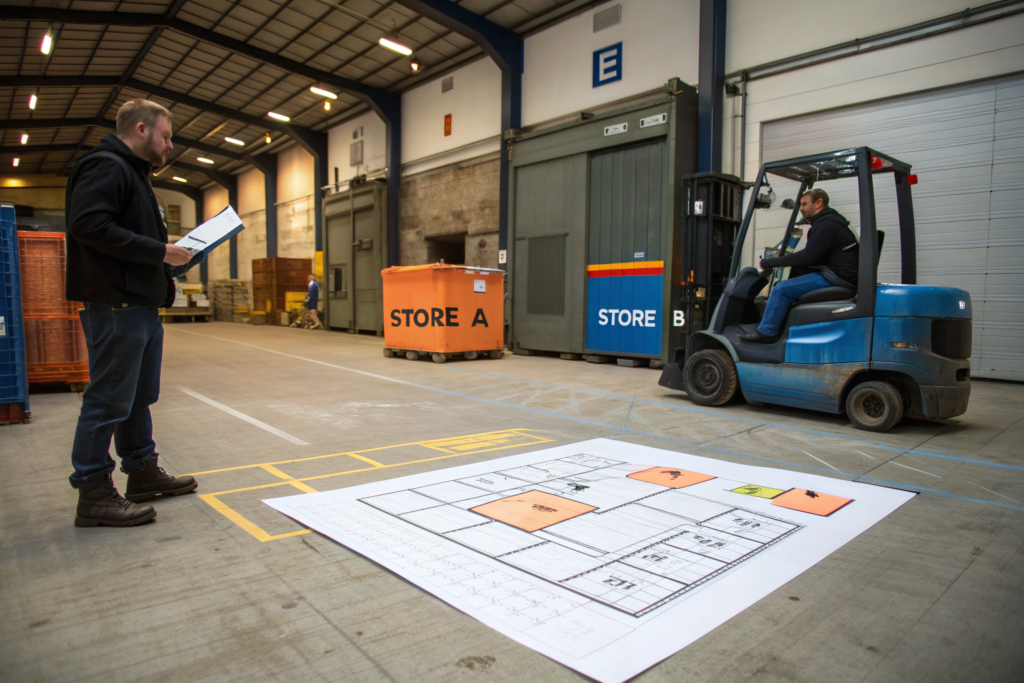
During the packing process, we assign each purchase order line item to a specific destination. The warehouse team picks the goods for Store A and builds dedicated pallets labeled "STORE A – LOS ANGELES." They then pick the goods for Store B and build separate pallets labeled "STORE B – NEW YORK." These pallets are loaded into the container in reverse delivery order; the pallets for the last stop go into the nose of the container first, and the pallets for the first stop go near the doors. When the truck arrives at Store A, the receiving team unloads their pallets, and the remaining pallets for Store B are already organized and secured in the front. This method requires no re-sorting and minimal unloading time. This container loading optimization guide explains the spatial logic.
Why is the "tailgate split" method risky for mixed accessory cartons?
The tailgate split involves loading the container so that all of Store A’s goods are in the first section nearest the doors, and Store B’s goods are in the second section deeper inside. The problem with mixed accessories is that carton sizes vary wildly—a large carton of bulky knit scarves sits next to a tiny carton of delicate hair clips. Unless a solid load bar or a cargo net is installed at the exact dividing line, the cartons shift during ocean transit. By the time the container arrives in the US, the neat dividing line is a jumbled mess of mixed cartons. A tailgate split without a solid physical barrier—a cargo net strapped to the walls—is a sorting headache waiting to happen. We only recommend this method if the factory installs a proper dividing net and straps it down securely.
How Should Carton Labeling and Documentation Be Prepared for a Split Container?
The single biggest headache in a split container is not the physical unloading; it is the paperwork confusion. If the commercial invoice and packing list are not perfectly separated by destination, US Customs and Border Protection (CBP) may flag the shipment for examination, and the receiving team at each store will not know which cartons belong to them.
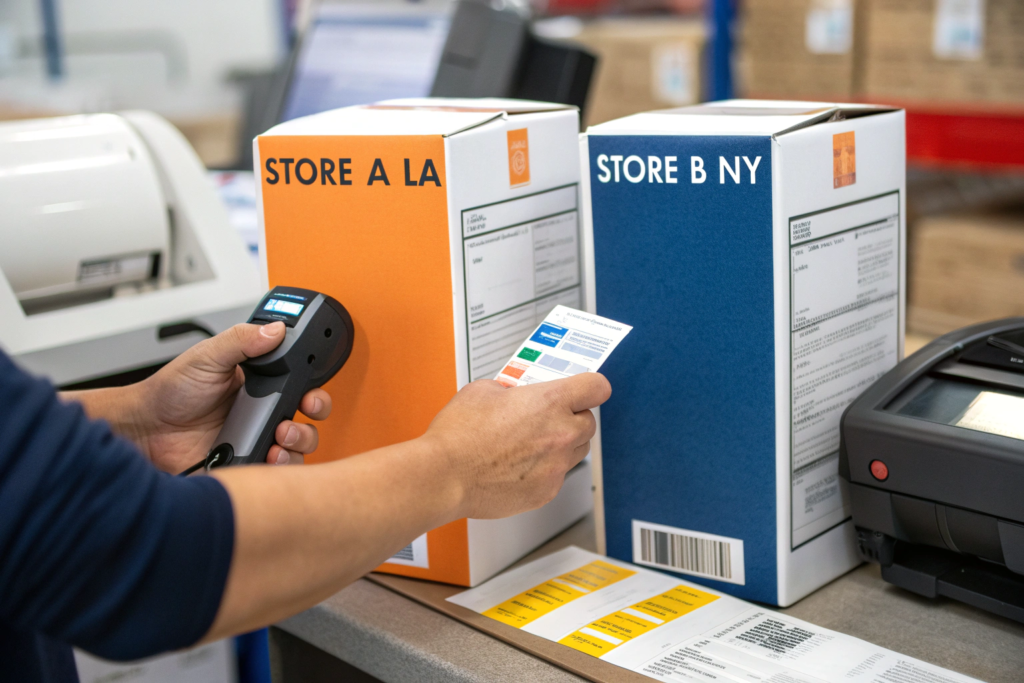
The solution is a "split documentation" package. The master Bill of Lading covers the entire container as a single movement from the factory to the first discharge port. However, the commercial invoice and packing list are divided into two clearly marked sections or issued as two separate documents under the same master file. Each carton is labeled with a destination-specific barcode and, ideally, a distinct color label—orange for Store A, blue for Store B. The instant a carton hits the receiving dock, the crew knows exactly where it belongs.
How should the commercial invoice be split to avoid customs delays?
The commercial invoice presented to US Customs should list the total value of the entire container to satisfy the entry requirements, but the itemized breakdown should be clearly grouped by the final destination. We typically create a single PDF containing two sequential commercial invoice sections. Section 1 lists all SKUs, quantities, and values destined for Store A. Section 2 lists the same for Store B. The total value at the bottom sums both sections. This format allows the customs broker to process a single entry while giving each store the exact breakdown they need for their receiving records. This US customs documentation for split shipments guidance is essential reading.
Why are color-coded carton labels a lifesaver during unloading?
When a warehouse team is unloading a container under time pressure, they do not read fine print. They scan visually for their store’s identifier. A large, brightly colored sticker on two adjacent sides of every carton allows the forklift operator to identify a "Store A" carton from across the loading bay. We use a system of destination-specific colors—orange for the first stop, blue for the second—and print the store name, address, and carton number on the label. This simple visual system eliminates the misdirected cartons that occur when both stores’ goods are in identical plain brown boxes with only a small text label to distinguish them.
What Are the True Costs of Factory Pre-Sorting Versus US Warehouse Sorting?
The decision of where to split the container is ultimately a financial one. The cost of having the factory pre-sort the goods is almost always a fraction of the cost of paying a US warehouse to break down a mixed pallet, sort through cartons, and rebuild pallets for the two destinations. The math is stark once you account for the US labor rate and the cost of the delay.
Factory pre-sorting involves an additional handling step at our warehouse, which we typically charge as a small per-pallet or per-carton fee. It also may slightly reduce the container’s volumetric efficiency, as store-specific pallets may cube out slightly less than a mixed pallet. US warehouse sorting involves devanning the container, sorting cartons by store, re-palletizing, and often storing the goods for a day or two until the second truck arrives. The total cost of this process is multiplied by the US labor rate, which is significantly higher than the Chinese labor rate.
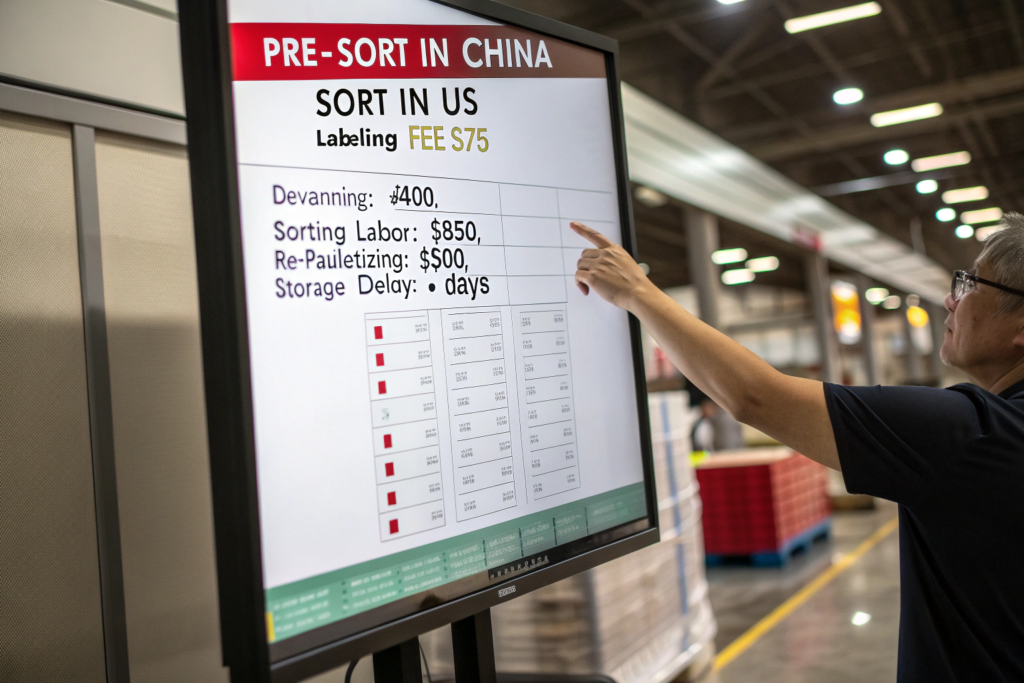
What is the typical cost difference between pre-sorting in China and in the US?
Pre-sorting at our factory adds a nominal charge to cover the labor and the destination-specific labels. US-based sorting at a third-party logistics provider or freight forwarder’s warehouse involves a devanning fee, a sorting labor charge billed hourly, and a re-palletizing fee. The total cost can range from several hundred to over a thousand dollars. Beyond the direct cost, the indirect cost of the delay—the goods sit in the warehouse for extra days while being sorted—can impact a retail floor set. The math nearly always favors factory pre-sorting for any split where the two stores are not receiving the exact same mix of SKUs.
How does container cube optimization affect the cost of splitting?
The most efficient way to fill a container is to mix different carton sizes together to fill every gap. When you pre-sort by store, you create two separate groups of cartons that may not interlock as perfectly. This can result in a slight loss of container utilization—perhaps a few cubic meters of empty space that could have been filled with additional goods. For a brand shipping a full container load, this minor loss of density is usually negligible compared to the US sorting cost. For a brand shipping a less-than-container load where every cubic meter counts, the trade-off is worth calculating. We can provide a cube utilization comparison for both loading strategies so you can make an informed decision.
How Can You Handle Replenishment and Cross-Docking After the Split?
Sometimes the best-laid split plan needs a last-minute adjustment. Store A might have sold through more inventory than expected during the transit time, or Store B might have a staffing shortage and cannot receive the full allocation. The ability to flexibly adjust the split after the goods arrive in the US, without incurring the full cost of a warehouse sort, is a valuable operational capability.
The solution is a hybrid strategy: pre-sort 80% of the goods at the factory into the two store allocations, but leave the remaining 20% in a flexible "buffer pallet" that is loaded last into the container. This buffer pallet can be allocated to either store after the container arrives, based on the most current sales data. This strategy combines the cost efficiency of factory pre-sorting with the flexibility of a small cross-dock operation.
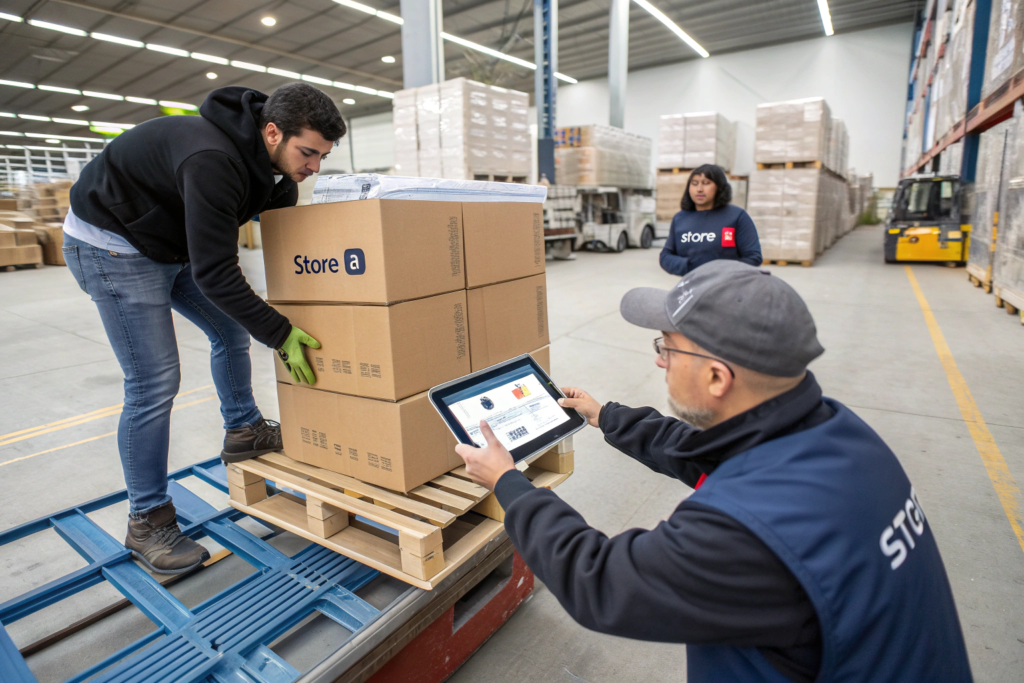
What is a "buffer pallet" and how does it prevent stock-outs?
A buffer pallet contains an extra, balanced assortment of the bestselling SKUs that are not pre-allocated to either store. When the container arrives at the first stop, the brand’s logistics manager checks the latest sales data and directs the buffer pallet to whichever store needs the inventory more urgently. This prevents a situation where Store A is sold out of a bestselling beanie while Store B has a full shelf of the same item. The buffer pallet is a small insurance policy against the forecasting errors that are inevitable in fashion accessories.
How does a "drop-ship" contingency plan work for the second store?
If the two stores are very far apart—say, Miami and Seattle—and the cost of trucking the container from the first stop to the second is high, an alternative is to route the second store’s goods through a small-parcel carrier like UPS or FedEx. We can pack the second store’s goods in individual cartons that are small enough to be shipped via ground parcel, not freight. When the container arrives at the first store, they simply hand the pre-labeled parcel cartons to the daily UPS pickup. This converts the second delivery from an expensive dedicated truck to a standard ground shipment, saving hundreds of dollars. This drop-ship retail logistics strategy is ideal for smaller second-store allocations.
Conclusion
Splitting a container of mixed accessories for two US stores does not need to be a logistical nightmare or a budget-breaking expense. The best practice is to solve the problem at the source, inside the factory, where the labor cost is lowest and the control over carton labeling and palletizing is highest. Pre-palletizing by store, labeling cartons with destination-specific color codes, and preparing split commercial invoices ensures that the goods flow smoothly through customs and onto the right truck.
We have walked through the loading methods, the documentation strategies, the cost comparison between factory sorting and US warehouse sorting, and the flexible replenishment tactics that give you control even after the container sails. The common thread is preparation. A container split that is planned on the factory floor costs a small fee. A container split that is improvised on a US warehouse floor costs a small fortune.
If you are planning a split shipment for your retail chain and want to coordinate the labeling, palletizing, and documentation with our logistics team, we can provide a split-loading plan and a cost estimate for your specific store destinations. Our Business Director Elaine manages our US retail logistics and can arrange the container split according to your store compliance requirements. Contact her directly at elaine@fumaoclothing.com. Let’s ensure your accessories land on the right shelf, at the right store, on the right day.