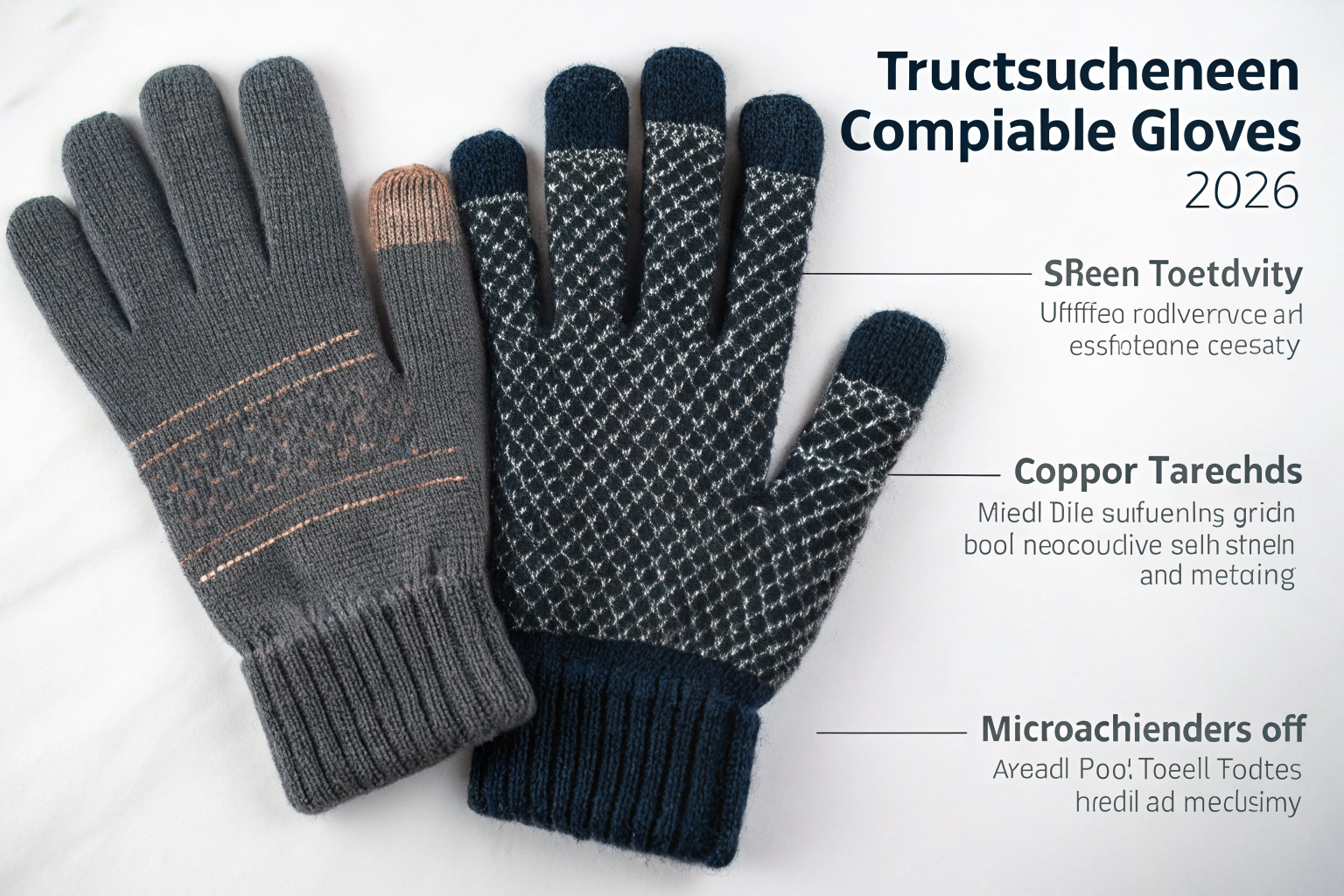
Last winter, I received a frustrated email from a client named Mark. He ran a successful online store selling premium cold-weather accessories. His best-selling item was a beautiful pair of cashmere-lined leather gloves. But his return rate for that product was 15%. The number one reason cited in the returns? "The touchscreen fingertips don’t work." Customers were complaining that they could not answer a call, swipe through a playlist, or text while wearing the gloves. The supposedly "tech-compatible" fingertips were inconsistent, worked for a week and then stopped, or only functioned if they pressed absurdly hard. Mark was losing money on every returned pair and, more importantly, losing customer trust. If you are like Ron, you know that in 2026, a winter glove that doesn’t work with a smartphone is a winter glove that will be returned. The fear of promising tech compatibility and delivering a frustrating, non-functional experience is one of the biggest anxieties in the cold-weather accessory market.
The 2026 trends for touchscreen-compatible gloves are defined by a shift away from simple conductive fabric patches and toward fully integrated, high-performance solutions. The three key trends are: (1) the dominance of "Knitted-In" conductivity, where silver or copper-infused yarns are seamlessly integrated into the entire glove, not just the fingertip; (2) the rise of durable, "True-Touch" microfiber palm and finger overlays that provide a precise tactile feel and enhanced grip, mimicking the bare finger on the screen; and (3) the "Hybrid Layering" approach, where touchscreen functionality is paired with weatherproof membranes and ultra-thin insulation, creating a glove that is both fully connected and genuinely warm. The era of the single, unreliable, peeling fingertip patch is over.
I run AceAccessory in Zhejiang Province. We are located in the heart of China’s knitwear and technical textile ecosystem. I have spent years testing conductive yarns, coatings, and fabrics. I have learned what works, what fails, and what consumers actually demand. The touchscreen glove problem is a perfect intersection of textile engineering, consumer electronics, and fashion. A beautiful glove that cannot connect is a failure. A technically perfect glove that looks like a piece of industrial equipment is also a failure. The 2026 consumer wants Effortless, Invisible Connectivity that is as much a part of the glove as the cuff or the lining. Let me walk you through the specific technologies and trends that are defining this critical product category for the coming winter season.
Why Is "Knitted-In" Conductivity Replacing Conductive Patches?
For years, the standard solution for touchscreen gloves was the Conductive Patch. This was a small circle of conductive fabric or a coating applied to the index fingertip and thumb. It was the only option available for many seasons, but it has a fundamental flaw: It is a temporary addition, not an integrated feature.
The Failures of the Conductive Patch:
- Peeling and Delamination: The patch is glued or heat-pressed onto the glove. After repeated flexing, exposure to moisture, and friction, the adhesive bond fails. The patch peels off. The glove loses its tech function.
- Inconsistent Contact: The patch can shift. If it is not perfectly aligned with the wearer’s fingertip, the screen will not register the touch. The user has to constantly adjust the glove.
- Loss of Dexterity: The patch can be stiff or thick. It interferes with the natural tactile sensation of the fingertip. It feels clumsy.
- Aesthetic Disconnect: The patch looks like a band-aid. It disrupts the visual flow of the glove and immediately signals "tech add-on" rather than "premium design."
The 2026 Solution: "Knitted-In" Conductivity.
This is a fundamentally different approach. Instead of applying conductivity as an afterthought, we Engineer It Into the Yarn Itself. We use conductive yarns—typically a blend of polyester or nylon wrapped with Pure Silver, Copper, or Silver-Coated Copper —and knit them directly into the entire glove shell or, at minimum, the entire finger, not just the fingertip pad.
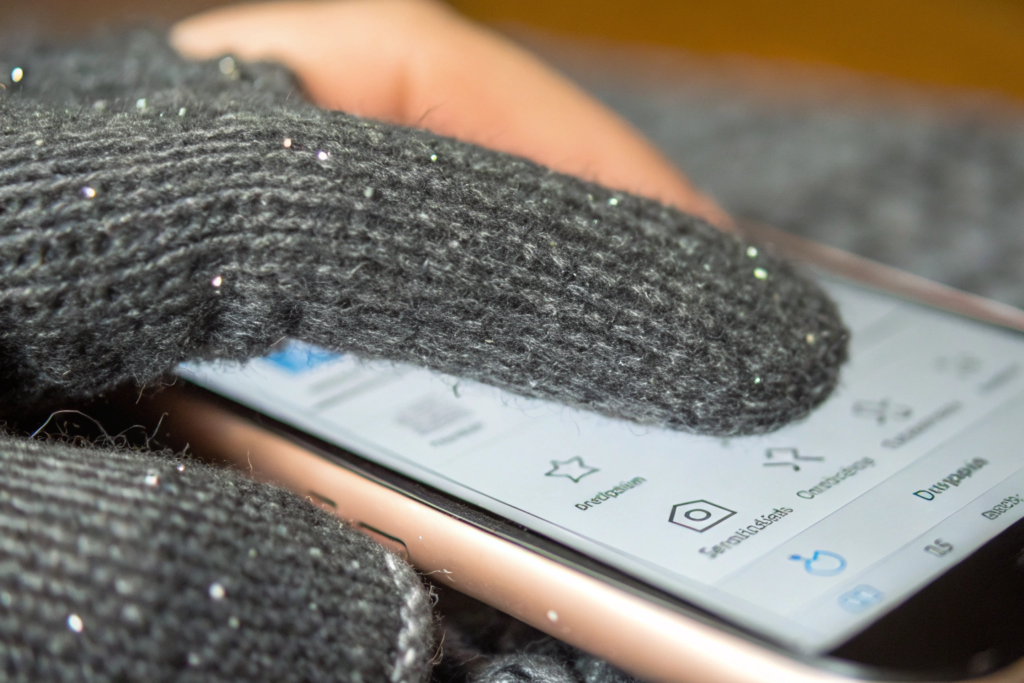
The result is a glove where the Entire Finger is the Conductor. The connectivity is permanent. It cannot peel off. It cannot shift. It provides a much larger and more reliable contact area with the screen. This technology is the new baseline for any premium touchscreen glove in 2026. At AceAccessory, we have validated these conductive yarns through extensive wash and abrasion testing. We offer this as our standard for all our tech-compatible knit gloves .
How Do Silver-Coated Yarns Provide Seamless, Whole-Finger Connectivity?
The magic is in the material science. Silver-Coated Nylon Yarn is the current gold standard for knitted-in conductivity. Here is why.
The Physics of the Connection:
Your smartphone screen is a Capacitive Sensor. It detects the tiny electrical charge conducted by the human body. A bare finger works because skin is conductive. A standard wool or acrylic glove is an Insulator. It blocks your body’s electrical charge. The screen cannot detect your touch.
How Silver-Coated Yarn Bridges the Gap:
- Silver is the Most Conductive Metal on Earth. Even a thin, microscopic coating on a nylon fiber is enough to carry the tiny bio-electric charge from your skin to the screen.
- Seamless Integration: The silver-coated yarn is plied together with the base yarn (wool, acrylic, cashmere) and knitted into the glove on the same machine. It becomes a Structural Component of the Fabric. There is no glue, no separate piece, no seam.
- Whole-Finger Coverage: Because the yarn is knit throughout the entire finger, the Entire Finger Surface becomes conductive. You can tap with the pad, swipe with the side of the finger, or even use a knuckle. The screen registers the touch from any angle.
- Durability: The silver coating is bonded to the nylon fiber at a molecular level. It will not wash off or wear away under normal use. A properly engineered silver-coated yarn can withstand 50+ Home Laundering Cycles without losing its conductivity.
At AceAccessory, we source certified silver-coated yarns and test every batch for Conductivity and Wash Fastness. This ensures that your gloves will work reliably, season after season. This is the foundation of a premium touchscreen glove .
What Is the "True-Touch" Microfiber Overlay and Why Does It Improve Accuracy?
While knitted-in conductivity solves the connection problem, the "True-Touch" Microfiber Overlay solves the precision and feel problem. Even a well-knit conductive glove can feel slightly "vague" on the screen. The texture of the knit fabric can interfere with the smooth glide of a swipe and make it difficult to tap small icons accurately.
The True-Touch Solution:
A thin, durable, and highly tactile Microfiber Synthetic Leather is precisely bonded or stitched onto the Grip Zone of the palm, thumb, and fingertips. This is a common feature on performance outdoor gloves, and it has now migrated into the fashion market.
Why It Enhances the Touchscreen Experience:
- Mimics a Bare Finger: The microfiber surface is incredibly smooth and has a high coefficient of friction against glass. It provides a Precise, Tactile, Non-Slip Contact. You can feel the screen. You can type accurately. You can use swipe-to-type (glide typing) without skipping.
- Enhanced Pressure Sensitivity: The thin, dense material transmits touch pressure more effectively than a soft, airy knit. This is critical for functions that require a firm, deliberate press.
- Bridging the Air Gap: The microfiber overlay eliminates the tiny air gap between the knitted fibers and the screen. This ensures a Consistent, Uninterrupted Capacitive Signal.
The Aesthetic and Durability Bonus:
A well-designed microfiber palm and finger overlay adds a premium, high-performance aesthetic. It also reinforces the glove in high-wear areas, adding durability where the glove grips a steering wheel, a ski pole, or a phone.
At AceAccessory, we offer a range of Touchscreen-Ready Microfiber Materials in various colors and textures. We can integrate them into both knit and woven glove designs. It is the detail that elevates a touchscreen glove from "functional" to "flawless."
How Are Touchscreen Gloves Being Engineered for Severe Cold and Wet Conditions?
The classic touchscreen glove is a thin, fashion-oriented knit—perfect for a crisp autumn day, but useless in a snowstorm. The next frontier for 2026 is the All-Conditions Connected Glove. This is a glove that provides touchscreen compatibility without sacrificing genuine warmth, windproofing, or water resistance.
The Engineering Challenge:
The fundamental problem is that conductivity and heavy insulation are historically at odds. A thick layer of Thinsulate™ or fleece is an insulator; it blocks the electrical connection to the screen. A waterproof membrane is a solid plastic sheet; it also blocks the connection.
The 2026 Solution: The "Hybrid Layering" Approach.
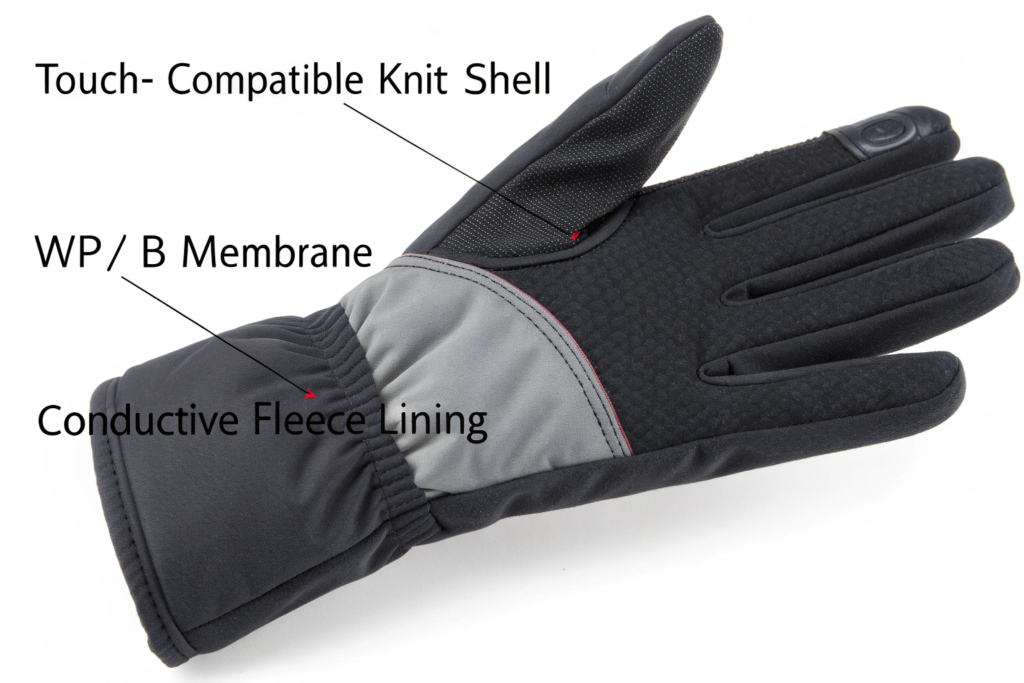
We are now engineering gloves with Three Distinct, Integrated Layers:
-
The "Weather Shield" Outer Shell:
- Material: A tightly woven, windproof, and durable water-repellent (DWR) treated Softshell Fabric or a technical Nylon Ripstop.
- Function: Blocks wind, sheds light rain and snow, and provides abrasion resistance.
- Touch Compatibility: This layer is Non-Conductive. It is the protective shield. The touchscreen functionality is achieved through a Laser-Cut Opening or a Conductive Overlay Patch precisely placed on the fingertips, or the shell is designed to end just below the conductive knit fingertips.
-
The "Climate Control" Middle Membrane:
- Material: A thin (0.015mm), Waterproof-Breathable (WP/B) Polyurethane Membrane (similar to Gore-Tex® but thinner and more flexible for the fingers).
- Function: Creates a Complete Waterproof Barrier. Prevents liquid water from penetrating to the insulation and skin. Allows water vapor (sweat) to escape, keeping hands dry and warm.
- Touch Compatibility: Standard WP/B membranes are non-conductive. The touch connection is carried through the membrane at specific, engineered points using Conductive Through-Hole Technology or by designing the membrane to not cover the conductive fingertips.
-
The "Connected Insulation" Inner Lining:
- Material: A soft, warm, brushed fleece that has been Infused with Conductive Fibers or is knit with a silver-coated yarn grid.
- Function: Provides the primary thermal insulation. Because it is conductive, it carries the body’s bio-electric charge from the skin all the way to the outer touch point.
- Touch Compatibility: Fully Conductive. This is the layer that connects your hand to the outer touch point.
This hybrid construction allows a glove to be genuinely Waterproof, Windproof, Insulated, and Fully Touchscreen Compatible. It is the new gold standard for premium, all-conditions winter gloves. At AceAccessory, we are at the forefront of integrating these advanced textile technologies into beautiful, fashion-forward designs.
Can a Waterproof Membrane Be Truly Touchscreen Compatible?
This is the million-dollar question, and the answer in 2026 is a definitive Yes, through Point-Specific Engineering. A solid sheet of waterproof membrane across the entire fingertip will block the capacitive signal. The solution is to create a Conductive Passage Through the Membrane.
We achieve this using one of two methods:
Method 1: The "Micro-Porous" Conductive Membrane.
A specialized, ultra-thin membrane is developed with Microscopic Pores filled with a conductive polymer. This material is inherently both waterproof and conductive. It is expensive and at the cutting edge of textile technology. We use it for our most premium, seamless designs.
Method 2: The "Through-Hole" Conduction Point (More Common and Robust).
- Precision Laser Cutting: A tiny, perfectly circular hole (approx. 1-2mm diameter) is laser-cut in the waterproof membrane at the exact center of the fingertip.
- Conductive Bonding: The conductive outer fabric (e.g., the True-Touch microfiber) is directly bonded to the conductive inner lining (e.g., the conductive fleece) Through This Tiny Hole. A conductive adhesive is used at this single, precise point.
- Waterproof Sealing: The edge of the hole is sealed, and the bond prevents water from migrating through the hole. The rest of the membrane remains a solid, waterproof barrier.
The result is a membrane that is 99.99% waterproof, with a single, engineered "Conductive Via" at the fingertip. This technology allows us to build truly waterproof touchscreen gloves that are reliable and durable. This is the kind of advanced manufacturing expertise we offer.
How Does a Layered Construction Prevent Data Signal Interference?
This is a sophisticated but important point. The human body’s capacitive signal is very weak. If the layers of the glove are too thick, or if the conductive path is not well-designed, the signal can degrade.
Our layered construction is designed to act as a Focused Waveguide for the body’s signal, not a barrier.
The Principles of Signal Integrity in Glove Design:
- Maximize Skin Contact: The inner conductive lining is designed to fit snugly against the skin, maximizing the Capacitive Coupling between the hand and the glove. A loose, baggy lining will have a weaker signal.
- Direct Path Conduction: We avoid "signal drift." The conductive pathway from the inner lining to the outer touch point is As Direct as Possible, with no gaps, no non-conductive barriers, and no sharp angles. It is a straight, engineered bridge.
- Insulate the Non-Touch Areas: The non-conductive insulation (like Thinsulate™) is strategically placed on the Back of the Hand and the Non-Touch Fingers. The fingertip area itself is insulated only by the conductive fleece. This keeps the fingertip warm without adding signal-blocking bulk.
- Moisture Management: A dry hand conducts better. Our waterproof-breathable membrane prevents external moisture from saturating the glove and degrading the signal, while also allowing internal sweat vapor to escape. A damp, sweaty glove will have a weaker, more intermittent connection. Our system keeps the internal environment dry and the signal strong.
This level of engineering is what separates a glove that "sometimes works" from a glove that "always works." At AceAccessory, we test our glove designs with a variety of smartphones and in a range of dry and humid conditions to ensure reliable signal integrity. This is our quality assurance for the connected age.
What Are the Style Trends for Connected Gloves in 2026?
Touchscreen technology is no longer just a feature for bulky ski gloves. It has permeated every category of cold-weather accessory, and the 2026 style trends reflect this integration. The demand is for Invisible Tech—gloves that look and feel luxurious first, and are effortlessly connected second.
The Three Dominant Style Trends for 2026:
-
The "Quiet Tech" Minimalist Knit.
- Aesthetic: Clean, unadorned, modern. Think premium 12-gauge knit in solid, sophisticated "Post-Neutral" colors (Deep Plum, Bitter Chocolate, Charcoal).
- Tech Integration: Invisible. The entire glove is knit from a conductive silver-coated cashmere or merino wool blend. There is no visual difference between the touch finger and the other fingers. The technology is a hidden asset.
- Vibe: Understated luxury. For the professional who wants to check their phone on the commute without sacrificing their refined look.
-
The "Urban Commuter" Performance Hybrid.
- Aesthetic: Sleek, technical, and purposeful. A softshell back-of-hand with a tailored silhouette. A premium "True-Touch" microfiber palm and finger overlay.
- Tech Integration: Visible and Tactile. The microfiber overlay is a design feature, often in a contrasting tone or a subtle geometric pattern. It signals "high performance" and "precision."
- Vibe: Confident, modern, active. For the city dweller who walks, bikes, or takes public transit and needs weather protection, grip, and flawless connectivity.
-
The "Apres-Ski" Touchscreen Mitten.
- Aesthetic: Cozy, voluminous, and playful. Chunky cable knits, fluffy faux fur trims.
- Tech Integration: The Flip-Top or the Integrated Conductive Patch. A classic mitten with a hidden, conductive patch on the thumb and index finger area, or a design that allows the fingertip to be exposed and re-covered.
- Vibe: Cozy luxury with a practical twist. For the ski lodge, the winter festival, or the cold-weather hike where warmth is paramount, but the perfect photo must be captured.
At AceAccessory, we have developed sample lines in all three of these trend directions. We can help our clients choose the style and technology integration that best aligns with their brand DNA and target customer. This is our design trend expertise .
Why Are "Bitter Chocolate" and "Deep Plum" the New Neutrals for Tech Gloves?
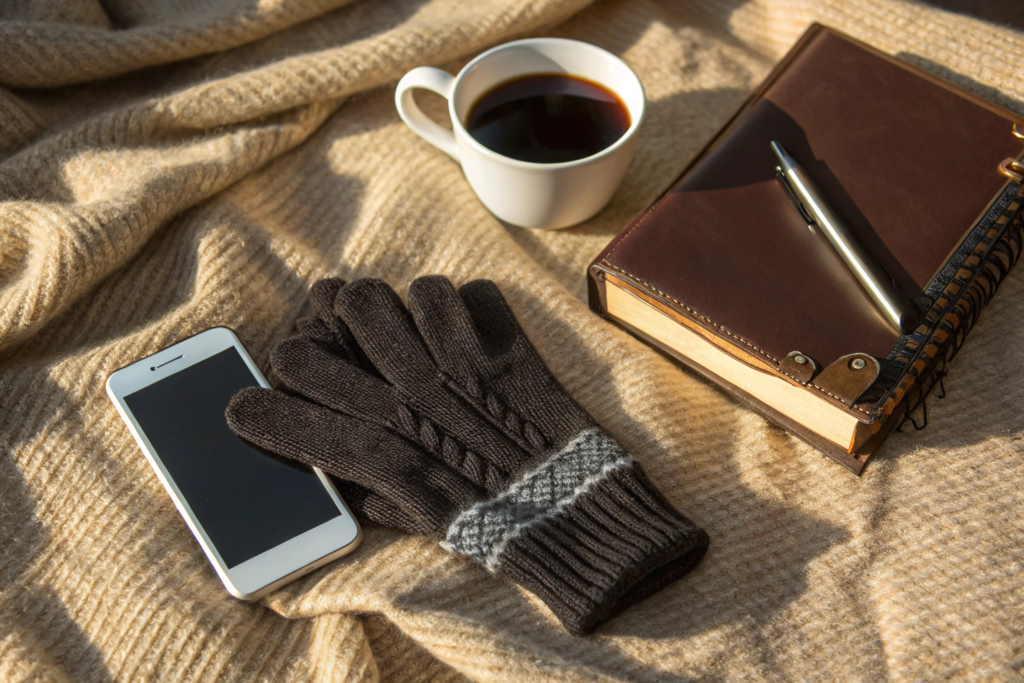
Stark black has long been the default for tech accessories. It is practical because it hides dirt. But in 2026, the consumer is craving Warmth and Personality. The cold-weather palette is shifting to richer, more nuanced darks. As we explored in our Q1 2027 trends, Deep Plum and Bitter Chocolate are the new anchors.
- Bitter Chocolate: A very dark, warm brown. It is softer and more inviting than stark black. It pairs beautifully with the warm tones of a wool coat or a leather bag. It feels Grounded and Luxurious.
- Deep Plum: A dark, inky purple. It is mysterious, sophisticated, and adds a subtle, unexpected touch of color to a dark winter outfit. It is the "interesting" neutral.
The Tech Advantage:
These dark, saturated colors are excellent at Hiding the Minute Metallic Flecks of the conductive yarns. A black glove can sometimes show the silver yarn as a visible sparkle. On a deep plum or chocolate ground, the silver yarn blends in much more seamlessly. The "Invisible Tech" aesthetic is easier to achieve.
At AceAccessory, our color library for conductive yarns has expanded significantly. We can match these trending dark hues perfectly, creating a glove that is both technologically advanced and aesthetically beautiful.
How Are "Invisible Tech" Gloves Being Styled for the Modern Professional?
The modern professional works from a phone, but they also attend meetings, meet clients, and want their accessories to reflect a sense of Understated Polish. The bulky, visibly technical glove is a mismatch for this world.
The "Invisible Tech" Glove Styling Formula:
- Silhouette: Slim and Tailored. A fine-gauge knit (12- or 14-gauge) that fits the hand closely, like a second skin. No slouchy cuffs or bulky seams.
- Material: Luxe Blends. A touch of cashmere for softness and warmth, blended with the conductive yarn. The hand-feel is impossibly soft. The technology is completely hidden.
- Color: Refined Darks. Deep Plum, Bitter Chocolate, or a rich, heathered Charcoal.
- The Look: It is worn with a classic camel wool overcoat, a leather briefcase, and a minimalist watch. The wearer pulls out their phone, seamlessly swipes through an email, and puts it away. No one notices the gloves. That is the point. The technology is invisible, enabling the person to remain effortlessly connected and impeccably styled.
This is the ultimate expression of the "Quiet Luxury" trend in accessories. It is a product that serves its function perfectly and beautifully without ever calling attention to itself. At AceAccessory, this is our design philosophy for our premium connected knitwear.
Conclusion
The 2026 trends for touchscreen-compatible gloves mark a definitive end to the era of the unreliable, peeling fingertip patch. The technology has matured, and the consumer expectation has shifted. Connectivity is no longer a novelty feature; it is a baseline requirement, expected to be as reliable and seamless as the glove’s warmth or fit.
The future is defined by integration and invisibility. "Knitted-In" silver yarns and "True-Touch" microfiber overlays provide flawless, whole-finger conductivity that is permanently bonded to the glove. Advanced "Hybrid Layering" techniques allow this connectivity to coexist with genuine waterproofing and insulation, creating all-conditions gloves for the active, connected life.
And finally, these technical capabilities are being wrapped in designs that prioritize beauty and feel. The "Quiet Tech" minimalist knit and the warm, sophisticated "Post-Neutral" palette ensure that the connected glove is not just a gadget, but a refined, luxurious accessory in its own right.
If you are developing a connected glove program for the 2026 season and want a partner who understands both the textile engineering and the fashion sensibility required, we can provide samples of our conductive yarns and hybrid constructions. Contact our Business Director, Elaine. She can send you a tech pack of our touchscreen solutions and a swatch book of our 2026 conductive yarn palette. Email Elaine at: elaine@fumaoclothing.com.