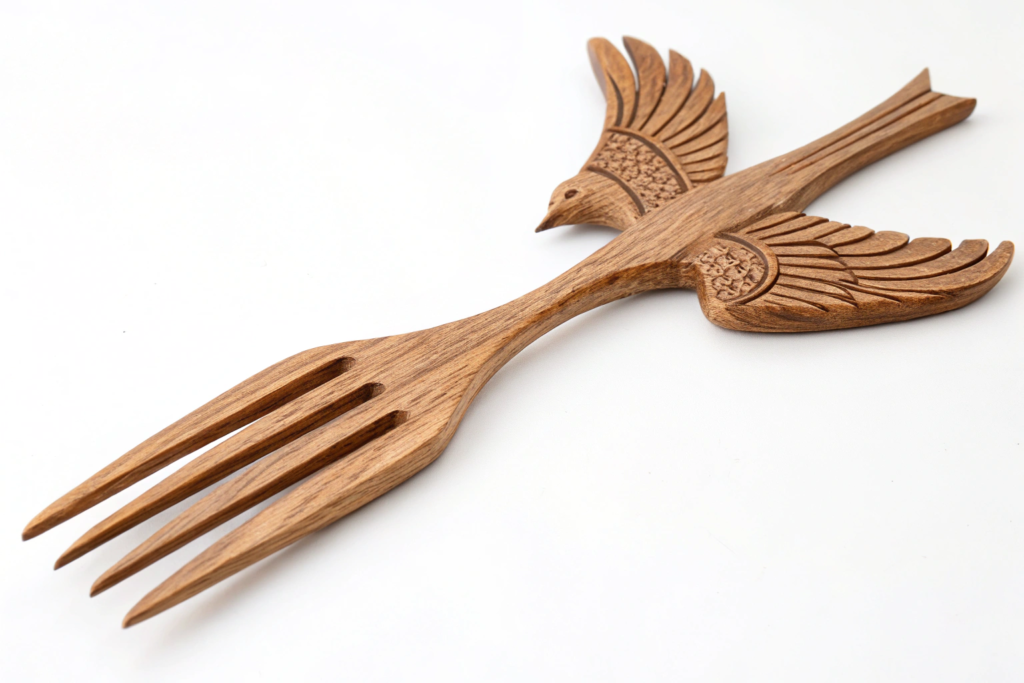
I had a client named Anya who runs a successful Etsy shop selling handcrafted items for women with long, thick hair. She had been sourcing simple, straight wooden hair sticks from a small workshop, but her customers were begging for something more—something sculptural, something that could actually hold a heavy French twist without slipping out by lunchtime. She sketched a beautiful, curved, three-prong design inspired by a bird in flight. She took it to several factories. They all told her the same thing: "Minimum order 5,000 pieces. Mold fee $2,500. Too complex." She came to me, deflated, thinking her design would never see the light of day. I looked at her sketch and said, "We can do this." If you are like Ron, you understand that the most loyal customers are often found in niche markets. The fear of being told "No, it’s too complicated" or "Yes, but only if you order a shipping container full" is a constant barrier to innovation.
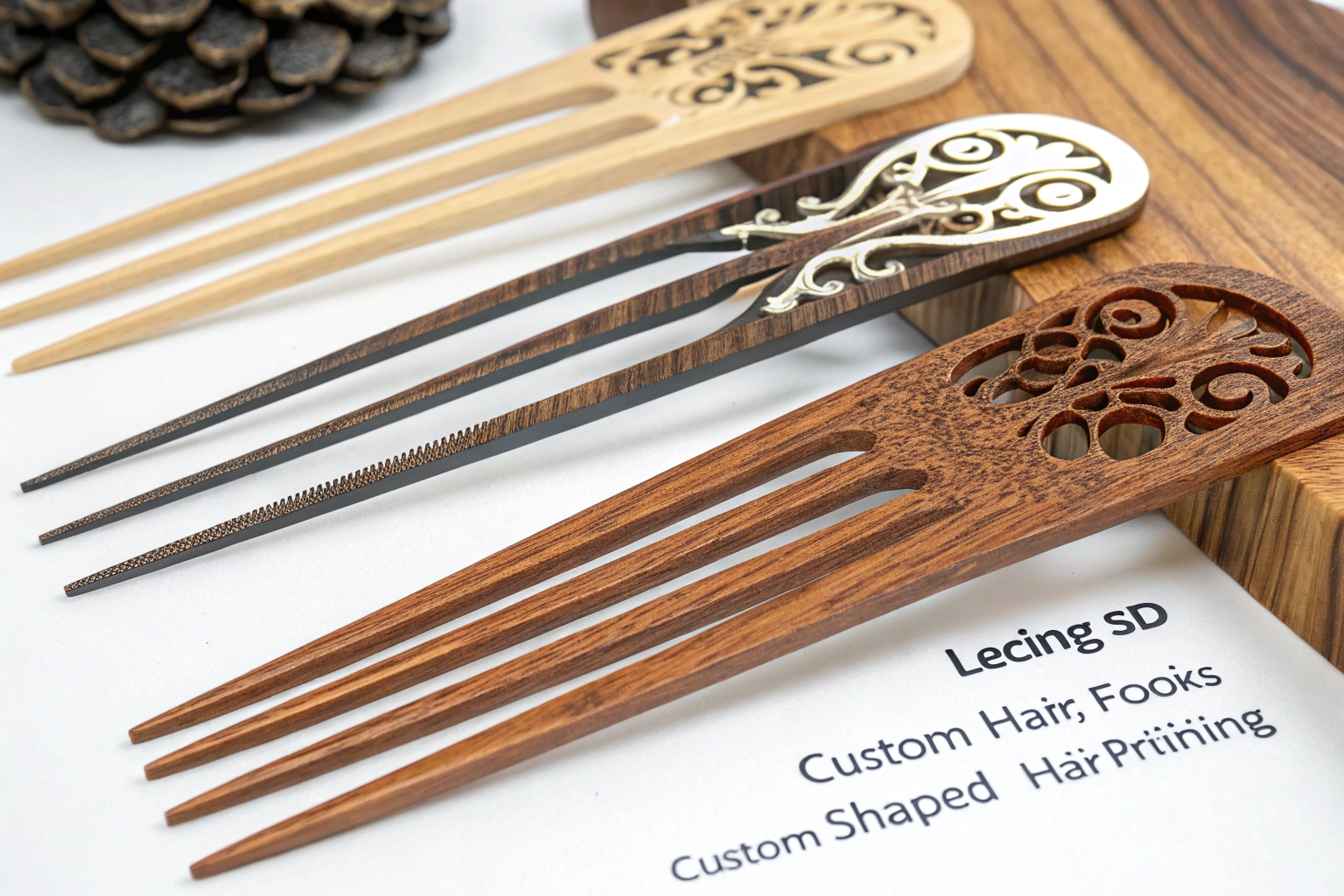
Yes, we can absolutely produce custom shaped hair forks for long hair. This is a specialized category that we have developed significant expertise in. We can manufacture custom forks using a variety of methods tailored to your quantity and budget: CNC machining for precise wooden and acrylic forks, die-casting for intricate metal alloy forks, and 3D printing for rapid prototyping and low-volume production of complex shapes. The key is understanding the functional requirements—prong length, curve radius, and tip smoothness—that make a hair fork effective for holding heavy, long hair.
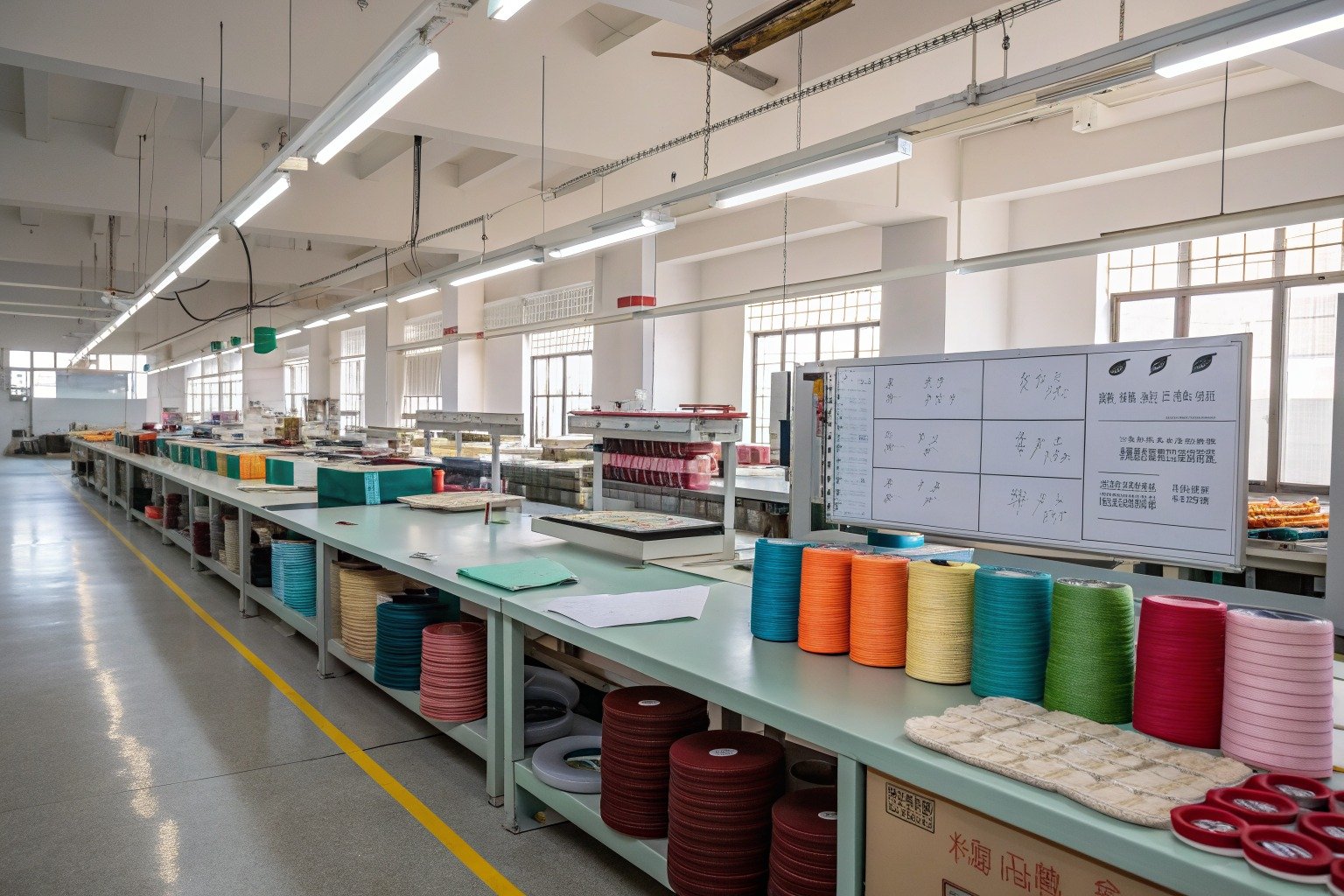
I run AceAccessory in Zhejiang Province. While we are known for hair claws and fashion accessories , our capabilities in shaped wood and acetate have grown significantly. I have spent time studying the unique engineering challenges of the Hair Fork. It is not just a pretty shape. It is a Functional Tool. The prongs must be long enough to anchor into a bun. The curve must match the natural curve of the skull. The tips must be perfectly smooth so they glide through hair without snagging. The spacing between the prongs must provide tension without being impossible to insert. A beautiful fork that doesn’t hold hair is a failure. Let me walk you through the specific manufacturing methods we use and how we translate a sculptural vision into a functional, durable hair accessory.
What Manufacturing Methods Are Used for Custom Shaped Hair Forks?
The manufacturing method is dictated by three factors: Material, Complexity, and Quantity. There is no single "best" way to make a custom hair fork. There is the Right Way for your specific design and business model. At AceAccessory, we offer three primary pathways for custom fork production.
Method 1: CNC Machining (for Wood and Acetate).
- Process: A block of premium wood (sandalwood, ebony, maple) or a sheet of cellulose acetate is placed on a Computer Numerical Control (CNC) milling machine. A cutting tool carves the 3D shape of the fork directly from the solid material based on your digital design file.
- Best For: Sculptural, Organic Shapes. Smooth curves, flowing lines, 3D contours. Low to Medium Volumes (50 – 1,000 pieces).
- Advantages: No Mold Fee. Extremely precise. Excellent for natural materials. Short lead time.
- Limitations: Slower per-unit production time than molding. Not ideal for very high volumes (10,000+ pieces).
Method 2: Die-Casting (for Metal Alloys).
- Process: A Steel Mold is created. Molten Zinc Alloy or Brass is injected into the mold under high pressure. The part is ejected, trimmed, and polished.
- Best For: Intricate, Detailed Metal Forks. Vintage-inspired filigree, nature motifs, geometric precision. High Volumes (500 – 10,000+ pieces).
- Advantages: Low per-unit cost at scale. Captures fine detail. Substantial, premium weight.
- Limitations: Requires a Mold Fee ($800 – $2,500). Longer lead time for mold creation.
Method 3: 3D Printing (for Prototypes and Low Volumes).
- Process: Your design file is printed layer-by-layer in High-Definition Resin or Durable Nylon.
- Best For: Prototyping. Verifying the shape, size, curve, and prong spacing before committing to CNC or molding. Also viable for Ultra-Low Volume (10-50 pieces) or incredibly complex geometries that cannot be machined.
- Advantages: Fastest Turnaround (3-5 Days). Zero tooling cost. Unlimited complexity.
- Limitations: Resin is not as strong as wood or metal for long-term daily use. Surface finish requires post-processing.
At AceAccessory, we guide our clients to the optimal method based on their goals. For Anya’s "Bird in Flight" fork, we used CNC Machining from Sandalwood. The quantity (200 pieces) was too low for a mold, but the sculptural shape was a perfect fit for CNC. The result was a stunning, functional piece of wearable art.
How Does CNC Machining Allow for Sculptural, Flowing Shapes in Wood?
This is the technology that has democratized custom woodworking. In the past, a complex curved fork like Anya’s bird design would have required Hours of Hand-Carving by a master artisan. The cost would have been prohibitive, and consistency across 200 pieces would have been impossible.
CNC Machining changes the equation.
- Digital Precision: Your 2D sketch or 3D model is converted into G-Code, the language of the CNC machine. This code dictates the exact path of the cutting tool with Micron-Level Precision.
- Multi-Axis Carving: Our CNC machines are 4-Axis. This means the cutting tool can approach the wood block from multiple angles. It can carve Undercuts and Complex 3D Curves that would be impossible on a simple 3-axis machine. It can perfectly replicate the subtle swoop of a bird’s wing or the organic curve of a flowing river.
- Material Flexibility: We can use Exotic Hardwoods that are too dense or brittle for hand-carving. The CNC machine doesn’t get tired. It carves Ebony with the same precision as Maple.
- Consistency: Every single fork in the batch of 200 is an Exact Replica of the digital file. There is no variation from piece to piece. This is essential for a brand selling a premium, consistent product.
The Finishing Touch:
CNC machining leaves a slightly textured surface. Our artisans then Hand-Sand and Polish each fork through a series of progressively finer grits, up to 1000-grit. This removes the tool marks and reveals the deep, natural luster of the wood. Finally, the fork is finished with a food-safe Natural Oil and Wax Blend. This protects the wood, repels moisture, and gives it a silky, smooth feel that glides through hair. This hybrid of Digital Precision and Artisanal Finishing is what makes our custom wood forks so special.
What Are the Functional Requirements for Prong Length and Curve Radius?
This is where manufacturing expertise meets Ergonomics. A beautiful shape is worthless if it doesn’t function as a hair tool. For long, thick hair, the fork must act as a Cantilever and a Wedge.
Based on our testing and client feedback, here are the critical functional dimensions for a fork designed for long hair:
| Feature | Functional Requirement | Why It Matters |
|---|---|---|
| Prong Length | Minimum 4.5 inches (11.5 cm). Ideal: 5.5 – 6.5 inches (14 – 16.5 cm). | The prongs must penetrate through the bun and anchor into the hair against the scalp. Short prongs will simply fall out. |
| Overall Curve Radius | Gentle curve matching the Curve of the Skull. | A straight fork will sit awkwardly and create pressure points. A curved fork hugs the head and distributes tension evenly. |
| Prong Spacing | 3mm – 5mm gap between prongs. | Too narrow, and it’s impossible to insert. Too wide, and it provides no tension or grip. The gap creates a Friction Lock against the hair. |
| Tip Shape | Fully Rounded, Blunt Tips. | Sharp, pointed tips will Scratch the Scalp and Snag Hair. A smooth, rounded tip glides safely through the hair. |
| Prong Thickness | Tapered from 4-5mm at the base to 2-3mm at the tip. | The taper allows for easy initial insertion, while the thicker base provides strength and volume. |
At AceAccessory, we review every custom design against these functional requirements. If a client submits a beautiful design with 3-inch prongs, we will gently advise: "This shape is stunning, but for long hair, we strongly recommend extending the prong length to at least 5 inches. It will make the difference between a decorative object and a functional tool." This consultation is a key part of our design support .
What Is the Minimum Order Quantity (MOQ) for Custom Hair Forks?
This is the question that Anya was most afraid to ask. She had been burned by the "5,000 piece minimum" before. The answer for custom hair forks is surprisingly accessible, especially compared to injection-molded plastic accessories.
MOQ Breakdown by Manufacturing Method:
| Method | Material | MOQ | Rationale |
|---|---|---|---|
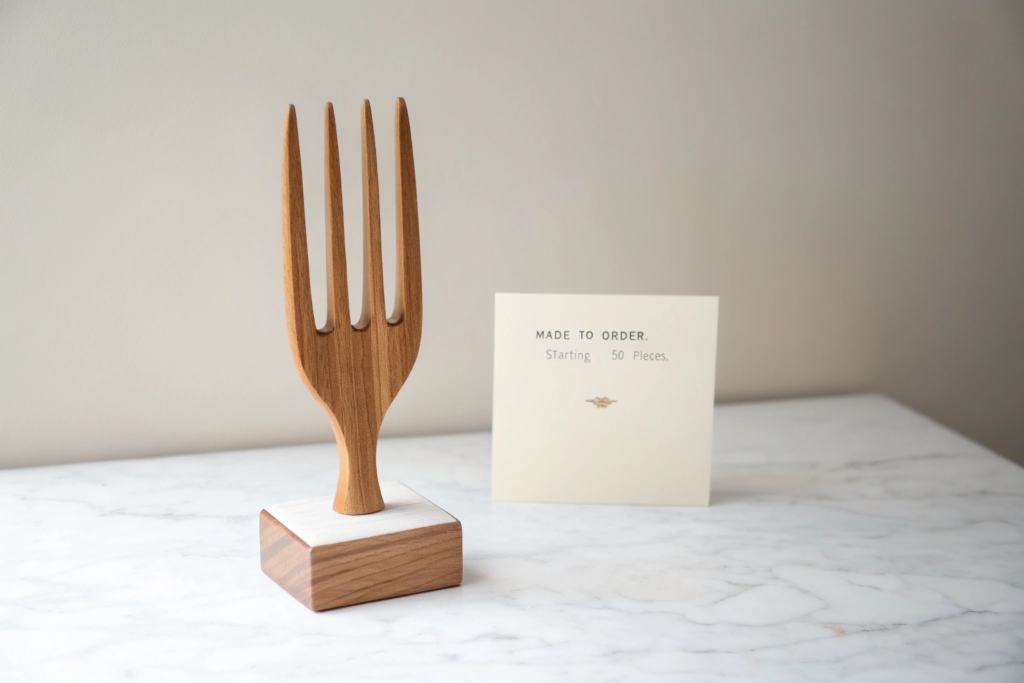
| CNC Machining | Wood, Acetate | 50 – 100 Pieces | The primary cost is Machine Setup and Programming Time. Once the file is ready, carving 50 pieces is economically viable. |
| Die-Casting | Zinc Alloy, Brass | 500 Pieces | The cost is driven by the Steel Mold. The mold cost must be amortized over a minimum quantity. |
| 3D Printing | Resin, Nylon | 1 Piece | No tooling. Each piece is printed on demand. |
The "Samples First" Model:
We encourage all clients to start with a 3D Printed Prototype (1-2 pieces) to validate the design. The cost is low ($30 – $60). Once the design is approved, we move to the CNC Production Run of 50 pieces.
This low MOQ for CNC forks opens up a world of possibilities for:
- Boutique Brands: You can offer a unique, exclusive design without massive inventory risk.
- Bridal Designers: You can create a custom hair fork to match a specific bridal collection, ordering just enough for the season.
- Limited Edition Drops: You can test a new sculptural shape with a small batch, gauge customer response, and then scale up.
At AceAccessory, we specialize in these Low-Volume, High-Value production runs. We have optimized our workflow to make small-batch CNC production efficient and cost-effective. We believe in helping small brands and independent designers bring their unique visions to life. This is a core part of our manufacturing philosophy .
How Does the 3D Printing Prototype Phase Save Time and Money?
This is the single most important step in a successful custom fork project. Skipping the prototype phase to "save time" is the most expensive mistake you can make.
Scenario A: Skipping the Prototype.
- You approve a digital 3D rendering.
- We program the CNC machine and carve 50 forks in expensive Ebony wood.
- You receive the forks. You insert one into your hair. You realize the curve is slightly too shallow. It doesn’t hug your head. It sticks out awkwardly.
- Result: 50 beautiful, expensive, Unusable Ebony forks. You have paid for the material and the machine time. You have to start over.
Scenario B: The 3D Printed Prototype.
- You approve the 3D rendering.
- We 3D print a Full-Scale, High-Detail Resin Prototype of your fork. Cost: $45. Time: 4 Days.
- You receive the prototype. You hold it. You feel the curve. You try it in your hair.
- "Hmm, the prongs are perfect, but the decorative top is slightly too wide. It catches on my sweater."
- You email us: "Reduce the top width by 5mm."
- We adjust the digital file. Cost of Change: $0.
- We 3D print a revised prototype. You approve it.
- Then we carve 50 perfect Ebony forks.
Total Cost of Prototyping: ~$90.
Value of Preventing a Bad Batch: Priceless.
At AceAccessory, the 3D Printed Prototype is a standard, non-negotiable step in our custom fork workflow. It is the bridge between the digital world and the physical reality of your hair. It ensures that the final product is not just beautiful, but Functional. This is our quality assurance process in action.
Can You Mix Wood Types and Finishes Within a Single Order MOQ?
Yes, and this is a level of flexibility that many larger factories cannot offer. Because our CNC process is digital, switching from carving a Walnut fork to carving a Maple fork is as simple as loading a new block of wood and selecting the correct program file.
Our Policy on Mixed Orders for CNC Forks:
- The Total Order Quantity must meet the MOQ (e.g., 50 pieces).
- Within that 50 pieces, you can mix:
- Wood Types: (e.g., 25 Walnut, 25 Maple).
- Finishes: (e.g., 25 Natural Oil, 25 Black Stain).
Why This Matters for a Brand:
You can offer your customers Choice. Your product page can have a dropdown menu: "Select Wood: Walnut, Maple, Sandalwood." This increases your Average Order Value and allows you to cater to different customer preferences without having to stockpile massive inventory of each variation.
Limitations:
- Per-Variation Minimum: We typically require a minimum of 10-15 pieces per variation. This covers the minor machine setup time to switch materials and tooling.
- Complex Stains: Custom color matching (e.g., matching a specific Pantone for a painted finish) may require a higher minimum or a small color-matching fee.
At AceAccessory, we view this flexibility as a key advantage of our CNC manufacturing model. We want to help our clients offer a curated, diverse collection without the traditional inventory burden. This is how we support the growth of independent brands .
What Materials Are Best for Durable, Long-Hair Hair Forks?
The material choice is a balance of Aesthetics, Durability, and Functionality. For a fork designed to hold heavy, long hair, the material must be Strong, Smooth, and Non-Damaging to the hair.
Material Comparison for Hair Forks:
| Material | Strength & Durability | Hair Feel | Aesthetic | Best For |
|---|---|---|---|---|
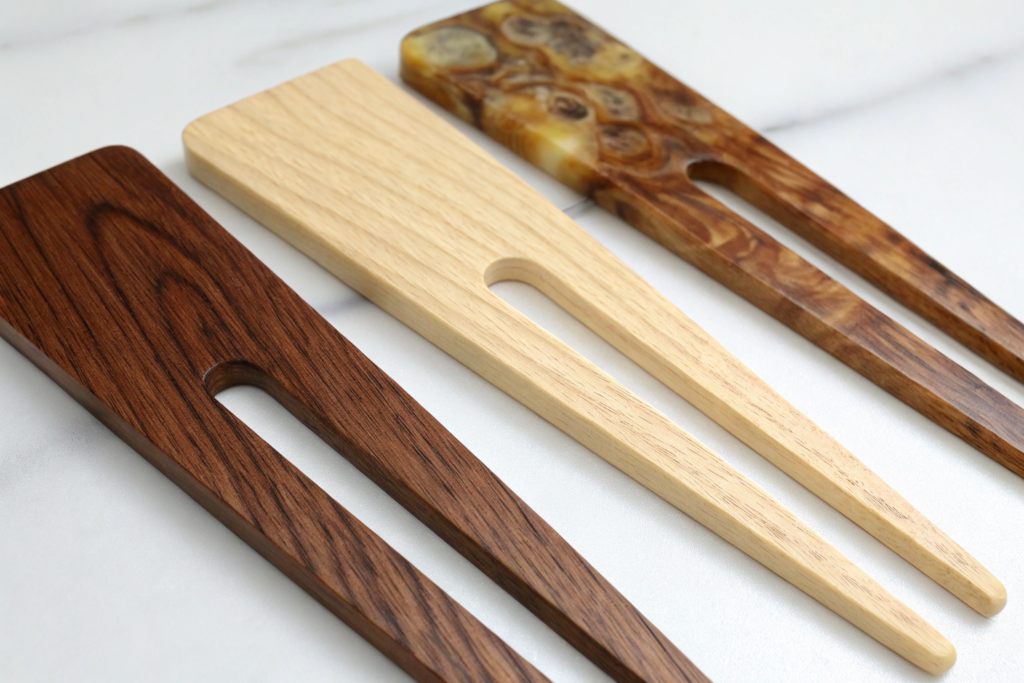
| Hardwoods (Walnut, Maple, Sandalwood, Ebony) | Excellent. Naturally strong. Can be sanded to a glass-smooth finish. | Superb. Warm, natural feel. Glides smoothly when polished. | Classic, Organic, Warm. Unique grain patterns. | Everyday Use, Heirloom Quality. |
| Cellulose Acetate | Good. Strong and flexible. Resists cracking better than some plastics. | Very Good. Smooth, cool to the touch. | Endless Colors and Patterns. High polish. | Fashion-Forward, Statement Pieces. |
| Bamboo | Moderate. Strong but can split along the grain if dropped. | Good. Very smooth, lightweight. | Eco-Friendly, Minimalist. | Lightweight, Casual Styles. |
| Zinc Alloy (Plated) | Good. Heavy, substantial feel. Prone to scratching if plated finish is thin. | Moderate. Smooth, but seams from molding can snag if not finished perfectly. | Intricate Detail, Vintage, Luxe. | Decorative, Statement Jewelry. |
| Resin (3D Printed) | Poor to Fair. Brittle. Not suitable for long-term daily use. | Fair. Can feel slightly "plasticky." | Prototyping. Complex, un-moldable shapes. | Prototypes Only. Not for sale. |
The Case for Hardwoods:
For a functional, long-lasting fork for long hair, Hardwood is King. It has the perfect combination of Strength, Smoothness, and Timeless Beauty. The natural oils in woods like Sandalwood and Ebony also provide a subtle, pleasant fragrance and natural water resistance.
The Case for Acetate:
If your brand is focused on Color and Pattern, Acetate is the superior choice. It can be produced in brilliant, swirling colors and even transparent "tortoiseshell" patterns. It is also hypoallergenic and made from renewable wood pulp.
At AceAccessory, we source our hardwoods from Sustainable, Certified Forestry. Our acetate is FSC-Certified. We are happy to provide documentation of material origin. This commitment to quality materials is fundamental to creating a premium accessory .
Why Is Sandalwood Prized for Its Natural Fragrance and Smooth Finish?
Sandalwood occupies a unique and revered position in the world of hair accessories, particularly in Asian and bohemian Western markets. It is prized for two distinct properties.
1. The Fragrance:
- Natural Aromatherapy: Genuine Sandalwood (Santalum album) heartwood contains a natural aromatic oil. This oil has a Warm, Woody, Sweet, and Calming Scent. The fragrance is released subtly as the fork warms against the scalp. It is a form of Silent Aromatherapy.
- Longevity: Unlike added synthetic perfumes, the natural sandalwood scent can last for Years, gently fading over time but never disappearing entirely.
- Cultural Significance: In many cultures, sandalwood is associated with spirituality, meditation, and purity.
2. The Smooth Finish:
- Natural Oil Content: Sandalwood is naturally Oily and Waxy. This inherent oiliness allows it to be polished to an Incredibly Smooth, Silky, Almost Soft Finish. It feels less like wood and more like a polished gemstone.
- Water Resistance: The natural oils make it Resistant to Moisture and Humidity. It will not swell or warp easily from the dampness of hair. It is an ideal material for use in a bathroom environment.
- Glide: This smoothness means the fork Glides Effortlessly through hair. It does not catch, pull, or snag.
Because of its slow growth and high demand, genuine Sandalwood is an expensive material. We source only Certified, Sustainably Farmed Sandalwood. We provide documentation to assure our clients and their customers that this precious material is ethically sourced. A Sandalwood fork is a true Heirloom-Quality accessory.
How Do You Finish and Seal Wood to Prevent Snagging and Moisture Damage?
The final finish is what transforms a carved wooden shape into a functional, durable hair tool. An improperly finished wood fork will feel rough, snag hair, and be vulnerable to moisture from damp hair or humidity. A properly finished fork is a joy to use and will last a lifetime.
Our Multi-Step Finishing Protocol for Wood Forks:
- Progressive Sanding: After CNC carving, the fork goes through 5-7 Stages of Hand Sanding, from 240-grit (to remove tool marks) up to 1000-grit or 1500-grit. This creates a surface that is already incredibly smooth to the touch.
- "Whiskering" (For Open-Grain Woods like Oak/Walnut): We lightly dampen the wood to raise the tiny wood fibers ("whiskers"). Once dry, we sand again with fine grit. This prevents the whiskers from rising later when exposed to hair moisture.
- Oil and Wax Finish (Our Standard):
- We apply a blend of Food-Grade Mineral Oil, Natural Beeswax, and Carnauba Wax.
- The oil penetrates the wood fibers, nourishing them and providing internal moisture resistance.
- The waxes create a Thin, Hard, Silky-Smooth Surface Film.
- We Buff the fork with a soft cotton wheel to achieve a soft, natural sheen.
- Result: A finish that is Water-Resistant, Smooth, and Completely Non-Toxic. It is safe for contact with skin and hair.
- Lacquer Finish (For High-Gloss):
- For a brilliant, glass-like shine, we use a Professional-Grade, Pre-Catalyzed Lacquer. This is sprayed in a dust-free booth in multiple thin coats, sanded between coats, and finally polished.
- Result: A deep, glossy, waterproof finish that showcases the color and pattern of the wood or acetate.
Avoid:
- Unfinished Wood: Will snag hair and absorb moisture.
- Thick, Gummy Varnishes: Can feel sticky and peel over time.
- Drying Oils Only (e.g., Pure Linseed): Takes weeks to cure and does not provide a hard surface film.
At AceAccessory, our standard Oil and Wax Finish is the result of years of refinement. It provides the perfect balance of Protection, Smoothness, and Natural Feel. This attention to finishing detail is what separates a truly professional hair accessory from an amateur craft project.
How Do You Ensure the Tips Are Smooth and Won’t Scratch the Scalp?
This is the single most important quality control checkpoint for a hair fork. The prong tips are the first point of contact with the scalp. A sharp, rough, or square-cut tip is a Scalp Scratcher. It will cause discomfort, snag hair, and result in a returned product and a negative review.
Ensuring a Perfectly Smooth Tip is a Multi-Step Process:
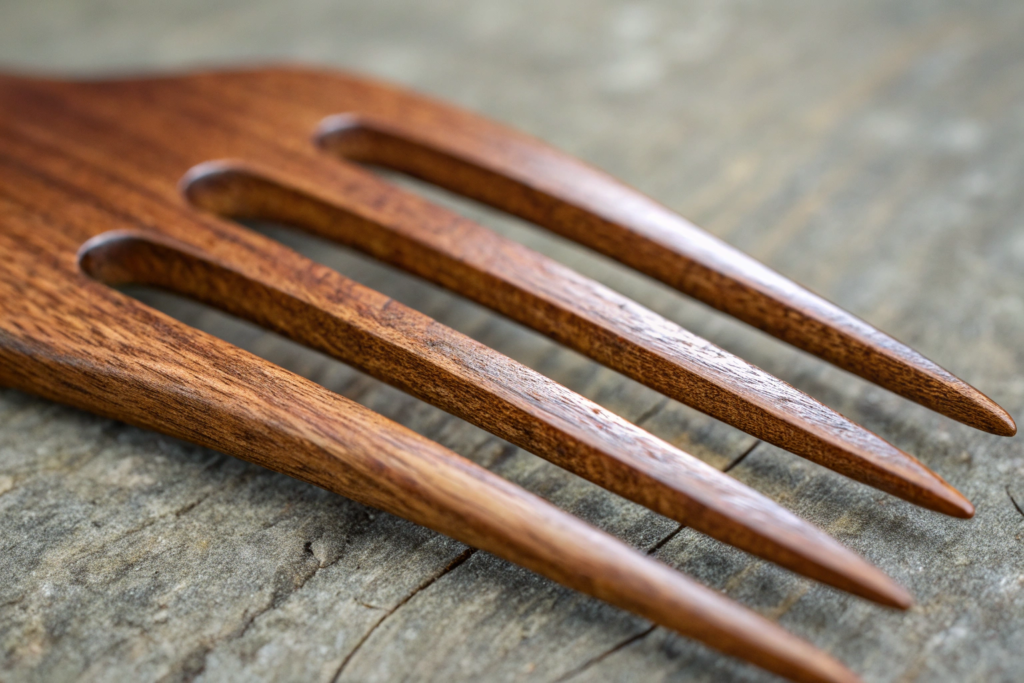
- Design Phase: The 3D digital model is designed with Fully Rounded, Domed Tips. We do not design pointed tips, not even for a "fairy" or "elf" aesthetic. Aesthetic must yield to function.
- CNC Carving Phase: The CNC machine is programmed to leave a Small, Deliberate "Nib" of material at the very tip. This is safer than trying to machine a perfect point, which can result in a fragile, sharp edge.
- Hand Finishing Phase (The Critical Step):
- Our artisans use a Hand File to gently remove the "nib" and shape the tip into a Smooth, Rounded Dome.
- They then use Progressive Sanding Sticks (like emery boards, but finer) to smooth the tip from 400-grit up to 1000-grit.
- The "Lip Test": This is our secret weapon. The artisan Gently Touches the Tip to Their Own Lip. The skin on the lip is incredibly sensitive. It can detect the slightest roughness or sharp edge that is invisible to the eye and imperceptible to the fingertip. If the tip does not feel Absolutely Smooth and Soft against the lip, it goes back for more sanding.
- Final QC Check: Before packing, each fork is individually inspected under bright light. The tips are visually checked for perfect roundness and smoothness. The "Lip Test" is performed on a random sample of each batch.
This meticulous, multi-sensory quality control process ensures that every AceAccessory hair fork that leaves our facility is Scalp-Safe. It is a non-negotiable standard. We know that one scratched scalp can lose a customer forever. This is our commitment to quality .
What Is the "Lip Test" and Why Is It the Gold Standard for Smoothness?
I want to elaborate on the Lip Test because it is a perfect example of the artisanal wisdom that complements our digital precision. It is a low-tech, high-sensitivity test that is more effective than any machine.
The Science of the Lip:
- High Density of Nerve Endings: The lips have one of the highest concentrations of tactile nerve endings in the human body, second only to the fingertips.
- Thin, Sensitive Skin: The skin on the lip is very thin and lacks a thick protective keratin layer. This makes it exquisitely sensitive to Texture and Temperature.
- Moisture Sensitivity: The lip is naturally moist. A tiny, invisible burr on a piece of wood will "catch" or "drag" on the moist lip surface far more noticeably than it would on dry skin.
The Machine Alternative (and Its Flaw):
You could use a Profilometer, a laboratory instrument that drags a diamond stylus across a surface to measure roughness in microns. This would give you a Number (e.g., Ra 0.4 µm). But a number does not tell you how the tip Feels. A surface with a uniform, micro-roughness might measure the same as a surface with a single, tiny, sharp peak. The lip test detects that Single Sharp Peak instantly.
Training the "Lip":
Our senior artisans have been doing this for years. They have developed a Calibrated Sense of Touch. They can run a tip across their lip and instantly know: "This is a 9 out of 10. Needs 10 more seconds on the 800-grit stick." It is a skill that combines tactile sensitivity with deep material knowledge.
This is the kind of detail that separates mass-produced, generic accessories from a thoughtfully crafted artisanal product . It is a detail we are immensely proud of.
How Does Prong Spacing Affect Hold and Ease of Insertion?
The space between the prongs is not arbitrary. It is a critical design parameter that determines the Functionality of the fork. It is a delicate balance between Grip and Usability.
-
Prong Spacing Too Narrow (e.g., < 2mm):
- Effect: Difficult or Impossible to Insert. The fork acts like a solid block. It cannot weave through the hair. The user will struggle and potentially damage their hair trying to force it in. High Return Rate.
-
Prong Spacing Too Wide (e.g., > 8mm):
- Effect: No Grip. The fork slides in easily, but it provides Zero Tension. The hair simply falls through the wide gaps. The fork will slide out of the hair within minutes. Non-Functional.
-
Optimal Prong Spacing (3mm – 5mm):
- Effect: The "Goldilocks Zone."
- Insertion: The prongs are spaced closely enough to act as a Wedge, gently parting the hair. They are far enough apart to allow the fork to be woven through the bun with a gentle back-and-forth motion.
- Hold (The Friction Lock): Once inserted, the hair settles into the gaps between the prongs. The natural volume and texture of the hair create Friction against the sides of the prongs. This friction locks the fork in place. The more hair is captured in the gaps, the stronger the hold.
At AceAccessory, our standard prong spacing for a three-prong fork is 4.0mm. We have found this to be the optimal dimension for the widest range of hair types (from medium-thick to very thick). For a two-prong fork, we use a slightly wider spacing of 5.0mm to provide adequate grip.
This is the kind of Functional Engineering that is baked into our designs. It is not visible to the eye, but it is immediately apparent to the customer when they use the product. It is the difference between a fork that sits in a drawer and a fork that becomes a daily essential.
Conclusion
Producing a custom shaped hair fork for long hair is a beautiful synthesis of art and engineering. It requires a manufacturing partner who understands not only the aesthetic possibilities of materials like hardwood and acetate but also the precise functional requirements that make a fork a reliable, comfortable, and effective tool for managing heavy hair. The shape must be sculptural, but the curve must be ergonomic. The prongs must be elegant, but the tips must be impeccably smooth.
Through the strategic use of CNC machining, we have made this category accessible to boutique brands and independent designers with remarkably low minimum order quantities. The combination of 3D printed prototyping and small-batch production allows for rapid iteration and market testing without the financial risk of massive inventory commitments. The focus on premium, sustainable materials like Sandalwood and FSC-certified Acetate elevates the humble hair fork into a cherished, heirloom-quality accessory.
The true measure of our success is not just a beautiful product photo. It is a customer who writes a review saying, "This fork is not only stunning, but it actually holds my thick hair all day without slipping or snagging." That is the standard we build to.
If you have a sketch or a vision for a custom hair fork and want to explore the possibilities of bringing it to life, we are here to guide you through the process, from digital model to finished product. Contact our Business Director, Elaine. She can provide a quote for a 3D printed prototype based on your design concept. Email Elaine at: elaine@fumaoclothing.com