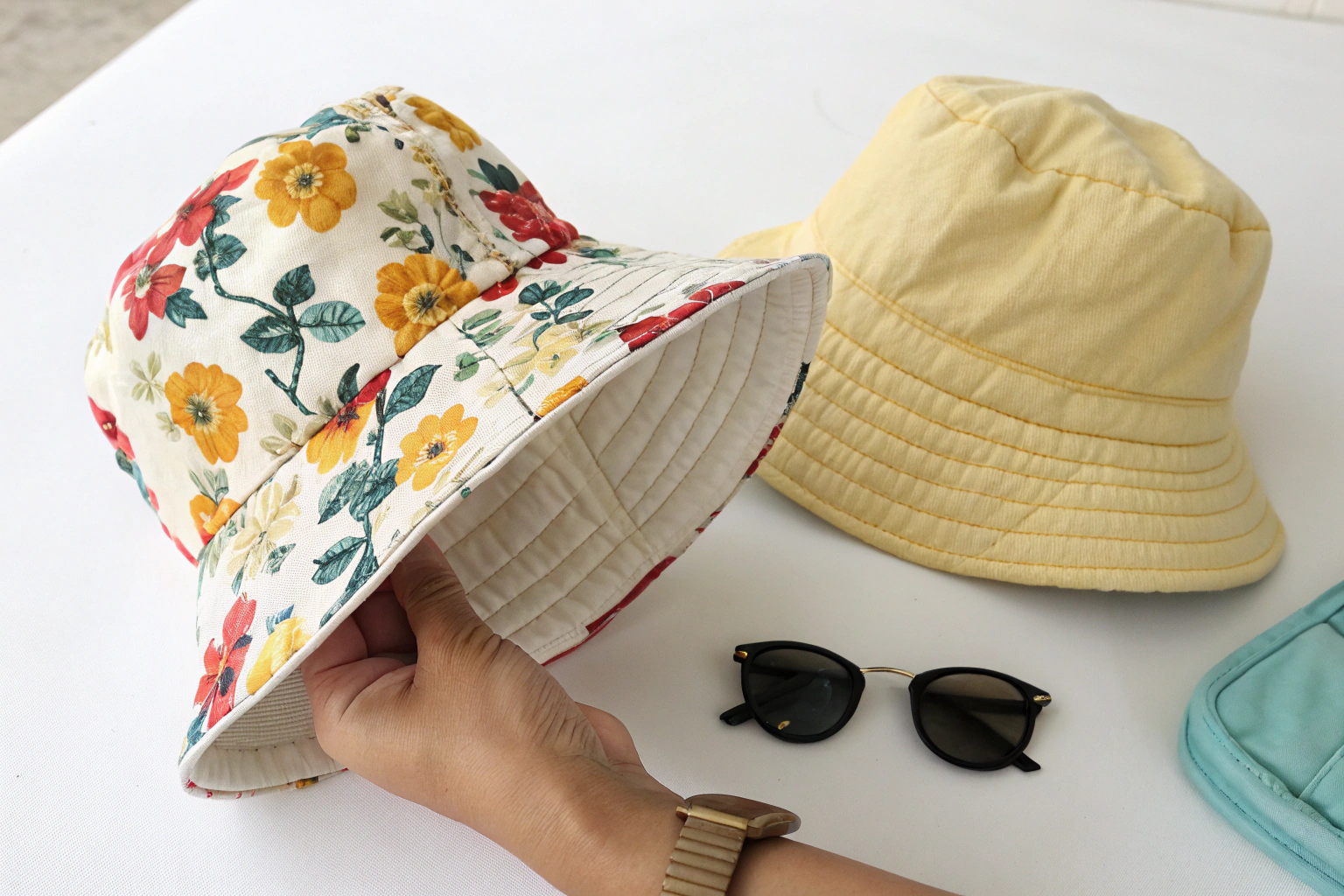
A brand owner from Vancouver contacted me last autumn with a design problem that was also a brilliant retail opportunity. Her customers loved the bucket hat silhouettes she had been selling, but her sales data showed a predictable dip every time the seasons changed. Her cotton summer hats sold out in August and then sat unsold in September. Her fleece winter hats sold from November through February and then gathered dust. She asked me if we could make a single hat that combined both functions in one reversible design. I told her we could, and the result was the best-selling SKU in her entire headwear collection for the following year.
Yes, Shanghai Fumao can produce reversible bucket hats engineered for both summer and winter wear. We construct them using a clean, bound-edge seam that finishes both sides without a visible raw hem, regardless of which side is facing out. On one side, we use a lightweight, breathable summer fabric such as printed cotton voile, linen, or recycled polyester mesh. On the reverse, we use an insulating winter fabric such as fleece, quilted nylon, or a soft wool blend. Our pattern-making and finishing techniques are specifically adapted for reversible construction, ensuring proper drape and consistent sizing in both orientations. I will explain exactly how a reversible bucket hat is engineered, what fabric combinations work best for true seasonal versatility, and how to package and market the duality to your customers.
How Is a Reversible Bucket Hat Constructed to Be Fully Finished on Both Sides?
The core technical challenge of a reversible bucket hat is not the sewing of two hats and the joining of them. That would create a thick, lumpy, unfinished interior. The challenge is constructing a single, cleanly finished garment that looks professionally manufactured from both sides. This requires a specific pattern adaptation, a dedicated binding process, and an understanding of how two different fabrics will drape and wear when they are permanently joined together.
What Is the "Bound Seam" Method for a Clean Finish on Both Sides?
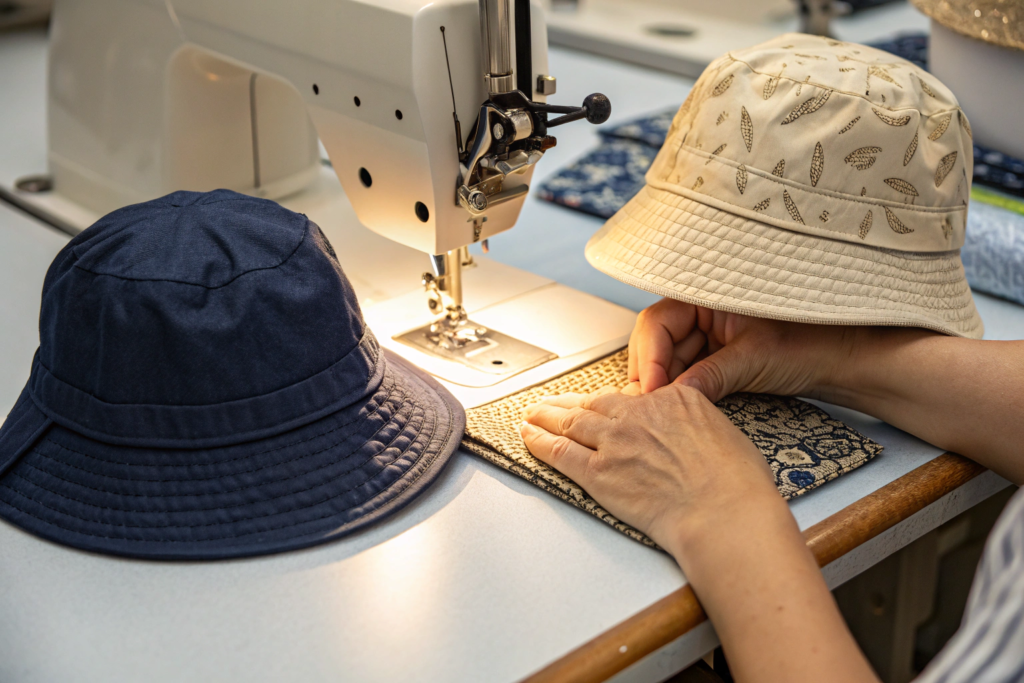
A standard bucket hat is constructed by sewing the crown panels together and then attaching the brim. The raw seam allowances are left exposed on the inside, usually hidden by a sweatband or a lining. These raw edges are unacceptable on a reversible hat, because the inside becomes the outside when the hat is flipped. The solution is a bound seam finish, often called a Hong Kong finish or a welt seam finish. An additional strip of thin, flexible fabric binding is folded over the raw seam allowance, encasing it completely. The binding is stitched down with a clean, parallel line of topstitching. The result is a seam that looks intentionally finished and garment-quality from both faces of the fabric. This binding strip runs along every major construction seam in the hat, including the crown panel joins, the crown-to-brim attachment, and the brim’s outer edge.
This binding technique requires a skilled sewer using a specialized binding attachment on an industrial sewing machine. The attachment folds the binding strip precisely as it is fed under the needle, and the sewer must guide the curved brim and the circular crown join smoothly, without puckering the binding. On a non-reversible hat, this step is entirely absent. Our sample room is equipped with the binding attachments and staffed with sewers experienced in this precise, difficult technique. You will often see this finish on high-end, unlined jackets and couture garments. On a bucket hat, it signals a premium level of make.
How Are the Seam Allowances Managed to Avoid a Bulky, Uneven Drape?
Managing the bulk of two layers of fabric meeting each other at a seam intersection and then being encased in a binding strip is a technical calculation for any reversible hat. The pattern is cut and sewn with an eye to minimizing bulk at critical points, particularly the center top of the crown where all panels converge. There are several methods we use depending on the thickness of the fabrics chosen. In one method, we split the seam allowances. Instead of both seam allowances being pressed to one side, which creates a single thick ridge, they are carefully pressed open, overlapping each other slightly, which distributes the bulk widely and keeps the seam flat. In other designs, a tiny strip of the seam allowance is trimmed away where a bulk could form.
Our master pattern maker also adjusts the pattern piece dimensions to account for the "turn of cloth." The outer layer of a fabric must travel a slightly longer distance around a curve than the inner layer. If both fabrics are cut from an identical pattern, the layer on the outside of the curve will be tight, and the layer on the inside will be loose and baggy. For a reversible hat, where each fabric will exchange these roles when flipped, the pattern pieces for the thicker winter fabric are very subtly resized to ensure a perfectly smooth drape in both orientations. This is the engineering that makes the difference between a professional reversible product and one that looks homemade. At Shanghai Fumao, our sample room calculates these specifications for every reversible style we develop.
What Fabric Combinations Work Best for a Dual-Season Hat?
The secret to a successful dual-season bucket hat is choosing two fabrics that each perform their specific seasonal function perfectly but also work together structurally. They must have compatible drape, comparable stretch, and the ability to be cut, sewn, and finished with the same bound-seam technique. A combination that is too disparate in weight or flexibility will pucker, twist, or simply not feel comfortable against the head in one of its orientations. The pairing must be a deliberate technical choice, not just a fun visual contrast.
Why Are Cotton-Linen and Fleece a Popular Reversible Combination?
The combination of a lightweight, natural-fiber cotton-linen blend for the summer side and a soft, insulating polyester fleece for the winter side is one of the most commercially successful reversible pairings for the bucket hat silhouette. The cotton-linen blend, typically a 70/30 or 80/20 mix, has the breathable, cool-to-the-touch feel and the crisp, casual drape that defines a classic summer bucket hat. It takes garment washing and enzyme treatments beautifully, giving the summer side a soft, worn-in look from the first wear. The linen content provides natural wicking, keeping the head dry on hot days.
The fleece side, which is worn against the head in winter, provides immediate, soft, non-allergenic warmth. The crucial compatibility factor is that neither side is heavy enough to overwhelm the other. The combined weight of the linen and the fleece is appropriate for the bound seam technique and does not feel excessively heavy on the head in either orientation. The aesthetic contrast, a natural, textured, perhaps faded cotton on one side and a solid, cozy, heathered fleece on the other, communicates the dual-season functionality to the customer instantly. The visual cue is as important as the physical performance and this contrast is a key selling point for this fabric combination.
How Do You Pair a Printed Polyester with a Quilted Nylon for Travel?
For a more technical, packable, and travel-oriented reversible hat, one of the strongest material pairings is a recycled polyester, which can be brightly digitally printed, on the summer side and a lightweight, diamond-quilted nylon on the winter side. The printed polyester is vivid, fade-resistant, and dries almost instantly. The customer wears this side out on a bright summer hike or at a music festival. The quilting on the nylon reverse side is the functional secret. The thin layer of wadding between the nylon layers, which are stitched together in a repeating diamond pattern, visually communicates warmth, and functionally, it insulates very effectively for the weight. The quilted nylon also has a distinct, puffy, premium outerwear aesthetic that is highly fashionable for city wear during the colder months.
This combination has an additional synergy. The nylon quilting naturally resists wind, while the printed polyester resists water from a sudden summer shower. The entire hat can be folded and packed into a small travel pouch. This packability is an incredibly strong retail feature that directly addresses the needs of the travel and outdoor customer. The reversible nature of the hat is not just a style choice. It is a space-saving packing solution. Detailed specifications for textile technical performance, such as those for sustainable performance textiles, can provide additional context when you are making final selections for your own travel-ready reversible hats.
How Should You Package and Present a Reversible Hat to Customers?
A reversible hat is a product that sells itself, but only if the customer understands the duality in the first three seconds of interaction. If the hat is folded on a shelf in a way that only shows one side, the key innovation, the seasonal versatility, is invisible, and the customer perceives it as just another single-season bucket hat at a higher price point. The packaging and the visual merchandising are an integral part of the product’s value proposition.

What Is the Best Fold and Display Method to Show Both Sides?
The most effective display technique is the half-and-half fold. The hat is folded in half, not flattened, with one side of the brim deliberately flipped back over the crown to reveal the contrasting interior. The customer sees the summer print on one half and the winter fleece on the other simultaneously. This visual prompt immediately communicates the reversible design without the need for a single word of copy. The fold should be secured with a small, easily removable paper tag string or a thin elastic band, so the hat itself is not creased or damaged by a tight, restrictive packaging.
For online sales, the primary product photograph must show this half-and-half arrangement as the hero image. A secondary ghost mannequin video, where the hat is worn and then flipped inside-out in real time by the model, is one of the most effective conversion tools I have seen for this product category. It removes any confusion about how the flipping works and highlights the engineered cleanliness of the reversed side.
How Do You Explain the Seasonal Versatility on the Hangtag?
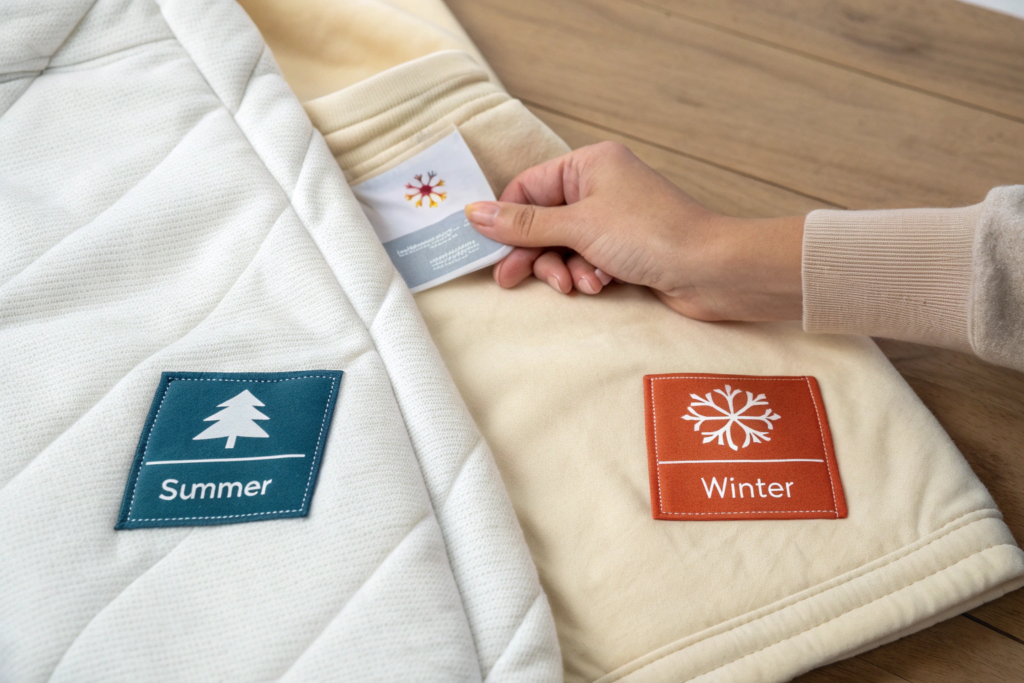
The hangtag is the silent salesperson. The messaging must be visual and immediate. The front of the hangtag can be purely graphic, perhaps the cap with its alternating seasonal designs. The back must use simple, benefit-driven language. Customers do not buy dual-season construction because it is clever. They buy it because it solves a packing problem or a value problem. The copy on the hangtag can convey that this is essentially two hats in one. The customer might live in the summer print during the day and switch to the fleece by the evening fire. The travel-ready concept can be emphasized for tourists.
An icon-driven care label is also critical. It should be stitched into the internal seam and provide simple instructions for spot-cleaning both fabrics and hand-washing. Because the hat contains two different materials, it cannot be simply thrown in the machine on a generic cycle. A clear, concise care tag prevents a ruined product and a disappointed customer. This kind of thoughtful, instructive labeling defines a premium product. Our design team can provide the graphic assets for these tags, and you can find more detail on how we handle these specifics in our custom accessories development services.
Conclusion
Producing a reversible bucket hat that genuinely serves a customer in both summer and winter is a far more sophisticated exercise than simply sewing two hats together. It is a technical product that requires a skilled pattern maker to manage the turn of cloth and seam allowances, a sewer with the specialized binding equipment and training to execute the clean, bound-seam finish, and a design team that can curate fabric pairings that perform their specific seasonal functions without fighting each other structurally. A summer cotton-linen joined to a winter fleece offers a premium, natural-fiber, cozy experience. A printed, recycled polyester paired with a quilted nylon is the high-performance, technical, and packable option that sells brilliantly to the travel and outdoor market.
When the product is made correctly, the clean, fully finished interior is a mark of genuine quality that the customer sees and feels. The packaging and merchandising must then be designed to communicate this dual-nature feature instantly, using the half-and-half fold to capture the customer’s attention and a benefit-driven hangtag to close the sale.
If your brand is developing a reversible headwear collection and you want a factory partner that understands the specific engineering and finishing requirements detailed in this article, contact our Business Director Elaine at elaine@fumaoclothing.com. Tell her your target season, your brand aesthetic, and the seasonal fabric pairing you envision. She can coordinate a technical sample using our bound-seam finishing technique, delivered with a set of factory-matched summer and winter fabric swatches. Let us help you create the hat that your customers will pack for every trip, no matter the forecast.