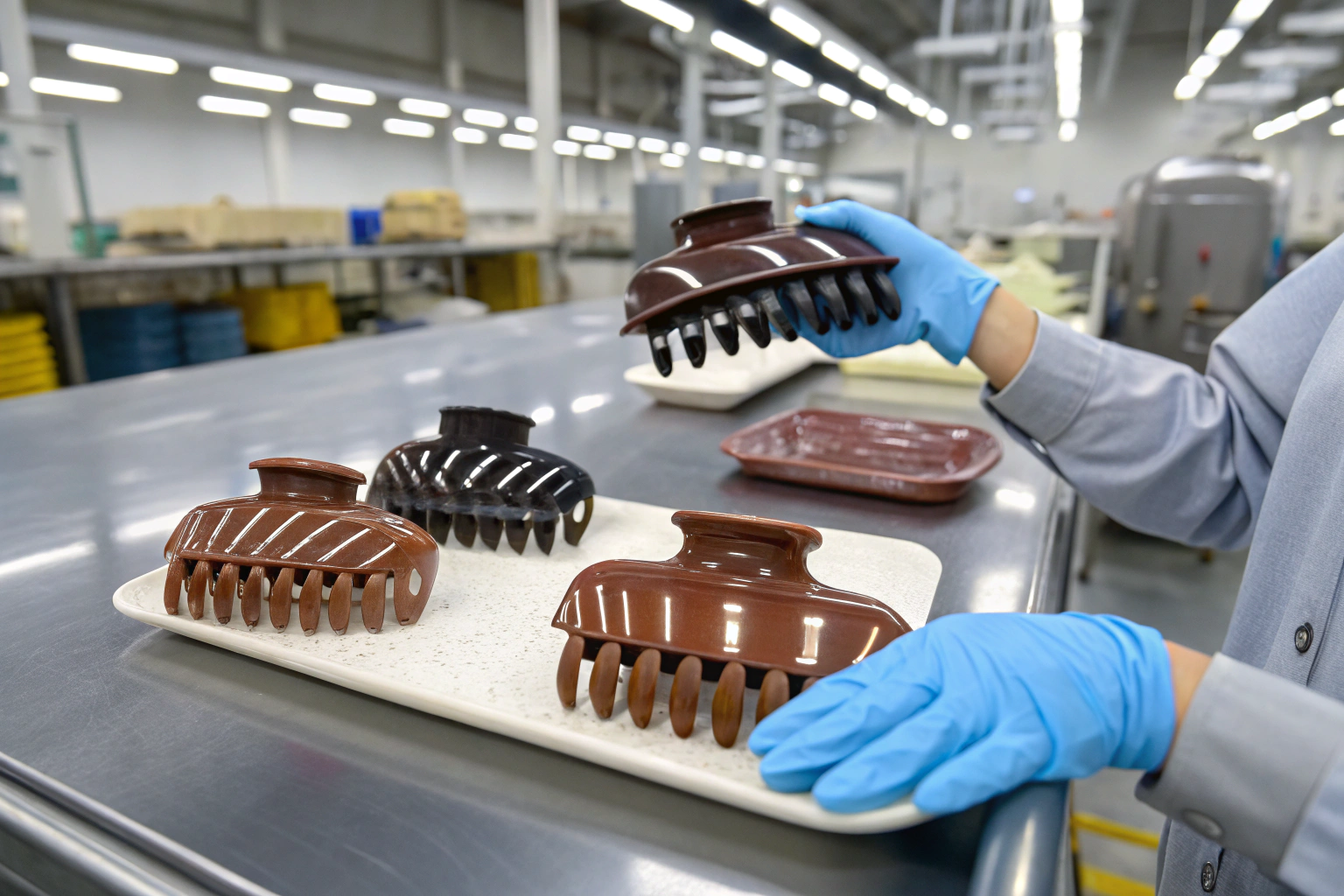
I still remember the call. A buyer from a major drugstore chain needed 5,000 hair claws. Half matte black. Half glossy black. Same design. Same mold. She had already been turned down by two factories who told her she needed two separate production runs and two separate mold charges. She was frustrated. She thought she was asking for something simple. To me, it was simple. To those other factories, it was a problem they did not want to solve.
Yes, you can absolutely produce both matte and glossy finish hair claws within a single production batch. The surface finish is controlled by the mold cavity texture, not by the plastic material itself. By using a family mold with different cavity treatments, or by running the same mold with interchangeable inserts, we deliver both finishes in one seamless production cycle.
The secret is not in the injection molding machine. It is in the mold engineering and the willingness to plan ahead. Let me explain exactly how we make this work for our clients so you never have to pay twice for what should be one batch.
What Molding Techniques Allow Two Finishes in One Cycle?
Most buyers do not realize that the gloss level of your hair claw has almost nothing to do with the plastic pellets. The plastic is the same polycarbonate or ABS. The magic happens on the steel wall of the mold cavity. A mirror-polished cavity produces a glossy claw. A sandblasted or chemically etched cavity produces a matte claw.
This means we can control the finish without changing your material cost, your cycle time, or your assembly process. It is a mold treatment decision, not a materials decision. Once you understand this, you unlock enormous flexibility for your product line.
How Does a Family Mold Combine Matte and Glossy Cavities?
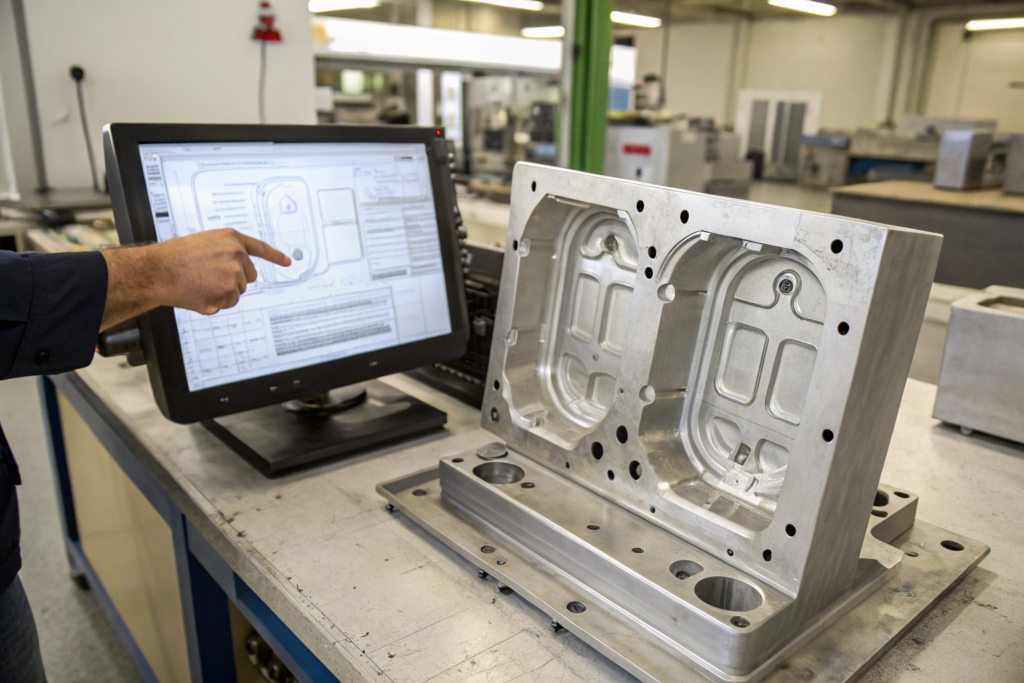
A family mold is a single mold base that holds multiple cavities for different parts, or in this case, the same part with different surface finishes. We machine the steel block to include, for example, four glossy cavities and four matte cavities. Every time the mold closes and injects, you get four glossy claws and four matte claws. One shot. One cycle time. One batch.
This is how we solved the problem for the drugstore chain buyer. We built a family mold with eight cavities total. She got her 2,500 glossy and 2,500 matte claws produced simultaneously. The per-unit cost stayed the same as a single-finish run. If you are considering a multi-SKU launch, understanding injection mold design options like this is critical to controlling your upfront investment.
What Is an Interchangeable Insert System for Surface Finishes?
Sometimes a full family mold is not the best path. Maybe you are testing the market and do not know your matte-to-glossy ratio yet. This is where interchangeable inserts shine. We build the main mold body with removable cavity inserts. One set of inserts has a glossy polish. The other set has a matte texture. Swapping them takes a skilled technician about thirty minutes.
This gives you incredible flexibility. Run 1,000 glossy claws on Monday morning. Swap inserts during lunch. Run 1,000 matte claws Monday afternoon. It is technically one production batch, one mold base, one setup. The per-unit cost is almost identical because the cycle time does not change. For brands testing product variants, this approach minimizes mold investment while maximizing SKU variety.
How Does Mold Surface Treatment Create Glossy or Matte Effects?
The surface of your mold cavity is not smooth by accident. It is crafted deliberately. A glossy finish on a hair claw feels premium, sleek, and catches the light beautifully. A matte finish feels soft, modern, and hides fingerprints well in humid bathroom environments. Both have their place in your collection.
At Shanghai Fumao, our mold polishing team treats cavity finishing as an art. They spend hours, sometimes days, on a single cavity to achieve exactly the right surface roughness measurement for your intended look. This is not automated. This is skilled human work.
What Mold Polishing Process Achieves High-Gloss Finishes?
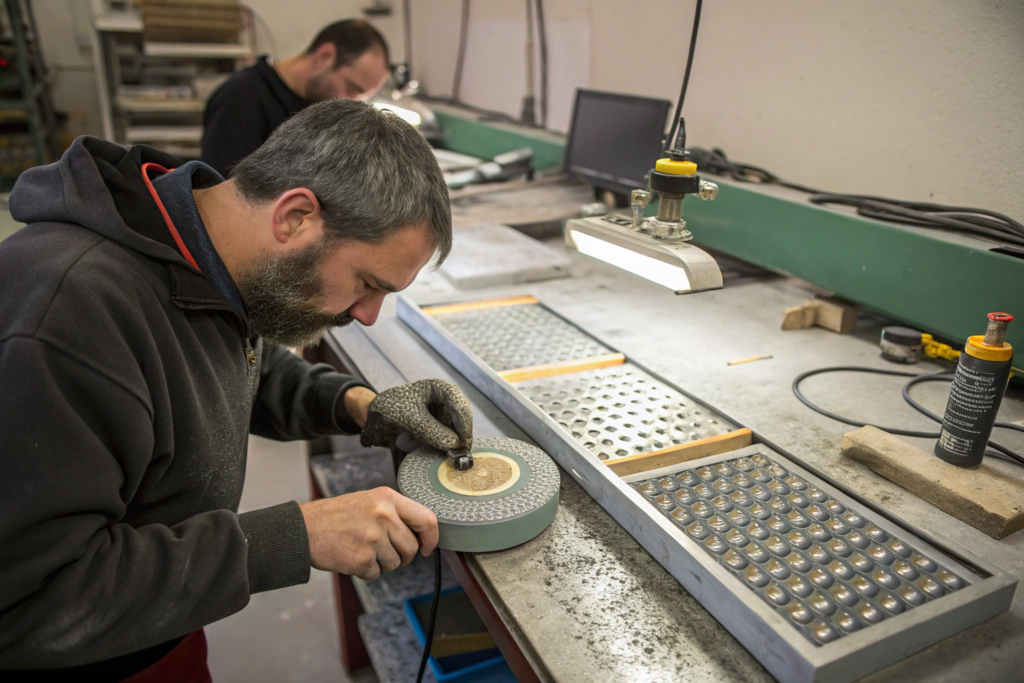
To get that wet-look, mirror-like shine on a hair claw, the mold cavity must be polished to an SPI A-1 or A-2 finish. The process starts with progressively finer grits of diamond compound on rotary tools. Our polisher works up from a rough cut to a finish so smooth you can see your reflection in the steel. The surface roughness is measured in microns.
I recently watched one of our senior polishers finish a cavity for a high-end French boutique brand. He spent six hours on one cavity. When I held it under the inspection light, it looked like a tiny black mirror. That steel now produces claws that look like wet glass. If you are interested in the technical standard behind this, the SPI mold finish standards define exactly what A-1, A-2, and A-3 finishes mean and how they are achieved.
How Is a Consistent Matte Texture Applied to Mold Cavities?
Matte does not mean rough. It means uniformly textured at a microscopic level. We achieve this primarily through controlled sandblasting or chemical etching. The cavity is masked and then blasted with fine glass beads or aluminum oxide media at a specific pressure. The result is a velvety, non-reflective surface that transfers perfectly to the injected plastic.
The challenge is consistency. If the blasting pressure varies by even a small amount, some claws come out with a slightly different matte depth than others. Our QC team checks matte finish samples under a gloss meter to ensure the reading stays within your tolerance across the entire production run. Proper surface finishing techniques are what separate a premium matte claw from one that just looks cheap and scratched.
Why Is Quality Control Different for Mixed-Finish Batches?
You might think inspecting hair claws is simple. Look at them. Good? Ship them. But when you have matte and glossy finishes mixed in one carton, the inspection process doubles in complexity. A defect that is invisible on a matte claw can be glaring on a glossy one. And vice versa.
At our Zhejiang factory, a mixed-finish batch gets two separate QC passes with two different inspection criteria. We do not treat them the same because they are not the same. Your customer in Chicago does not care that the matte was hard to inspect. They care that the claw looks right.
What Specific Defects Occur in Glossy Finishes During Production?
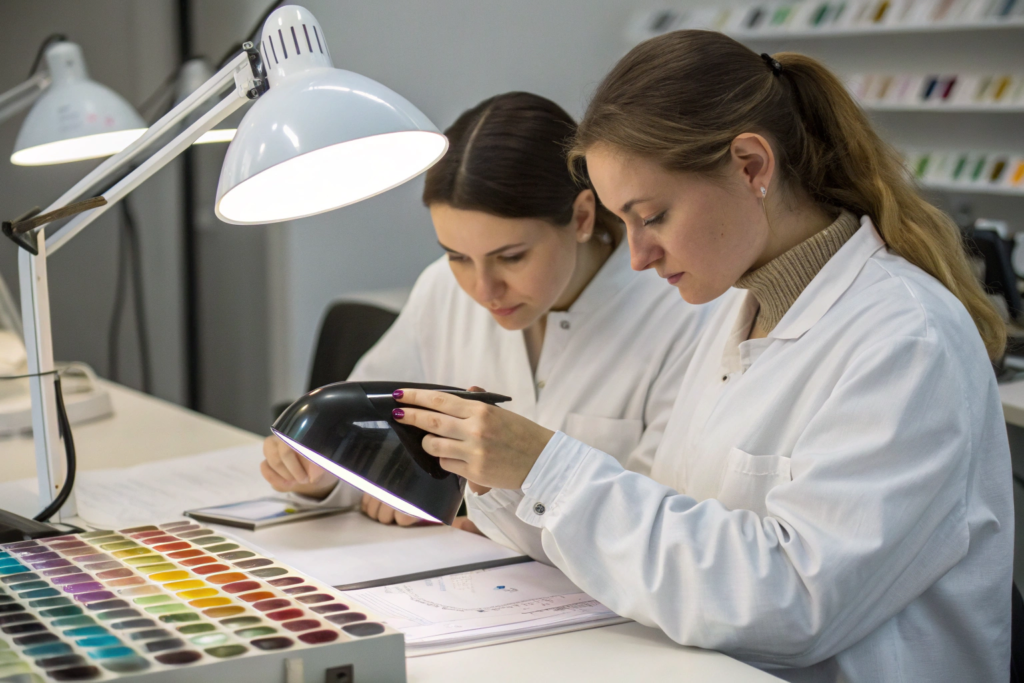
Glossy surfaces are unforgiving. Every tiny sink mark, flow line, or ejection pin shadow is visible. The high reflection amplifies imperfections. A microscopic scratch on the mold cavity shows up as a bright line on every single claw until we stop and re-polish.
Our inspectors check glossy claws under multi-angle bright light. They look for silver streaks, weld lines, and any cloudiness in the transparent or translucent colors. A glossy claw with a visible flow mark is a reject. That same flow mark on a matte claw might be completely hidden by the texture. This is why you need a team that understands injection molding defects and how they interact with surface finishes.
How Do You Ensure the Matte Texture Is Consistent Across Cavities?
Matte finishes hide some sins but create new inspection needs. The main risk is gloss variation. If one cavity starts to wear, its matte texture can become slightly shinier over time, creating a mismatch in your multipack or shelf display. We measure matte gloss units with a calibrated gloss meter at a 60-degree angle.
We also perform a tactile check. Our QC staff runs a fingertip across sample claws from every cavity. The feel should be identically soft and velvety. If cavity number three feels even slightly smoother than cavity number one, we flag it for maintenance. Consistent surface roughness measurement is just as important as dimensional accuracy when your product’s perceived quality depends on its feel in the customer’s hand.
How Do Mixed Finishes Affect Your Cost and Lead Time?
The biggest lie I hear in this industry is that mixed finishes cost significantly more. They do not. Not if your factory planned for them from the mold design stage. The raw material is the same. The machine is the same. The cycle time is the same. The packing is the same.
The only real cost difference is in the initial mold treatment. Polishing one cavity and texturing another takes slightly more engineering time than treating all cavities identically. But this cost is tiny when spread across your total order volume. It is measured in tens of dollars, not hundreds.

How Does a Family Mold Save You Mold Cost on Two Finishes?
Let us do simple math. If you commission two separate molds, one for glossy and one for matte, you pay for two mold bases, two sets of machining, and two trial runs. That could be $4,000 to $8,000 total for small hair claw molds. A family mold that combines both finishes in one base might cost you $2,500 to $4,500. You save nearly half.
You also save on future maintenance. One mold base to clean. One set of ejector pins to stock. This is why we almost always recommend a family mold for buyers who know upfront they want both finishes. If you are budgeting for your custom injection molding project, factor in the mold design strategy early. It makes the biggest difference to your startup cost.
What Is the Lead Time Impact of Producing Two Finishes Together?
Producing matte and glossy claws separately in two production runs adds setup time. The mold has to be removed from the machine, a different mold installed, and the machine parameters re-tuned. Each mold change costs you half a day or more. Two runs mean two setups.
A single batch with a family mold or interchangeable inserts requires only one setup. The press runs continuously. Your 5,000 pieces ship days earlier than they would with two separate runs. This is crucial when you are chasing a holiday shelf date or a promotional event. I have seen single-batch mixed-finish production cut manufacturing lead time by an entire week compared to the split-run alternative. One week can mean the difference between your product launching on schedule and arriving after the season ends.
Conclusion
So, can you produce both matte and glossy finish hair claws in one batch? Absolutely. The two most practical methods are a family mold with separate glossy and matte cavities, or a single mold with interchangeable inserts that swap in minutes. Both approaches use the same plastic, the same machine, and the same production cycle. Your per-unit cost stays flat. Your minimum order quantity for each finish becomes manageable.
The trade-off is small. You invest a bit more thought and a modest additional cost into the initial mold design. In return, you get two distinct SKUs from one production slot. Your inventory variety doubles without your lead time doubling. For brands selling to retailers who expect both a glossy option and a matte option on the shelf, this capability is a competitive advantage.
At Shanghai Fumao, we have been building mixed-finish molds for hair accessories long before it became trendy. Our Zhejiang factory has the in-house mold polishing and texturing expertise to execute both finishes flawlessly in one mold base. Our QC team knows how to inspect glossy and matte parts to different standards within the same batch. And our project managers know how to schedule the run so it ships complete, not split.
If you are designing your next hair claw collection and want to offer your customers both a glossy and a matte option without breaking your budget, please talk to our Business Director Elaine. She can quote you a family mold solution and a production timeline that makes sense for your launch. Email her directly at elaine@fumaoclothing.com. Describe your design and your finish preferences. She will show you how achievable a mixed-finish batch really is.