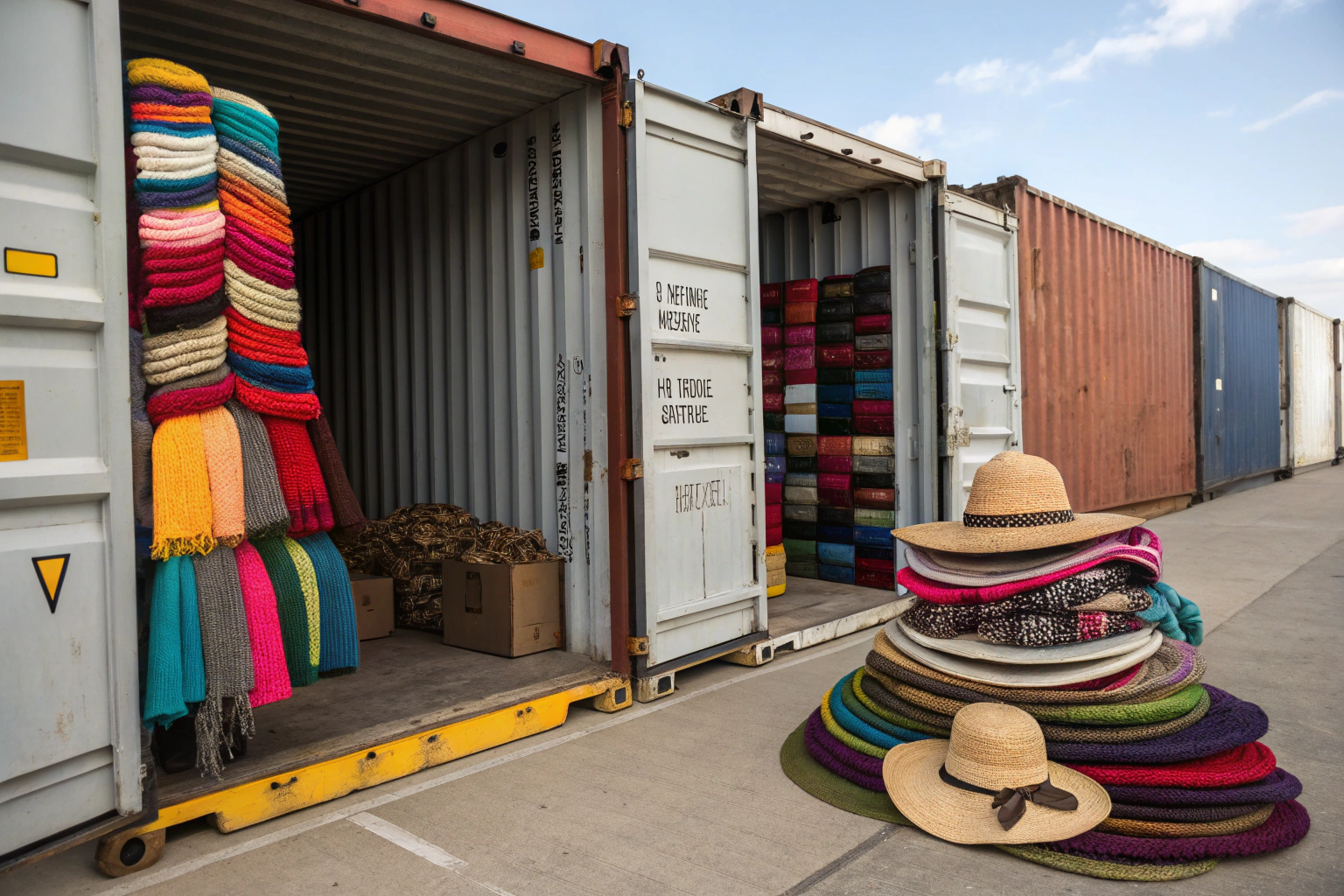
I made an expensive mistake about eight years ago that I still think about every time I see a mixed pallet. A client wanted to save on freight costs by combining two seasons in one 40-foot container. We loaded 200 cartons of thick wool scarves and knit hats right next to 150 cartons of delicate paper straw hats. The container left Shanghai in November. It arrived in Los Angeles in December. The straw hats were ruined. Not crushed. Ruined by something invisible. The moisture from the wool goods had migrated during the voyage and settled into the paper straw. Every brim was wavy and limp. The claim was denied because the packing list showed "mixed general cargo." We ate that cost. I never made that mistake again.
Yes, you can absolutely mix winter and summer accessories in the same sea container. But you need to do it with a specific set of rules and precautions. You cannot just throw cartons of gloves and cartons of straw hats into a box and hope for the best. The ocean environment is harsh. It creates condensation. It creates temperature swings. And different materials react to that environment in completely opposite ways. At Shanghai Fumao, we have developed a packing protocol that allows our clients to maximize container utilization without sacrificing product integrity.
The key is understanding how different materials breathe and how they interact with each other over a 30-day voyage. You are not just shipping items. You are managing a small climate inside a steel box. And that climate changes as the ship crosses from cold northern waters into tropical humidity near the equator. If you understand the science of what happens inside that container, you can mix seasons safely and save thousands in logistics costs.
What Are the Risks of Mixing Knit Beanies and Straw Hats in One Shipment?
The biggest risk is not physical crushing. The biggest risk is moisture migration and transfer. Natural fibers like wool and cotton are hygroscopic. That is a fancy word that means they soak up water from the air like a sponge. Synthetic fibers like acrylic do not absorb much water, but they trap moisture between the yarns. Paper straw is also hygroscopic, but it becomes weak and deformed when it absorbs water.
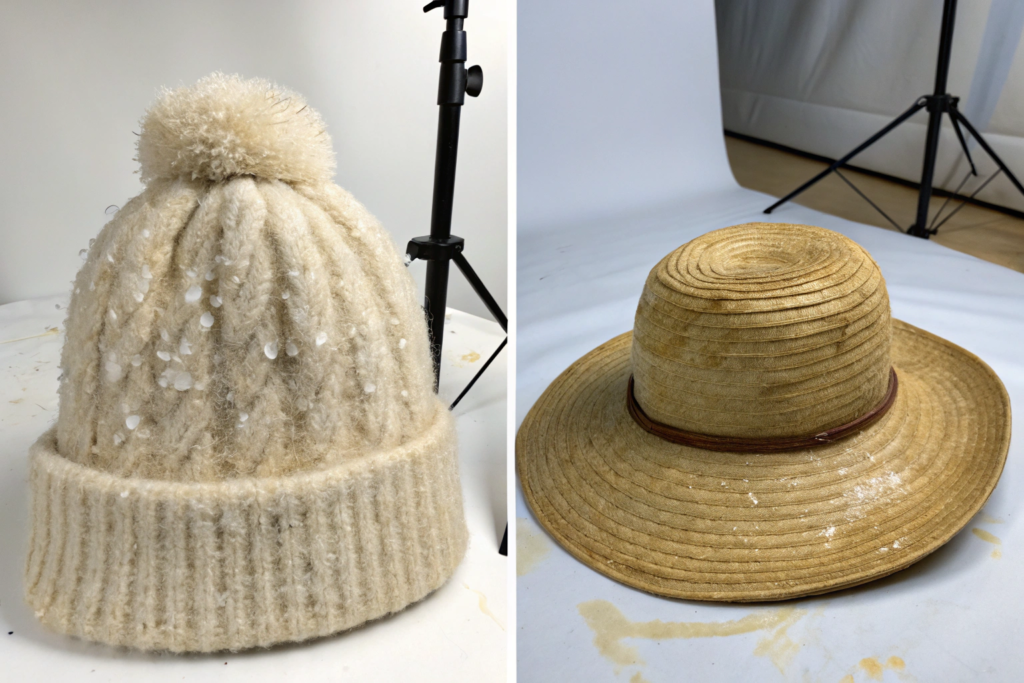
When you lock these different materials inside a sealed steel container for four weeks, they try to find an equilibrium. The container heats up during the day and cools down at night. This creates condensation on the ceiling and walls. That water drips down or gets absorbed by the goods closest to the source. The wool scarves might be fine with a little extra humidity. In fact, they might even feel softer. But the paper straw hat sitting three cartons away will drink up that same moisture and lose its structural integrity. The brim will warp. The crown will soften. You open the container in New Jersey, and your summer inventory looks like it survived a monsoon.
How Does Container Sweat Damage Paper Straw and Fabric Differently?
Container sweat is the term we use for condensation inside the box. It happens when warm, humid air inside the container hits the cold steel walls at night. The water droplets form on the ceiling and run down the sides. This is a physical process. It is unavoidable unless you use specific moisture control products.
For paper straw hats, container sweat is a death sentence. The viscose or natural fibers absorb the water almost instantly. Even if the water does not touch the hat directly, the humidity spike softens the starch or stiffening agent used to hold the brim shape. You end up with a hat that looks fine in the carton but flops over when a customer picks it up. The straw material also becomes a breeding ground for mildew if the moisture does not dry out quickly.
For fabric items like knit hats and scarves, the damage is different. Wool can felt and shrink if it gets wet and then rubs against itself during the ship’s movement. Acrylic will not shrink, but it can develop a musty smell that is nearly impossible to remove without washing. Cotton items can develop yellow water stains that show up weeks after unpacking. These are hidden defects that you do not see until the customer pulls the item out of the retail packaging. Our quality control team has documented every type of moisture failure so we know exactly how to prevent them.
Why Do Temperature Swings Cause Condensation in Mixed Material Shipments?
The inside of a sea container is not climate controlled unless you pay a premium for a reefer. A standard dry container goes through wild temperature swings. A container leaving Ningbo in January might start at 5 degrees Celsius. By the time it crosses the equator near Singapore, the internal temperature can hit 45 degrees Celsius. Then it drops again as it approaches the California coast.
This temperature cycle creates a pump effect. Warm air holds more moisture. When the container cools down, the air cannot hold that water anymore, so it dumps it onto the coldest surface available. Usually, that is the ceiling or the goods packed against the walls. This is basic shipping physics.
When you mix wool beanies and straw hats together, the problem compounds. The wool acts as a moisture reservoir. It absorbs water during the humid, hot phase. Then, when the container cools, the wool slowly releases that moisture back into the air. The paper straw sits there absorbing it. It is like putting a wet sponge next to a piece of cardboard in a sealed plastic bag. The cardboard will always lose. Understanding this dynamic is why we are so careful about how we layer different product categories inside the container.
How Should You Pack Summer and Winter Accessories to Prevent Damage?
The solution to the mixing problem is not to avoid mixing entirely. The solution is to create physical and chemical barriers between the incompatible materials. You have to think like a packaging engineer, not just a shipper. The goal is to control the micro-environment inside each individual carton so that it does not matter what is happening in the carton next to it.
We use a three-layer protection strategy at AceAccessory for any mixed seasonal shipment. First, we address the individual product packaging. Second, we address the carton-level protection. Third, we address the container-level placement. Each layer adds a small cost, but it is insurance against a much larger loss. The math is simple. Spending an extra 200 dollars on protective materials saves you from a 20,000 dollar chargeback.
What Type of Inner Packaging Protects Straw Hats from Wool Scarf Moisture?
The first line of defense is the polybag. But not all polybags are the same. A standard LDPE bag with a simple fold-over closure does almost nothing to stop moisture transfer. The water vapor molecules are small enough to pass right through the plastic film and through the gaps in the fold.
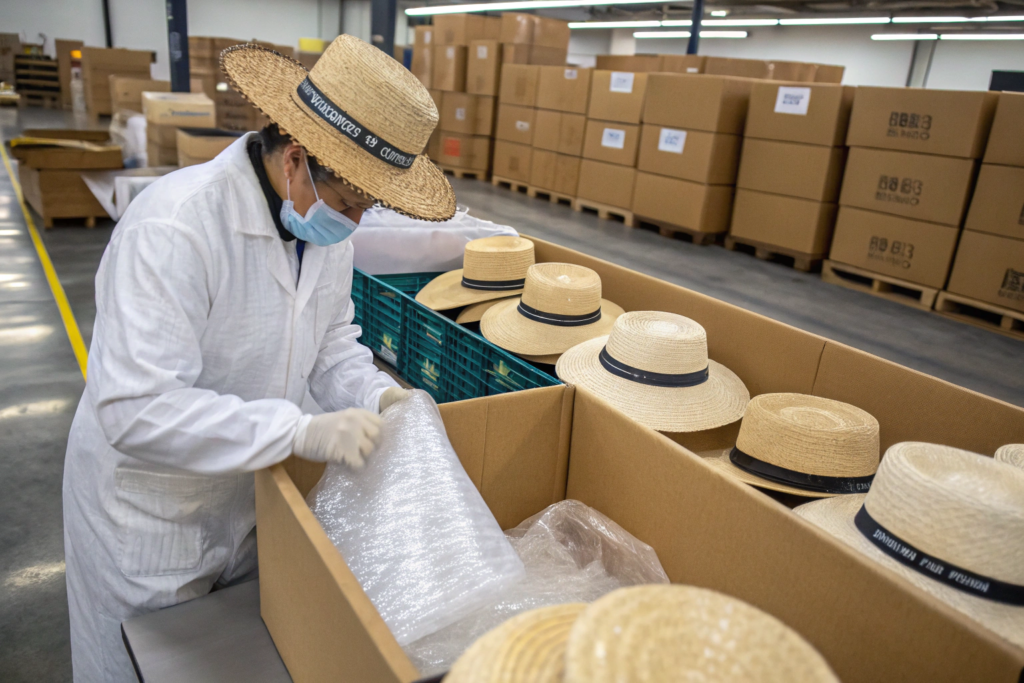
For straw hats traveling with winter goods, we use a specific type of vapor barrier bag. These bags are made from a thicker gauge of polyethylene, often with a metalized layer or a nylon core. They are heat-sealed shut, not folded. This creates a true hermetic seal. Moisture outside the bag cannot get in. This is the same technology used for shipping electronics or pharmaceuticals. It might seem like overkill for a hat, but when that hat is sitting next to a carton of damp wool gloves, it is the only thing keeping it dry.
Inside the sealed bag, we also place a small desiccant packet. This is silica gel that absorbs any residual moisture trapped inside the bag during packing. It acts as a final safety net. For winter goods like knit hats, we do not seal them in vapor barriers. They need to breathe a little. Instead, we pack them in standard polybags with small vent holes to allow slow moisture equalization. The key is that the straw hats are isolated in their own dry bubble while the wool goods can handle the ambient container humidity.
Where Should You Position Different Materials Inside the Container?
The placement of cartons inside the container matters as much as the packaging itself. The worst place to put a moisture-sensitive product is against the container walls or directly under the ceiling. These are the surfaces where condensation forms first.
When we load a mixed container for clients like you, we use a sandwich method. The moisture-sensitive items go in the center of the container, surrounded by the less sensitive items. For example, a pallet of straw hats would be loaded in the middle of the container, not touching any walls. It would be flanked on both sides by pallets of synthetic baseball caps or fashion belts. These items are less affected by humidity and act as a buffer.
We also place desiccant blankets on top of the cargo before closing the doors. These are large sheets filled with absorbent material that hang from the ceiling lashing rings. They catch the condensation before it drips onto the cargo. We also place humidity indicator cards in several cartons throughout the load. When you open the container in the U.S., you can see immediately if the internal humidity exceeded safe levels during the voyage. This shipping protocol has reduced our moisture-related claims to nearly zero.
Does Mixing Seasons Change the Customs Clearance or Duty Rate?
This is a question I get a lot from buyers who are trying to be efficient with their inventory. They worry that if they put a carton of winter hats in with a carton of summer hats, the customs officer at the port will flag the shipment for inspection or apply a higher duty rate to the whole container. This is a valid concern because customs clearance is already stressful enough without adding complications.
The good news is that mixing seasons does not change the duty rate or trigger automatic inspections. Customs and Border Protection does not care if your container looks like a department store. They care about two things: the declared value and the correct Harmonized Tariff Schedule code for each item. As long as your paperwork matches what is physically inside the box, you are fine. At AceAccessory, we handle this documentation for you so there are no surprises at the port.

How Do I Declare Mixed HTS Codes for Knit Hats and Straw Hats on One Bill of Lading?
The Bill of Lading is the master document that describes the cargo. It does not need to list every single SKU. It can simply say "Fashion Accessories" or "Hats and Headwear" as the general description. The detailed breakdown happens on the Commercial Invoice and the Packing List.
Each line item on the Commercial Invoice must have its own specific HTS code. For example, a carton of acrylic knit hats will use HTS heading 6505.00. A carton of paper straw hats will use a different HTS heading under the 6504 or 6502 categories depending on the material. The duty rate is calculated per line item, not as a blended average for the whole container.
This means you do not pay the higher duty rate on everything. You only pay the higher rate on the specific items that fall under that code. Our shipping department generates a detailed packing list that shows exactly which carton numbers correspond to which HTS code. If customs does a tailgate exam and opens carton number 27, they can instantly verify that it matches the description for that line item. This transparency reduces the likelihood of a full intensive exam. We also recommend using a customs broker who is familiar with apparel and accessories classifications to ensure smooth clearance.
Will a Mixed Container Trigger More Frequent FDA or CPSC Inspections?
Fashion accessories are generally not regulated by the FDA unless they have a medical claim. A straw hat is not a medical device. So FDA is not a concern here. The agency that might take an interest is the CPSC, the Consumer Product Safety Commission. They care about lead content in metal trims, small parts that could be a choking hazard, and flammability of fabrics.
Mixing seasons does not increase your risk of a CPSC hold. The risk is based on the product type itself, not what it is shipped next to. For example, hair clips with small metal springs or glued-on gems are more likely to be flagged for lead testing than a plain straw hat. A wool scarf might be flagged for flammability if it is made of a loose, fuzzy yarn.
The key to avoiding CPSC delays is to have your compliance certificates ready before the container lands. We provide General Certificates of Conformity for all items that fall under CPSC jurisdiction. This shows the testing lab results for lead and flammability. As long as the paperwork is in order, the fact that the scarf is in the same box as a beach hat is irrelevant to the inspector. Our quality control system includes pre-shipment testing for all regulated components so that your goods clear customs without a hitch.
What Are the Cost Benefits of Consolidating Summer and Winter Orders?
Let us talk about the reason you are even considering this. Money. Shipping a full container load is always cheaper per unit than shipping a less-than-container load. But most small to medium brands cannot fill an entire 40-foot container with just straw hats in February. They also cannot fill one with just wool scarves in August. So they end up shipping LCL and paying a premium for every cubic meter.
Consolidating your seasonal orders into one container allows you to access FCL pricing even if you do not have FCL volume in a single category. The savings can be substantial. On a per-unit basis, shipping FCL can be 40% to 60% cheaper than shipping LCL. For a product like a fashion hat that might retail for $24.99, saving a dollar on freight goes straight to your bottom line.

How Much Freight Cost Can I Save by Combining 500 Knit Hats and 500 Straw Hats?
Let us run a realistic scenario. Suppose you need 500 knit beanies and 500 straw fedoras. That is 1,000 hats total. If you ship them separately as two LCL shipments, you pay for a minimum of one cubic meter each, plus all the origin and destination handling fees twice. Your total freight bill might be around $800 to $1,200.
If you combine them into one shipment, you are still paying LCL rates because 1,000 hats does not fill a container. But you only pay one set of handling fees. You only pay one customs entry fee. Your total freight bill might drop to $500 to $700. The savings come from consolidating the fixed costs.
The real savings kick in when you can combine enough volume to book a full 20-foot or 40-foot container. For a 20-foot container from Ningbo to Los Angeles, the all-in cost might be around $3,500. If you can fill that container with a mix of winter accessories and summer accessories, your per-unit freight cost drops to pennies. A beanie that cost $0.85 to ship LCL might cost $0.25 to ship FCL. Multiply that by 10,000 units, and you are talking about real money. We work with our clients to build mixed pallets that maximize container space while respecting the material compatibility rules.
Does Combining Shipments Reduce Warehousing Fees at U.S. Ports?
Yes, and this is an often overlooked benefit. When you receive multiple LCL shipments at different times, you pay separate handling fees to the Container Freight Station for each one. The CFS charges a minimum fee per shipment to unload the consolidation container and stage your pallets for pickup.
By combining everything into one shipment, even if it is still LCL, you only pay that CFS fee once. More importantly, you only coordinate one truck pickup. The drayage cost to move a container from the port to your warehouse is a fixed cost. Doing it once for a mixed load is cheaper than doing it twice for separate loads.
There is also a time benefit. Receiving one shipment means one appointment at your warehouse dock. One receiving report. One quality check. Your team spends less time managing inbound logistics and more time selling. This efficiency is why many of our wholesale buyers prefer to build a mixed seasonal order with us. They get the variety their customers want without the logistics headache of multiple deliveries.
Conclusion
Mixing winter and summer accessories in one sea container is not only possible, it is a smart business strategy when done correctly. The key is to respect the materials. Wool and paper straw do not play well together unless you create the right barriers. Polybags, vapor seals, desiccants, and strategic carton placement are your tools for success. The cost savings from FCL freight rates and consolidated handling fees can significantly improve your margins on both knit hats and straw hats.
At Shanghai Fumao, we have learned these lessons through years of trial and error. We have seen the ruined inventory and the denied claims. We built our packing and shipping protocols to prevent those outcomes for our clients. When you work with us, you do not have to worry about whether your scarves and your sun hats will survive the journey together. We manage that risk for you.
The next time you are planning a buy that spans seasons, think about consolidation. It is a simple way to reduce your landed cost without compromising product quality. And if you have questions about a specific mix of products, ask us. We can tell you exactly what packaging adjustments are needed to make it work safely.
If you are ready to build a mixed seasonal order or just want to understand your freight options better, please reach out to our Business Director, Elaine. She can review your product mix and provide a realistic shipping plan that protects your goods and your budget. You can contact her directly at elaine@fumaoclothing.com. Let us help you ship smarter.