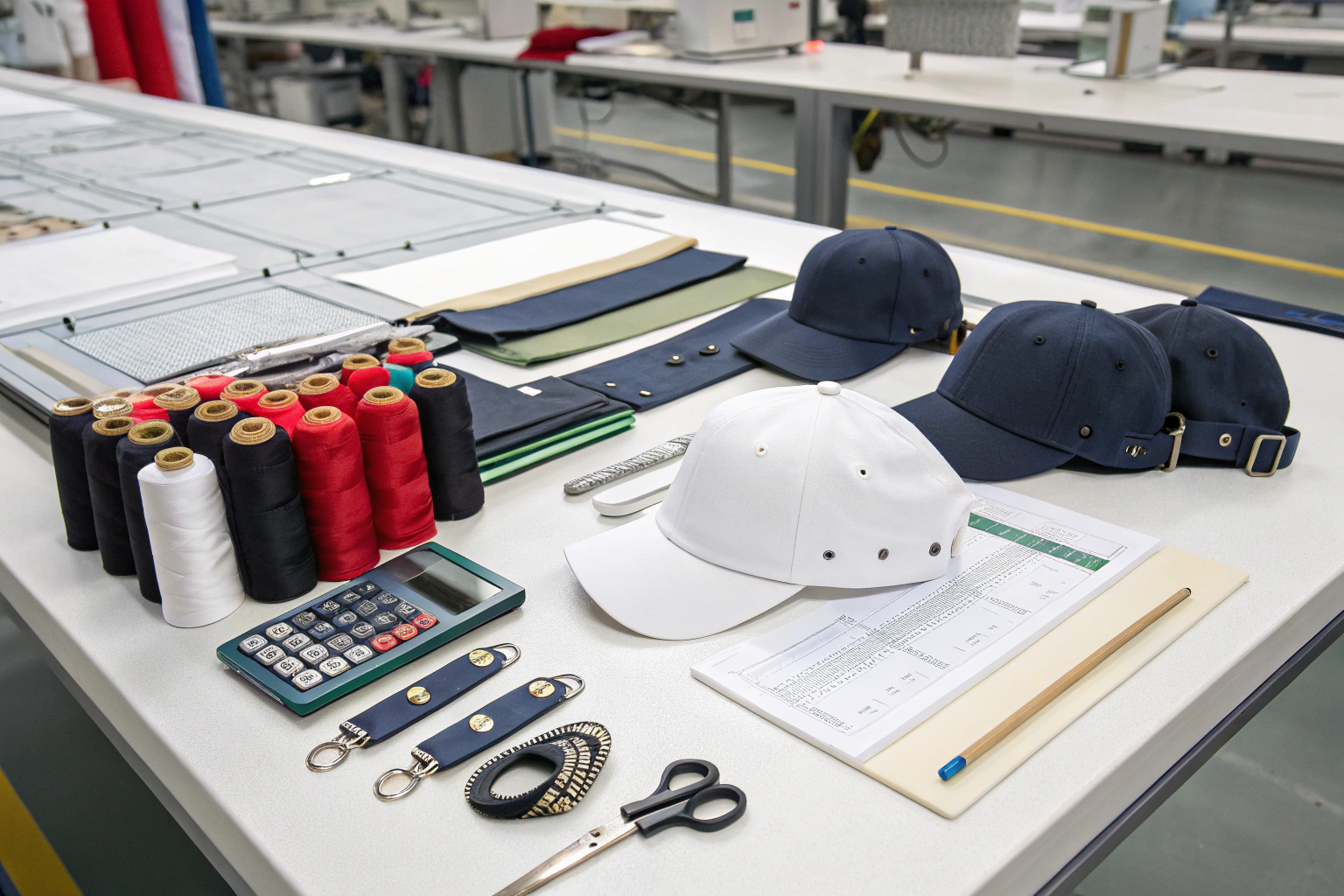
I remember a phone call with a new client from Texas about three years ago. He wanted 500 custom baseball caps with his ranch logo embroidered on the front. He had a price in his head. He had seen caps online for six dollars retail and assumed he could get them made for three dollars each. When I gave him the real quote, there was a long silence on the line. Then he said, "Why is it so much more than the ones I see on Amazon?" I walked him through every single component. The fabric weight. The embroidery stitch count. The sweatband material. The buckle type. By the end of the call, he understood. He also placed the order because he realized the cheap caps would fall apart after three washes and make his brand look bad.
The average cost of a custom baseball cap from a Chinese manufacturer ranges from $2.80 to $8.50 per unit, FOB Ningbo or Shanghai. But that range is so wide it is almost useless without context. A $2.80 cap is a completely different product from an $8.50 cap. They might look similar in a photo on Alibaba. They are not similar in your hand. At shanghai Fumao, I want you to understand exactly where your money goes. I want you to be able to look at a quote and know if you are getting value or getting fooled.
The cost of a baseball cap is like a layer cake. The bottom layer is the fabric. The middle layer is the labor and construction. The top layer is the trim and decoration. And the plate it sits on is the packaging and logistics. You can adjust each layer up or down to hit a target price point. But you cannot remove a layer without the whole thing collapsing. Let me show you exactly how this cake is built.
What Percentage of a Baseball Cap Cost Is Raw Materials?
Raw materials are the foundation of the cap. They also represent the largest single chunk of the cost. In a typical custom baseball cap order, raw materials account for 40% to 55% of the total FOB price. That percentage goes up if you choose premium fabrics. It goes down slightly if you order very high quantities where labor efficiency improves.
The main raw material is the shell fabric. This is the cotton twill, polyester mesh, or wool blend that makes up the crown and the top of the brim. The weight of this fabric is measured in ounces per square yard. A lightweight 6-ounce twill is cheaper. A heavy 10-ounce brushed cotton is more expensive. The difference is about $0.40 to $0.80 per cap just for the shell material. Then you add the buckram, which is the stiff inner layer that gives the front panels their structure. Then the sweatband, the visor board, the plastic sizing strap, the metal buckle, and the thread. Every single piece has a cost and a quality grade.
How Much Does Cotton Twill Fabric Contribute to the Final Cap Price?
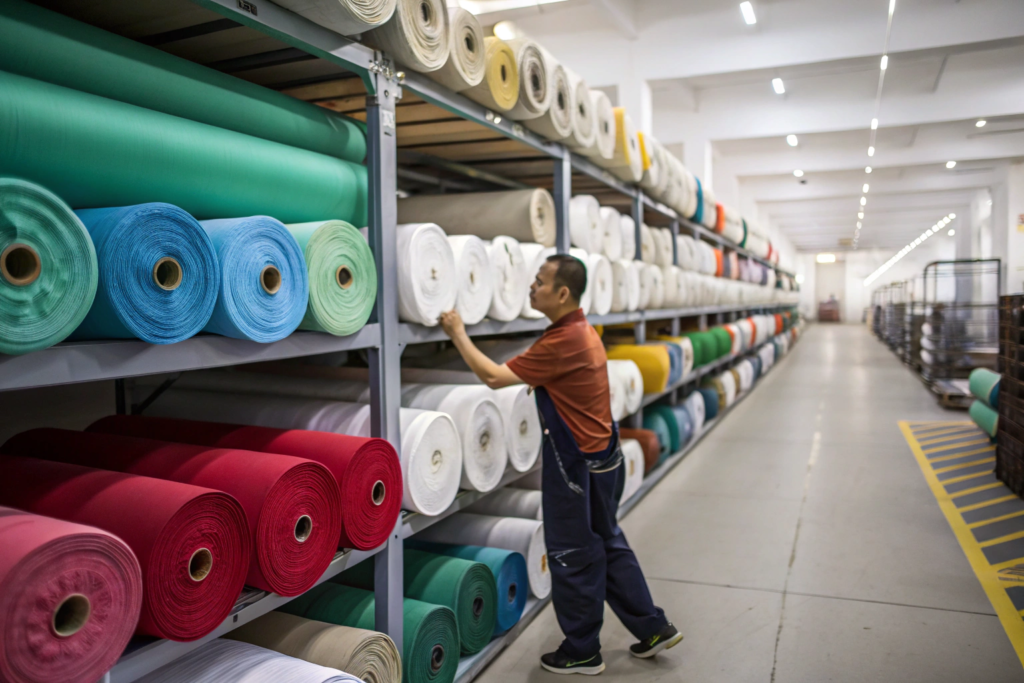
The shell fabric is the biggest material cost driver. For a standard six-panel structured cap, you need about 0.6 to 0.7 yards of fabric per cap. This includes waste from cutting the curved pattern pieces. Fabric waste is a real cost. A cap pattern has curves. You cannot nest the pieces together perfectly like a jigsaw puzzle. You lose about 15% to 20% of the fabric as scrap.
A basic 8-ounce cotton twill in a stock color like black, navy, or khaki costs around $2.50 to $3.50 per yard from our mills in Zhejiang. That puts the shell fabric cost at roughly $1.50 to $2.20 per cap. If you want a custom-dyed color that matches your brand’s Pantone, the fabric cost jumps because the mill has a minimum dye lot charge. That can add $0.50 to $1.00 per cap for small orders.
If you choose a premium fabric like a wool blend or an organic cotton, the yard price can double. A high-quality wool blend for a winter weight cap can cost $7.00 to $9.00 per yard. That pushes the shell fabric cost to over $4.00 per cap before we even cut the first panel. This is why those beautiful wool caps from heritage brands retail for $45.00. The fabric cost is real. You can also explore our range of knit hats which use different material pricing structures entirely.
What Do Buckram, Visor Board, and Sweatband Add to Material Costs?
These are the hidden components that customers never see but always feel. The buckram is a stiff, fusible material that gets heat-pressed to the inside of the front two panels. It is what makes the cap stand up tall. Cheap buckram is thin and loses its shape after a few wears. Good buckram is thicker and has a stronger adhesive. The cost difference is about $0.08 per cap. That is a tiny amount. But it is the difference between a cap that looks crisp on the shelf and one that looks tired.
The visor board is the stiff insert inside the brim. It is typically made of polyethylene plastic. A standard visor board costs around $0.12 to $0.15 per cap. A premium visor board that is more flexible and resists cracking in cold weather costs $0.20 to $0.25. This is a small upgrade that makes a huge difference in how the cap feels when you bend the brim.
The sweatband is the strip of fabric inside the front of the cap that touches your forehead. A basic polyester sweatband costs pennies. A cotton twill sweatband is more comfortable but costs more. A padded, quilted sweatband adds significant comfort and cost. The range here is $0.10 to $0.35 per cap. Our quality control team checks every sweatband seam to ensure it is soft and does not irritate the skin.
How Does Embroidery Stitch Count Affect Custom Baseball Cap Pricing?
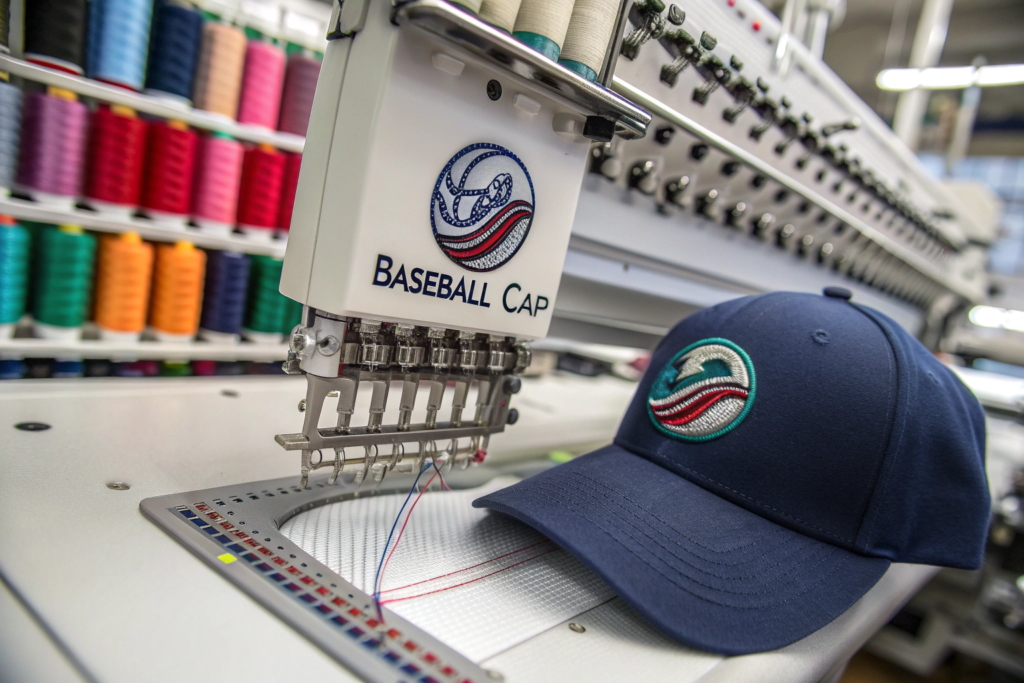
Embroidery is where a generic cap becomes your brand’s cap. It is also where a lot of buyers get surprised by the cost. Embroidery is not printing. It is a mechanical process that takes time. The machine needle moves up and down, piercing the fabric thousands of times. Every stitch takes a fraction of a second. Those fractions add up.
The cost of embroidery is calculated by stitch count. A simple text logo with a small font might be 3,000 stitches. A large, complex graphic with multiple colors and fine details might be 15,000 stitches or more. The machine time, the thread consumption, and the setup labor all increase with the stitch count. This is not a flat fee. This is a direct variable cost.
What Is the Cost Difference Between 5,000 and 15,000 Stitch Logos?
Let me give you a real breakdown. Embroidery on caps is priced per 1,000 stitches. The rate varies by factory and order volume, but a typical range is $0.15 to $0.25 per 1,000 stitches. This includes the thread cost and the machine operator’s time.
A simple 5,000-stitch logo costs around $0.75 to $1.25 to embroider. This is a basic left chest size logo. A couple of words. Maybe a small graphic element. It is fast. The machine runs for about 3 to 4 minutes per cap.
A detailed 15,000-stitch logo costs $2.25 to $3.75 to embroider. This is a large back design or a very intricate front patch. The machine runs for 8 to 10 minutes per cap. You are paying for that time. Also, complex designs with many thread color changes take longer. The machine has to stop, cut the thread, and switch to the next needle. Each color change adds about 15 seconds of cycle time. That time adds up across 1,000 caps.
We also have to consider the digitizing fee. This is a one-time setup cost to convert your logo artwork into a stitch file that the embroidery machine can read. A simple embroidery digitizing file costs around $30 to $50. A complex one with lots of detail and underlay stitching can cost $80 to $150. This fee is usually amortized over the order. Our design team handles this process and provides a stitch simulation before we run a physical sample.
Why Do Multiple Embroidery Locations Increase the Unit Price?
A cap with embroidery on the front, the side, and the back costs more than a cap with just front embroidery. This seems obvious, but the reason is not just the extra stitches. The reason is the extra handling labor.
Each embroidery location requires a separate machine setup. The cap has to be hooped onto a specific frame for that position. The front embroidery uses a wide, curved frame. The side embroidery uses a narrow, flat frame. The back embroidery, often on the plastic strap, uses a different frame again. The operator has to remove the cap, change the frame, and reload the cap for each location.
This handling time adds labor cost. It also increases the risk of misalignment. A cap that is loaded slightly crooked on the side frame will have a crooked logo. That cap becomes a second-quality item. We have to build a small allowance for this spoilage into the price. For a cap with three embroidery locations, the labor cost for embroidery can be 30% to 40% higher than a single-location cap, even if the total stitch count is similar. If you are looking for simpler decoration options, our custom hats can also be produced with woven labels or printed patches which have different cost structures.
What Labor and Construction Costs Are Involved in Cap Manufacturing?
China is no longer the absolute cheapest place to make a baseball cap. Vietnam and Bangladesh have lower hourly wages. So why do so many premium cap brands still manufacture in China? Because of the skill and the speed. A good cap is hard to sew. The curves are tight. The seams have to match perfectly at the center point. The brim has to be attached with even tension. An inexperienced sewer will make a cap that twists to one side or puckers at the seams.
Labor cost accounts for roughly 25% to 35% of the FOB price of a custom baseball cap. This includes the cutters, the sewers, the pressers, the quality inspectors, and the packers. The wage rate in Zhejiang is higher than in other provinces, but the productivity is also higher. A skilled sewer in our factory can complete more units per hour with fewer defects. That efficiency offsets some of the wage difference.
How Many Sewing Operations Are Required for a Standard Six-Panel Cap?
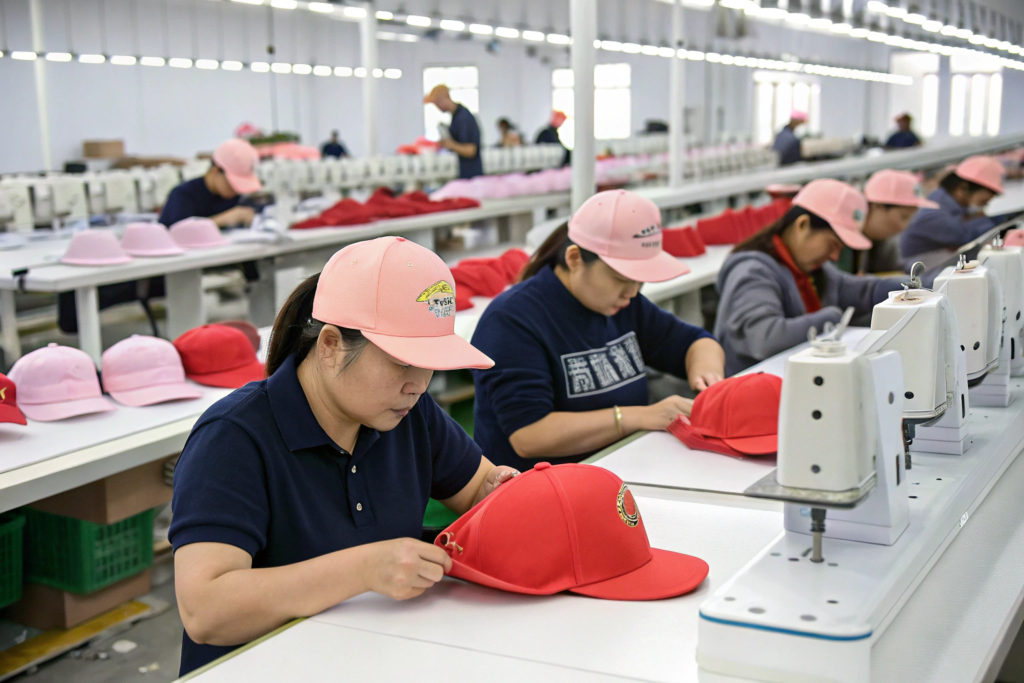
A standard six-panel structured cap goes through about 22 to 25 separate sewing operations from cut fabric to finished product. This is not a simple item. It is a piece of engineered headwear.
Here is a simplified breakdown of the main operations:
| Operation Step | Description | Approximate Time (Seconds) |
|---|---|---|
| 1. Panel Joining | Sew six crown panels together with top button | 90 |
| 2. Visor Assembly | Cover visor board with fabric and stitch edges | 45 |
| 3. Visor Attachment | Sew completed visor to front crown | 60 |
| 4. Sweatband Application | Fold and stitch sweatband inside crown | 40 |
| 5. Closure Attachment | Sew plastic snap or metal buckle to back | 35 |
| 6. Finishing & Trim | Close back seam, attach labels, clean threads | 50 |
Each of these steps requires a different sewing machine and a different skill. The visor attachment is particularly tricky. The fabric has to be stretched evenly around the curve of the plastic board. Too much tension and the brim curls up. Too little and it sags. This is where the experience of the sewing operator really matters. A new worker might take 90 seconds and produce a mediocre brim. A veteran worker takes 60 seconds and produces a perfect brim. That 30-second difference across 1,000 caps is over 8 hours of labor saved. We invest in worker training to maintain this efficiency.
What Is the Price Impact of Choosing a Structured Versus Unstructured Crown?
A structured cap has buckram fused to the front panels. An unstructured cap, often called a "dad cap," has no stiffening. It is soft and conforms to the head. Many buyers assume an unstructured cap is cheaper because it has fewer materials. That is only half true.
The unstructured cap does save the cost of the buckram, about $0.08 per cap. It also saves one fusing operation where the buckram is heat-pressed to the fabric. However, the sewing of an unstructured cap can be slightly more difficult. The soft fabric panels are floppy. They do not feed through the machine as cleanly as the stiff structured panels. The sewer has to work a little slower to keep the seams aligned.
In practice, the cost difference between a structured cap and an unstructured cap from the same material is negligible. It might be $0.10 to $0.15 per cap. The choice should be driven by style and your customer’s preference, not by trying to save a few pennies on buckram. The real cost driver is still the shell fabric and the embroidery.
How Do Order Quantity and Packaging Influence the Per-Unit Cost?
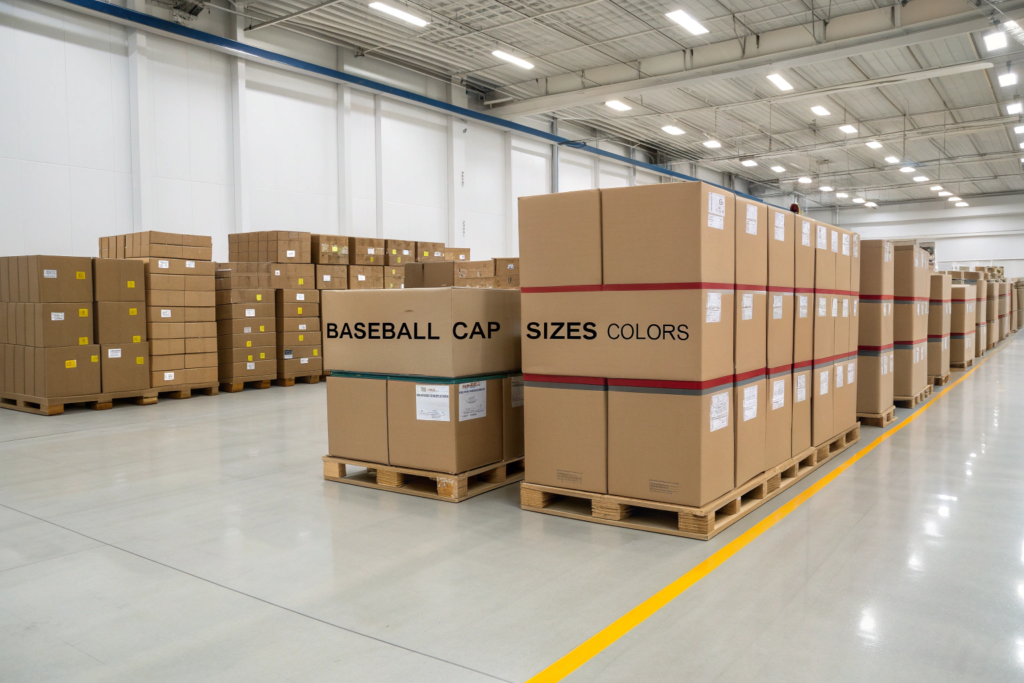
Quantity is the great equalizer in manufacturing. The fixed costs of setting up a production line do not change much whether you order 100 caps or 10,000 caps. The machine still needs to be threaded. The pattern still needs to be laid out. The embroidery file still needs to be digitized. When you spread those fixed costs over a larger number of units, the per-unit cost drops.
Packaging is another layer of cost that buyers often forget to budget for. A cap in a polybag costs less than a cap in a custom printed box. That box costs less than a cap with a hangtag, a barcode sticker, and a tissue paper wrap. Every touch adds labor and material cost.
What Is the Unit Cost Difference Between 500 Pieces and 5,000 Pieces?
Let me give you a realistic example based on a mid-range structured cotton twill cap with a 7,000-stitch front embroidery.
| Cost Component | 500 Pieces (Per Unit) | 5,000 Pieces (Per Unit) |
|---|---|---|
| Fabric & Materials | $3.20 | $2.80 |
| Embroidery Digitizing (Amortized) | $0.20 | $0.02 |
| Labor & Construction | $2.50 | $2.00 |
| Overhead & Profit | $1.10 | $0.78 |
| Total FOB Price | $7.00 | $5.60 |
The difference is $1.40 per cap. That might not sound like much. But multiply it by 5,000 caps, and it is $7,000 in savings. That is real money that can cover your freight costs or increase your margin.
The biggest jumps in efficiency happen at the fabric cutting stage. For a 500-piece order, we might cut the fabric manually with electric shears. For a 5,000-piece order, we use a computerized cutting machine that cuts multiple layers at once with precision. This saves labor and reduces fabric waste. The sewing line also runs smoother. The workers get into a rhythm. They do not have to stop and re-learn the specific details of your cap design. This production efficiency is why larger orders get better pricing. If you are testing a new design, our small batch options can help you validate the market before committing to full production volumes.
How Much Do Custom Hangtags and Individual Polybags Add to Final Cost?
Packaging is a series of small costs that add up. A standard individual polybag with a suffocation warning printed on it costs about $0.04 per cap. A custom printed polybag with your logo costs $0.08 to $0.12 depending on the number of colors.
A basic cardboard hangtag with a simple string costs around $0.06 to $0.10. A fancy hangtag with foil stamping, embossing, and a multi-page fold-out costs $0.25 to $0.50. The string to attach it has to be tied by hand. That takes about 10 seconds of labor per cap, adding another $0.05.
A custom printed box for a single cap is a significant expense. A basic two-piece box with a single-color print costs $0.60 to $0.80. A premium rigid box with magnetic closure and full-color printing can cost $1.50 to $2.50. That is almost the cost of the cap itself in some cases. We always ask our clients to think about the retail environment where the cap will be sold. A cap on a peg hook in a discount store needs nothing more than a hangtag with a price. A cap in a boutique gift box on a shelf needs the full premium presentation. We can source all of these packaging options and provide clear pricing so there are no surprises.
Conclusion
The cost of a custom baseball cap is not a single number. It is a sum of dozens of small decisions. The fabric weight you choose. The number of stitches in your logo. The number of embroidery locations. The structure of the crown. The quantity you order. The way you package it. Each decision pushes the final price up or down. Understanding this breakdown gives you control. You can decide where to invest for quality and where to save for margin.
At shanghai Fumao, we believe in transparent pricing. We do not want you to be the person on the phone with a long silence, confused about why the quote is different from what you expected. We want you to understand the value you are getting. A $5.60 cap from us is built to last. It has a sweatband that absorbs moisture, a brim that holds its curve, and embroidery that does not unravel. A $2.80 cap from a trading company might look the same in a photo. It is not the same in a customer’s hand.
If you are ready to develop your own custom baseball cap program, let us walk you through the options. We can show you fabric swatches, stitch simulations, and packaging samples. We can help you build a cap that fits your brand and your budget.
To get started or to request a detailed quote based on your specific design, please contact our Business Director, Elaine. She can provide a cost breakdown tailored to your exact specifications. You can reach her directly at elaine@fumaoclothing.com. Let us make a cap you are proud to sell.