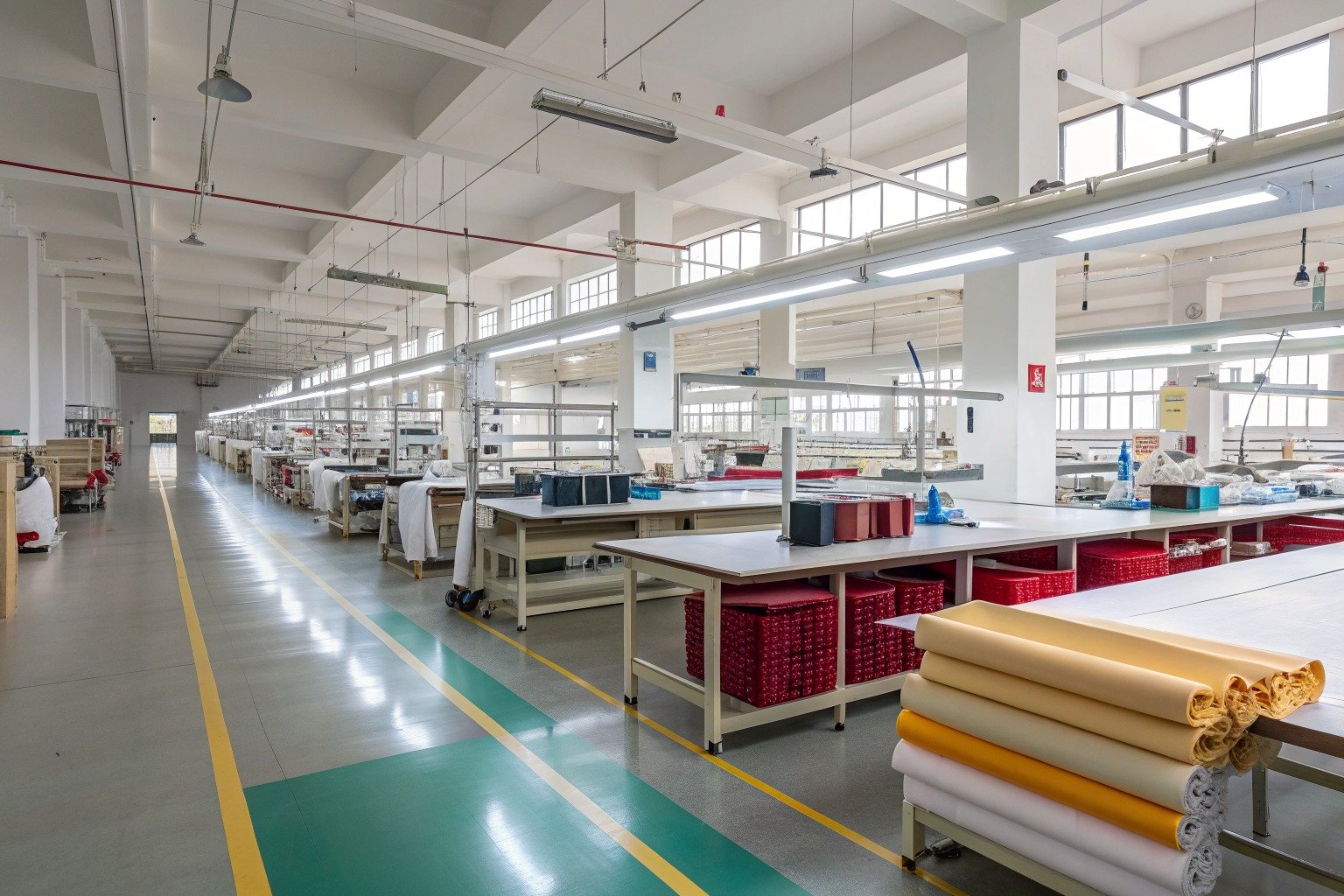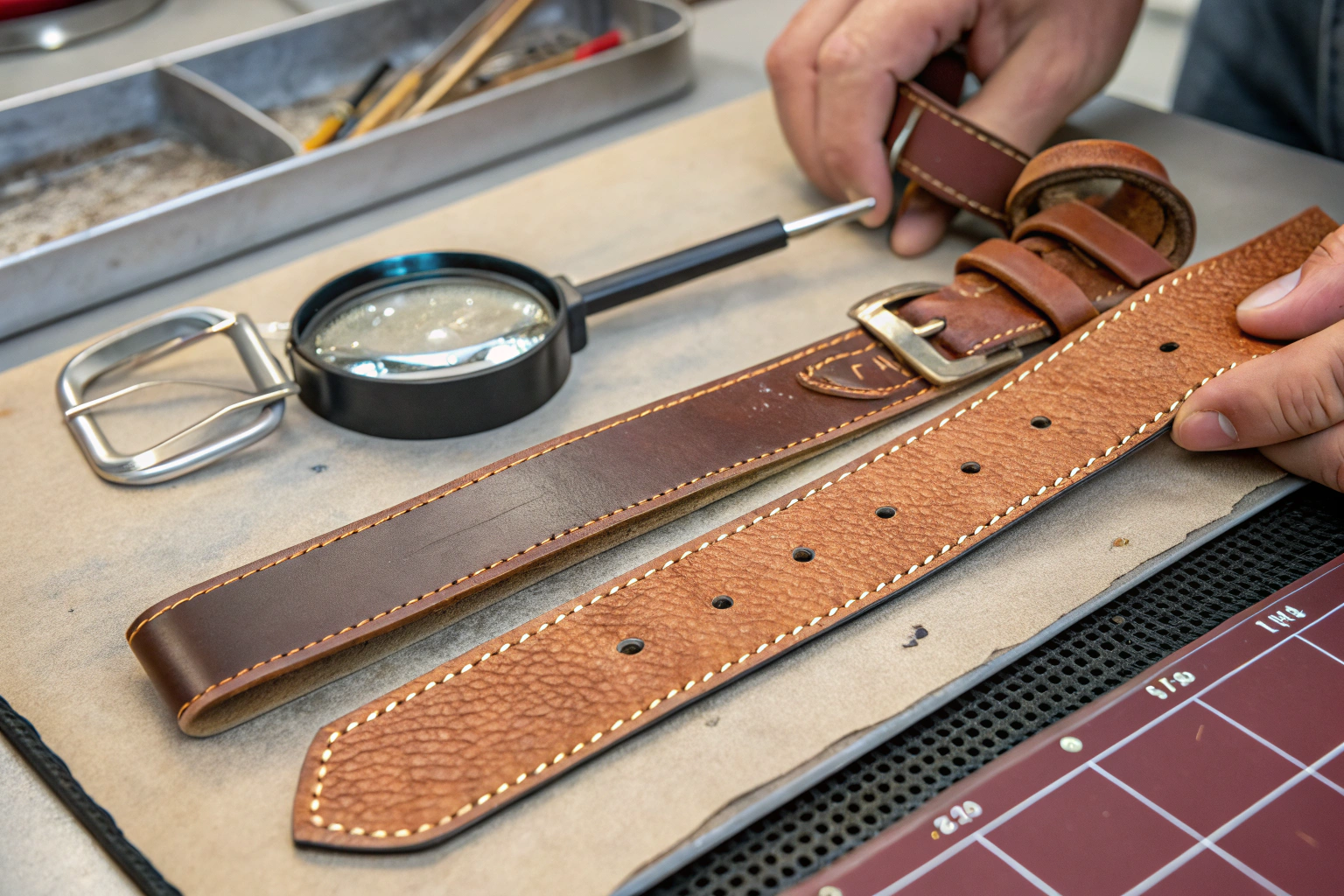
A buyer from a European leather goods brand once told me a story that made my jaw tighten. He had ordered 10,000 "genuine leather" belts from a factory he found at a trade show. The price was good. The samples looked fine. Three months after the belts hit retail, the returns started. The leather was peeling apart in layers. The surface was cracking like old paint. Customers were furious. He had a lab test the belts. They were bonded leather, a composite of leather dust and polyurethane glue pressed into a sheet and embossed with a fake grain pattern. The factory had sold him leather-flavored particle board at a genuine leather price. The recall cost him his annual profit and his reputation with the retailer. He asked me how to make sure this never happened again.
To verify that a factory’s leather belts are genuine and not bonded, you must use a combination of physical inspection methods, burn testing, and third-party laboratory analysis. Genuine leather has visible natural grain variation, a distinct organic smell, a fibrous cross-section, and burns like hair. Bonded leather has a uniform, printed grain pattern, a chemical smell, a homogeneous cross-section, and burns like plastic. The definitive test is a fiber content analysis from an accredited leather testing laboratory.
At Shanghai Fumao, we produce leather belts from full-grain, top-grain, and genuine leather for brands across North America and Europe. We know the difference because we cut, stitch, and finish real leather every day. Let me give you the tools to verify what you are buying, whether from us or from any other factory.
What Physical Inspection Methods Reveal Genuine Leather?
Your hands and eyes are the first and most accessible verification tools. You do not need a laboratory to spot most bonded leather. You need to know what to look for and what to feel for. I have trained dozens of buyers to perform a five-minute physical inspection that catches the majority of bonded leather imposters.
The key principle is this. Genuine leather is an organic material. It is inconsistent by nature. Every hide is different. Every area on the same hide is slightly different. Bonded leather is a manufactured material. It is consistent by design. Every sheet is identical. Every inch of the surface is identical. Look for inconsistency. If the material looks too perfect, too uniform, and too predictable, your suspicion should be aroused.
What Grain Patterns and Pores Indicate Real Leather?
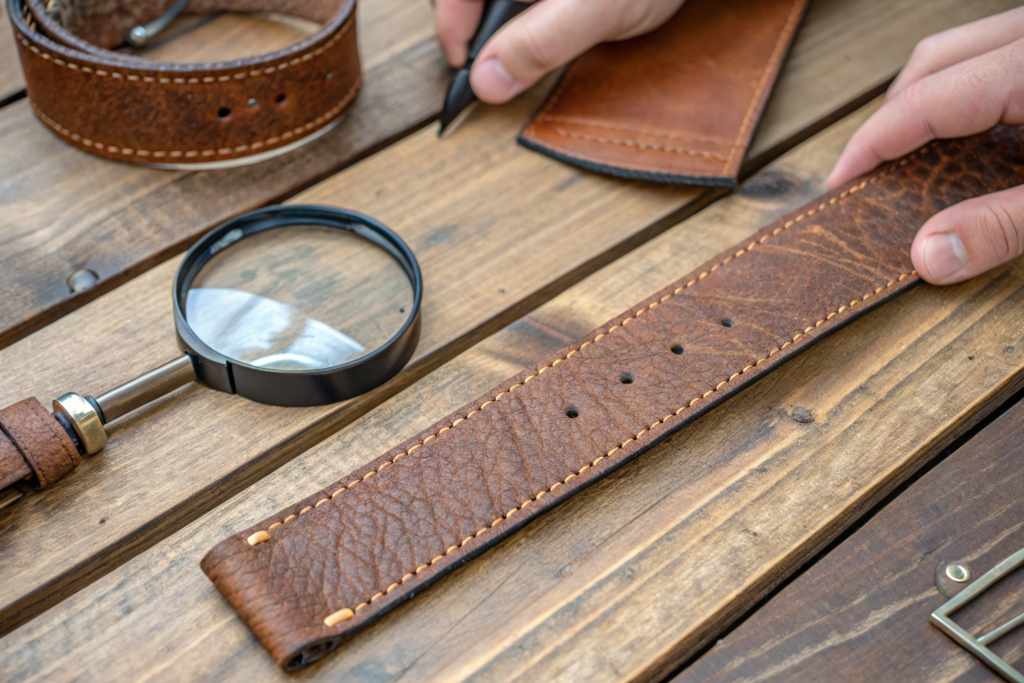
Real leather has pores. Under a magnifying loupe with 10x magnification, the surface of a genuine leather belt shows a landscape of tiny openings where hair follicles once grew. The pores are irregular in size, shape, and spacing. No two square centimeters are identical. On full-grain leather, the pores are clearly visible. On top-grain leather, which has been sanded to remove imperfections, the pores are less defined but still present with an irregular pattern.
Bonded leather has no pores. The surface grain is not a natural structure. It is an embossed pattern pressed into the polyurethane coating by a textured roller. Under magnification, the grain pattern repeats exactly. The same peak, the same valley, at the same interval. It looks like wallpaper, not like skin. Run your finger across the surface. Real leather has a slight drag, a microscopic texture that is not completely smooth. Bonded leather’s embossed surface can feel slippery or uniformly textured. The difference is subtle but distinct once you have felt both. If you are comparing genuine leather identification characteristics, the pore test under magnification is the most accessible and reliable physical check.
How Does the Edge and Back Side of the Leather Differ?
Turn the belt over. Look at the back side, also called the flesh side or the suede side. On a genuine leather belt, the back side is suede-like. It has a fibrous, fuzzy texture. You can see the interlaced collagen fibers that make up the leather’s structure. The fibers can be rubbed off with friction. The back side looks and feels organic.
Bonded leather has a fabric backing. It is usually a poly-cotton or polyester textile that provides structural support for the weak bonded leather layer. The fabric is visible and obvious. If you see a woven textile backing, the material is almost certainly bonded leather or a leather-like synthetic. Some very low-quality genuine leather belts have a split leather back that is coated or painted. This can confuse the visual check. Scratch the coating with your fingernail. If the material underneath is fibrous and suede-like, it is leather. If it is a uniform, non-fibrous material, it is likely bonded or synthetic. The cut edge also tells a story. A cut edge of a genuine leather strap shows a fibrous cross-section. A cut edge of bonded leather shows a uniform, particle-board-like cross-section, often with a visible layer of the surface coating and the fabric backing. Understanding leather edge and backing identification empowers you to make a quick field assessment.
How Does a Simple Burn Test Distinguish Leather from Bonded?
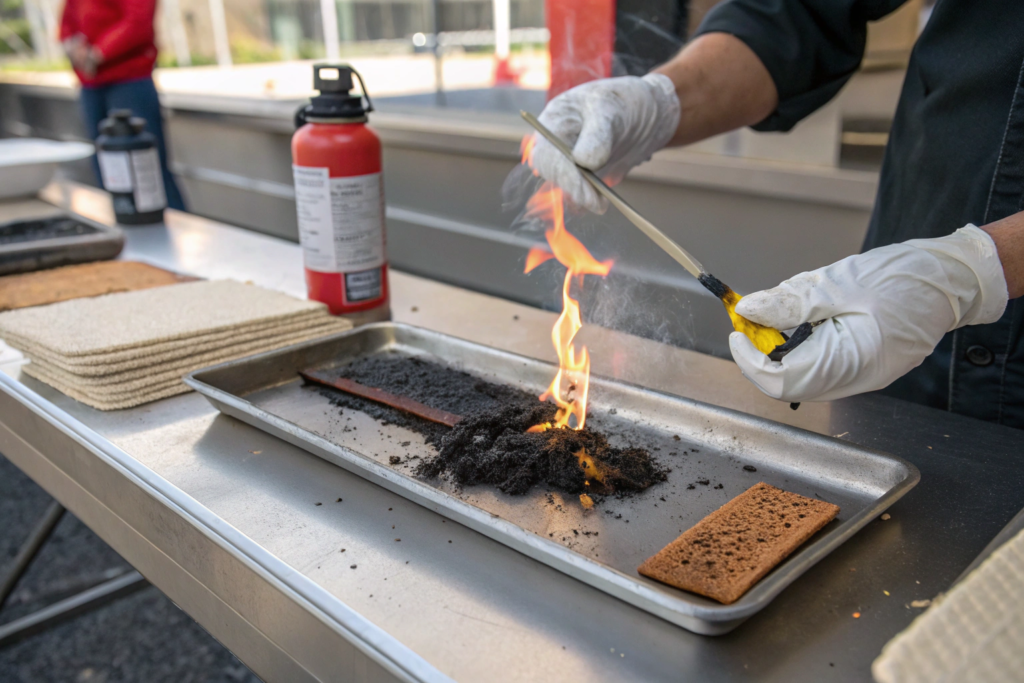
The burn test is the most definitive field test available without laboratory equipment. I must preface this with a strong safety warning. Perform this test in a well-ventilated area, over a non-flammable surface, with water or a fire extinguisher nearby. Use tweezers or pliers. Do not hold the material in your fingers. The test is destructive. Use a small sample, not a finished belt you intend to sell.
The burn test works because genuine leather is a natural protein fiber, chemically similar to hair or wool. Bonded leather is a composite of leather dust and polyurethane or other plastic binders. The chemical composition of the two materials produces completely different burning behaviors.
What Does Genuine Leather Smell and Look Like When Burned?
Take a small strip of genuine leather, about the size of a fingernail clipping, with tweezers. Hold it to a flame. Real leather burns slowly. It curls away from the flame. It produces a fine, grey ash that crumbles to powder when touched. The smoke is light in color. The critical identifier is the smell. Burning genuine leather smells exactly like burning hair. It is an organic, proteinaceous odor. Anyone who has ever smelled burnt hair from a curling iron or a campfire knows this smell. It is unmistakable.
After the flame is removed, genuine leather may continue to smolder for a moment but will usually self-extinguish. The burnt edge is hard and brittle. When you crush it between your fingers, it turns to ash. There is no molten residue. No hard plastic bead. Understanding leather burn test characteristics gives you a reliable field method that is difficult for a factory to fake.
Why Does Bonded Leather Burn Like Plastic?
Bonded leather burns completely differently. Hold a small strip to a flame. It ignites quickly. It melts as it burns. Burning droplets may fall from the material. This is molten polyurethane. Do not let it touch your skin. The smoke is thick and black. The smell is acrid, chemical, and unmistakably like burning plastic. There is no hair-like odor at all.
When the flame is removed, the bonded leather may continue to burn. It does not self-extinguish as reliably as genuine leather. When the burnt residue cools, it forms a hard, shiny bead or crust. This is the solidified plastic binder. It does not crush to ash. It is a solid, plastic mass. This residue alone is proof that the material contains a significant synthetic component. If your burn test produces melting, black smoke, a plastic smell, and a hard residue, the material is not genuine leather. It is a bonded or synthetic composite. Professional material identification through combustion analysis is a standard technique used by quality control departments worldwide.
Why Is Third-Party Laboratory Testing the Definitive Verification?
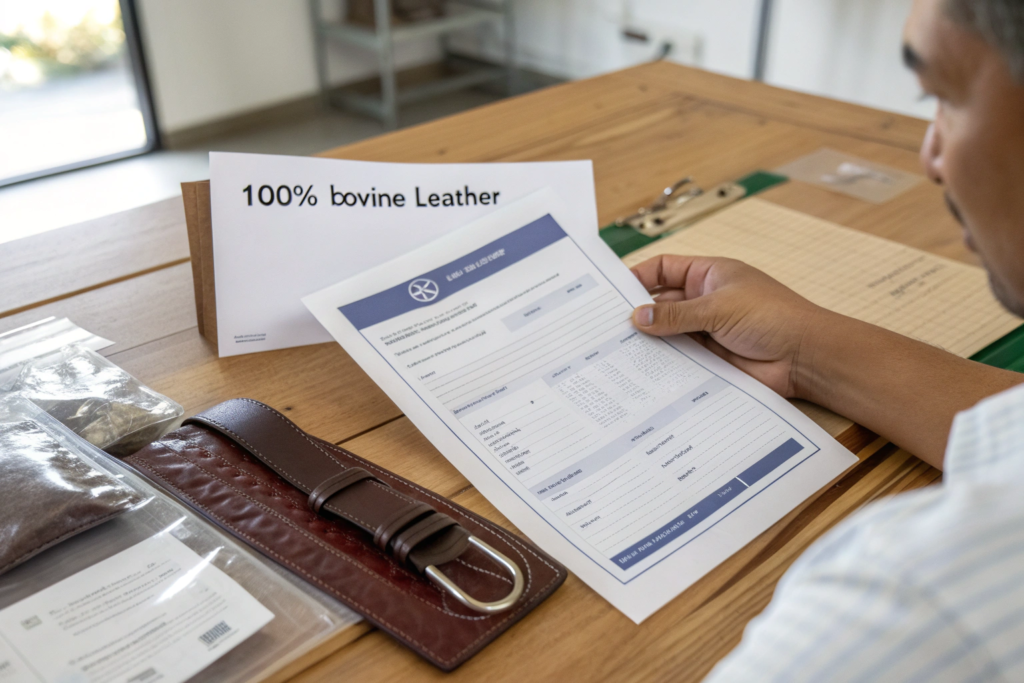
Physical inspection and burn testing are valuable field methods, but they are not definitive in a legal or commercial dispute. If you need to prove to a retailer, a regulator, or a court that a belt is not genuine leather, you need a laboratory test report from an accredited third-party laboratory.
At Shanghai Fumao, we provide laboratory test reports for leather authenticity upon request. We also welcome our clients to commission their own independent testing. We have never failed a leather authenticity test because we use genuine leather. A factory that resists third-party testing is a factory that has something to hide.
What Specific Tests Does a Leather Laboratory Perform?
An accredited leather testing laboratory performs a fiber content analysis. This test determines the exact composition of the belt material. The laboratory uses microscopy to examine the fiber structure. Genuine leather shows a characteristic three-dimensional network of collagen fibers. Bonded leather shows leather fibers fragments suspended in a synthetic binder matrix. The microscopist can see the difference clearly.
Chemical analysis may also be performed. Fourier Transform Infrared Spectroscopy, or FTIR, identifies the chemical bonds present in the material. Genuine leather shows the characteristic protein peaks of collagen. Bonded leather shows the protein peaks plus the distinctive peaks of polyurethane or other synthetic binders. The laboratory report states the material composition as a percentage. A belt that is 100% genuine leather will be reported as such. A belt that is 60% leather fibers and 40% polyurethane binder will be reported as bonded leather. The report is a legal document. It can be used as evidence in a dispute. If you are sourcing accredited leather testing laboratories, look for ISO 17025 accreditation, which certifies the laboratory’s technical competence.
How Do You Use Lab Results to Hold a Factory Accountable?
The laboratory report is your objective evidence. If the report states the belts are bonded leather and the factory’s purchase order or contract specified genuine leather, you have a clear case of material non-conformance. The factory cannot argue with the lab report. They can only argue about the remedy.
Your contract should specify the material composition and reference a testing standard. For example, "Belt strap material shall be 100% genuine full-grain bovine leather, verified by ISO 17131 fiber identification testing by an ISO 17025 accredited laboratory." This language leaves no room for interpretation. If the factory substitutes bonded leather, the lab report is the proof. The remedy should also be specified in the contract. A full refund plus freight costs. A remake at the factory’s expense. A penalty equal to a percentage of the order value. Having these terms in writing before the order is placed gives you the leverage to enforce accountability. Without a lab report and a clear contract, a factory can dismiss your complaint as a subjective opinion. With them, you have a legally enforceable claim. Professional supplier contract quality clauses should always include objective material verification standards.
How Does Our Factory Guarantee Authentic Leather Sourcing?
At Shanghai Fumao, leather authenticity is not something we prove after a problem arises. It is built into our sourcing, receiving, and production processes. We buy leather directly from tanneries with established reputations. We inspect every incoming hide. We maintain traceability from the finished belt back to the tannery lot.
Our clients do not need to conduct burn tests on our belts to verify authenticity. They are welcome to, and the belts will pass. But the real assurance is in our supply chain transparency. We can show you the hide your belt came from. We can show you the tannery certificate. We can show you the independent lab report.
What Tanneries and Certifications Do We Source From?
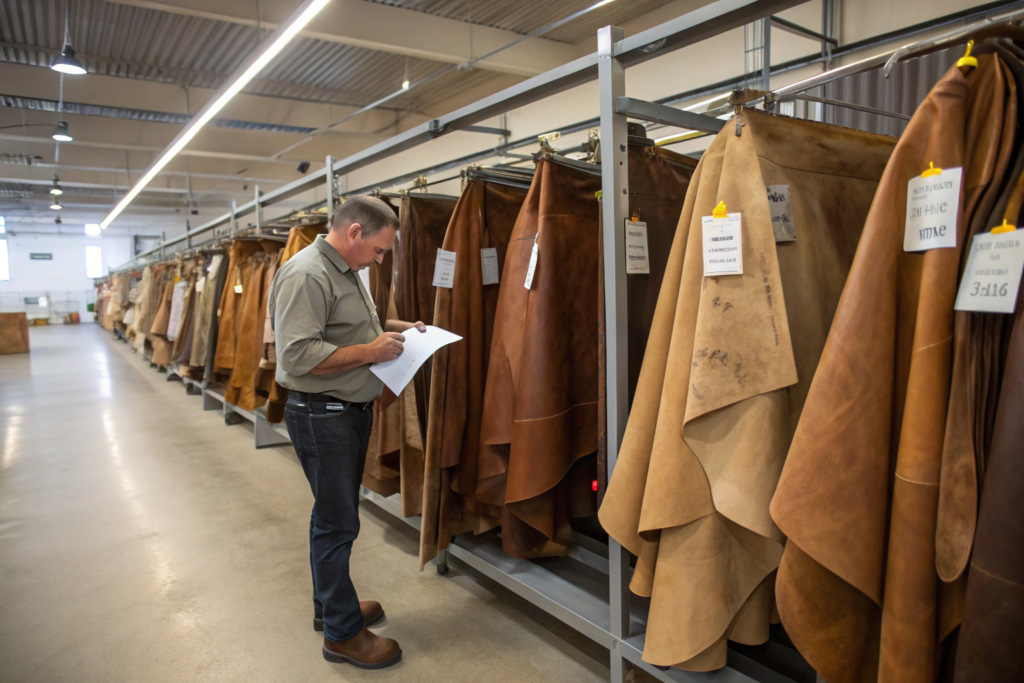
We source leather from tanneries that are certified by the Leather Working Group, or LWG. LWG certification audits the tannery’s environmental performance, chemical management, and traceability. An LWG-certified tannery operates to a standard that is independently verified. The leather we purchase comes with a certificate of origin and a material specification sheet.
The specification sheet states the leather type, the animal source, the tanning method, the finish, and the thickness. We match this specification to your order requirements. If your tech pack calls for full-grain cowhide, 1.4 to 1.6 millimeters thick, drum-dyed with an aniline finish, that is exactly what we procure. The tannery certificate is filed with your order documentation. If you ever need to trace a belt back to its source, the information is available. This Leather Working Group certified tannery directory is a resource for brands that want to verify their leather supply chain.
How Do We Inspect Incoming Leather for Authenticity?
Every incoming leather shipment is inspected by our QC team before it enters our inventory. The inspection is a multi-point check. The leather type and finish are verified against the purchase order. The thickness is measured with a thickness gauge at multiple points on each hide. The color is checked under a lightbox against the approved color standard. The surface is inspected for defects like scars, insect bites, and branding marks.
A sample from each shipment is subjected to a burn test as a rapid authenticity check. A separate sample is sent to an accredited laboratory for fiber content analysis if the order specification requires certified testing. Any hide that fails the inspection is returned to the tannery. We do not use questionable leather in our production. The cost of a failed QC inspection is a fraction of the cost of a failed customer relationship. Understanding incoming material inspection procedures is a hallmark of a professionally managed factory.
Conclusion
Verifying that a factory’s leather belts are genuine and not bonded requires a layered approach. Start with physical inspection. Look for natural grain variation and pores under magnification. Check the back side for a fibrous suede texture, not a fabric backing. Examine the cut edge for a fibrous cross-section. Perform a burn test on a small sample. Genuine leather smells like burning hair and produces a fine ash. Bonded leather smells like burning plastic and produces a hard, molten residue. For definitive proof, commission a fiber content analysis from an ISO 17025 accredited leather testing laboratory.
The best strategy, however, is to partner with a factory that has transparent leather sourcing and rigorous incoming inspection. A factory that can show you the tannery certificate, that welcomes independent lab testing, and that has never failed a leather authenticity verification because it only uses genuine leather.
At Shanghai Fumao, our leather supply chain is documented, traceable, and certified. Our incoming QC process catches any material discrepancy before it reaches your production order. Our belts are made from the leather we specify, whether that is full-grain, top-grain, or genuine leather as defined by industry standards. We do not substitute bonded leather because we would not accept it from our own suppliers.
If you have been burned by a bonded leather substitution and you are looking for a belt manufacturer with verifiable leather authenticity, please contact our Business Director Elaine at elaine@fumaoclothing.com. She can provide leather certification documents, arrange independent lab testing of our belts, and walk you through our leather sourcing and inspection process. Your brand’s reputation is built on the materials you use. Make sure those materials are what you paid for.