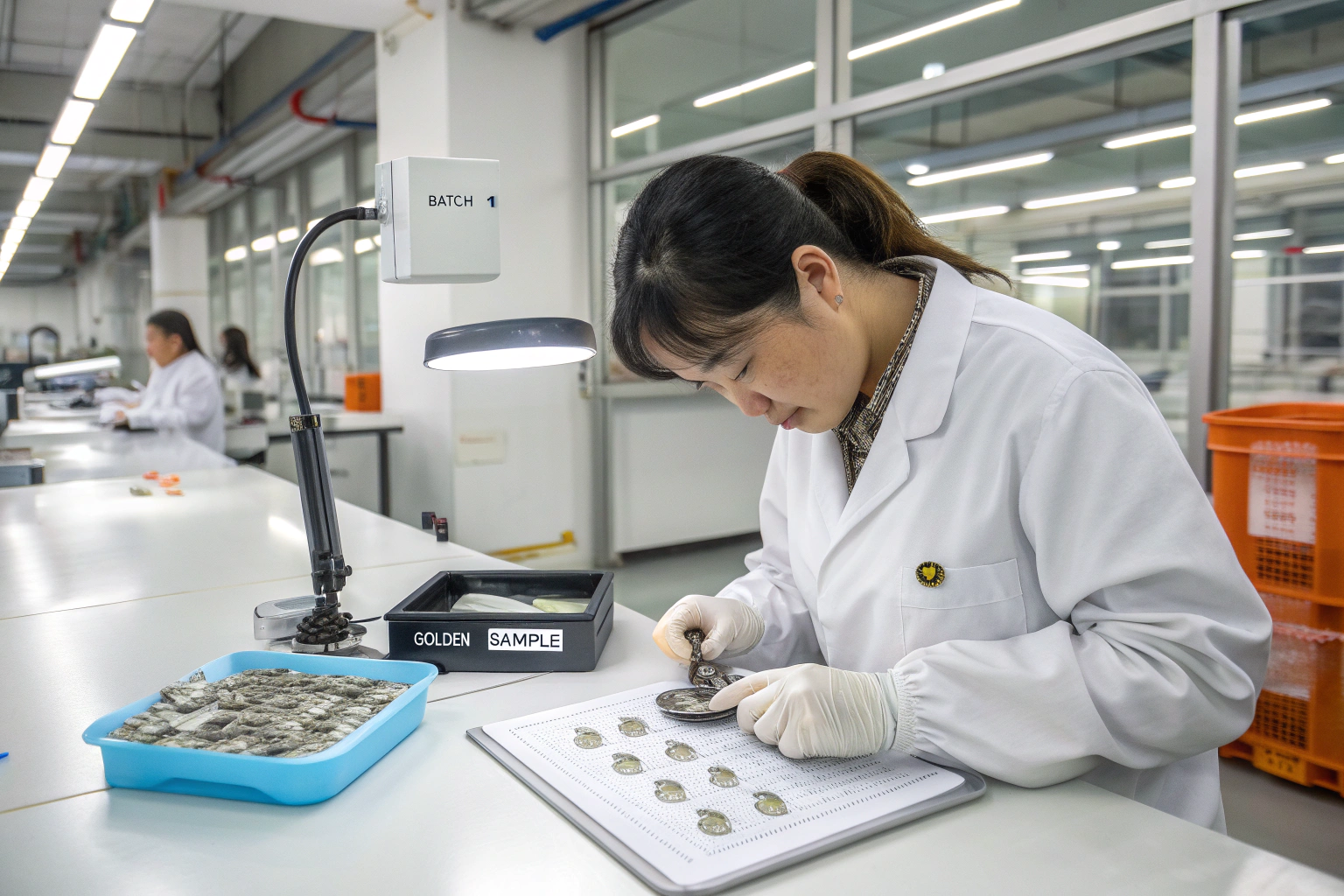
You open a carton from batch one. The hair clip springs snap crisply. The acetate gleams. The teeth align perfectly. You open a carton from batch two, same SKU, same purchase order, and the spring feels weak. The color is half a shade lighter. The teeth slightly overlap instead of aligning flush. Your customer emails you a photo of a broken clip and asks if you changed factories. You did not. The same factory produced both batches, but the invisible drift in material, tooling, and operator technique between batch one and batch two just damaged your brand reputation.
You avoid quality variation between two batches of hair clips by locking the exact raw material lot, injection mold cavity number, spring temper specification, and polishing grit into a sealed master production record that must be physically matched before any second batch begins. The factory must pull the batch one retained sample from the QC archive and measure every critical dimension on the batch two first articles against that specific physical reference, not against a digital spec sheet alone.
Variation is not random bad luck. It is the direct result of a factory that treats each batch as a fresh start instead of a continuation of the first successful run. I want to show you exactly how we freeze the variables between batches, from the acetate dye lot to the spring cycle counter, so your repeat order arrives identical to the sample that won your trust.
Why Does Acetate Color Drift Happen Between Production Lots?
Acetate is not a synthetic polymer extruded in a fully automated continuous chemical plant. It is a semi-synthetic material made from wood pulp and acetic acid, and the coloring process involves dispersing organic pigments into a viscous dope before casting it into sheets. This process has inherent batch-to-batch variability because the pigment dispersion quality depends on mixing time, temperature, and the exact particle size of the pigment powder.
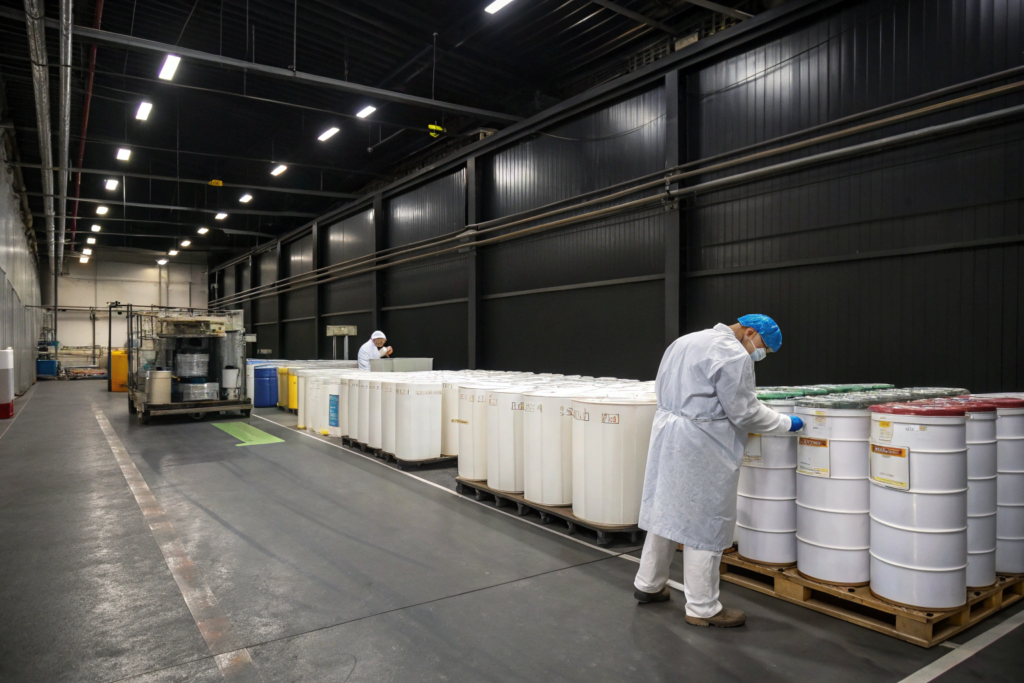
Acetate color drift happens when the pigment masterbatch supplier changes the pigment source mine, when the mixing time in the ball mill varies by even 15 minutes, or when the casting oven temperature fluctuates by 5 degrees, altering the cure. A factory prevents this by ordering the entire projected pigment lot for a client’s annual volume upfront and storing it in a climate-controlled dark room, and by validating each new batch against a sealed color standard under a spectrophotometer before cutting a single blank.
We order 12 months of pigment for each custom acetate color from our chemical supplier in a single blended lot. The supplier mixes the entire quantity in one master batch, homogenizes it, and ships it in sealed, light-proof containers. When we receive a reorder for a specific tortoiseshell hair clip, we pull pigment from that exact same lot. The color is chemically identical to the lot used in batch one.
How does a spectrophotometer verify color consistency numerically?
We measure the acetate sheet of each incoming production batch against the batch one sealed sample using a Konica Minolta spectrophotometer set to D65 illuminant and 10-degree observer angle. The instrument calculates the Delta E CMC color difference value. We set our internal tolerance at a Delta E of less than 0.8. If a batch measures 1.2 Delta E, it is visually perceptible to a trained eye. We reject that sheet lot and do not cut clips from it.
What if the pigment supplier changes their raw material source mid-year?
This is a constant risk in the chemical supply chain. We mitigate it by requiring our pigment suppliers to sign a "no-substitution" clause in their annual contract. They must notify us 90 days before any change in raw pigment source, and we receive a pre-change sample to test against our archived master. This gives us time to communicate with the brand if a visible color shift is unavoidable.
How Do Spring Tension Specifications Maintain Consistent Grip Across Batches?
The spring inside a hair clip is a precision torsion spring. Its grip force depends on the wire diameter, the number of coils, the leg angle, and the tempering heat treatment. A spring wound from 0.80-millimeter wire grips differently than one wound from 0.83-millimeter wire, even though both fall within a sloppy factory’s "0.8mm" tolerance band.
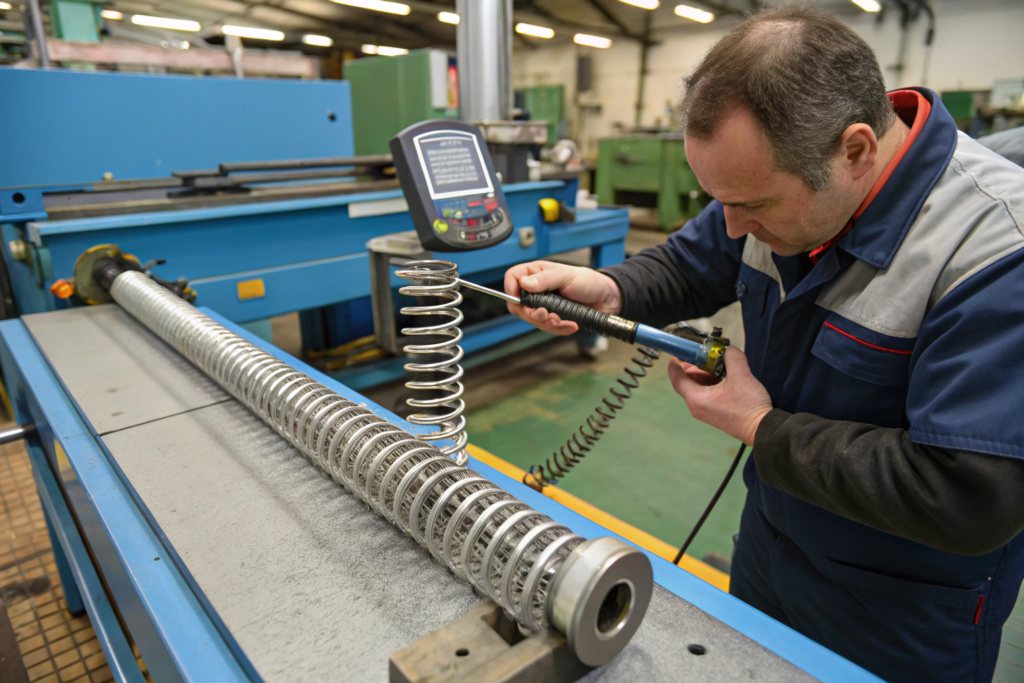
We maintain consistent grip by specifying spring wire diameter to a tight 0.80 plus or minus 0.01 millimeter tolerance, locking the coil count at exactly 5.5 turns, and measuring the closing force of every 50th spring on a digital tension gage that records the Newton force required to compress the spring legs through a 20-degree arc. The digital record catches a drifting spring coiling machine before it produces a single defective batch.
The spring coiling machine operator runs a first-article check with a digital force gage at the beginning of each shift and every time the wire spool is changed. The force reading must fall between 2.8 and 3.2 Newtons at 20 degrees of leg compression. If the reading hits 3.4 Newtons, the operator adjusts the coiling mandrel diameter slightly to loosen the coil and reduce spring force.
Why is zinc electroplating thickness critical for spring longevity?
The spring protects itself from scalp sweat corrosion via a thin zinc electroplating layer, typically 5 to 8 microns thick. If the plating is too thin, the spring rusts after three months of wear. If it is too thick, the plating flakes off and jams the hinge. Our QC department measures the zinc thickness on a sample of springs from each plating rack using an X-ray fluorescence gauge.
How does the spring cycle test simulate years of use?
We randomly pull 20 springs from each production batch and install them into a life-cycle testing machine that opens and closes the clip 10,000 times continuously at a rate of 30 cycles per minute. The spring must not fracture, and the closing force at cycle 10,000 must be at least 80% of the initial force measured at cycle one. This fatigue test catches a bad heat-treatment batch that passes a static force check but will snap after a month on a customer’s dressing table.
What Mold Cavity Management Prevents Dimensional Drift in Part Geometry?
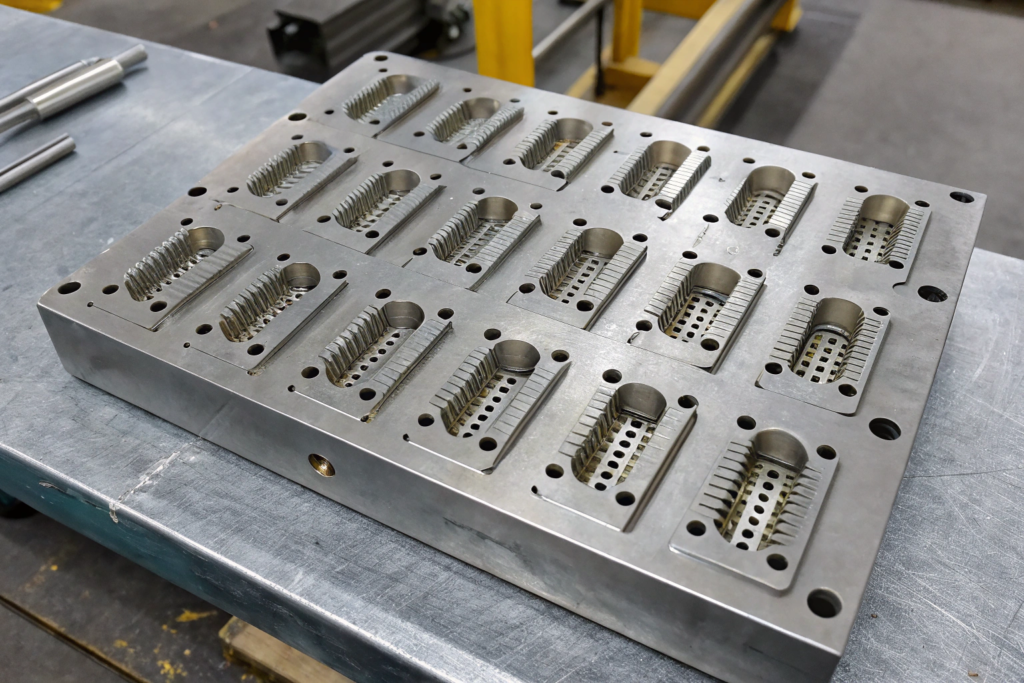
An injection mold for a hair claw clip has 8 or 16 cavities, each producing an identical clip part with each shot. Over 50,000 cycles, cavity number 7 might wear its ejector pin slightly, leaving a tiny raised burr on the clip tooth. Cavity number 12 might develop a slight sink mark due to uneven cooling channel flow. If the factory does not track per-cavity wear, batch two will contain different defects than batch one.
We prevent dimensional drift by engraving a cavity identification number on every clip part, so any defect traced to a specific cavity triggers a focused inspection of that cavity’s steel surface. We also perform a full cavity-dimensional scan using a coordinate measuring machine every 20,000 shots, comparing each cavity’s output to the original cavity dimensions from the mold qualification report.
Each molded clip part carries a tiny, nearly invisible number, 1 through 16, on an interior non-visible surface. This number corresponds to the mold cavity that produced it. If QC finds a tooth gap variance, they immediately identify the affected cavity and isolate it for repair without stopping production on the other 15 cavities. This targeted maintenance prevents unnecessary downtime.
How often are mold cavities polished to prevent resin sticking?
Acetate injection molding releases a small amount of monomer gas during each shot. Over time, this gas creates a microscopically sticky deposit on the polished steel cavity surface, causing the clip part to drag slightly during ejection and distort. We anticipate this and schedule a light cavity polish with a 3000-grit diamond paste after every 15,000 injection cycles. The polishing restores the mirror finish and eliminates the ejection drag.
What happens to the mold when a batch gap exceeds six months?
If a client reorders after a year of dormancy, the mold sits in our temperature-controlled storage vault, coated with a protective rust inhibitor. When the reorder fires, the mold maintenance technician inspects the cavity edges under 10x magnification for corrosion pitting, re-polishes the cavities, and runs a short trial shot of 50 pieces. These 50 pieces are dimensionally inspected against the original batch one blueprint before the bulk run commences.
What Inline QC Checkpoints Catch Drift Before a Full Batch Ships?
Finding a defect during final inspection means 5,000 clips are already produced wrong. The defect must be caught at the point of creation, not at the shipping dock. Inline QC checkpoints positioned along the production line stop a drifting process immediately, not after the batch is boxed.
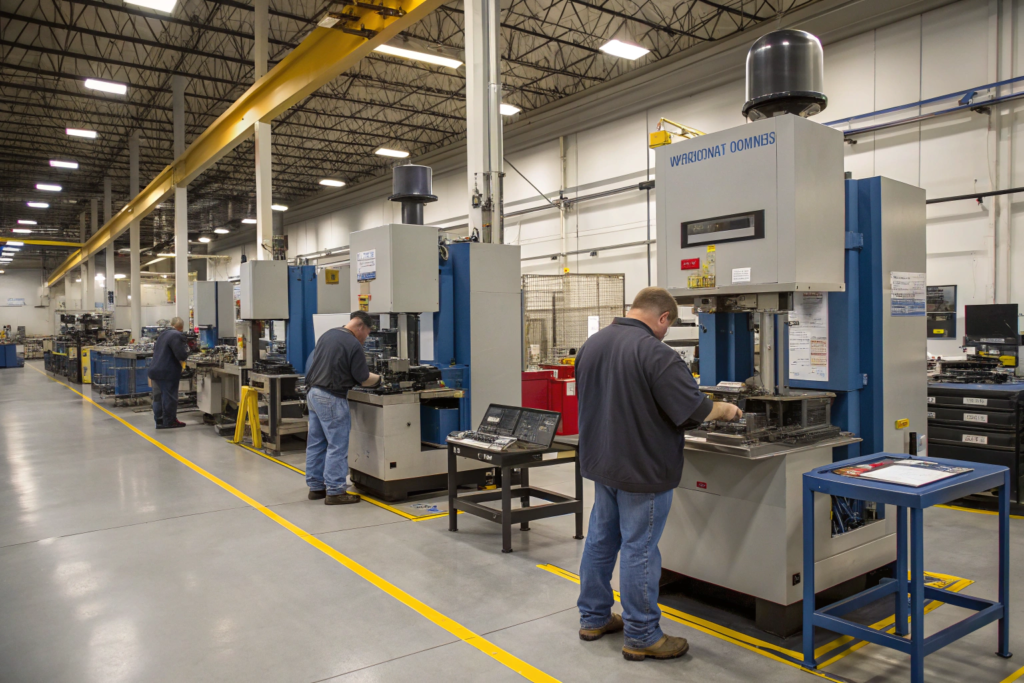
Our inline QC checkpoints are positioned at four locations: after injection molding for dimensional sprue check, after spring insertion for tension force measurement, after polishing for surface scratch inspection under 1000-lux lighting, and after assembly for a matched-pair tooth alignment test using a silhouette projection comparator. Any checkpoint failure stops the line until the issue is corrected.
The line leader at each check station pulls five pieces every 30 minutes and runs the specific test for that station. The results are entered into a digital QC log that plots the measurements on a statistical process control chart. If the chart shows an upward trend toward the upper control limit, the line leader adjusts the machine before a single piece falls outside the acceptable range.
How does a silhouette comparator catch tooth alignment issues?
The assembled hair clip is placed on a glass stage. A bright light projects the clip’s silhouette onto a large circular screen with an overlay drawing of the perfect tooth alignment from the batch one master. Any tooth that deviates from the overlay line by more than 0.1 millimeters is immediately visible to the inspector. The silhouette check takes three seconds per clip and is 100% accurate.
Are these QC records shared with the client?
Yes, we export the SPC charts and the cavity-by-cavity dimensional reports as a single PDF batch record. The client receives this quality data pack with the shipping notification. They can see exactly how each batch performed against the batch one baseline, providing full material transparency and reducing the need for their own incoming inspection.
Conclusion
Quality variation between two batches of hair clips is caused by uncontrolled raw material lots, uncalibrated spring coiling machines, worn mold cavities, and final inspection that discovers defects after production. Eliminating this variation requires a factory to freeze the pigment lot, measure every 50th spring force, engrave cavity numbers onto parts, and install inline QC checkpoints that catch drift in real time.
Our Zhejiang facility operates under this batch-locked production system for every repeat order. We pull the golden sample from the archive, verify the raw material lot, scan the mold cavities, and run the first article against the batch one measurement record before we cut a single acetate blank for batch two.
If you need a hair clip manufacturer that delivers identical quality across repeat orders, send your current approved sample to our Business Director, Elaine. She will log it into our golden sample archive and prepare a batch-locked production plan for your reorder. Write to her at elaine@fumaoclothing.com. Let’s make sure your batch two is indistinguishable from the batch your customers loved.