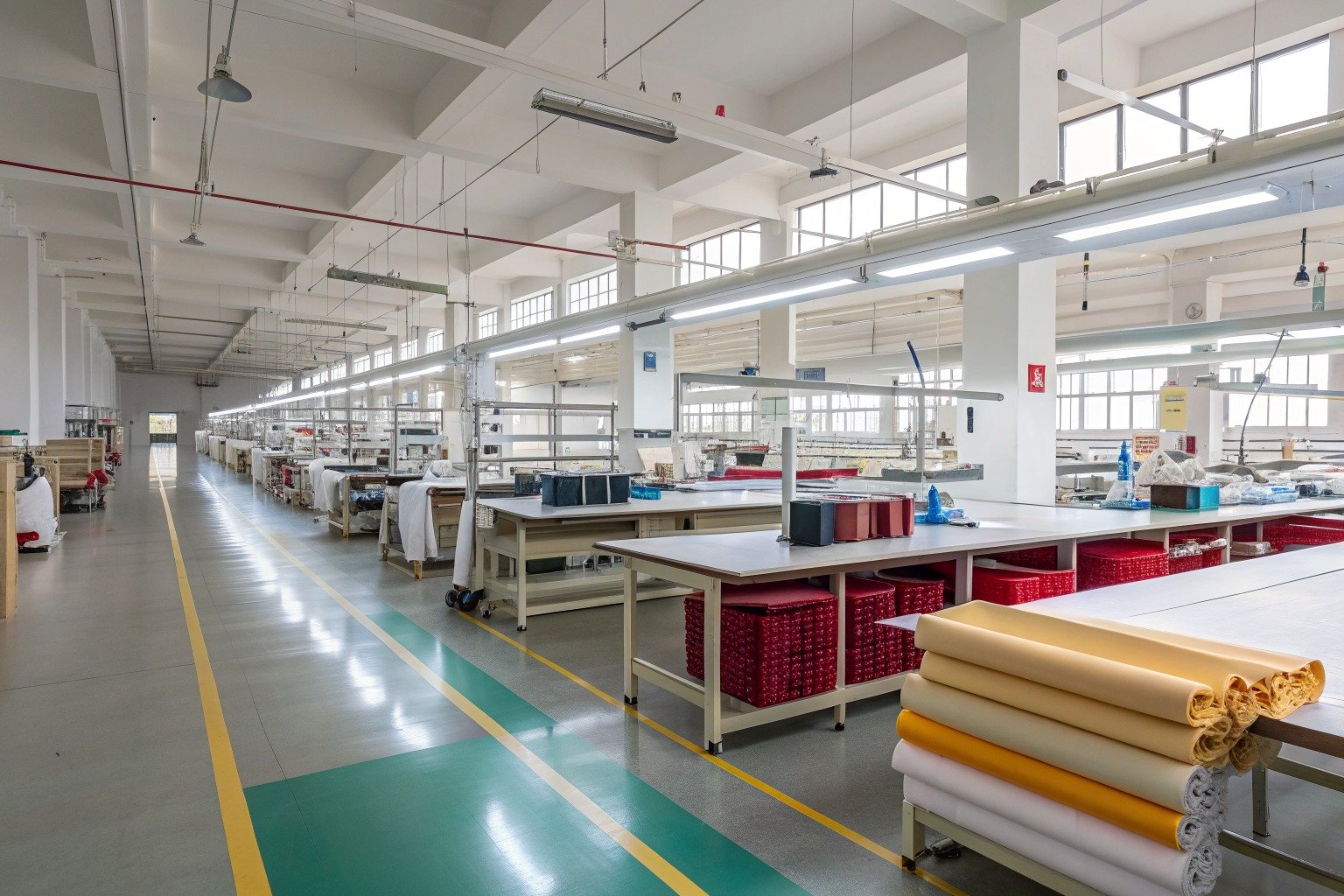
I had a difficult conversation last year with a brand owner who had not ordered from us in four years. She had launched a line of custom-shaped resin hair clips with us in 2019. The designs sold well, but she decided to pause the brand to focus on her family. In 2024, she was ready to relaunch. She called me, nervous, and asked if her molds still existed. I pulled up her client file, confirmed her mold inventory, and had a technician physically verify that the molds were on the shelf and in good condition. Two weeks later, we were producing her first reorder using the same molds she had paid for five years earlier. Her relaunch happened on schedule and at a fraction of the cost of re-developing the molds from scratch.
A professional factory keeps your custom molds and tooling indefinitely as long as you remain an active client, meaning you place at least one order within a rolling period that we define clearly in our tooling agreement. If the client relationship goes dormant, we maintain the molds for a specified period, typically two to three years from the date of the last order, and we communicate with you before any mold is considered for disposal. Your molds are your property. You paid for them. They are stored, maintained, and protected as your asset. I will explain exactly how mold ownership works, how molds are stored and maintained, what happens in situations of dormancy or factory transition, and what you should have in writing to protect your tooling investment.
Who Owns the Molds and What Does Your Contract Say?
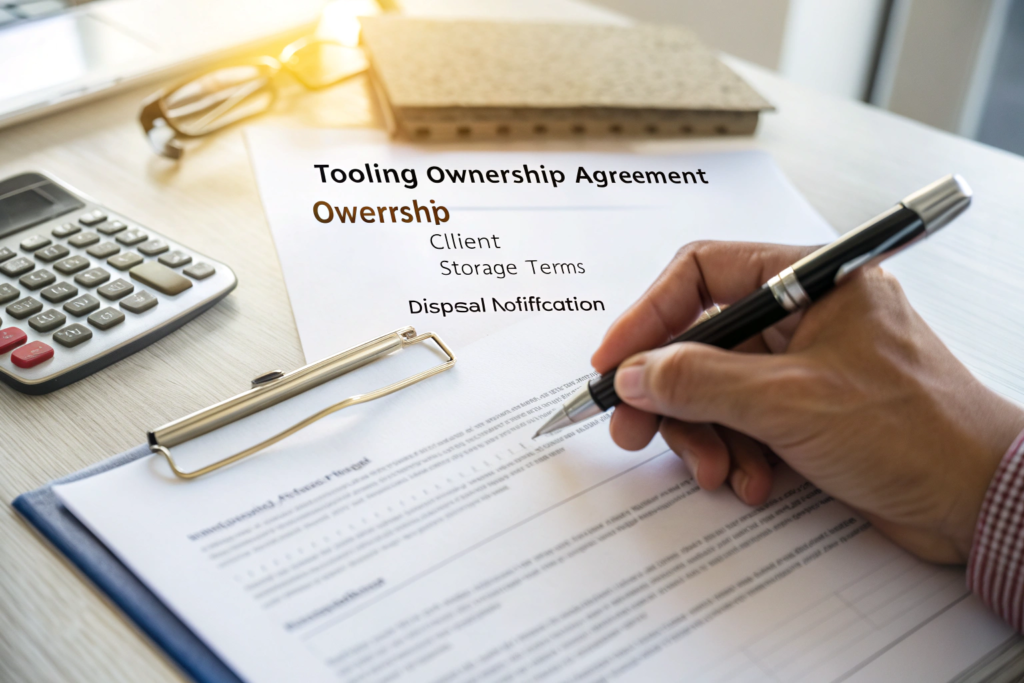
The single most important question about custom molds is not how long they are kept. It is who owns them. If the mold ownership is unclear, the storage duration and maintenance responsibility are unclear as well. A clear, written agreement that establishes you as the owner of the mold, defines the factory’s responsibilities as the custodian, and specifies the terms under which the mold may be disposed of is the foundation of mold asset protection.
Is the Mold Fee a Purchase or a Partial Amortization Charge?
When a factory quotes a mold fee, the commercial nature of that fee determines who owns the mold. There are two common models in the industry, and you must know which one applies to your transaction. In the direct purchase model, you pay the full cost of the mold design, material, machining, and trial. The mold belongs to you. The invoice states that the mold is client property. You have the right to take possession of the mold at any time, to transfer it to another factory, or to have it stored and maintained by the current factory under agreed terms.
In the partial amortization model, the factory charges you a reduced upfront mold fee, sometimes called a contribution or a setup charge, that covers only a portion of the mold cost. The factory recovers the remaining mold cost through a per-unit surcharge on your production orders over an agreed volume or time period. In this model, the mold may belong to the factory until the full cost is amortized, at which point ownership transfers to you, or the factory may retain permanent ownership and simply charge you a lower mold setup fee as an incentive for a long-term production commitment. The key is to know which model applies. Ask directly, "Does the mold fee I am paying represent the full cost of the mold, and do I own the mold outright upon payment?" A transparent factory answers this question clearly and documents the answer in the purchase agreement or a separate tooling ownership agreement.
I advise brand owners to opt for the direct purchase model whenever the budget allows. Full ownership gives you complete control over your production asset. You are not tied to a specific factory because they hold your mold and you have not yet met the amortization threshold. You can move the mold if the relationship sours or if you find a better production partner. Control over your tooling is control over your supply chain. Industry resources on mold ownership and intellectual property provide further context on how to structure these agreements to protect your interests.
What Happens to My Molds If I Decide to Switch Factories?
If you own your molds outright under a direct purchase agreement, they are your property, and you have the unconditional right to take physical possession of them at any time. You can instruct the factory to ship the molds to you, to another factory you designate, or to a third-party storage facility. The factory is obligated to release your property promptly upon your written instruction and upon settlement of any outstanding invoices for storage or production services.
The practical process of transferring molds requires some coordination. The factory prepares the molds for shipment. They are cleaned of any residual production material, coated with a rust-preventative oil or wrapped in VCI paper, and packed in a sturdy crate suitable for freight transport. The factory provides a packing list identifying each mold by its unique client code and description. You arrange the freight pickup or the factory arranges it at your cost. The molds ship to the destination you specify.
This right to transfer is the fundamental protection that full mold ownership provides. A brand owner who discovers that the factory has fallen below acceptable quality standards, or who simply finds a more competitive production partner, can exercise the transfer right and move production without losing the sunk investment in custom tooling. A brand owner who is in a partial amortization agreement where the mold is not yet fully owned does not have this same freedom. The transfer may not be permitted until the amortization threshold is met, or the factory may require payment of the unamortized balance before releasing the mold. This is a commercially reasonable position for the factory, but it is a restriction on the brand’s flexibility that should be understood and accepted at the time the agreement is signed.
How Are Molds Stored, Maintained, and Protected from Damage?
A metal mold is a precision tool. The mold cavity that forms your custom hair clip, your branded belt buckle, or your unique resin shape was machined to tolerances measured in microns. A mold that is poorly stored can develop surface rust, corrosion pitting, or physical damage from being knocked against other molds on a shelf. A damaged mold produces defective parts until it is repaired at significant cost or, in the worst case, replaced entirely at your expense. Proper storage and maintenance prevent this degradation.
What Environmental Controls Prevent Rust and Corrosion on Metal Molds?
The primary enemy of stored steel molds is moisture. Ambient humidity in the air condenses on the cold metal surface of the mold, causing oxidation. Over months and years, this oxidation progresses from a light surface bloom to deep pitting that destroys the surface finish of the mold cavity. A mold that produces a glossy, mirror-finish part today can produce a dull, textured part after a year of improper storage.
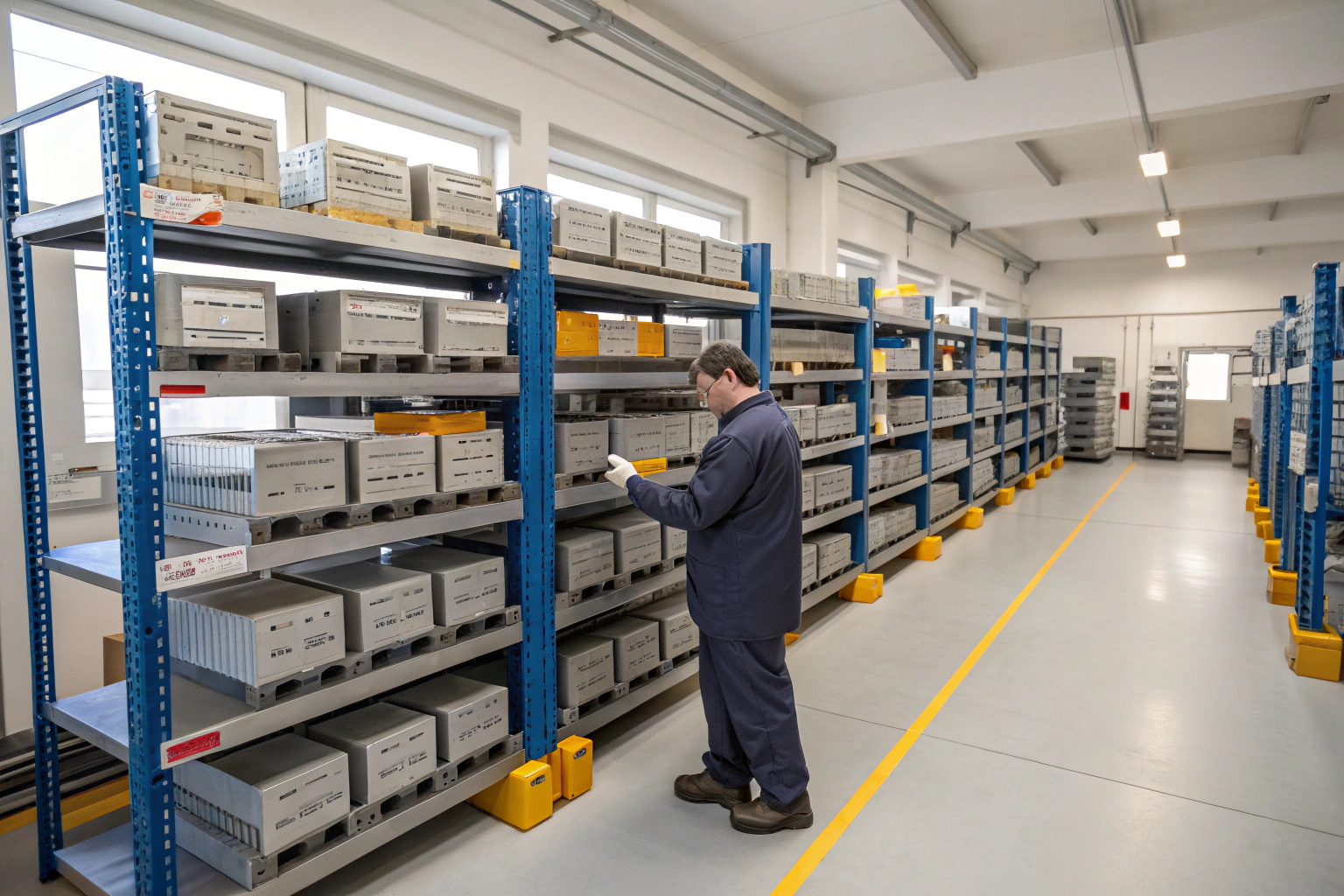
Our mold storage protocol controls the storage environment and applies direct surface protection. The mold storage area is a climate-controlled room where relative humidity is maintained below 50%. The temperature is stable to prevent condensation cycles that occur when warm, humid air contacts cold metal. Molds are stored on dedicated steel shelving units, not on the floor, not stacked on top of each other, and not in contact with any material that could transfer moisture or corrosive agents.
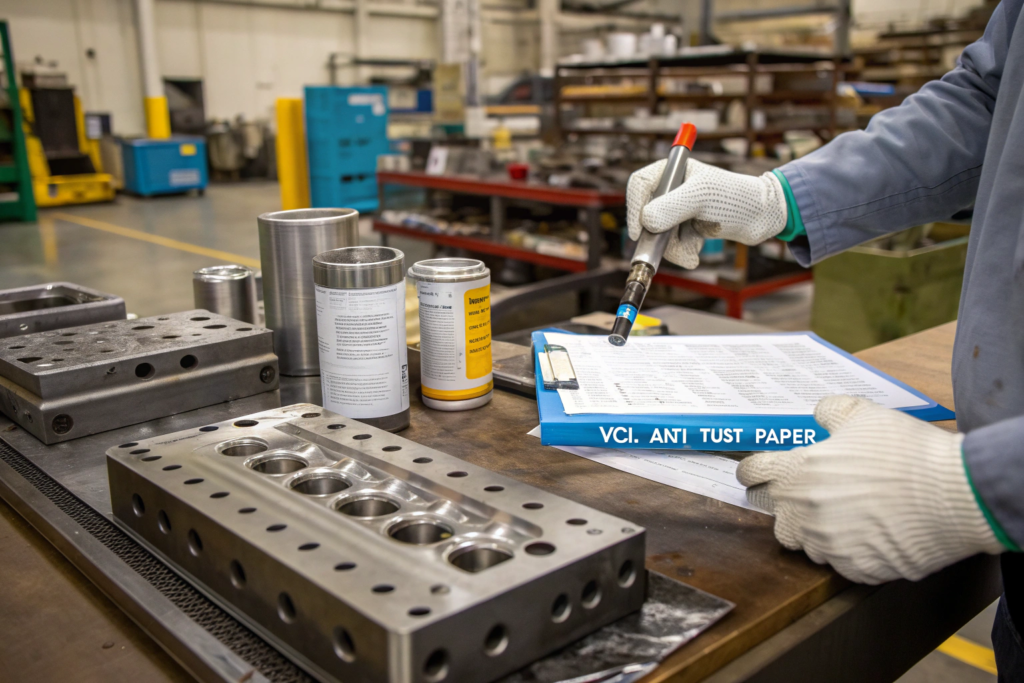
Each mold receives direct surface protection before being placed on the shelf. The mold cavity and all precision surfaces are coated with a thin layer of rust-preventative oil that displaces moisture and forms a protective film. The mold is then wrapped in volatile corrosion inhibitor paper, commonly called VCI paper, which releases a vapor that condenses on the metal surface and actively prevents oxidation. The wrapped mold is labeled with its unique client code, description, and date of last maintenance. These environmental controls and direct protection measures ensure that a mold stored for years is in production-ready condition when retrieved.
How Often Are Stored Molds Inspected and Serviced?
A mold placed on a shelf and forgotten for years is a mold that will have a problem when it is eventually retrieved. Regular inspection and preventative maintenance are part of the custody responsibility that a professional factory accepts. Our standard protocol includes an annual visual inspection of every mold in the storage inventory. The technician retrieves the mold, unwraps the VCI paper, inspects all surfaces for any sign of corrosion, staining, or physical damage, and documents the inspection in the mold maintenance log.
If any surface oxidation is detected, it is immediately removed with a non-abrasive cleaning compound, and the protective oil and VCI wrap are reapplied. If any mechanical components of the mold, such as ejector pins, slide mechanisms, or threaded inserts, show signs of stiffness or corrosion, they are disassembled, cleaned, lubricated, and reassembled. The maintenance action is recorded in the log with the date, the technician’s name, and a description of the work performed.
If a mold is brought out of storage for a production run, it undergoes a pre-production inspection before it is mounted on the machine. The technician confirms that all surfaces are clean and undamaged, that all moving components operate smoothly, and that the mold is dimensionally correct by molding a test shot and measuring the resulting part against the approved sample or tech pack. This pre-production inspection catches any issues that may have developed during storage and prevents them from contaminating the first production batch. At Shanghai Fumao, this mold custody and maintenance protocol is a documented, auditable part of our quality management system.
What Happens If Your Brand Pauses or Goes Dormant?
Life happens. Brands pause. Founders take breaks. A product line that sold well for two seasons is shelved while the brand owner focuses on a new category. In these situations, the custom molds that were built for the paused product line still exist, and the brand owner still owns them. A professional factory has a clear policy for managing dormant client assets and a commitment to communicating with the client before taking any action that would affect those assets.

What Is Our Notification Policy Before Disposal of Dormant Molds?
Storage space in a climate-controlled mold storage area is a finite and valuable resource. A factory cannot reasonably be expected to store every mold forever for every client who ever placed an order, regardless of whether the client is still active. A reasonable balance between the client’s property rights and the factory’s operational needs is established through a clear, communicated dormancy policy.
Our policy defines a dormant client as a client who has not placed a production order within a rolling two-year period. When a client approaches dormancy, typically at the 18-month mark since the last order, our project management team sends a friendly communication to the client’s last known email address. The communication reminds the client of the molds we are storing for them, confirms the current storage condition, and inquires whether the client anticipates any future production needs for those designs.
If the client reaches the full two-year dormancy threshold without placing an order, we send a formal notice informing the client that their molds are scheduled for disposal in 90 days. The notice provides a complete mold inventory list, the disposal date, and the options available to the client. The client can choose to place a new order, pay a nominal annual storage fee to extend the storage period, request that the molds be shipped to them at their cost, or authorize the disposal. If no response is received within the 90-day notice period, the molds are removed from storage and responsibly recycled as scrap metal. We never dispose of a client’s molds without this multi-stage notification process. The policy is documented in the tooling ownership agreement signed at the start of the relationship.
Can You Request Long-Term Storage Beyond the Standard Window?
Yes. If a brand owner knows in advance that a product line will be paused for an extended period, perhaps two or three years, and wants the assurance that the molds will be maintained and ready when the line is relaunched, we offer a long-term storage agreement. Under this agreement, the client pays a modest annual storage fee that covers the cost of the climate-controlled storage space, the annual inspection, and the re-application of protective treatments. The molds are maintained in production-ready condition indefinitely as long as the storage fee is current.
The long-term storage agreement is also appropriate for molds that represent a significant intellectual property investment and that the brand wants to protect against any risk of accidental disposal or damage. The storage fee is a small fraction of the original mold cost and is often a wise investment for a brand that has built its identity around a custom component shape or a unique hardware design. The storage agreement is a separate, simple addendum to the original tooling ownership agreement.
Conclusion
A professional factory keeps your custom molds and tooling as long as you remain an active client and communicates clearly with you well in advance of any decision to dispose of dormant assets. Your molds are your property. You paid for them under a direct purchase agreement. They are stored in a climate-controlled environment, protected with rust-preventative treatments and VCI wrap, and inspected annually to ensure they remain in production-ready condition. You have the right to take physical possession of your molds at any time and transfer them to another facility.
The foundation of this asset protection is a written tooling ownership agreement that states clearly that you own the molds, that defines the storage terms and the factory’s maintenance responsibilities, and that specifies the dormancy period and the notification process before disposal. A brand owner who signs such an agreement, and who keeps their contact information current with the factory, can be confident that their custom tooling investment is secure.
If you are considering a custom product development project that requires mold or tooling investment, or if you currently have molds at another factory and are unsure of their status or your ownership rights, contact our Business Director Elaine at elaine@fumaoclothing.com. She can provide a copy of our standard tooling ownership agreement for your review, discuss mold storage and maintenance practices in detail, and, if you wish, coordinate the transfer of your existing molds to our facility for inspection and ongoing custody. Your molds are a valuable business asset. They deserve to be protected as such.