
I received an inquiry last year from a designer in Brooklyn who had built her brand around small-batch, artisanally dyed silk accessories. She had been producing her scarves with a small studio in upstate New York, but her wholesale accounts were growing, and her domestic production cost was making her retail price uncompetitive. She wanted to move production to a factory in China, but she was skeptical. She believed the handmade, irregular beauty of tie-dye could not be replicated in a factory setting. I told her she was partly right. A standard cut-and-sew factory cannot do what she needed. But a factory with a dedicated handwork and dyeing atelier, one that employs skilled artisans who understand the specific binding, folding, and dyeing techniques, absolutely can. We started with a technique sample run, and within two months, she had a production partner who could match her studio’s quality at a cost that made her wholesale margins healthy.
You get a Chinese scarf supplier to produce high-quality tie-dye silk scarves by identifying a supplier who has a dedicated hand-dyeing department or a long-term partnership with a specialized dyeing atelier, not by asking a standard digital-print factory to add tie-dye to their list of services. True tie-dye is a manual, labor-intensive art. It involves binding, stitching, folding, or clamping fabric before immersing it in dye baths. The results are inherently variable and require an experienced eye to control. You must provide a very specific set of visual references, clearly defined tolerances for color and pattern variation, and a realistic understanding that no two scarves in a tie-dye production run will ever be perfectly identical. I will explain how to qualify a supplier for this specialized work, how to brief them on the exact technique you want, and how to structure the sampling and QC process to respect both the artisanal nature of the product and the commercial requirements of a saleable wholesale order.
What Tells You a Factory Can Truly Handle Hand-Dyeing Silk?
Tie-dye is not a single technique. It is a family of resist-dyeing methods, including traditional Chinese Zha Ran, Japanese Shibori, and Indian Bandhani, each producing entirely distinct visual effects. The supplier must demonstrate genuine familiarity with the specific technique you require, not just a generic ability to dip a twisted scarf into a bucket of color. You verify this by asking for technique-specific samples, by examining the physical evidence of their dyeing setup, and by understanding where true artisanal hand-dyeing fits within a modern factory structure.
Why Should You Ask for Technique-Specific, Not Just Product-Specific, Samples?
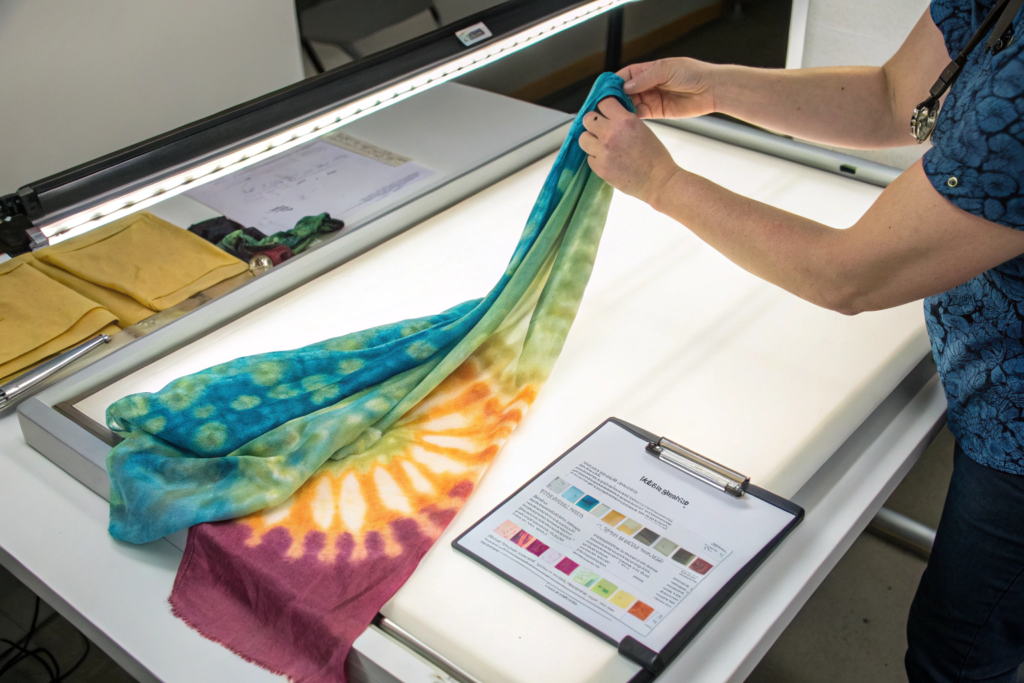
A product-specific sample shows that the factory can produce a scarf that looks generally like your mood board image. A technique-specific sample shows that the factory understands how to produce that exact visual effect. The difference is critical for tie-dye. A factory that produces a sample with a random crumple-dye effect may not be able to produce a specific Shibori Arashi, pole-wrapping, pattern with its characteristic diagonal, storm-like lines.
When you send your inquiry, specify the exact resist-dyeing technique you require. For instance, state whether you want "Shibori Itajime," a shape-resist technique created by folding the fabric and clamping it between wooden blocks. Ask for a "kanoko" sample, which involves binding hundreds of tiny points with thread to create a field of small, circular bursts. Request a traditional Chinese "Zha Ran" sample, where the silk is stitched in specific running lines and then pulled tightly to gather the fabric before dyeing, creating delicate, feathery patterns.
A supplier who genuinely understands these techniques will be able to discuss the specifics with you. They might explain that a particular pattern requires tightly twisted silk, not a loose silk charmeuse, to hold the resist effectively. They might note that certain dyes work better with specific binding threads to prevent wicking. A supplier who responds simply with "yes, we can do tie-dye" without asking clarifying questions about the technique is likely treating tie-dye as a generic coloring process, which will not deliver the specific, nuanced result your brand requires for the textiles used in these artisanal processes.
What Physical Signs in a Factory Indicate Real Dyeing Capability?
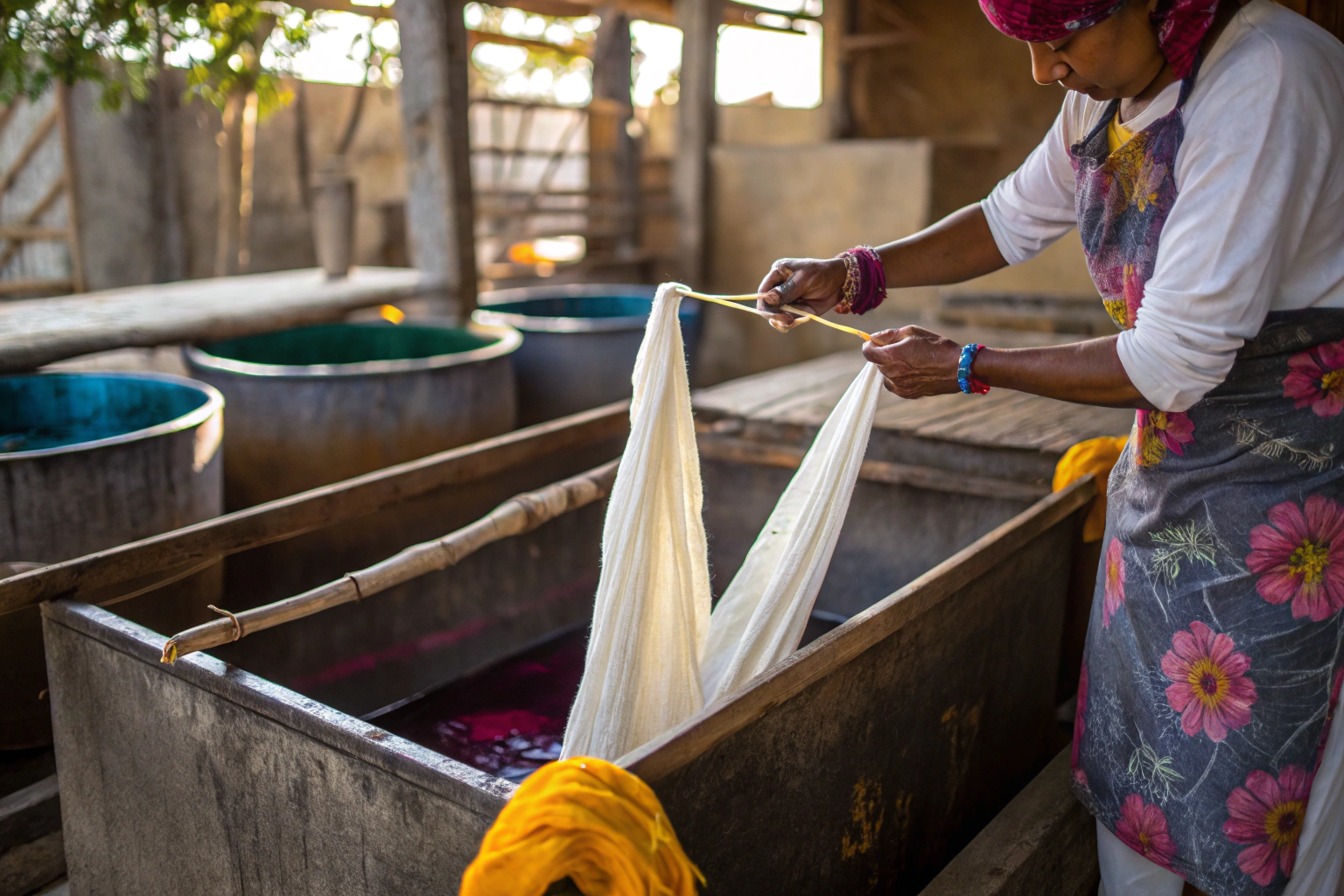
When you tour the factory or request a live video walkthrough, certain physical signs indicate a serious, capable wet-processing operation. Look for a dedicated, ventilated dyeing area. Silk dyeing with reactive or acid dyes requires controlled temperature water, stainless steel vats, and a clean rinse area. A dark, cramped corner with plastic buckets suggests an operation that does not prioritize environmental control or worker safety. Look for a secure storage area for chemicals. Professional textile dyes and fixatives must be stored in a ventilated, locked area with proper labeling and safety data sheets. A factory that cannot show you a compliant chemical storage setup is running an uncontrolled process with inconsistent results.
Observe the drying process. Silk scarves after dyeing must be dried in a clean, dust-free area, away from direct sunlight which can fade the fresh dye. The factory should have a designated drying room with hanging racks, not scarves draped over random equipment near a window. Inspect the washing and finishing area. Properly dyed silk goes through a thorough rinse to remove unfixed dye and then a finishing bath to restore the soft hand. If the factory’s washing setup looks like it would struggle with lint and hard water, the final silky texture will be compromised. Most importantly, look for the presence of skilled artisans. Hand-dyeing is not an automated process. You should see workers who are focused and precise, tying complex knots, folding fabric into geometric shapes, or carefully dipping bound silk bundles into vats. A factory with true hand-dyeing capability has a dedicated team in this department, staffed by workers whose hands move with the practiced ease of trained artisans. At AceAccessory, our specialty dyeing and handwork department is structured exactly this way, harmonizing skilled manual craft with modern factory standards for safety and quality control.
How Do You Brief a Supplier on Tie-Dye Patterns with Acceptable Variation?
The single biggest point of friction in tie-dye production is the definition of acceptable variation. A brand owner who has fallen in love with a single, specific scarf in an inspiration image may reject an entire production batch because the pattern in each scarf is not an exact replica of that one image. This breaks the fundamental nature of hand-dyeing. You must brief your supplier on the overall aesthetic, the color palette, the scale of the pattern, and the specific dye distribution boundaries that define the design as either a success or a failure.
What Is a Good Reference Sample Kit to Send for Clarification?
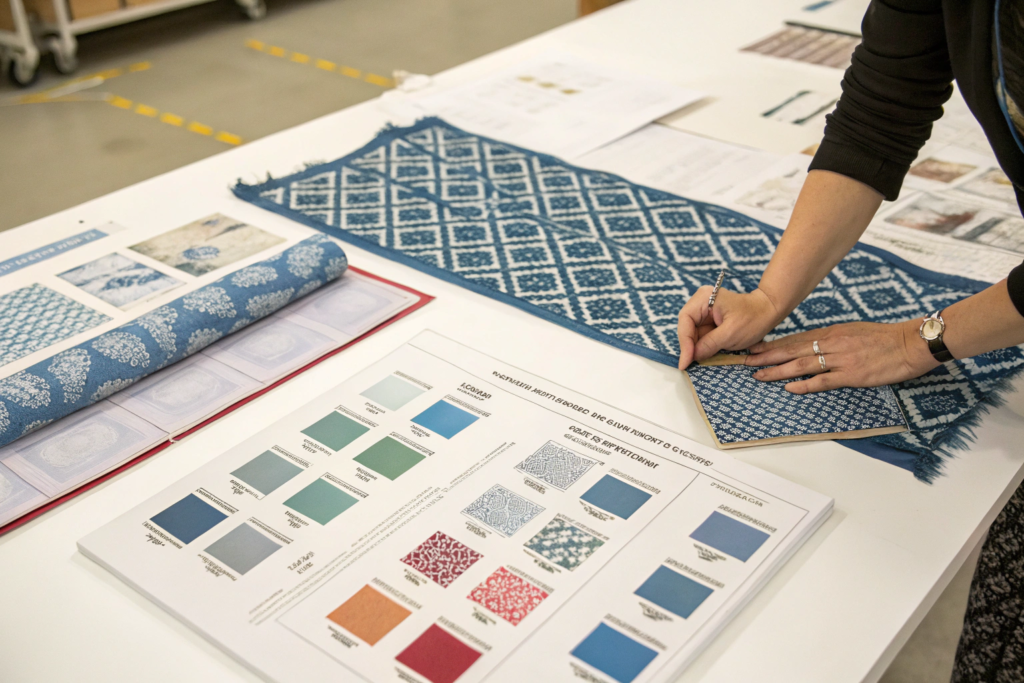
A physical reference sample kit removes the ambiguity of digital photos and written descriptions. The ideal kit includes a color target, such as a Pantone swatch or a physical, dyed silk swatch, for each color in the design. A pattern boundary reference is crucial. This should be a physical collection of small sample swatches, either produced by your previous supplier or sourced from the market, that clearly demonstrates the boundary of acceptable pattern morphology. For example, for a bandhani dot pattern, the boundary sample should show the maximum acceptable size of a dot, the minimum acceptable size, and the maximum acceptable irregularity of its shape. A silk fabric reference must specify the exact base silk, such as 8 momme or 12 momme silk habotai, 100% mulberry silk, with a specific finish you require, because the weave and weight of the silk dramatically affect dye absorption and the final look of the pattern.
An exclusive, absolute reject reference should also be included. This is a sample demonstrating a critical failure, such as unintended color bleeding beyond a certain distance from the resist point, harsh bleach spots, or an overall pattern scale that is completely unrecognizable. This gives the QC team a clear "never exceed" boundary. While photographs of these items are helpful, nothing replaces physical samples that can be compared side-by-side with production output under standardized lighting. If you are developing a new technique together, you can work with the factory’s sampling atelier to create this boundary kit collaboratively during the sampling phase.
Which Terminology Bridges the Gap Between Art Direction and Dye Chemistry?
Bridging the communication gap between an art director’s visual language and a dyer’s technical world requires precise, shared vocabulary. Vague terms like "watercolor," "sunset," or "organic" mean almost nothing to a technician. Define the terms you will both use. "Pattern scale" refers to the approximate size of the repeat or the primary motif, measured in centimeters, from 2cm dots to 15cm wide stripes. "Definition" clarifies whether the edges of the dyed areas should be sharp and crisp, softly blurred, or feathered and bleeding. "Saturation" specifies the color intensity at the deepest part of the dye application, rated as a percentage where 100% is the maximum dye uptake the silk can hold without excess unfixed dye.
"Penetration" is critical for folded or bound resist techniques. It communicates whether the dye should fully penetrate through all the inner folds of the wrapped fabric, creating an even color, or if it should only strike the outer surface, leaving the interior a paler shade or un-dyed for a more stark contrast. The final term to define is "base tone." The base silk tone can be left pristine white, given an overall pale base color before the resist is applied, or dyed a solid contrasting background color after the first tie-dye pattern is complete. Having a shared and specific vocabulary for these concepts avoids a situation where a supplier interprets your request for a "soft" look as a pale dye concentration, when you actually wanted a high-saturation look with soft, blurred edges. A professional dye house will work with you to translate your creative vision into these objective processing parameters.
What QC Standards Are Fair for an Artisanal, Variable Product?
Standard AQL quality control, where an inspector counts individual, objective defects like a loose thread or a missed stitch, does not fully apply to the aesthetic evaluation of a hand-dyed product. You need a two-part QC protocol that separates the objective quality of the scarf itself from the subjective aesthetic acceptance of its unique dye pattern. The scarf must first pass objective tests for silk quality, hem integrity, colorfastness, and dimensional accuracy. Then it must pass an aesthetic review against your boundary samples.
How Do You Define a Defect List for an Artisanal Process?
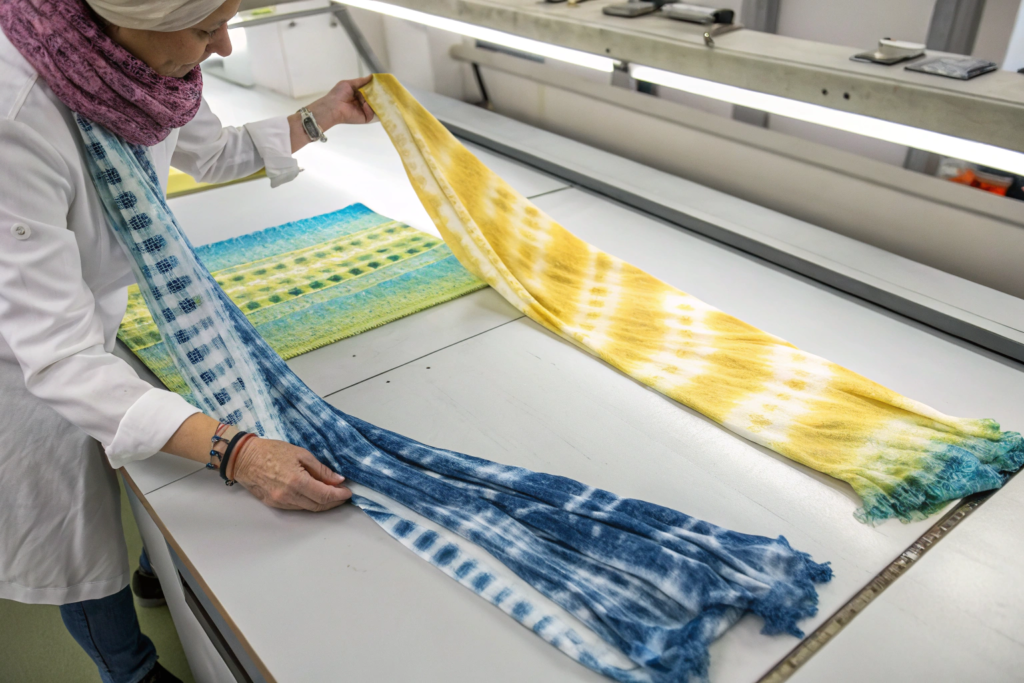
The objective defect list for a tie-dye silk scarf begins with the universal textile defects. Any hole, tear, pulled thread, or broken seam is a critical defect. Colorfastness is tested by rubbing a white cloth on the dyed silk, and any significant color transfer is a major defect. The hem must be invisibly hand-rolled, with consistent tension and no loose threads, and the scarf’s dimensions must be within the agreed tolerance of the tech pack.
The unique aesthetic defect list must be defined in reference to your boundary kit. A "blotch" or "stain" is defined as an unintended, irregular spot of color larger than a specific size, say 5mm in diameter, that is clearly not part of the resist pattern. A "pattern collapse" defect is recorded when an intended area of tight resist fails, and dye floods into it, losing the characteristic texture. An "under-dye" defect is when large, visible patches of the scarf show no dye at all, clearly outside the aesthetic intention of the particular technique.
Because each scarf is unique, 100% inspection by a trained QC worker who has the boundary kit in hand is the only way to assess the aesthetic component. This worker compares each opened scarf to the approved boundary references. If a scarf falls within the acceptable aesthetic range, it is passed. If it falls outside, it is designated a second-quality product. You and the supplier agree in advance what percentage of second-quality units, typically 5% to 10% for variable handwork, is factored into the production plan and cost. This is how we manage the balance between artisanal authenticity and commercial reliability at AceAccessory, by making every production batch include a small overrun to cover the expected number of aesthetic second-quality units.
How Can a "Digital Twin" or Pre-Production Reference Set Standardize the Look?
To make the aesthetic QC process more objective, you can create a "digital twin" or an approved physical reference set during the sampling phase. This involves working with the factory to produce a set of five to ten fully finished sample scarves that represent the deliberate, controlled variation you are seeking. These are not just production rejects. They are deliberately created to map the range of acceptable outcomes.
Working with the head dyer, you would create samples that show the pattern at its most "open" and loosely defined, at its most "tight" and concentrated, with the color dialed to the saturation boundaries, and with the registration slightly shifted. These become the approved "bookends" that visually map the acceptable range. The factory’s QC team can then compare every production scarf against this set of pre-approved references. If a finished scarf looks like it would belong in this specific family of samples, it passes. If it looks starkly different, as if it were made with a completely different formula or hand, it fails. This is an incredibly effective way to remove subjective arguments from the QC process and is exactly the type of collaborative development a specialized dye house excels at.
Conclusion
Getting a Chinese scarf supplier to produce beautiful tie-dye silk scarves is about finding a partner who respects the art of hand-dyeing, not just a factory that prints on fabric. You must qualify that partner deeply. Look for their ability to discuss specific, named resist techniques and the physical evidence of their dye-house capability, including ventilated vats, controlled drying, and skilled hands. You must brief them with immense precision. Go beyond a single mood image and provide a physical reference kit that explicitly maps the desired color, pattern scale, and crucially, the acceptable boundaries of variation.
The final and most important commercial step is to establish a QC standard that honors the unique, variable nature of the product while protecting your brand’s quality promise. A two-part QC protocol, a standard objective defect list combined with an aesthetic review against a pre-agreed boundary set, achieves this. When this entire system is in place, the result is not a cheap imitation of an artisanal product. It is a genuine, handcrafted item, produced at scale with commercial reliability.
If your brand is ready to develop a line of tie-dye silk scarves and you are looking for a factory partner with a dedicated, skilled hand-dyeing atelier, contact our Business Director Elaine at elaine@fumaoclothing.com. Send her your initial design concepts, your reference images, and your target retail price point. She can coordinate the critical first step: a technique-specific sample run crafted by our senior dyers, so you can hold the quality in your hands and know you have found your partner. The beauty of tie-dye deserves a factory that understands its soul.




