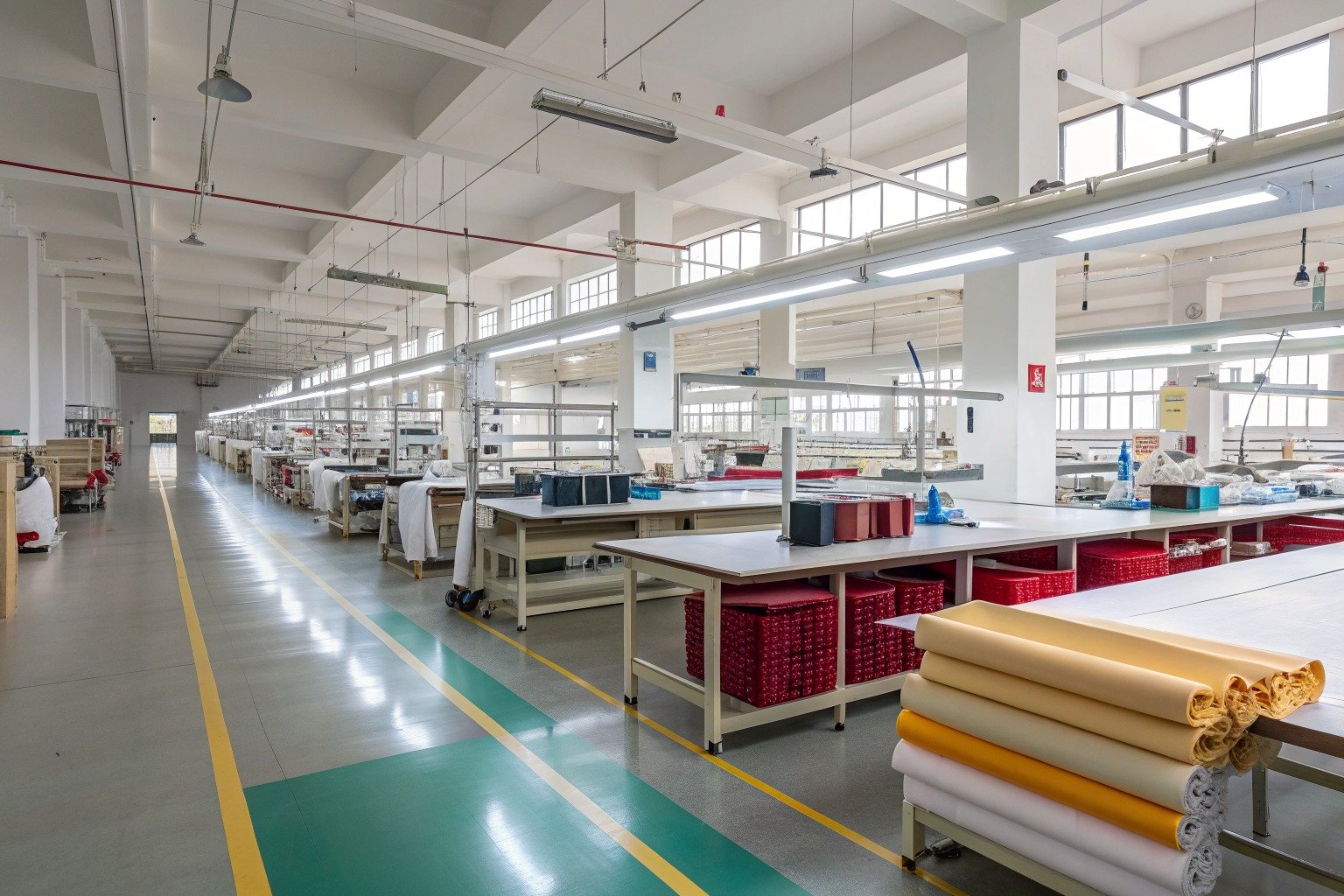
I received an email last month from a corporate gifting buyer who was frustrated. She had been sourcing custom branded tumblers for her company’s annual client appreciation event. She had asked five different suppliers for a price quote, and she had received five different formats back. One was a single number in the body of an email. One was a formal quotation with two line items, unit price and shipping. One had a mold fee listed but no explanation of whether it was a one-time charge or a per-order charge. She could not compare the quotes because she did not know what was included in each number, and she did not know what questions to ask to get the information she needed. I walked her through the cost components of a custom cup order, helped her create a simple request format that she sent to all five suppliers, and within three days she had quotes she could actually compare on an apples-to-apples basis.
You get a meaningful price breakdown for a custom cup order by requesting a structured quotation that separates the cost into distinct, labeled categories. You need the unit price for the blank cup itself, the decoration cost per unit and any associated setup fees, the packaging cost per unit, the mold or tooling fee if a custom shape is required, and the freight and logistics estimate. A supplier who provides a single all-in price without this breakdown is either bundling costs in a way that makes true comparison impossible, or is not willing to be transparent about where your money is going. I will explain each cost component, how it varies with material, decoration method, and order quantity, and how to structure your request so you get back the information you need to make a sourcing decision.
What Are the Core Cost Components of a Custom Cup Order?
A custom cup is not a single-cost item. It is an assembly of components and processes, each with its own cost driver. Understanding what these components are and how they behave at different order quantities is the foundation of getting and understanding a meaningful price quote. A supplier who cannot or will not separate these cost elements is either inexperienced at professional quoting or is deliberately hiding a cost item that may surface later.
How Do Blank Cup Costs Vary by Material: Plastic, Stainless Steel, and Ceramic?
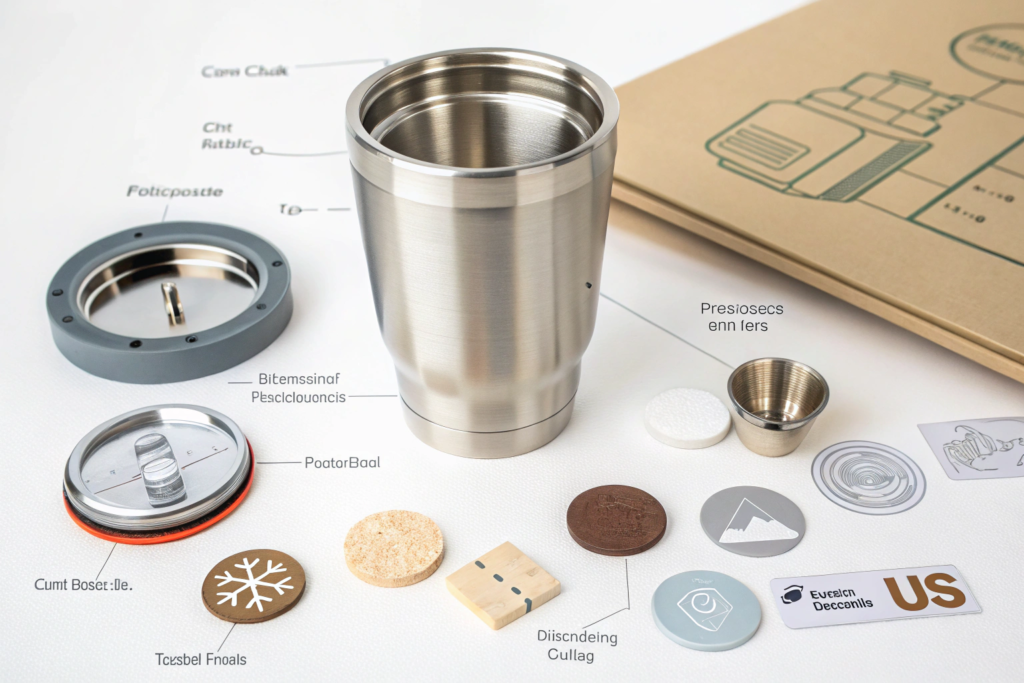
The blank cup is the undecorated base product before any customization is applied. It is the single largest cost component of a custom cup order, and its cost depends primarily on the material, the manufacturing process, and the country of origin. The blank cup cost is what the supplier pays their cup manufacturer for the undecorated vessel, plus any inbound freight and quality inspection cost.
Stainless steel tumblers are the premium-priced blank category. The raw material cost of stainless steel is higher than plastic or ceramic. The manufacturing process, which involves deep drawing a steel sheet into a cup shape, welding the seam, polishing the surface, and applying any base coating, is capital-intensive. A double-wall vacuum-insulated stainless steel tumbler costs significantly more than a single-wall uninsulated steel cup. The vacuum insulation process adds manufacturing steps and quality control checks that increase the blank cost.
Plastic cups, including acrylic, Tritan, and polycarbonate, are the mid-to-lower-priced blank category. The blank cost depends on the plastic resin type. Tritan, a high-clarity, BPA-free copolyester, is more expensive than standard acrylic or polycarbonate. The manufacturing process is injection molding or extrusion blow molding, both of which are efficient at high volumes. Plastic cups are lighter than stainless steel or ceramic, which reduces freight cost, a secondary benefit that affects the total landed cost.
Ceramic mugs are in the lower-to-mid-priced blank category. The raw materials, clay and glaze, are inexpensive. The manufacturing process involves slip casting or jiggering the clay body, bisque firing, glazing, and glaze firing. The energy cost for the two kiln firings is the primary driver of ceramic blank cost. Ceramic mugs are heavier than plastic or steel, which increases freight cost. The trade-off is that the blank cost is low, but the freight cost per unit is higher, and the breakage rate in transit, typically 1% to 3% and accounted for in the packing cost, is a factor not present with metal or plastic.
The blank cup cost is volume-sensitive. The supplier’s cost for the blank is lower when they purchase it from the cup manufacturer in quantities of 5,000 or 10,000 units than in quantities of 500. A transparent supplier will show you how the blank cost tiers down with increasing order quantity, so you can make an informed decision about the order size that balances your inventory budget with your unit cost target. You can refer to general sourcing guides for promotional products to understand common material markups and standard blank cost ranges for drinkware categories.
What Decoration Methods Drive Different Printing and Setup Costs?
Decoration is the customization that transforms a blank cup into your branded product. The decoration cost has two components. The setup or screen charge, which is a one-time fee per color or per design element, and the running cost, which is the per-unit cost to apply the decoration to each cup. Different decoration methods have different setup and running cost profiles.
Screen printing is the most common decoration method for cylindrical cups, particularly plastic and stainless steel. A screen is fabricated for each color in the design. The setup charge covers the screen fabrication, the color matching, and the press setup. The per-unit running cost is low. Screen printing is economical for medium to large quantities, typically 500 units and above. The setup charge is amortized over the order quantity, so the per-unit decoration cost decreases as the quantity increases. For a simple one-color logo on 1,000 cups, screen printing is the cost-effective choice.
Pad printing uses a silicone pad to transfer ink from an etched plate onto the cup surface. It is suitable for irregular surfaces and for smaller decoration areas. Pad printing setup costs are lower than screen printing for small designs, but the per-unit running cost is higher. It is suitable for small to medium quantities or for designs with fine detail that screen printing cannot achieve on a curved surface.
Laser engraving uses a laser beam to etch the design directly into the cup surface. There is no ink and no consumable screen or pad. The setup cost is essentially zero. A digital file is loaded into the laser software, and the laser engraves the design. The per-unit running cost is higher than screen printing for large quantities because the laser engraving cycle time is slower than the screen printing press cycle. Laser engraving is ideal for small quantities, for personalized individual names or numbers, and for stainless steel cups where the laser removes the surface coating to reveal the bare steel underneath, creating a permanent, high-contrast mark.
Wrap or full-color digital printing produces photographic-quality, full-color graphics on the entire cup surface. The setup cost is zero for the decoration itself, though there may be a design file preparation fee. The per-unit running cost is higher than spot-color screen printing. Digital wrap printing is appropriate for complex, multi-color designs, for photographic images, and for small to medium quantities where the screen printing setup charges for multiple colors would be disproportionate.
How Should You Structure a Quote Request to Get Comparable Responses?
The quality of the quote you receive is directly determined by the quality of the request you send. A vague request sent to five suppliers will produce five incomparable quotes, each with different assumptions about the product specification, the decoration method, the packaging, and the included and excluded costs. A structured request that specifies the exact information you need and the exact format in which you want it received will produce quotes you can compare side by side and evaluate objectively.

What Specific Information Should You Include in an RFQ for Cups?
A complete request for quotation for custom cups includes the product specification, the decoration specification, the packaging specification, the quantity and delivery information, and a clear request for the cost breakdown structure. Sending this information in a standardized format to all suppliers saves you hours of follow-up clarification.
The product specification should state the cup type, such as stainless steel tumbler, ceramic mug, or Tritan water bottle. You should include the desired capacity in ounces or milliliters. The product dimensions, height and diameter, should be provided if you have a specific size requirement. The material and finish, such as double-wall vacuum insulated with a matte powder coat or high-gloss clear coat, should be clearly stated. The color of the cup itself must be specified. If you want a rose gold vacuum tumbler, say so. If you are open to the supplier’s stock color recommendations, say that too. A reference image or a link to a similar product helps eliminate ambiguity.
The decoration specification should state the decoration method if you have a preference, or describe the design so the supplier can recommend the appropriate method. Provide the number of colors in the design, the approximate decoration size in inches or centimeters, and the decoration location or locations on the cup, such as front, back, wrap, or bottom. Attach your artwork file if it is ready, or describe the artwork and note that final artwork will be provided upon order confirmation.
The packaging specification should state whether you want an individual gift box, a bulk pack for event distribution, or a specific retail-ready package. If you have a packaging design, provide it. The quantity and delivery information should state the total order quantity and whether there are multiple colorways or designs. If you want pricing for multiple quantity tiers to evaluate volume trade-offs, request pricing at specific tiers, such as 500, 1,000, and 2,500 units. Provide the delivery address, the requested in-hands date, and the preferred shipping method if known.
How Do You Ask for a Cost-Per-Phase Breakdown Without Sounding Confrontational?
Some buyers worry that asking for a detailed cost breakdown will annoy the supplier or make them seem difficult. This is the wrong mindset. A professional supplier expects a professional buyer to request a detailed quote. The request is not confrontational. It is a signal that you are a serious, experienced buyer who understands the cost structure of the product and is evaluating suppliers on a complete, comparable basis.
Frame the request positively and collaboratively. A sample request language that I use and recommend to my clients is: "Please provide your quotation in the following format so I can compare it accurately with other quotes I am reviewing. Blank cup unit cost, decoration setup charges listed per color, decoration running cost per unit, packaging cost per unit broken out by packaging type, any one-time tooling or mold fees clearly identified, and estimated freight cost to the specified destination address. Please also note whether the mold fee is refundable against future orders or is a one-time sunk cost." This language is clear, professional, and communicates that you are an organized buyer who values transparency.
A supplier who pushes back, who insists on providing only a single all-in price, or who says their costs are confidential, is either unable to break down their costs because they are a trading company that does not control the production process, or is unwilling to be transparent because they are embedding hidden fees. A supplier who responds to a structured RFQ with the requested format within a reasonable timeframe is a supplier who is organized, transparent, and treats quoting as a professional business process. At AceAccessory, we respond to structured RFQs with structured quotes because we want our clients to understand exactly what they are paying for.
How Do Mold Fees and Setup Charges Work for Custom Shaped Cups?
If your custom cup design requires a shape that is not available from the supplier’s stock blank catalog, a custom mold is required. A mold fee is a one-time charge for the design and fabrication of the tooling that will produce your cup’s specific shape. This fee is separate from the per-unit cup cost and is a significant upfront investment that should be clearly understood before committing to a custom shape design.
What Is the Difference Between a One-Time Mold Fee and a Recurring Charge?
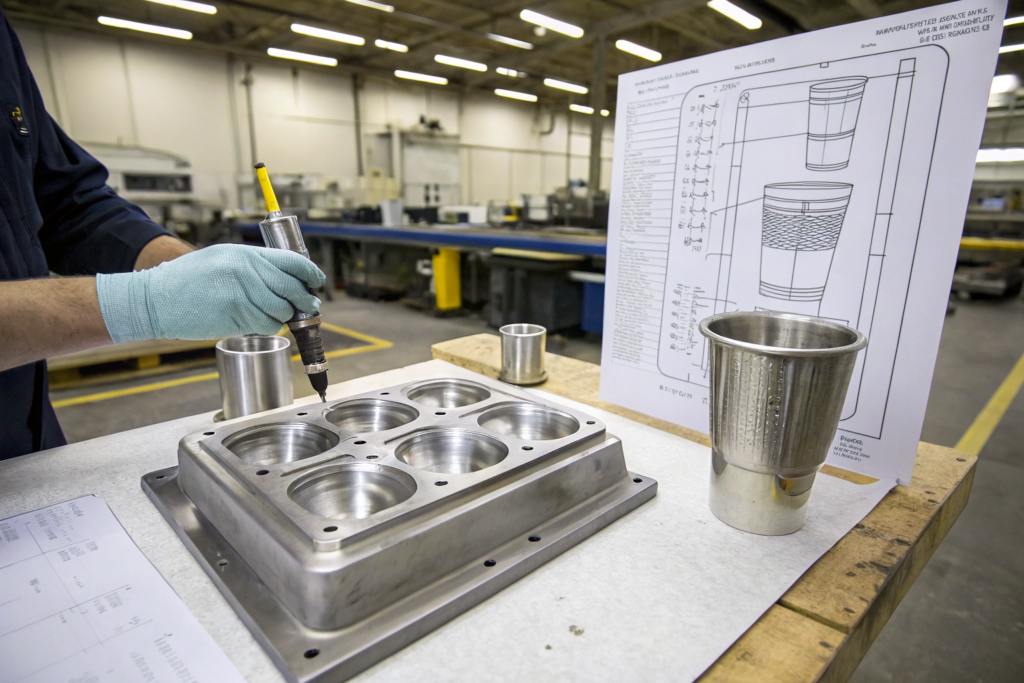
A mold fee is the cost to design, machine, and polish the steel or aluminum mold that will form the cup shape. For a stainless steel tumbler, the mold is used in the deep drawing or hydroforming process that shapes the flat steel sheet into the cup profile. For a plastic cup, the mold is used in the injection molding process. For a uniquely shaped ceramic mug, the mold is the plaster form used in the slip casting process.
A legitimate mold fee is a one-time charge. You pay it once, and the mold belongs to you. The mold is stored at the factory and maintained for use exclusively on your production orders. The mold has a usable lifespan, typically tens of thousands to hundreds of thousands of cycles depending on the material and process, and the mold cost should be amortized over the total quantity of cups you expect to order over that lifespan.
Some suppliers quote a mold fee but then add a recurring amortization charge to every production order. This is not inherently illegitimate, but it must be disclosed. If the supplier quotes a low upfront mold fee but plans to recoup the remaining mold cost through a per-unit surcharge on every reorder, you need to know the total cost of the mold over your expected order volume to compare it accurately against a supplier who quotes a higher upfront fee with no recurring charge. Ask directly whether the mold fee quoted is the complete, one-time cost for the mold, or whether there is an additional per-unit charge on each order. Ask for the mold lifespan and the expected number of cycles. Ask whether the mold fee is refundable, partially or in full, after a specified volume of orders is reached.
For complex custom shapes that may require design iteration, ask whether the mold fee includes one round of adjustments based on the first sample, or whether each adjustment round will incur an additional charge. Mold development for a custom shape often requires a sample round, a feedback round, and a mold adjustment before the production mold is approved. A transparent supplier clarifies the mold development process and the associated costs upfront. Industry references on injection molding cost structures can provide general context for what drives mold costs in plastic production, and similar principles apply to metal forming and ceramic casting.
How Are Screen Printing and Engraving Plate Fees Structured?
Decoration setup charges, often called screen charges or plate charges, are the setup costs for the decoration process. These charges are not the same as a custom shape mold fee. They are specific to the decoration and are generally charged per design and per order, though some suppliers roll the setup charge into the per-unit running cost for large orders.
A screen charge for screen printing covers the cost of coating a mesh screen with emulsion, exposing the design onto the screen, and developing it. Each color in the design requires its own screen, and each screen incurs a setup charge. A one-color logo has one screen charge. A four-color design has four screen charges. The screen charge is typically a flat fee per screen, and the screen can be reused for reorders of the same design. Ask whether the screen is stored and available for reorders at no additional charge, or whether a new screen fee applies to each reorder.
An engraving plate fee for pad printing covers the cost of etching the design into the metal printing plate. Like a screen charge, it is a one-time fee per design, and the plate can be reused for reorders. A laser engraving setup charge covers the programming time to convert your artwork into the laser engraving file and to test the engraving parameters on a sample cup. Laser engraving does not have a plate or screen, so the setup charge is a programming labor fee, not a physical material fee. A digital wrap printing setup charge covers the time to prepare the artwork file for the wrap printing process and to print a color proof for your approval.
Conclusion
Getting a meaningful price breakdown for a custom cup order is a matter of asking for the right information in the right format from the start. The core cost components are the blank cup unit cost, which varies significantly by material and insulation type, the decoration setup and running costs, which vary by decoration method and number of colors, the packaging cost per unit, which varies by packaging format, and any one-time fees such as custom shape molds or decoration screens.
A structured RFQ that specifies the product, decoration, packaging, quantity, and delivery details, and that explicitly requests the cost breakdown in the format you need, produces comparable quotes that you can evaluate objectively. A supplier who responds to a structured RFQ with a structured quote in a reasonable timeframe is demonstrating the transparency and professionalism that underpin a trustworthy sourcing relationship.
If you are ready to request a price breakdown for a custom cup order, or if you have received quotes from other suppliers and want a comparative quote structured for easy comparison, contact our Business Director Elaine at elaine@fumaoclothing.com. Send her your product specification, your decoration details, your packaging preferences, and your target quantity and delivery date. She can provide a structured cost breakdown that separates the blank cost, the decoration cost, the packaging cost, and any applicable mold or setup fees, so you can see exactly where your investment is going and make an informed decision.