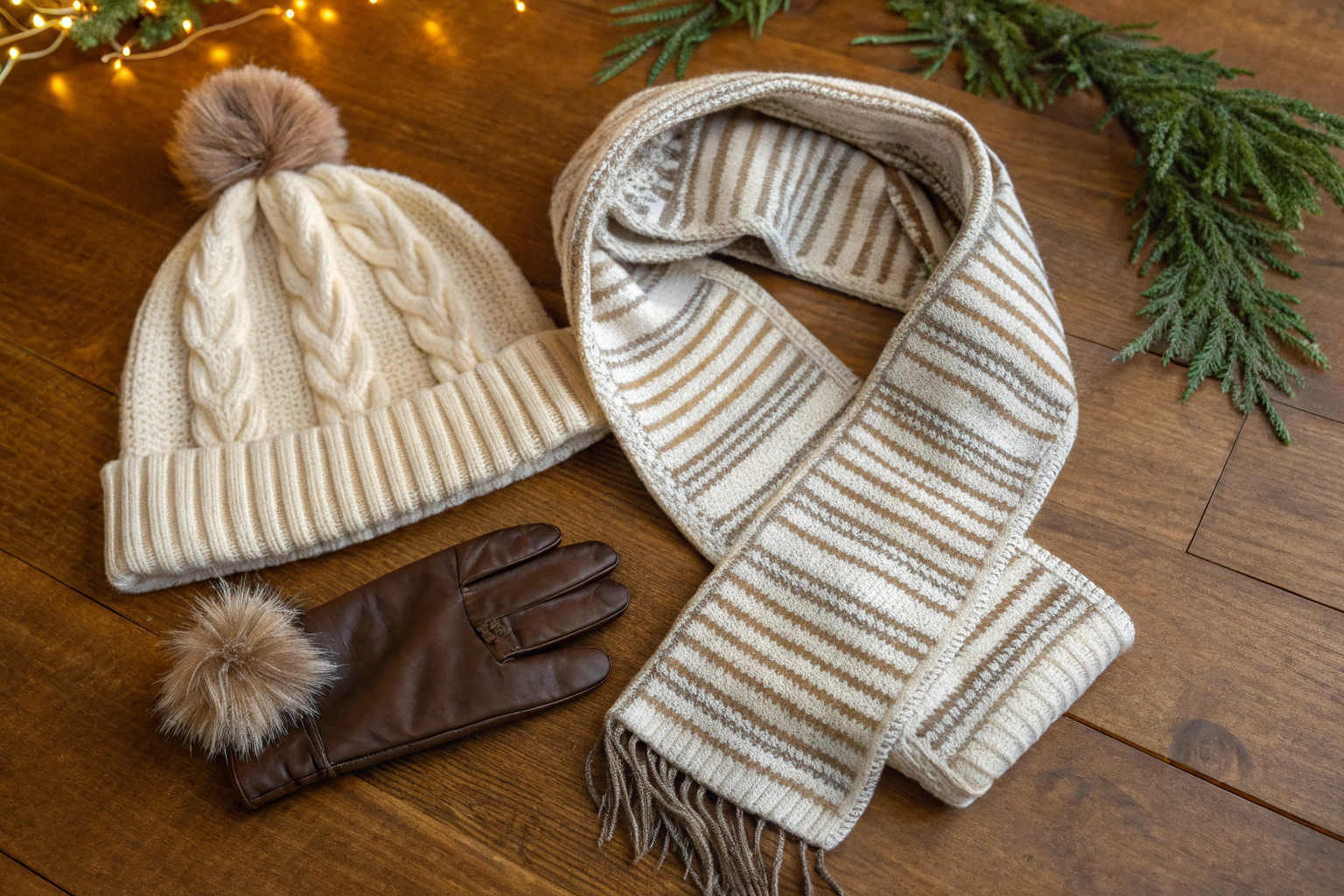
A buyer from a department store chain in Canada once visited our showroom specifically looking for gift sets. She had data showing that her highest margin winter accessory sales came not from individual pieces, but from coordinated sets that solved a gifting problem for her customers. The challenge was consistency. She had tried sourcing sets from two separate factories, one for the hats and one for the scarves, and the color matching was always slightly off. The yarn dye lots did not align, and the packaging did not feel like a unified product. She asked me if one factory could manage the entire set from raw yarn to finished, packaged product, ensuring that the hat was the same color, texture, and quality tier as the scarf that accompanied it. I told her we could, and that season her coordinated gift set became one of the top-performing SKUs in her accessories department.
Yes, AceAccessory can produce matching sets of hats and scarves entirely within our own production facility. We control the yarn sourcing, the color dyeing, the knitting, the finishing, and the packaging under one roof. This vertical integration means the beanie on your retail shelf and the scarf folded next to it are made from the same yarn lot. They share the same color consistency. They carry the same hand feel. They are finished and packaged as a deliberate, designed pair, not as two separately sourced items that happen to be sold together. I will explain how we maintain color and material consistency across product categories, what set configurations are most common, how packaging and branding turn two items into one gift-ready product, and how the production and pricing work when you order sets instead of individual pieces.
What Is the Key to Achieving Perfect Color Consistency Between Hats and Scarves?
The single biggest complaint about matching accessory sets is that they do not actually match. The hat is a slightly warmer beige than the scarf. The scarf is a slightly more muted navy than the hat. These mismatches happen because the two items were produced from different dye lots, sometimes from different yarn suppliers, and were never physically brought together at the same inspection point. Solving this problem requires a factory that controls the yarn supply and the dyeing process centrally and that inspects the two items together as a set before they are packaged. This is not a difficult problem to solve technically, but it requires an operational discipline that a factory producing only hats or only scarves cannot provide.
How Do You Control Yarn Dye Lots Across Different Knit Structures?
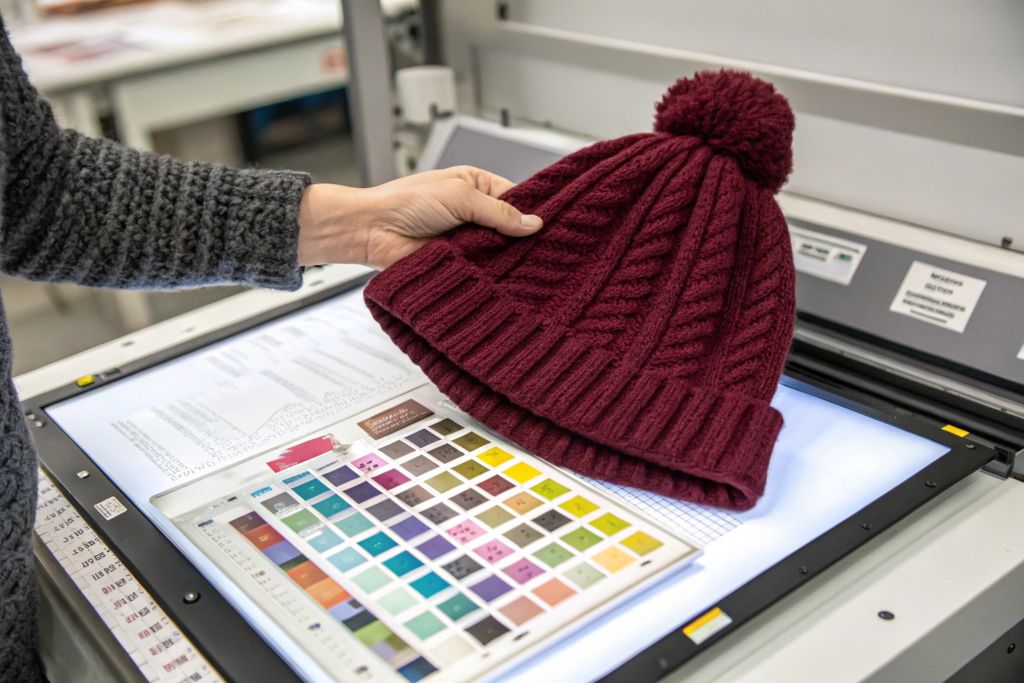
A beanie and a scarf made from the same yarn color will not necessarily look like the same color to the human eye if the knit structures are different. A chunky cable-knit beanie creates deep shadows between the cable ridges, which makes the color appear darker and richer. A fine-gauge, flat-knit scarf in the same yarn reflects light more evenly and appears lighter and more uniform. This is not a dye lot problem. It is an optical effect of the knit structure, and the only way to manage it is to have a development team that understands textile optics and deliberately compensates for structural color shift.
The solution begins at the yarn specification stage. When a matching set is ordered, our development team reviews the knit structures for the hat and the scarf together, before yarn dyeing begins. If the scarf uses a finer gauge than the hat, we may specify a slightly deeper dye concentration for the scarf yarn to compensate for the lightening effect of the flat surface. If the hat uses a heavy, textured stitch that creates shadow, the dye concentration may be adjusted to compensate for the darkening effect of the texture.
The adjustment is not guesswork. We knit a small swatch of each proposed structure in the lab dye batch, compare the two swatches side by side under standardized D65 lighting, and measure the color difference with a spectrophotometer. The Delta E value between the two structures is calculated. If the Delta E is above the commercially acceptable threshold, the dye formulation is adjusted, and new swatches are knit and re-measured. This process, called structural color compensation, is a standard part of our development workflow for matching sets. It is not an extra service. It is the core competency that makes a matching set a genuinely matched product.
Beyond the structural compensation, the fundamental requirement is that both the hat yarn and the scarf yarn come from the same master dye lot. We order yarn from our spinners and dyers in quantities that cover the total yarn requirement for the full set order, including both product categories and accounting for knitting waste. The yarn for the hats and the yarn for the scarves are dyed together in a single dye batch, or are assembled from a single master lot, so there is zero dye lot variation between the two products. This level of material planning is only possible when one production team controls the entire order. For more information on color measurement standards used in textile production, you can reference the spectrophotometer technology that professional color labs use to ensure objective accuracy.
What Finishing Techniques Ensure a Consistent Hand Feel Across Sets?
Color is the visual match. Hand feel is the tactile match. A beanie that feels soft, plush, and cozy must be paired with a scarf that feels equally soft, plush, and cozy, or the set feels inconsistent to the customer who touches both items before purchasing. The finishing processes that determine hand feel include washing, softening treatments, brushing, and steaming.
These finishing processes affect hats and scarves differently because of their different geometries and knit densities. A beanie is a shaped, three-dimensional garment that is finished on a blocking form. A scarf is a flat, two-dimensional rectangle that is finished on a flat steaming table. The finishing temperature, the duration of steam exposure, and the application of softeners must be calibrated to produce an equivalent hand feel on two different product forms.
Our finishing team develops a paired finishing specification for each matching set. The specification details the exact finishing process for the hat component and the exact finishing process for the scarf component, and it includes a tactile approval check where a QC inspector handles both items together and confirms that they feel like the same quality tier. If the scarf feels slightly stiffer than the hat after the first finishing trial, the scarf finishing process is adjusted. It might receive an additional wash cycle or a slightly higher softener concentration. The hat and the scarf are only approved for packaging when both the color and the hand feel have been confirmed as a match through objective measurement and subjective tactile evaluation. This paired finishing discipline is another capability that an integrated factory like AceAccessory can provide because both products are finished in the same facility by the same team.
What Are the Most Popular Matching Set Configurations for Wholesale?
The matching set category is not limited to a single silhouette. Different retail channels and different customer demographics prefer different configurations. Understanding which combinations are volume drivers for which channels helps you structure your set assortment to match your distribution strategy.
Why Are Knit Beanie and Infinity Scarf Combinations Trending for Gifting?
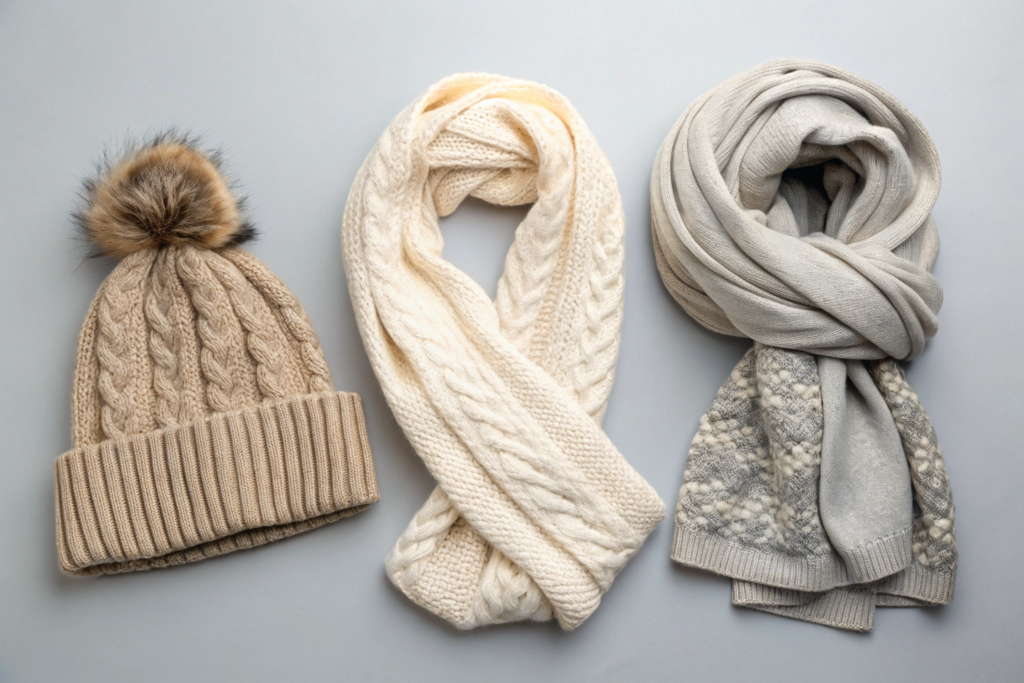
The beanie and infinity scarf set has become the dominant configuration in the mid-tier gift market for several specific reasons. The infinity scarf, a continuous loop with no loose ends, is perceived as modern, easy to wear, and universally flattering. It requires no styling skill. The customer simply loops it around the neck once or twice, and it looks finished. This ease of use makes it a safe gift choice. The giver does not need to know the recipient’s scarf-tying ability or preference.
From a production perspective, the infinity scarf is efficient to knit as a seamless tube on circular knitting machines, which aligns well with the production capabilities of a factory that also knits beanies, which are also circular knit tubes. The yarn consumption for an infinity scarf is economical compared to a long, fringed wrap scarf. This keeps the set retail price point accessible. The combination provides a strong perceived value because the customer sees two substantial, gift-boxed pieces for a price that feels reasonable.
The gift packaging for a beanie and infinity scarf set is also straightforward. Both items fold compactly and fit neatly into a standard gift box size. The pom-pom detail on the beanie adds visual excitement to the open-box presentation, and the matching infinity scarf provides the functional substance. For a department store buyer planning a holiday gift program, or for a boutique owner curating a winter gift display, this configuration consistently outperforms other permutations in sell-through data.
How Do Lightweight Travel Sets Differ Structurally from Winter Cold-Weather Sets?
Lightweight travel sets respond to a different customer need. The customer is not bracing against a freezing wind. The customer is on an airplane, walking through an airport terminal, or experiencing a cool evening on a spring or fall trip. The set must be light, packable, and breathable, while still providing a coordinated, put-together appearance.
The most common lightweight travel set configuration pairs a fine-gauge slouchy beanie with a matching rectangular wrap scarf or an extra-long, narrow stole. The yarn choice is typically a lightweight blend such as modal and cashmere, fine merino wool, or a linen and cotton blend for warm-weather travel. The knit structure is a fine gauge, often a simple stockinette with ribbed edges, which creates a fabric that drapes beautifully around the neck without bulk.
Structurally, the travel scarf is usually finished with simple, clean edges rather than heavy fringe. Fringe adds weight, adds bulk when packed, and tends to become untidy in a travel bag. A fine rolled hem or a narrow ribbed edge gives the travel scarf a refined, minimal look that matches the light, unstructured feel of the slouchy beanie. The travel set is often packaged in a reusable travel pouch, which can be the same fabric as the set itself, adding a functional third piece to the set that reinforces the travel-oriented brand positioning.
How Does Packaging Transform Two Products into One Gift-Ready Set?
Two separate accessories become one gift-ready product through the packaging. The packaging is the customer’s first physical interaction with the set, and it must communicate that this is a deliberate, curated gift, not two randomly paired items someone threw into a box. The packaging design, the structural format, the attached branding, and the interior presentation all contribute to the perceived value of the set and justify a higher retail price point than the sum of the two individual items sold separately.
What Gift Box Options Add Perceived Value Without Excessive Cost?
The packaging cost for a matching set should be proportional to the retail price point and the brand positioning. The goal is to add perceived value that the customer is willing to pay for, not to consume margin with excessive packaging cost. Several gift box formats achieve this balance effectively.
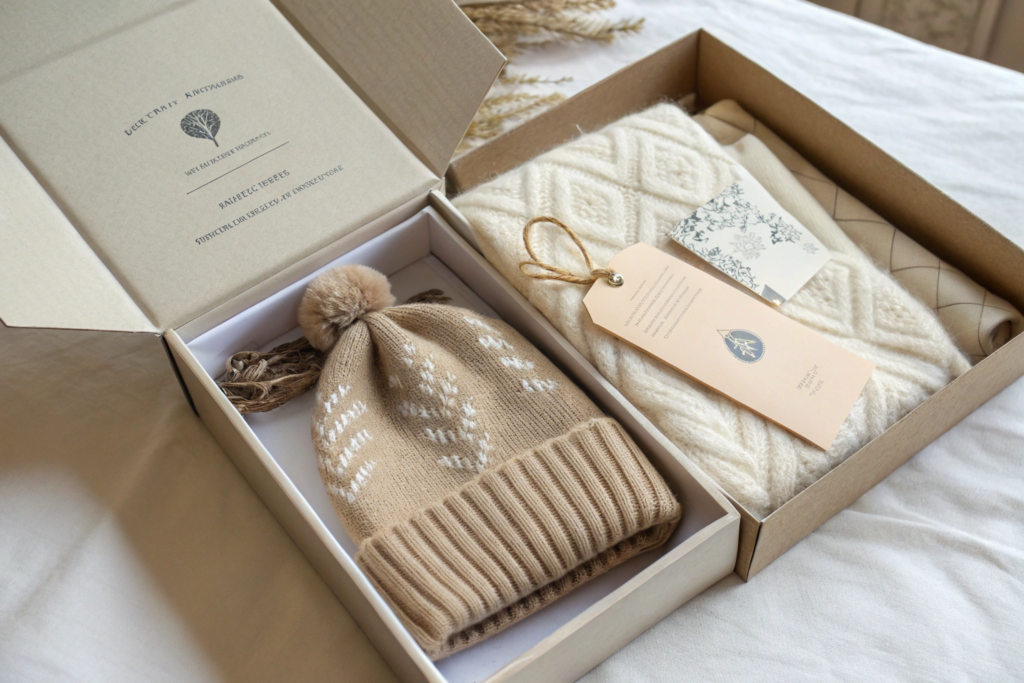
A rigid magnetic closure box with a soft-touch matte laminate finish is the premium standard for sets retailing in the $50 to $120 range. The box feels substantial and expensive in the customer’s hand. The magnetic closure provides a satisfying opening experience. The soft-touch finish communicates luxury. The box is reusable, adding post-purchase value as the customer uses it to store jewelry, accessories, or keepsakes. The cost per box is higher than simpler options, but the retail price premium the box supports typically more than covers the incremental packaging cost.
For sets retailing in the $25 to $50 range, a custom-printed folding carton with a ribbon belly band or a sleeve wrap is a cost-effective alternative. The box is printed with the brand’s design and secured with a removable ribbon band. The opening experience is simpler but still intentional, and the printed box communicates branded quality. For value-tier sets retailing under $25, a clear-front header card with a Euro slot for peg hook display, or a simple kraft gift bag with a branded tag, is appropriate. The set is visible to the customer, the branding is communicated on the card or tag, and the packaging cost is minimal.
The common requirement across all these packaging tiers is that the set is presented as a single unit. The hat and the scarf are displayed together inside the packaging. They are not individually bagged and simply placed in the same shipping carton. The packaging physically unifies the two products into one gift product. This unification is the packaging’s primary job.
How Should Care Labels and Branding Be Unified Across the Set?
A matching set must have consistent care labels and branding. A customer who buys a set and discovers that the hat care label says "Hand wash cold, lay flat to dry" and the scarf care label says "Dry clean only" is confused and frustrated. The two items are sold together. Their care requirements should be identical, or the differing care instructions should be explicitly explained on a unified set care card.
We produce matching sets with a unified care strategy. The yarn and the finishing processes for both items are selected so that the care instructions are the same. A single care card, printed and inserted in the set packaging, provides the care instructions for the complete set. The individual items may have a small care label sewn into the seam as required by retail regulation, but the consumer-facing care guidance is the unified set card.
Branding is also unified. The hangtag attached to the set presents the brand identity once, not twice. A single hangtag on the set provides the brand name, the set name, the fiber content, the care instructions, and the barcode. The individual items may have a small, discreet branded tab or label sewn into an interior seam, but the primary brand presentation is the set hangtag. This approach reinforces that the set is a single product with a single brand story, and it reduces the redundancy, and the cost, of attaching a full-branded hangtag to each individual piece. At AceAccessory, our packaging development team works with you to design the unified hangtag and care card for your matching set, ensuring the graphic design, the material choices, and the information content align with your brand standards and your retail channel requirements.
Conclusion
Producing matching sets of hats and scarves is a capability that flows directly from vertical integration. When yarn sourcing, dyeing, knitting, finishing, and packaging are all managed within a single factory, the color consistency, the texture consistency, and the unified presentation that define a successful matching set are natural outputs of the production process, not heroic efforts to coordinate between two separate suppliers. The yarn for both items comes from the same dye lot. The finishing processes are calibrated to produce equivalent hand feel. The QC inspection evaluates the items together as a set under standardized lighting with spectrophotometer verification.
The set configuration options range from the volume-driving beanie and infinity scarf combination for the gift market, to the lightweight travel beanie and wrap scarf combination for the resort and travel channel, to custom combinations defined by your brand’s seasonal collection theme. The packing transforms two separate accessories into a single, gift-ready product through a unified box, hangtag, and care card that present the set as a deliberate, curated offer, not two items that happen to share a carton.
If your brand is planning a winter accessories collection and you want to include matching hat and scarf sets that are controlled for color, texture, and packaging quality from a single production source, contact our Business Director Elaine at elaine@fumaoclothing.com. Send her your design concept, your target retail price point, and your packaging preferences. She can provide a set development proposal that includes yarn recommendations, a matched color and finishing specification, packaging samples, and a production timeline that delivers your sets ready for retail display. A truly matched set is not assembled. It is manufactured as a set from the first yarn specification to the final QC check.