
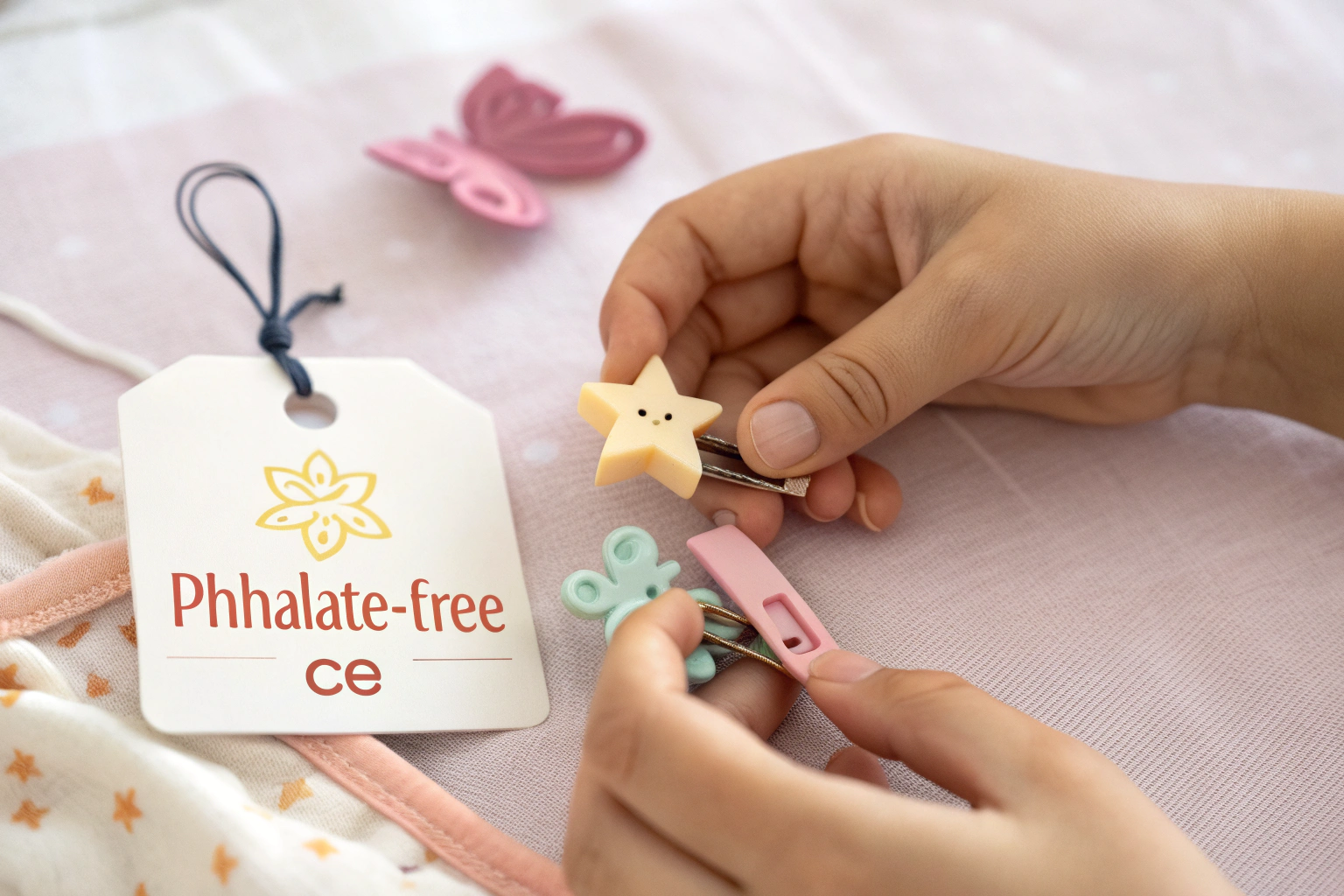
I received an urgent email last spring from a brand owner in Copenhagen who designs premium children’s hair accessories. She had been selling her clips through a major European department store chain for two seasons when the chain’s compliance department issued a new vendor mandate. Every hair clip, regardless of material or price point, had to be accompanied by a phthalate-free certification from an accredited laboratory, or the product would be removed from shelves. She was panicked because her existing supplier in another province of China had never provided any chemical compliance documentation, and when she asked, they sent her a one-line email saying, yes, our products are safe, no problem. That answer was not remotely sufficient for a European retailer with legal obligations under REACH. We had her clip material tested at an independent lab within two weeks, delivered the phthalate-free certificate, and her shelf space was secured.
European brands require phthalate-free hair clips for children because European Union regulations, specifically the REACH regulation, restrict the use of certain phthalates in products that come into contact with children. Phthalates are a group of chemical plasticizers used to make plastic and resin materials soft and flexible. In children’s products that can be mouthed, chewed, or held against the skin for extended periods, phthalates can migrate out of the material and into the child’s body. The EU has determined that certain phthalates are toxic to reproduction and may disrupt the endocrine system, and has therefore restricted their use in childcare articles and toys at concentrations above 0.1% by weight of the plasticized material. A hair clip worn by a child is a childcare article under EU law, and any phthalate-containing components, the resin body of the clip, the soft grip on the metal spring, the decorative charm, can render the product non-compliant and illegal for sale in the European market. I will explain exactly what phthalates are, which ones are restricted, how compliance is tested and documented, and why working with a factory that understands these requirements from material sourcing to finished product certification is essential.
What Are Phthalates and Why Are They Restricted in Children’s Products?
Phthalates are not a single substance. They are a family of chemical compounds used primarily as plasticizers, additives that make rigid plastic polymers soft, flexible, and elastic. In the context of hair accessories, phthalates are most commonly found in soft PVC components, in flexible resin formulations, in rubberized grip coatings on metal clips, and in certain adhesives and decorative elements. A hair clip made from untreated rigid polypropylene or unplasticized acrylic does not typically contain phthalates because no flexibility modifier is needed. The risk arises in materials that are intentionally softened, colored with certain pigment carriers, or produced using a cheaper polymer blend that incorporates recycled or lower-cost plasticized material.

Which Specific Phthalates Are Banned by EU REACH Regulations?
The EU REACH regulation, specifically Annex XVII, restricts the use of six specific phthalates in toys and childcare articles. The original three restricted phthalates are DEHP, di(2-ethylhexyl) phthalate, DBP, dibutyl phthalate, and BBP, benzyl butyl phthalate. These three are classified as toxic to reproduction and are restricted at a concentration limit of 0.1% by weight of the plasticized material, individually or in combination. Three additional phthalates were added later, DINP, diisononyl phthalate, DIDP, diisodecyl phthalate, and DNOP, di-n-octyl phthalate. These three are restricted under the same 0.1% concentration limit in toys and childcare articles that can be placed in the mouth by children.
For children’s hair clips, the key regulatory question is whether the product qualifies as a childcare article. Under REACH, a childcare article is any product intended to facilitate sleep, relaxation, hygiene, the feeding of children, or sucking on the part of children. Hair accessories worn by children are widely interpreted by European enforcement authorities and by the major European testing laboratories as falling within the scope of childcare articles, particularly if the clips are sized, designed, decorated, or marketed for children under the age of 14. The conservative and prudent interpretation adopted by all major European retailers is that children’s hair accessories are childcare articles and must comply with the phthalate restrictions.
This conservative interpretation is driven by liability considerations. A retailer that sells a children’s hair clip later found to contain restricted phthalates faces product recall costs, potential fines from national enforcement authorities, and brand reputational damage. The cost of compliance testing is a fraction of the cost of a single recall event. The detailed REACH restricted substances list maintained by the European Chemicals Agency provides the definitive regulatory text and is the reference that European retailers’ compliance departments use to enforce their vendor requirements.
How Do Phthalates Enter the Hair Clip Supply Chain Unexpectedly?
Phthalates are not deliberately added to hair accessories by brands or by responsible factories. They enter the supply chain through the raw material stream, often without the downstream manufacturer’s knowledge. This is the hidden risk that makes a factory’s material sourcing discipline the critical compliance factor. A resin compounder who supplies the raw resin pellets to the clip molding factory may use a phthalate plasticizer in their resin formulation to reduce cost or to improve the flow characteristics of the material during injection molding. The clip factory buys the resin as a generic material, relying on the compounder’s representation that the material is suitable for consumer products, without independently verifying the chemical composition.
Recycled plastic content is a second contamination pathway. Phthalate-containing PVC or other plasticized materials enter the recycling stream through post-consumer or post-industrial waste. If a factory uses recycled resin or buys from a compounder who incorporates recycled content, phthalates from the original plasticized material can contaminate the entire batch. A clip marketed as eco-friendly because it contains recycled content may, paradoxically, carry a higher phthalate risk than a virgin resin clip if the recycling stream is not carefully controlled and tested.
A third pathway is through imported components. A metal hair clip spring that is coated with a soft, rubberized grip material for comfort may use a phthalate-softened PVC for that grip coating. The spring is a small component, but it is part of the finished childcare article and must comply. A decorative charm, bead, or appliqué sourced from a third-party trim supplier may contain phthalate-softened materials. The factory that assembles the final clip is legally responsible for the compliance of every component, whether produced in-house or sourced from a subcontractor. A factory that does not require and verify phthalate-free certification from every component supplier is accepting unknown and potentially catastrophic compliance risk.
What Lab Tests Are Required for Phthalate-Free Certification?
Phthalate testing is a laboratory procedure, not a visual inspection. A factory cannot look at a resin clip and know whether it contains phthalates. The test must be performed by an accredited third-party laboratory using standardized analytical methods. A self-declaration from the factory or from the resin supplier, unsupported by a valid lab test report from an ISO 17025 accredited laboratory, is not adequate for European retailer compliance. The retailer’s compliance department will require the actual test report with the lab’s accreditation number, the test method, and the quantified results for each restricted phthalate.
How Does EN 14372 and Solvent Extraction Testing Work?
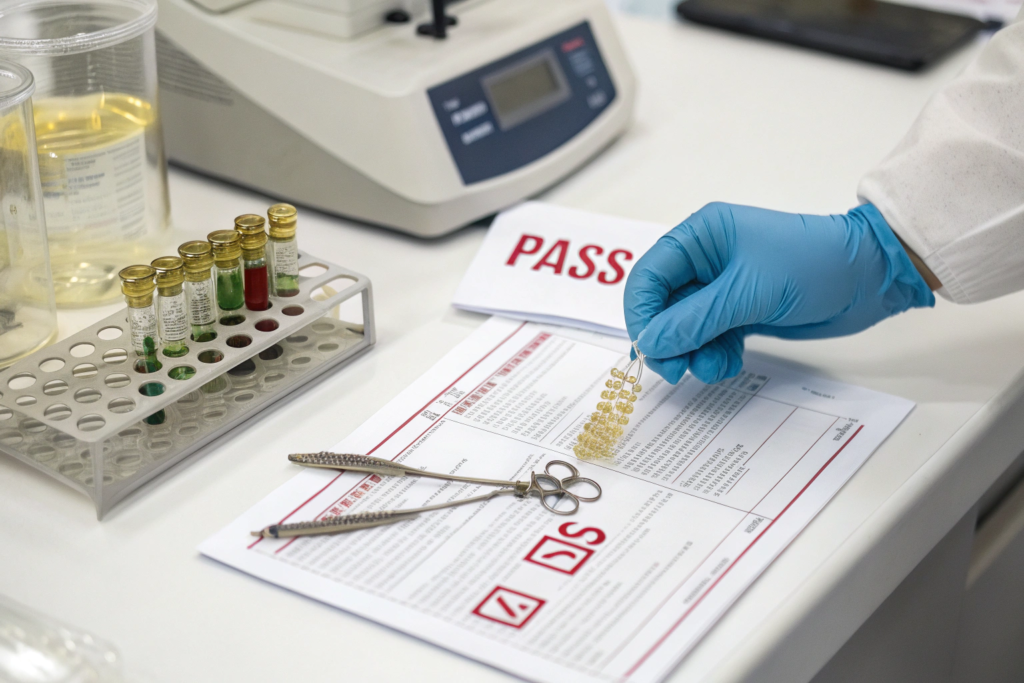
The standard test method for phthalates in childcare articles is specified in the European standard EN 14372. The test procedure involves cutting the product into its individual material components, because different materials in the same product may have different phthalate profiles. Each different plasticized material is tested separately. The resin clip body is one sample. The soft grip coating on the spring is a separate sample. A decorative PVC charm is a separate sample.
The laboratory extracts the phthalates from each material sample using a solvent, typically in a Soxhlet extraction apparatus, which continuously washes the material sample with hot solvent over several hours, drawing out the phthalate plasticizers into the solvent. The resulting solvent extract is then analyzed using gas chromatography-mass spectrometry, GC-MS, which separates, identifies, and quantifies each individual phthalate compound. The results are reported in milligrams of each phthalate per kilogram of material, which converts to the 0.1% by weight, or 1,000 mg/kg, regulatory threshold.
For a children’s hair clip to pass the test and be certified phthalate-free, the concentration of each of the six restricted phthalates must be below 1,000 mg/kg, or 0.1%, in each tested material component. A result of "not detected" or below the reporting limit, which is typically well below the regulatory threshold for accredited labs, is the ideal outcome. A result showing a detectable quantity below 1,000 mg/kg is technically compliant, but a result showing any concentration above the threshold fails the test and renders the product non-compliant for the European market.
The test report must be issued by a laboratory accredited to ISO 17025, which is the international standard for testing laboratory competence. The report should state the laboratory’s accreditation body and accreditation number. Major European retailers typically maintain a list of accepted laboratories, which often includes internationally recognized names such as SGS, Intertek, Bureau Veritas, and TÜV. A test report from an unaccredited laboratory or from a laboratory not on the retailer’s approved list may be rejected, requiring re-testing at additional cost and delay. Reference to EU phthalate testing standards provides the regulatory context and test methodology detail that informs certification requirements.
What Documentation Do European Retailers Actually Require at the Vendor Level?
The test report is the foundation, but it is only one part of the compliance documentation package that European retailers require. The full package typically includes the test report for the specific product or for the specific material formulation used in the product, clearly identifying the product by style number, SKU, or material code. A declaration of conformity, a document signed by an authorized representative of the manufacturer or importer, stating that the product complies with all applicable REACH restrictions and that the test report supports this declaration. A technical file that includes the product specification, the bill of materials identifying each material component, and the test reports for each plasticized material component.
For ongoing production, the retailer may also require a compliance continuity plan that describes how the factory ensures that the materials used in production are the same materials that were tested, and that no substitution or reformulation occurs without re-testing. This plan typically includes incoming material verification procedures, periodic re-testing schedules, often annually or upon any change in material source, and a supplier audit program for raw material suppliers.
It is the importer’s legal responsibility, meaning the brand or the retailer placing the product on the European market, not the Chinese factory. However, the importer depends on the factory for the test reports and the material traceability that support the importer’s legal obligations. A factory that cannot provide this documentation in a timely, organized, and technically accurate manner is not a viable supplier for the European children’s accessory market, regardless of how beautiful its products or competitive its prices. At AceAccessory, we maintain a phthalate-free compliance documentation file for every children’s product we produce. When a new European retail client requests compliance documents, we can provide the full package, the test report, the declaration of conformity, and the material traceability records, within one business day.
How Does a Factory Guarantee Ongoing Phthalate-Free Production?
A one-time phthalate test on a single sample proves that a specific batch of material was compliant on the day of that test. It does not prove that the material being used in production six months later, from a different resin supplier delivery, is also compliant. Ongoing compliance requires a material management system that controls the incoming material stream, verifies the compliance of each new material lot, and prevents substitution or contamination. A factory that treats the test report as a static certificate rather than a living compliance process is a source of undisclosed risk.
What Incoming Material Control Procedures Prevent Contamination?
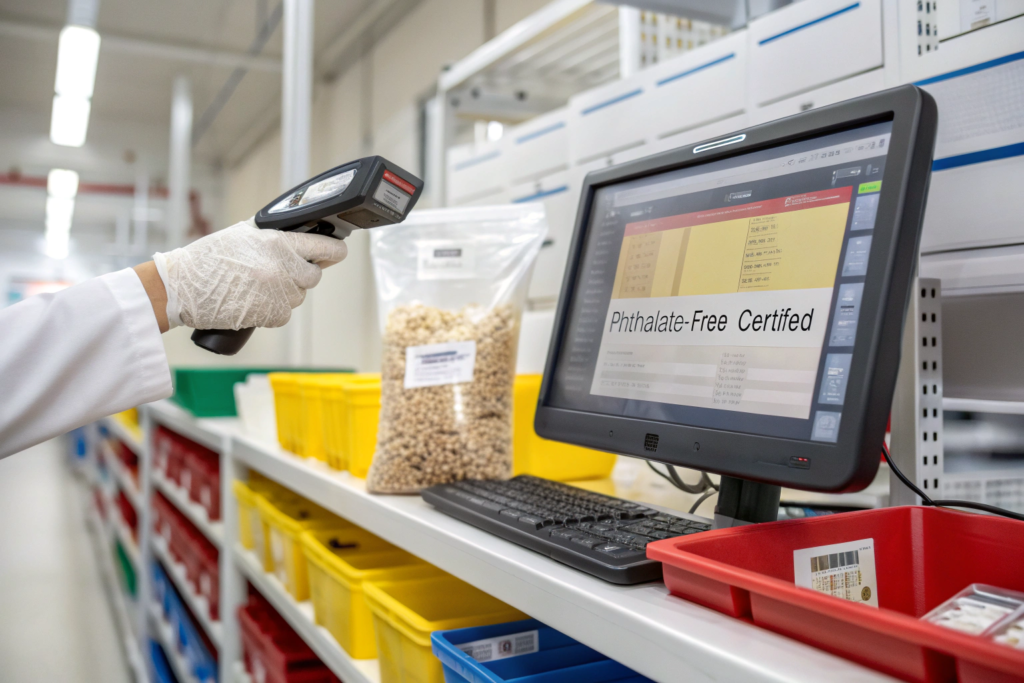
The incoming material control procedure is the first and most important line of defense against phthalate contamination. Every shipment of resin, every delivery of plastic components, every batch of adhesive or coating material that could potentially contain phthalates is quarantined upon arrival and not released to production until its compliance status is verified. The procedure operates on the principle of positive release. Material is assumed non-compliant until proven compliant.
The verification process begins with a certificate of analysis or a material specification sheet from the supplier, which states the chemical composition and confirms the absence of restricted phthalates. This supplier documentation is necessary but not sufficient. The factory maintains a library of third-party test reports for each material formulation from each supplier, with the test reports updated on a defined schedule, typically annually or upon any change in supplier, material formulation, or production process. An incoming material log records each delivery by supplier, lot number, date, and quantity. The log links each material lot to the valid compliance test report on file.
Random re-testing of incoming materials is conducted on a sampling basis, where the factory periodically sends a sample from a newly received material lot to an independent laboratory for phthalate screening, even if the supplier documentation is current. This re-testing serves as a verification of the supplier’s ongoing compliance and catches any drift or undisclosed reformulation. A material lot that fails the re-test triggers a rejection of the entire lot, a supplier corrective action request, and a temporary halt on that supplier’s material until the root cause is identified and corrected. These chemical compliance management principles provide a framework for designing a material control system that meets the expectations of European retail compliance auditors.
How Are Production Batches Traceable Back to Material Lots?
Traceability is the ability to trace a specific finished product unit back through the production process to the specific lots of raw materials from which it was made. In a recall scenario, traceability determines whether the recall is limited to a single production batch or must extend to every unit produced over a longer period. A factory with poor traceability must take the conservative approach and recall all units. A factory with excellent traceability can isolate the recall to the specific batches that used the non-compliant material, saving the brand from a larger recall scope.
The traceability system begins with material lot coding. Each delivery of resin or other plastic material receives a unique lot number upon receipt. When the material is moved from quarantine to the production line, the lot number is recorded on the production work order. The work order becomes the link between the specific material lots and the specific production batch. Each production batch of finished clips receives a unique batch code. The batch code is printed on the product packaging, on the carton label, and recorded in the finished goods inventory system.
If a phthalate test of a finished production batch reveals a failure, the batch code is entered into the traceability system, and the system identifies the specific incoming material lots that were used in that production batch. All other production batches that used the same material lots are immediately identified and quarantined. The recall is precisely targeted, and the financial and reputational damage is minimized. The material lot codes, the production work orders, and the finished goods batch codes are all documented in the technical file and are available for review by the retailer’s compliance auditor during a factory audit.
Conclusion
European brands require phthalate-free hair clips for children because EU law requires it, European retailers enforce it, and the health of the children who wear the products depends on it. The six phthalates restricted under REACH, DEHP, DBP, BBP, DINP, DIDP, and DNOP, are limited to a concentration of 0.1% by weight in any plasticized material component of a childcare article. Children’s hair clips fall within the scope of this restriction as widely interpreted and enforced across the European market.
Compliance is proven through third-party laboratory testing to EN 14372, performed by an ISO 17025 accredited laboratory, with quantified results for each restricted phthalate below the regulatory threshold. The test report, a declaration of conformity, and a material traceability file constitute the compliance documentation package that European retailers require from their vendors. Ongoing compliance is maintained through incoming material control procedures, including supplier documentation verification, lot-level material logging, random re-testing of incoming materials, and a production batch traceability system that links each finished product to its raw material lots.
A Chinese accessory factory that supplies the European children’s market must have these systems in place and operational, not just documented in a binder that is brought out for audits. The factory must understand the chemical composition of every material in every component of the product, must control that composition at the incoming material gate, and must be able to prove it with current, accredited test reports at any time. This is the standard that European brands rightfully demand, and it is the standard that we maintain in our production of children’s accessories.
If your brand is sourcing children’s hair accessories, or any accessories intended for children, for the European market, and you need a factory partner whose phthalate-free compliance documentation is current, comprehensive, and retailer-ready, contact our Business Director Elaine at elaine@fumaoclothing.com. Tell her your target retailers and the specific product categories you are developing. She can provide our phthalate-free certification documentation, our material traceability records, and a sample compliance file structured exactly as your retailer’s compliance department expects to receive it. Your children’s products deserve the safety that European law demands, and your brand deserves a factory that treats compliance as a production discipline, not a paperwork exercise.




