
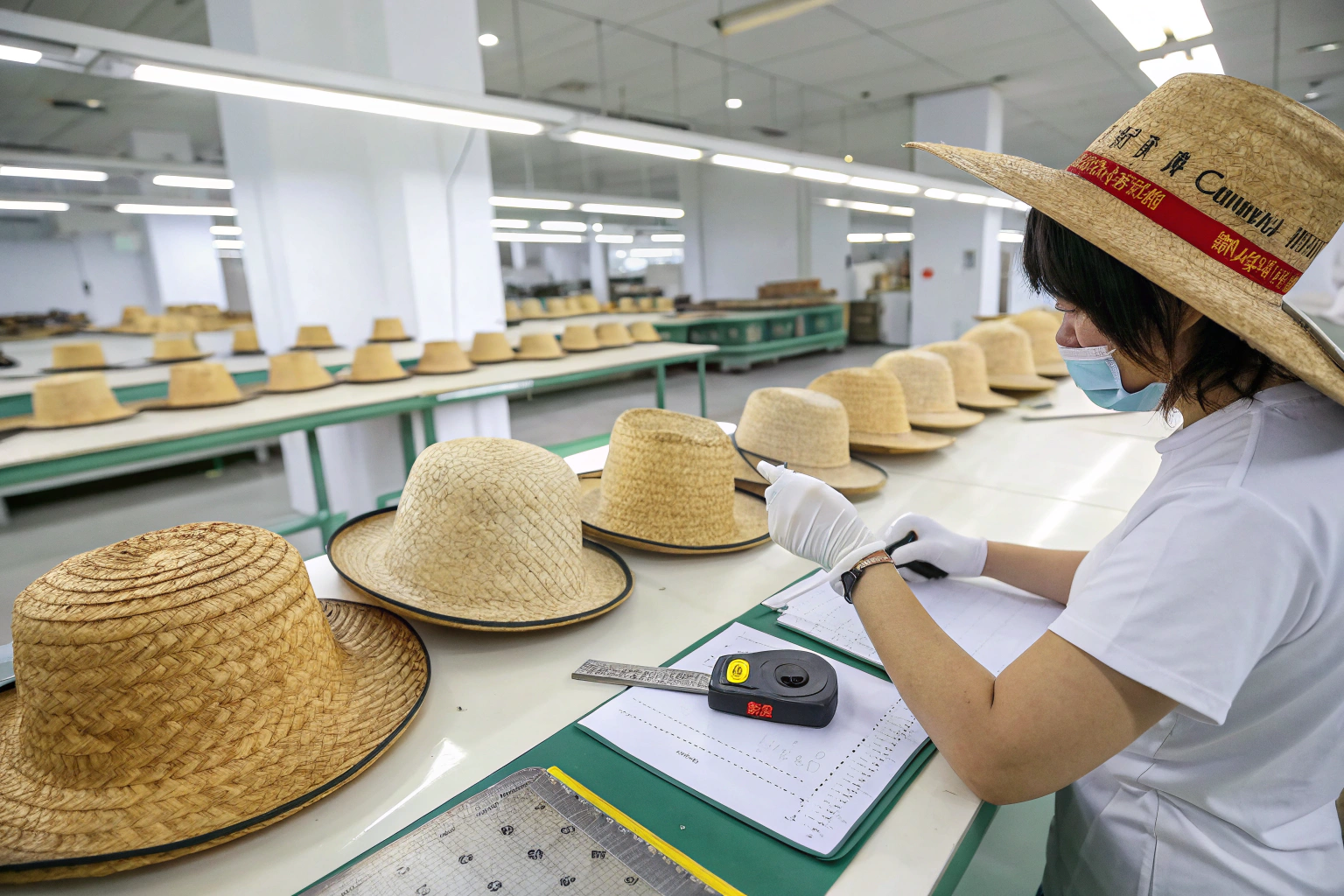
I remember opening a shipment of straw hats at a client’s warehouse in Miami three summers ago. The hats looked perfect in the pre-shipment photos. From the outside, the cartons were clean and dry. But when we pulled the hats out, one by one, the problems revealed themselves. Brims were wavy instead of flat on half the units. Dark mold spots hid inside the weave on a few crowns. And the natural straw color was noticeably different between the top layer and the bottom layer of hats in the same carton, even though they were supposed to be the same dye lot. My client looked at me and asked if every straw hat order was going to be like this. I told him no, but only if someone is inspecting specifically for the things that go wrong with straw.
The most common defects on mass-produced straw hats fall into five categories. Shape distortion, where brims warp and crowns lose their intended silhouette. Weave irregularities, including broken straw fibers, uneven tension, and visible knotting errors. Color inconsistency, where shading varies across the hat or between units in the same order. Mildew and moisture damage, which can start invisibly inside the hollow straw fibers and bloom during transit. And trim attachment failures, where sweatbands, ribbons, and decorative bands are glued or stitched unevenly or detach with light handling. I will walk through each defect category so you know exactly what to reject, what is correctable, and how a professional QC process catches these issues before they become your problem.
Why Does Shape Distortion Happen on Straw Hats and How Can It Be Spotted?
Straw is a natural material, and it behaves differently than synthetic textiles under heat, humidity, and pressure. A straw hat that leaves the factory in perfect shape can arrive at your warehouse four weeks later looking like a completely different product if the shape was not properly set and stabilized during production. Shape distortion is the number one complaint I hear from buyers who source straw hats, and it is also one of the most preventable defects when you understand what causes it.
What Causes Brim Warping and Crown Collapse During Transit?
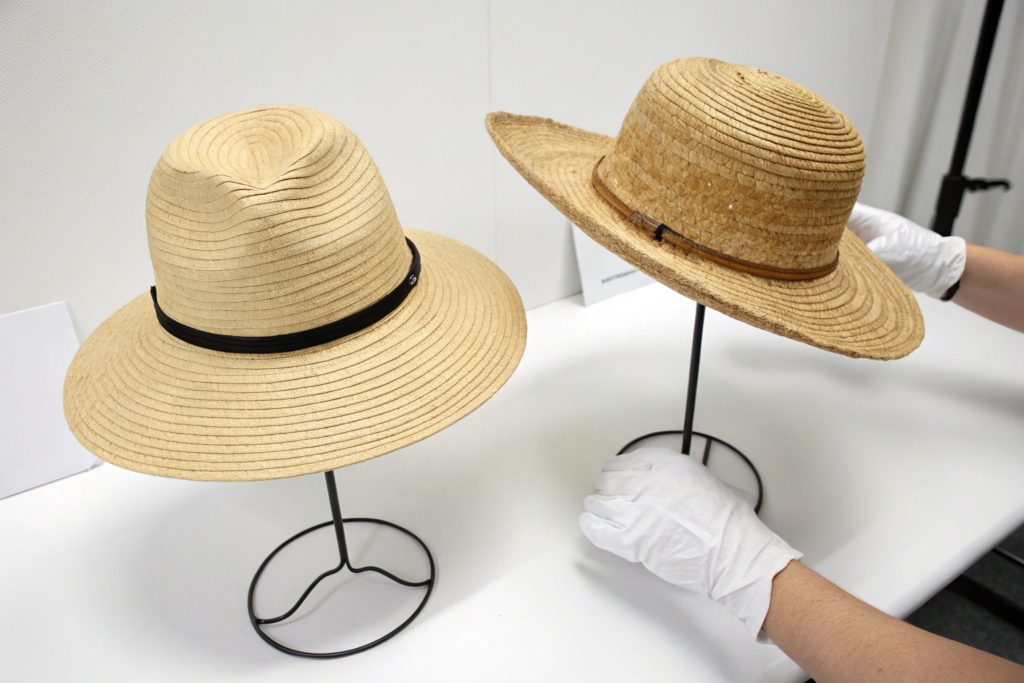
The brim of a straw hat is its most vulnerable structural element. A wide brim has a large surface area supported by relatively little material thickness at the edge. When the hat is packed into a carton, the brim flexes under the weight of hats stacked above it. If the straw was not properly blocked, which means shaped and set under heat and pressure on a metal form, the flex becomes permanent. The brim develops a wave or a dip that does not recover when the hat is unpacked and worn.
The root cause is usually insufficient blocking time or temperature. A properly blocked paper straw or raffia hat is held on the blocking form at a specific temperature and for a specific dwell time. If the factory rushes this process to increase output, the shape memory is weak. The hat holds its form long enough for the final QC inspector to check it and approve it, but after days of compression inside a shipping carton, the weak blocking fails. The brim loses its flatness, and the crown may develop a dent or lean to one side.
Another cause is moisture exposure during transit. Straw fibers absorb ambient humidity and become temporarily more pliable. A hat that is packed dry but travels through tropical humidity inside a container can soften, deform under the carton stacking pressure, and then dry again in the new distorted shape. This is a packing and logistics issue as much as a production issue. A hat with a properly set block and a moisture barrier in the packaging stands a much better chance of arriving in shape. Our QC team at AceAccessory checks brim flatness by placing the hat on a calibrated flat surface and measuring any gap between the brim edge and the surface at multiple points around the circumference. A gap exceeding a specified tolerance, typically two to three millimeters for a standard fashion hat, triggers a rejection or a re-blocking order.
How Should Symmetry and Brim Flatness Be Measured in QC?
Symmetry inspection for a straw hat is a structured measurement process, not a subjective glance from across the room. The QC inspector places the hat on a flat inspection table with the brim facing down. A calibrated ruler or a digital height gauge measures the distance from the table surface to the brim edge at four cardinal points: front, back, left, and right. These four measurements should be equal within a defined tolerance. If the front brim sits three millimeters higher than the back brim, the hat has a tilt that will be visible on a retail display and noticeable to the customer when worn.
Crown symmetry is checked by viewing the hat from the front and from the side, aligning the crown center with a vertical reference line. The inspector looks for any lean, any flattening on one side, or any asymmetry in the crown crease if the style has one. The crown height is measured with a caliper and compared to the tech pack specification. A crown that is five millimeters shorter than spec may not sound like much, but on a structured fedora or a wide-brim sun hat, that small dimension change alters the entire proportion of the hat and makes it look like a different style.
The brim flatness check is particularly important for styles with a snap brim, where the brim is intended to be worn snapped up in the back and down in the front. The snap feature must hold its position without the wearer constantly readjusting it. The inspector tests this by manually flexing the brim through its full range of motion and verifying that the material returns to its set position without cracking or staying in the flexed position. A brim that goes limp after a few flexes has a blocking failure and will generate returns from customers who expect the snap brim to stay snapped. Adopting a recognized testing protocol for accessories like standardized dimensional checks ensures your factory’s inspection method matches your retail customer’s expectations.
What Weave Irregularities Are Considered Unacceptable in Straw Hats?
The weave is the fundamental surface of a straw hat, and the customer’s eye goes to it immediately. An even, consistent weave communicates quality and craftsmanship. A weave with gaps, broken fibers, and visible knots communicates low cost and poor quality control. Weave defects exist on a spectrum from acceptable natural variation to unacceptable structural or cosmetic failure, and the boundary between the two must be defined clearly in the QC specification.
How Do Broken Straw Fibers and Uneven Tension Affect Durability?
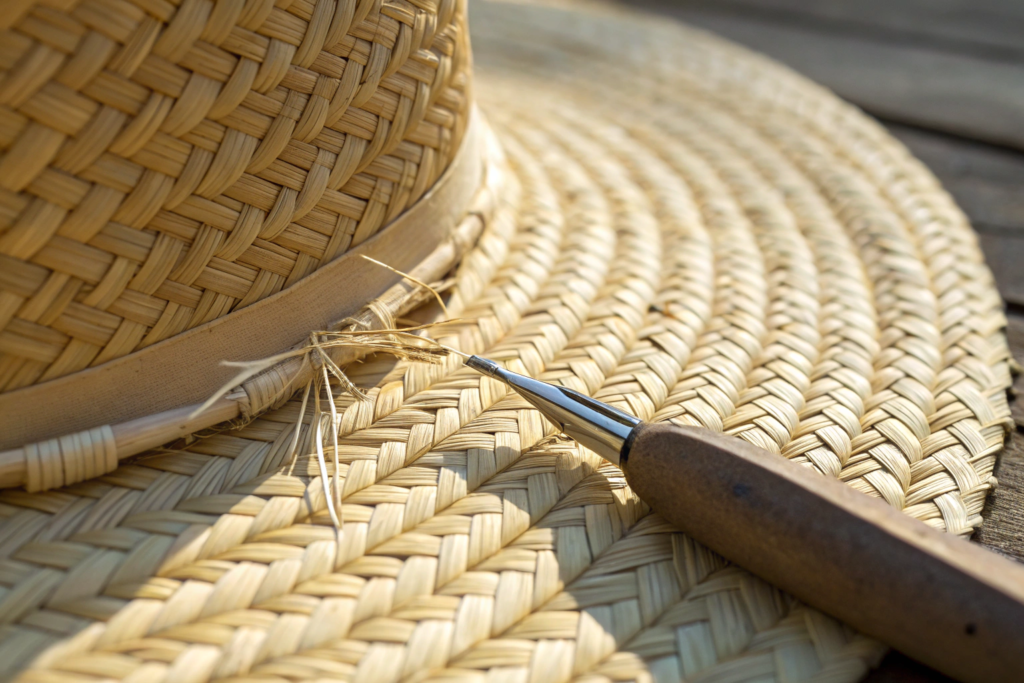
A single broken straw fiber may look minor on a finished hat, but it is a failure point that will only get worse with wear. Straw hats are handled by the brim every time they are put on and taken off. The brim flexes slightly with each handling cycle. A section of the weave where a fiber is already broken has lost its structural continuity. The adjacent fibers now carry more tension load, and they will eventually break as well. What begins as a tiny protruding fiber end becomes a visible hole in the weave after a few weeks of normal use.
Uneven weaving tension produces a subtler but equally serious problem. If the weaver applied inconsistent tension during the braiding or weaving process, the weave density varies across the hat surface. Tight sections are stiff and resistant to flexing. Loose sections are soft and prone to distorting. Where a tight section transitions to a loose section, a stress concentration forms. Over time, with handling and exposure to humidity changes, that stress concentration develops into a permanent crease or a visible ripple in the weave. This is not correctable once the hat is finished.
Our QC inspectors at AceAccessory check weave tension consistency by running a gloved hand over the entire hat surface, feeling for variations in tightness. They pay particular attention to the crown-to-brim transition area and the brim edge, which are the zones where weaving tension naturally wants to vary because of the changing geometry. An evenly woven hat feels consistently firm to the touch across its entire surface. A hat with tension issues reveals itself as alternating bands of hardness and softness. Visual inspection under angled light supplements the tactile check by making tension variations visible as subtle waves in the reflected light on the hat surface. Industry-standard textile testing methods provide objective pass/fail references for fiber integrity and weave consistency that remove subjectivity from the inspector’s judgment.
What Knots, Stains, and Discolorations Are Grounds for Rejection?
Straw is a natural plant fiber, and natural materials carry natural imperfections. A tiny, tight knot where two straw fibers are joined is a normal feature of almost any plant-fiber weave and is not a defect in standard-grade accessories. The question is the size, visibility, and quantity of these knots. A knot that protrudes from the surface and catches on a passing finger is a defect because it will snag on clothing and irritate the wearer’s skin. A knot that is visibly larger than the surrounding weave pattern and disrupts the visual uniformity of a fashion hat is a cosmetic defect on higher-grade products, though it may be acceptable on a rustic, craft-style product where natural imperfections are part of the intended aesthetic.
Dark stains on natural straw are grounds for rejection unless the product is explicitly marketed as having a natural, unprocessed finish. Stains typically originate from mold that started growing on the straw stalks before they were harvested and processed, or from contact with metal surfaces during the production process. A mold stain is a cosmetic blemish on day one but signals a deeper problem. The mold spores that caused the stain may be dormant within the straw fiber, waiting for humid conditions to reactivate. A hat with visible mold staining is likely to develop additional mold growth in transit or storage.
Discoloration in the form of localized yellowing or darkening that does not match the overall hat color is usually caused by uneven absorption of dye or bleaching chemicals during processing, or by localized heat damage from an overly hot blocking press. Unlike natural straw shade variation, which is a subtle, distributed characteristic of the material, these discolorations are concentrated in specific spots and are considered manufacturing defects in finished fashion products.
Why Does Color Inconsistency Plague Natural Straw Hat Orders?
Color inconsistency is the defect that frustrates retail buyers the most because it is often not apparent until the hats are unpacked and displayed side by side on a store shelf. A single hat, viewed in isolation, can look perfectly acceptable. That same hat, placed next to another hat from the same order that is two shades lighter, creates a presentation problem that makes the brand look careless. Natural straw is inherently variable in color, and managing that variability down to an acceptable commercial tolerance requires specific process controls.
How Do Natural Fiber Shade Variations Differ from Dye Lot Problems?
The color of a natural straw hat comes from two sources. The natural base color of the straw fiber itself and any applied dye, bleach, or tint. Natural straw base color varies depending on the plant species, the growing conditions including soil composition and sunlight exposure, the age of the stalk at harvest, and the drying method used. This variation is inherent and cannot be eliminated. It can only be managed through careful grading of the raw material before production begins.
A factory that produces natural straw hats in volume must grade the raw straw into color lots before the weaving process starts. Light, consistent golden straw goes into one lot for natural-finish and light-dye products. Darker, more variable straw goes into a different lot for dyed products where the dye will cover the base color variation. If this grading step is skipped, or if it is done carelessly, the base color variation carries through into the finished hats regardless of what dye is applied over it.
Dye lot problems are different and are entirely controllable. A dye lot variation occurs when two production batches of the same hat style are dyed in separate dye baths, and the dye concentration, water temperature, or immersion time varies slightly between the two baths. The result is two batches of hats that were supposed to be identical in color but are subtly different. A professional dye house documents the exact dye formula and process parameters for the first approved production lot and replicates those exactly for subsequent lots. If the first lot is archived and referenced, the second lot should match. The variation is a process discipline failure, not an inherent feature of the material. Using a color measurement standard like spectrophotometer readings against the Pantone reference during the dye process provides objective data that catches variation before it becomes a finished product problem.
What Lighting Conditions Should Be Used to Evaluate Straw Hat Color?
The lighting condition under which color is evaluated can make the difference between an accepted shipment and a rejected one. Color is a function of the light source under which it is viewed. A straw hat that appears a consistent warm beige under the warm yellow lighting of a factory floor may appear noticeably varied under the cool, blue-white fluorescent lighting of a department store or the daylight of an outdoor display.
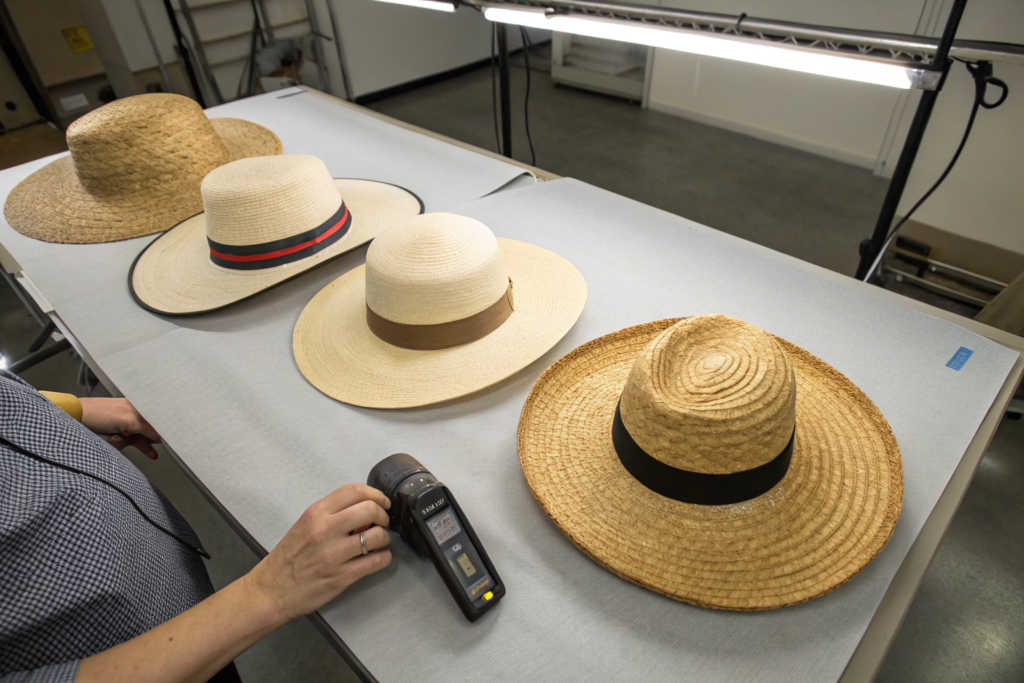
Professional QC inspection for color uses standardized D65 lighting, which simulates natural daylight at noon. The inspection booth has neutral grey walls so the inspector’s eye is not influenced by surrounding colors. The hats are placed side by side in the booth, and the inspector compares them under the standardized light, not under the ambient factory lighting. A colorimeter or spectrophotometer reading is taken at the crown and brim of each inspected hat, and the Delta E value, which quantifies the mathematical difference between the measured color and the reference standard, is recorded. For fashion accessories, a Delta E of less than 1.0 is considered an excellent commercial match. A Delta E between 1.0 and 2.0 is a commercially acceptable match for most retail tiers. A Delta E above 2.0 is a visible difference to most observers and is typically grounds for rejection or a discounted secondary sale.
The same standardized lighting protocol applies when evaluating color consistency between different materials on the same hat. A hat with a raffia straw body and a polyester ribbon trim must have color harmony between the two materials. The ribbon color is evaluated against the straw color under D65 light, and any visible mismatch is recorded as a trim color defect.
What Trim and Finishing Defects Are Most Frequently Found on Packed Hats?
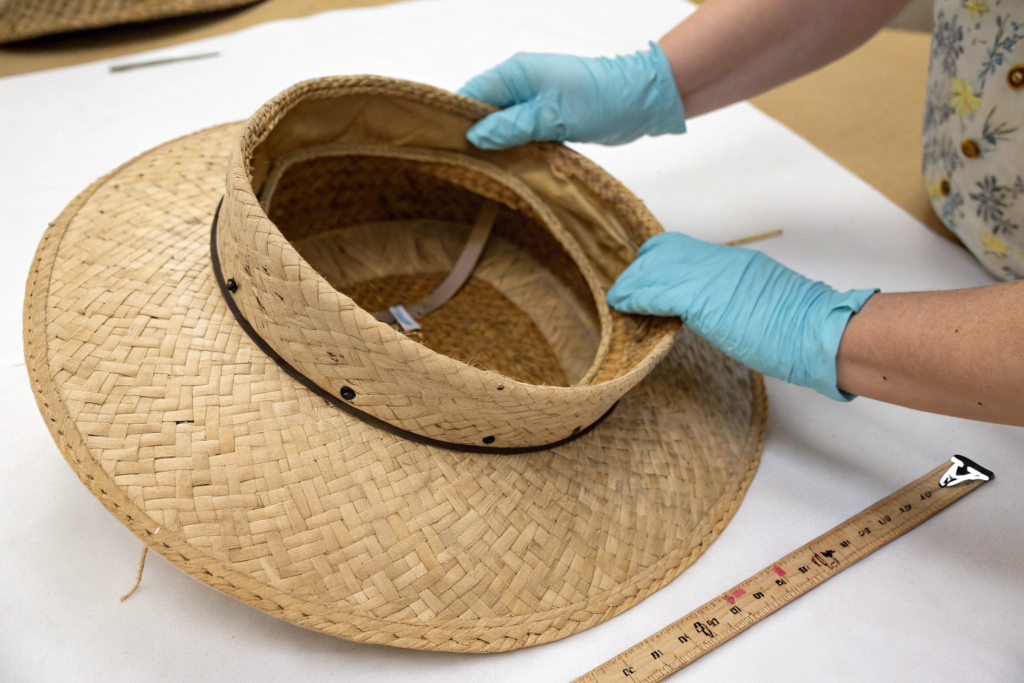
The straw body of the hat carries the most visible quality signals, but the trims and finishing details are where functionality lives. A sweatband that detaches on the first wear, a ribbon that was stitched crookedly, or a decorative band with loose glue residue on the straw surface each create a specific negative experience for the customer. These trim defects often occur during the final assembly stage, which is fast-paced and labor-intensive, making it a high-risk zone for QC oversight.
Why Do Sweatbands and Inner Linings Fail After Minimal Use?
The sweatband inside a straw hat serves both a comfort function and a structural one. It provides a soft interface between the potentially scratchy straw and the wearer’s forehead, and it helps the hat grip the head. A sweatband that fails, whether it detaches, wrinkles, or tears, makes the hat uncomfortable or unwearable, regardless of how beautiful the exterior looks.
The most common sweatband failure mode is glue detachment. Many factory sweatbands are attached with a hot-melt adhesive applied in a continuous bead or in intermittent dots along the sweatband’s leather or fabric backing. If the glue temperature is too low when it is applied, or if the adhesive is not appropriate for the specific straw material, the bond is weak. It may hold through the packing and shipping process but fail when the hat is worn and the sweatband is subjected to the combination of tension from head contact and moisture from perspiration.
Another common failure is a sweatband that is stitched to the hat but the stitching tension was too tight or too loose. Overly tight stitching perforates the straw fibers along the stitch line, creating a tear-away perforation that eventually causes the sweatband to rip free of the crown, taking a layer of straw fibers with it. Overly loose stitching leaves a gap between the sweatband and the hat body that catches on the wearer’s hair or fingers and gradually enlarges.
Our QC inspector at AceAccessory tests every sweatband in the inspection sample with a gentle but firm tug at multiple points around the circumference. The sweatband should not lift, shift, or peel. If it does, the hat fails inspection, and the entire batch is rechecked for sweatband adhesion. The inspector also checks that the sweatband lies flat against the crown with no bunching, no twisting, and no exposed glue residue on the visible straw surface adjacent to the sweatband edge.
How Should Decorative Bands and Stitching Be Inspected?
Decorative bands, ribbons, and stitched trims carry the branding and style identity of the hat. A grosgrain ribbon with a neat bow and a branded metal charm transforms a generic straw hat into a recognizable brand product. A crooked ribbon, a frayed bow tail, or a missing charm transforms the same hat into a reject.
The decorative band inspection checks several specific points. The band must sit level around the crown, not sloping up or down as it circles. This is checked by measuring the distance from the band’s lower edge to the brim break line at multiple points around the hat. The attachment points, whether they are hidden stitches, small dabs of glue, or a combination, must be secure and invisible from the outside. A band that is attached with visible glue squeeze-out on the straw surface is a cosmetic defect. A band that is attached with stitches and the stitch tension is so high that it puckers the straw is both a cosmetic and structural defect.
The bow or decorative knot must be symmetrical unless the style intentionally calls for an asymmetrical design. The bow loops should be even in size, the tails should be finished with a clean angled cut or folded hem so they do not fray, and the center wrap should be tight and secure. Any metal charm, bead, or trim piece attached to the band must have its attachment hardware, whether a jump ring, a prong, or a stitch, checked for security. A metal charm that falls off on the first wear because the jump ring was not properly closed creates a warranty return and a disappointed customer.
Stitching anywhere on the hat, including brim edge stitching, crown seam stitching, and trim attachment stitching, is inspected for thread continuity, uniform stitch length, and correct thread color match to the specification. A broken stitch line, a skipped stitch that leaves a visible gap, or a thread color that differs from the approved sample are all recorded as defects and scored against the AQL sample. Detailed inspection checkpoints for garment and accessory trim testing standards provide an excellent reference for what to specify in your straw hat tech pack regarding stitch security and trim attachment durability.
Conclusion
Mass-produced straw hats will always generate some level of defect rate because the material is natural, the weaving process is semi-manual in most factories, and the shipping journey is long and environmentally stressful. An acceptable defect rate is managed through defined QC tolerances, not eliminated entirely. The five defect categories that you must specify in your inspection criteria are shape distortion, particularly brim warping and crown symmetry failure. Weave irregularities, including broken fibers, tension inconsistency, and visible knots that snag or disrupt the surface beyond a natural material norm. Color inconsistency, both the inherent shade variation of natural straw fiber and the controllable variation from dye lot and bleaching process problems. Mildew and moisture damage that starts invisibly and becomes apparent only after transit. And trim attachment failures, where sweatbands, decorative bands, ribbons, and charms detach under normal wear.
A professional straw hat QC process is built around objective measurements, not subjective glances. Brim flatness is measured with a feeler gauge against a flat surface. Crown symmetry is checked against a vertical alignment line. Weave tension is evaluated by tactile sweep and visual inspection under angled light. Color is measured with a spectrophotometer and compared to a Delta E standard under D65 lighting. Sweatband adhesion is tested with a manual tug. Stitch continuity and trim attachment are visually confirmed against a reference sample and a defined defect list.
When you work with a factory that can describe their QC gates in this level of detail and provide you with the inspection reports that document the measurements, you gain the ability to manage straw hat quality from thousands of miles away.
If you are developing a straw hat collection and want to ensure your QC standards are defined and enforced before production begins, contact our Business Director Elaine at elaine@fumaoclothing.com. Share your tech pack, your approved sample if you have one, and your quality tolerance expectations. She can provide you with our standard straw hat defect classification guide and QC checkpoint list, and she can arrange a pre-production inspection protocol tailored to your specific hat styles. Your straw hats should arrive looking exactly as they did when you approved the sample, and that starts with a QC plan that catches the defects before the container door closes.




