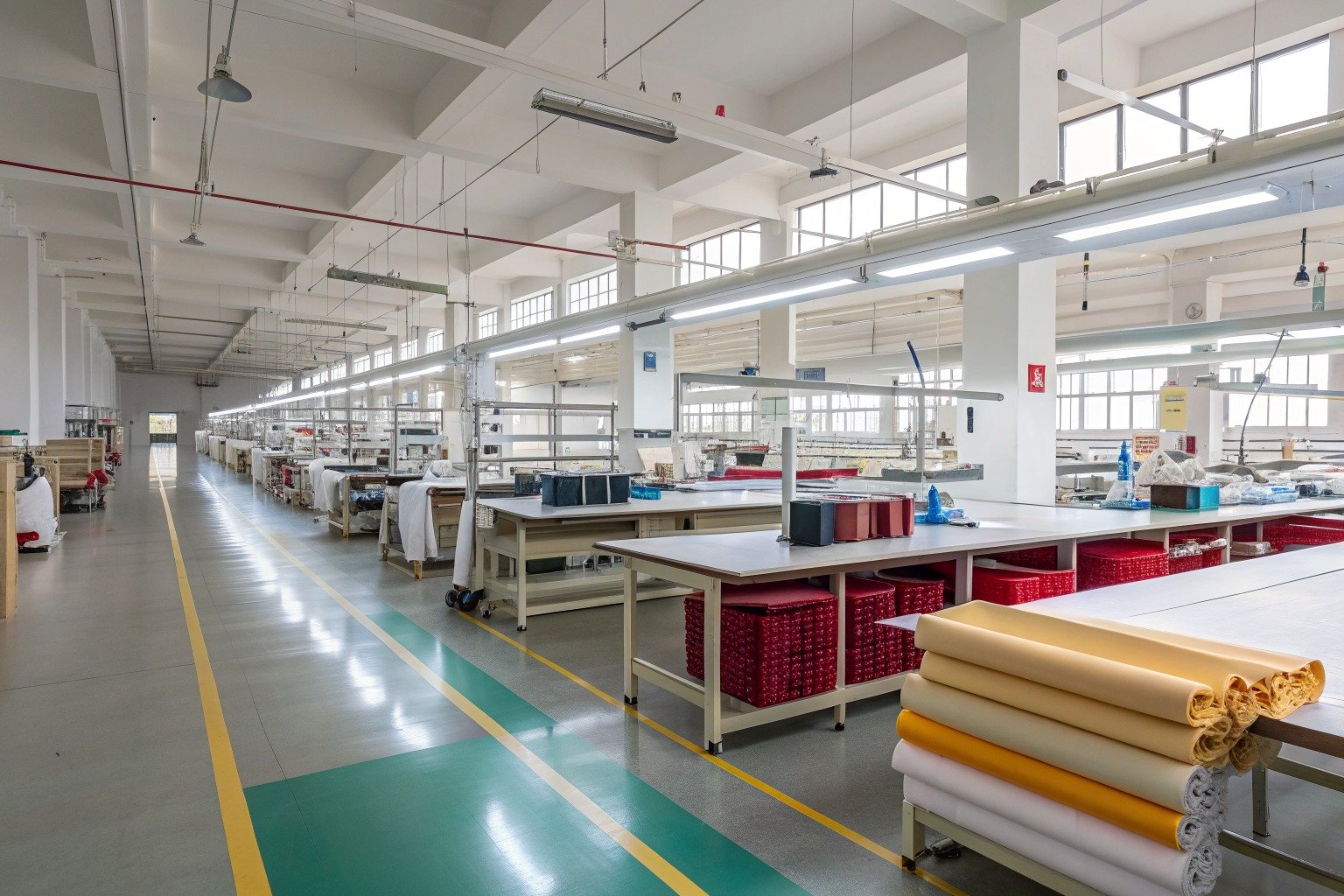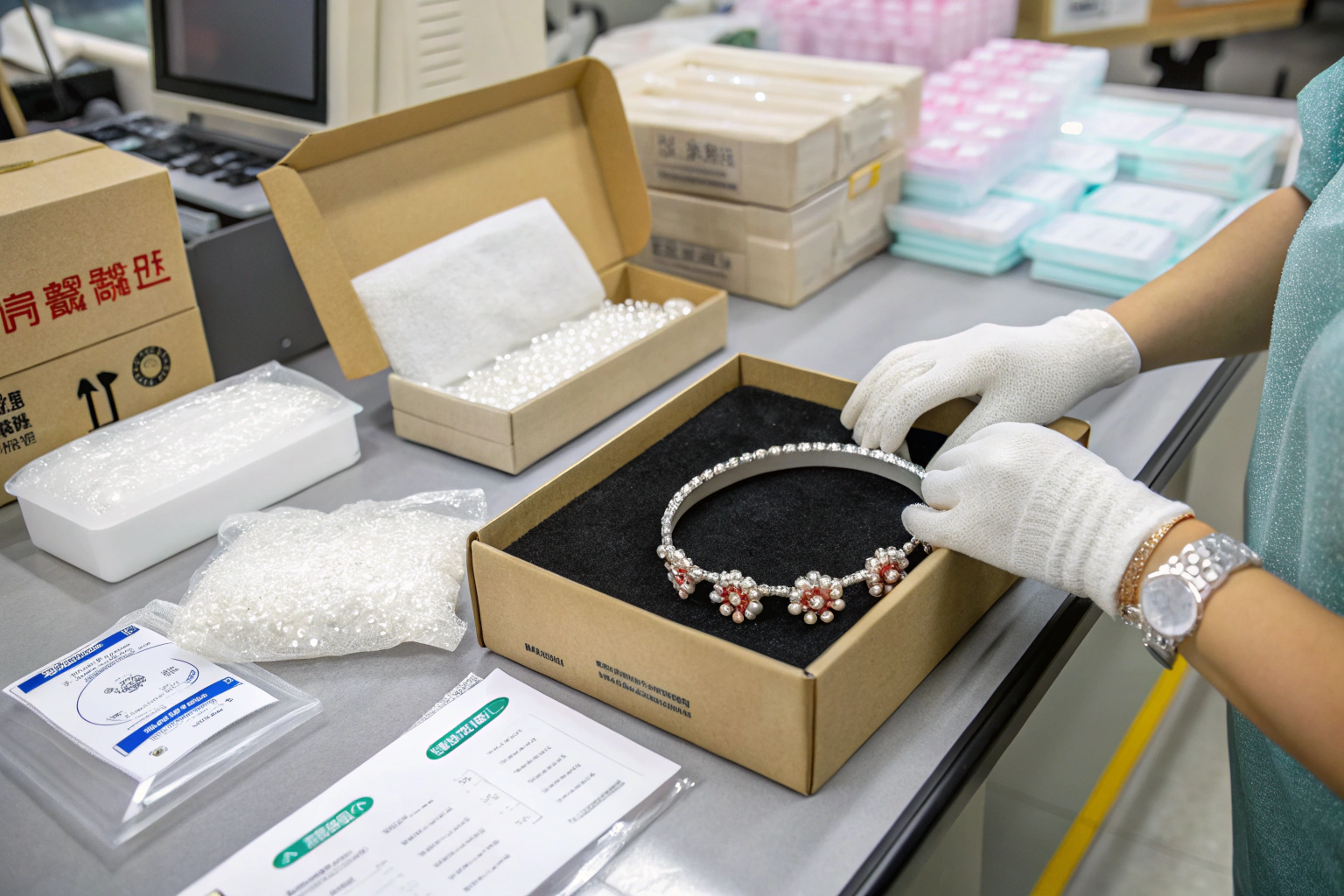
I remember a particularly painful email from a bride-to-be. She had ordered a set of delicate pearl-embellished hair bands from one of our brand clients for her wedding party. The package arrived via air express, and when she opened the box, the hair bands were tangled together, several pearls had detached, and one band had snapped entirely at its thinnest point. The brand replaced the order and ate the cost, but the emotional damage to that customer relationship was permanent. The hair bands themselves were beautiful. The packaging had failed them. Our client learned that day that the packaging for a delicate accessory is not just a container. It is an engineered protection system, and for air freight, where packages move through multiple sorting facilities, conveyor belts, and cargo holds, that system must be designed specifically for the stresses of air transport.
The best way to package delicate hair bands for air freight is to use a layered protection system. Each hair band should be individually secured in a sealed, non-abrasive polybag or tissue wrap to prevent tangling and surface abrasion. The individually wrapped bands are then placed into a rigid, crush-resistant box with custom-cut foam or paper-pulp inserts that immobilize each band and prevent shifting during transit. The rigid box is then packed into a master shipping carton with additional cushioning material that fills any void spaces and absorbs external impact forces before they reach the product boxes inside. This system addresses the three specific threats of air freight: crushing from stacked cargo, vibration abrasion from continuous movement, and tangling from product-on-product contact. I will explain each element of this protection system and how it is implemented in a production packing workflow.
What Are the Specific Risks of Air Freight for Delicate Accessories?
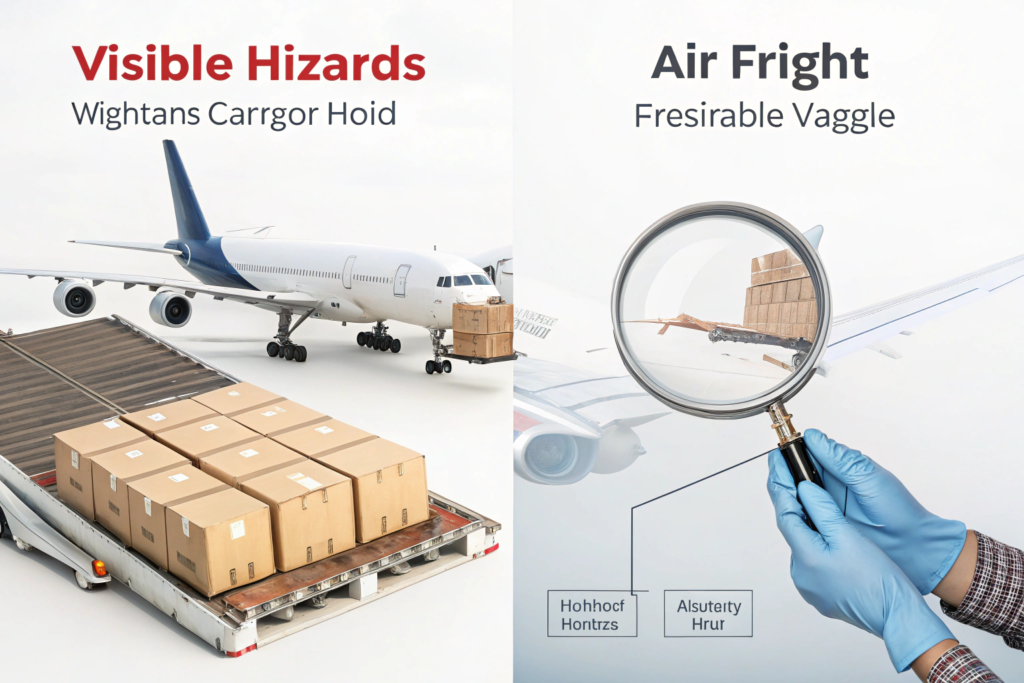
Air freight is generally gentler than ocean freight in terms of transit time and exposure to moisture and temperature extremes. A package traveling by air spends days in transit rather than weeks, and it is not subjected to the same container rain and humidity swings that plague ocean containers. However, air freight introduces its own set of specific mechanical risks that are different in nature from ocean freight risks. Understanding these risks is the first step toward designing packaging that mitigates them.
How Does Vibration Abrasion Damage Delicate Hair Band Surfaces?
Vibration is the most insidious threat to delicate accessories during air freight. Aircraft cargo holds are not perfectly smooth environments. The aircraft’s engines, the movement of the landing gear, and the turbulence during flight all transmit continuous, high-frequency vibration through the aircraft structure and into the cargo. This vibration, sustained for hours on a long-haul flight, causes any two surfaces in contact with each other to rub together microscopically. Over thousands of vibration cycles, this micro-rubbing wears away surface finishes, dulls polished metal, abrades delicate bead coatings, and scuffs smooth plastic or resin surfaces.
A delicate hair band with a metallic finish, a pearlized coating, or a soft fabric surface is particularly vulnerable to vibration abrasion. If the hair band is packed loosely in a box and allowed to rub against another hair band or against the inside of the packaging, the surface finish will show visible wear upon arrival, even if there is no apparent crushing or impact damage. The damage looks like dull patches, a loss of luster, or a fine powdery residue on the product surface, which is the abraded coating material.
Preventing vibration abrasion requires immobilizing each individual hair band so that it cannot move relative to its immediate packaging environment. A hair band that is secured inside a sealed polybag that is itself fitted into a cavity in a foam insert cannot rub against another hair band or against the box walls. The polybag surface is smooth and non-abrasive, so even if it does vibrate, the friction is against a material that will not damage the product. The immobilization principle solves not only vibration abrasion but also tangling, which is the other major risk of packing multiple hair bands within a single container. Industry research into packaging engineering for distribution provides standardized test protocols that simulate the vibration profiles of different transport modes, including air freight.
What Crush and Impact Forces Occur During Air Cargo Handling?
Despite the image of air freight as a premium, careful service, the reality of cargo handling involves impacts. Packages are loaded onto conveyor belts, sorted through automated sorting facilities, transferred between cargo dollies and aircraft unit load devices, and stacked in cargo holds. At each transfer point, packages experience impact forces. A box at the bottom of a stack in an aircraft cargo container experiences sustained crush force from the weight of the boxes above it, amplified during takeoff and landing when g-forces multiply the effective weight.
A delicate hair band made from thin metal wire, fine elastic, or fragile resin can deform or snap under crush force if its packaging box collapses. The rigid box is the primary defense against crush. A box made from corrugated cardboard with adequate bursting strength, typically rated for the weight of its contents plus a safety factor, will maintain its structural integrity under stacking loads. A flimsy box made from thin cardstock or a folding carton without corrugation will collapse, and the collapse will transfer the crush force directly to the product inside. The rigid box protects its contents by resisting the external force.
Internal cushioning protects against impact forces that the box transmits even when the box itself does not collapse. When a package is dropped from conveyor height onto a concrete floor, the box absorbs and distributes the impact, but some acceleration is still transferred to the contents. A foam insert or a paper-pulp tray acts as a shock absorber, cushioning the hair band against the sudden deceleration. A product that is rigidly fixed to the inside of the box experiences the full impact force. A product that is suspended in a cushioning medium experiences a dampened force. The cushioning material selection, thickness, and geometry all influence the level of impact protection.
How Should Individual Hair Bands Be Prepared Before Packing?
The preparation of the individual hair band unit, before it ever reaches the shipping carton, is the most detailed and labor-intensive step in the packaging process, and it is also the step that most directly determines whether the product arrives in retail-ready condition. A hair band that is properly prepared and individually secured at the unit level can survive significant external handling abuse because the protection is built around the product itself. A hair band that is thrown loosely into a box and cushioned only by the hope that nothing will shift is already damaged goods waiting to happen.
Why Is Individual Polybag Sealing Critical for Delicate Surfaces?
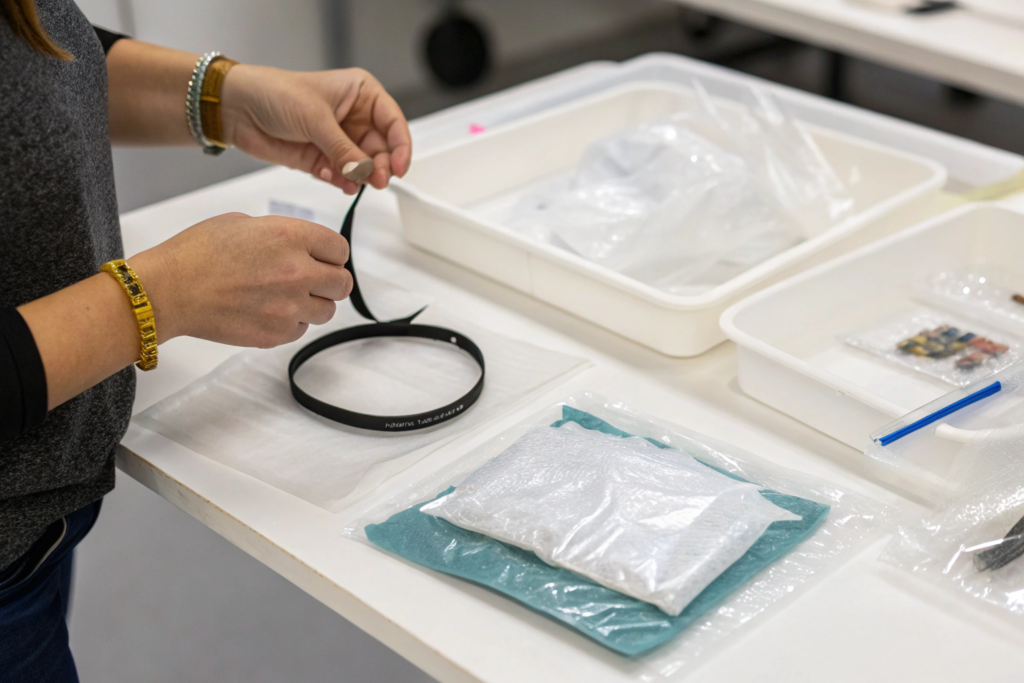
An individually sealed polybag is not primarily about cleanliness, although that is a benefit. It is about creating a controlled micro-environment around the product. A delicate hair band with a metallic finish, a soft fabric covering, or an embellished surface is vulnerable to three specific types of damage that an individual polybag prevents. The first is abrasion from contact with adjacent products or packaging materials. The second is tarnishing or corrosion from exposure to ambient humidity and airborne contaminants. The third is tangling, which is particularly important for hair bands that have loops, elastic sections, or thin, flexible shapes that easily intertwine.
The polybag material for delicate accessories should be virgin, not recycled, polyethylene to avoid contaminants and inconsistent film strength. The thickness should be a minimum of 40 microns, which provides adequate puncture resistance against the pressure of foam inserts during transport without being so thick that the bag feels industrial. The bag should be sealed, not folded over and tucked. A fold allows air exchange and does not prevent the product from working its way out of the bag if vibration causes it to shift. A heat seal or an adhesive strip seal creates an actual barrier. If the product is sensitive to static electricity, which can attract dust and cause embellishments to cling, an anti-static polybag formulation should be specified.
A small desiccant packet, typically a 1-gram or 2-gram silica gel sachet, should be placed inside the sealed bag with the product. Air freight cargo holds are generally dry, but the product may have been stored in a humid environment before packing, and the desiccant absorbs residual moisture inside the sealed bag, preventing tarnishing of metal components and inhibiting any potential mold growth on organic materials.
Should Delicate Embellishments Be Separately Wrapped or Supported?
Delicate embellishments, such as beads, pearls, crystals, metal charms, and fine chains, are the failure points on most damaged hair bands. These embellishments are attached to the band with small mechanical fasteners, adhesive, or thread wraps. During transport vibration and impact, these attachment points experience concentrated stress. An embellishment that is allowed to flop or swing relative to the band body acts as a tiny lever, concentrating force at its attachment point with every vibration cycle.
Beaded sections should be wrapped in a single layer of acid-free tissue paper before the hair band is placed in the polybag. The tissue provides a soft, non-abrasive cushion that prevents bead-to-bead contact within the bag and prevents the beads from rubbing against the polybag interior. For hair bands with pronounced three-dimensional embellishments, such as a large decorative flower, a crystal brooch element, or a metal filigree piece, the embellishment should be supported with a small piece of foam or a shaped paper-pulp insert that fits around the embellishment and holds it immobile relative to the band body. The support prevents the weight of the embellishment from flexing the attachment point during handling and vibration.
The wrapping and supporting materials must be chosen for chemical compatibility with the product. Acid-free tissue paper prevents the slow chemical degradation that acidic paper can cause on metal surfaces over time. Sulfur-free paper is specified for products containing silver to prevent tarnish. These specifications are details that an experienced factory includes in its packing work instructions, even when the client does not explicitly ask for them. The process of protecting delicate product surfaces is a core QC consideration, and referencing industry-standard protective packaging guidelines during product development ensures that every element from the polybag gauge to the paper acidity level is intentionally specified for its protective function.
What Box and Cushioning Structure Protects Against Crush and Impact?
The container structure, the outer carton and the inner product box, is the skeleton of the packaging system. If the skeleton collapses, the soft internal cushioning cannot protect the product. The structure must be designed with specific material specifications and geometries that are matched to the weight of the contents and the expected handling environment of air freight.
Why Is a Rigid Inner Box Essential for Preventing Hair Band Compression?
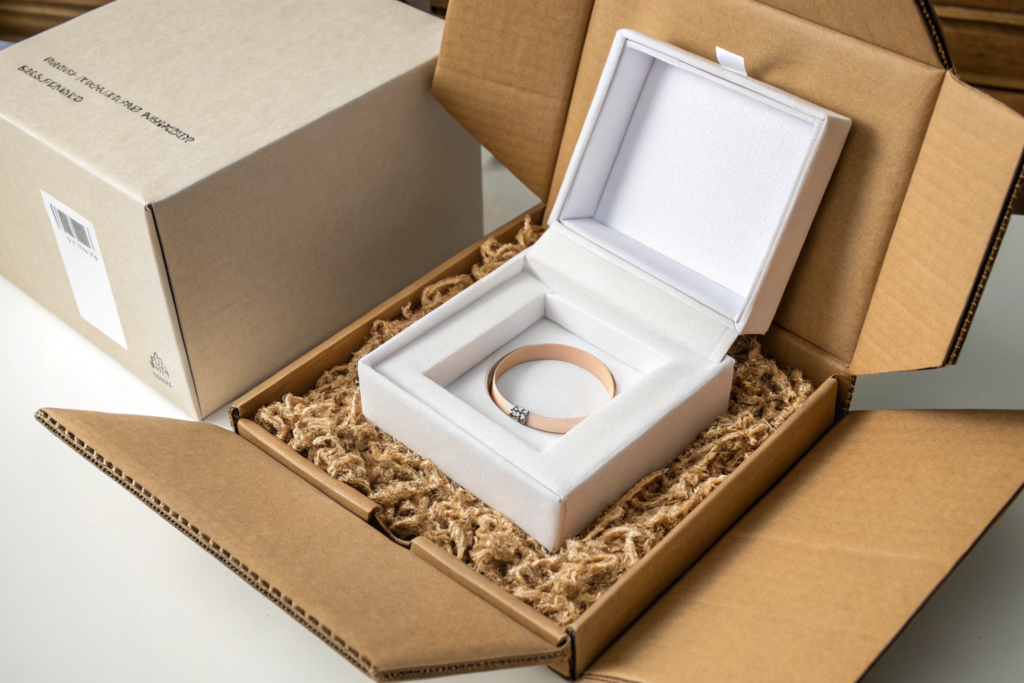
A rigid inner box serves as a protective shell around the individually bagged and cushioned hair band. This box is the retail-ready packaging, the box the customer opens, and it therefore serves a dual function. It is both a presentation piece and an engineered structural component of the shipping protection system. The key structural requirement is that the box must not collapse under the stacking weight of other boxes packed in the same master carton or in the same aircraft unit load device.
The inner box should be constructed from rigid chipboard or from corrugated cardboard with a suitable edge crush test rating for the stacking load it will experience. A folding carton made from thin SBS paperboard, the type used for a box of tea or a cosmetics carton, is generally not sufficient as the sole protective shell for a delicate hair band in air freight. It can work as a retail presentation piece inside an outer protective structure, but it should not be relied upon as the primary crush protection.
The inner box lid must not compress onto the product when weight is stacked on top. If the lid directly contacts the hair band, any downward force on the lid is transferred to the product. The foam or paper-pulp insert inside the box should create a stand-off distance between the lid and the highest point of the product. A correctly designed insert positions the product in the lower portion of the box cavity and leaves an air gap or a foam buffer above it. When the lid is closed, the lid contacts the insert, not the product. This gap is small, often only a few millimeters, but it is critical. Any lid deflection from stacking loads is absorbed by the insert, not by the hair band.
How Do Custom Inserts and Void Fill Work Together in the Master Carton?
The master carton is the outer shipping container that holds multiple inner product boxes for consolidated shipping. The master carton’s job is to contain, protect, and organize the inner boxes during transit. The inner boxes must be packed into the master carton so that they cannot shift relative to each other or relative to the carton walls. A master carton that contains interior void spaces is a carton that will collapse inward at those voids when force is applied, or whose contents will shift and impact each other, causing damage.
Custom die-cut inserts made from corrugated cardboard, molded paper pulp, or polyethylene foam are fitted inside the master carton to create individual cells for each inner product box. The cells are sized to fit the inner boxes with a slight friction fit so the boxes are held firmly in place but can still be removed without damage when unpacking. The insert separates each inner box from its neighbors, so the crushing force on the carton above one cell does not transfer to the inner box in the adjacent cell.
Void fill material fills any remaining space between the top of the inner boxes and the top flaps of the master carton, and any small gaps around the perimeter of the insert. Crinkled kraft paper, air pillows made from recyclable film, or loose-fill biodegradable packing peanuts are the standard options. The void fill must be packed densely enough that it does not settle and create a new void space partway through transit. A master carton that arrives at its destination with the void fill compacted down and a gap between the fill and the carton flaps is evidence that the carton was under-filled and its contents were subjected to shifting during transit. The weight of the contents and the carton dimensions should be checked against air freight dimensional weight pricing so the carton size is optimized for both protection and freight cost.
How Should Temperature and Humidity Be Managed During Air Transit?
Air freight cargo holds are pressurized and generally climate-controlled, but the journey from factory to final destination includes ground handling stages that expose the cargo to ambient environmental conditions. A shipment that departs from a hot, humid factory in southern China, sits on a tarmac in the sun during loading, flies in a climate-controlled cargo hold, and then arrives in a cold, dry North American winter airport has experienced multiple environmental transitions. Each transition can affect a delicate hair band that is sensitive to temperature or humidity.

Do Metal Components on Hair Bands Need Anti-Tarnish Protection?
Metal components on hair bands, including clasps, wire frames, decorative charms, and bead caps, are susceptible to tarnishing when exposed to humidity and airborne sulfur compounds. Tarnishing is a chemical reaction that can occur during transit, particularly during the ground handling phases when the cargo is exposed to ambient air at origin and destination. A hair band that leaves the factory with a bright, shiny metal finish can arrive with a dull, darkened, or spotted metal surface if it was not protected during transit.
Anti-tarnish protection for air freight is achieved through several complementary measures. The product should be packed with a desiccant packet inside its sealed polybag, as described earlier, to maintain low humidity in the immediate product environment. The metal components can be treated with a clear anti-tarnish coating or lacquer during manufacturing, which provides a long-term barrier against oxidation. For particularly sensitive metals such as silver or high-polish brass, anti-tarnish paper strips or tabs, which absorb sulfur compounds from the air, can be placed inside the sealed polybag or inside the inner product box. These measures create a protected local environment that travels with the product regardless of the external conditions.
The air freight environment is generally less humid than ocean freight, so the desiccant requirements are typically lower, but the protection should not be omitted entirely. A shipment of delicate hair bands that is placed in a non-climate-controlled cargo hold area or is held in an airport warehouse during a weather event benefits from the same moisture protection as an ocean shipment.
Should Environmental Data Loggers Be Used for High-Value Shipments?
An environmental data logger is a small electronic device that records temperature and humidity at set intervals throughout the shipment journey. For high-value delicate hair bands, such as those with precious metal components, genuine gemstone embellishments, or limited-edition designer collaborations, a data logger provides verifiable documentation of the environmental conditions the product experienced. If a shipment arrives with tarnished metal or damaged adhesive bonds, the data logger history helps determine whether the damage was caused by a transit environment excursion or by a pre-existing manufacturing issue.
The data logger is placed inside the master carton, typically attached to the inside wall or placed in a dedicated pouch, and it runs continuously from packing to unpacking. Upon arrival, the logger is plugged into a computer and the data is downloaded. The temperature and humidity history graph shows any spikes or excursions. A shipment that spent several hours in a high-humidity environment during ground handling is documented. A shipment that remained within acceptable limits throughout is documented. The logger data supports both quality analysis and insurance claims if damage occurs.
The use of a data logger is not standard for every shipment. It adds cost and requires someone at the receiving end to retrieve the logger and generate the report. For routine shipments of standard hair bands, the combination of a sealed polybag, a desiccant packet, and a rigid inner box with a foam insert provides sufficient environmental protection. The data logger is a risk management and quality verification tool appropriate for the highest-value products where the cost of potential damage justifies the cost of monitoring. For comprehensive logistics planning, understanding typical air cargo handling conditions helps set realistic specifications for packaging performance requirements and guides the decision on whether environmental monitoring is warranted for a particular product line.
Conclusion
Packaging delicate hair bands for air freight is a layered engineering challenge, not an art project with tissue paper and hope. The protection system must immobilize each individual hair band against vibration abrasion, the micro-rubbing that dulls finishes over hours of aircraft vibration. It must support delicate embellishments so that beads, crystals, and charms do not act as tiny levers concentrating stress at their attachment points. It must enclose each unit in a sealed, non-abrasive polybag with a desiccant packet to create a chemical and physical micro-environment that prevents tarnishing and surface damage. It must encase the polybagged product in a rigid inner box with a custom foam or paper-pulp insert that prevents crush compression from stacking loads and absorbs impact forces from handling drops. And it must pack the inner boxes into a master shipping carton with custom cell inserts and void fill that eliminate shifting, settling, and product-to-product impact during the journey.
A factory that understands these packaging principles and applies them systematically to every order, not just to the ones where the buyer explicitly demands special handling, is a factory that treats the product’s arrival condition as part of its quality responsibility. At AceAccessory, our packaging for delicate hair bands follows a documented protection standard. Each band is individually inspected, bagged with desiccant, inserted into a custom-fitted foam tray, and packed into a crush-rated rigid box. The box is packed into a master carton with cell dividers and void fill. The package is tested with a drop test and a vibration simulation before the packaging specification is approved for production use. The packing is not an afterthought. It is part of the product engineering.
If you are shipping delicate hair bands, or any fashion accessories with fragile surfaces, fine embellishments, or sensitive metal components, and you want to ensure they arrive via air freight in the same condition they left the factory, contact our Business Director Elaine at elaine@fumaoclothing.com. Send her images of your current packaging and describe any damage issues you have experienced in transit. She can provide our standard packaging specification for delicate accessories, including polybag gauge, insert material options, box construction standards, and test protocols. Your product deserves to arrive as beautifully as it left. That requires packaging that was designed for the journey, not just for the shelf.