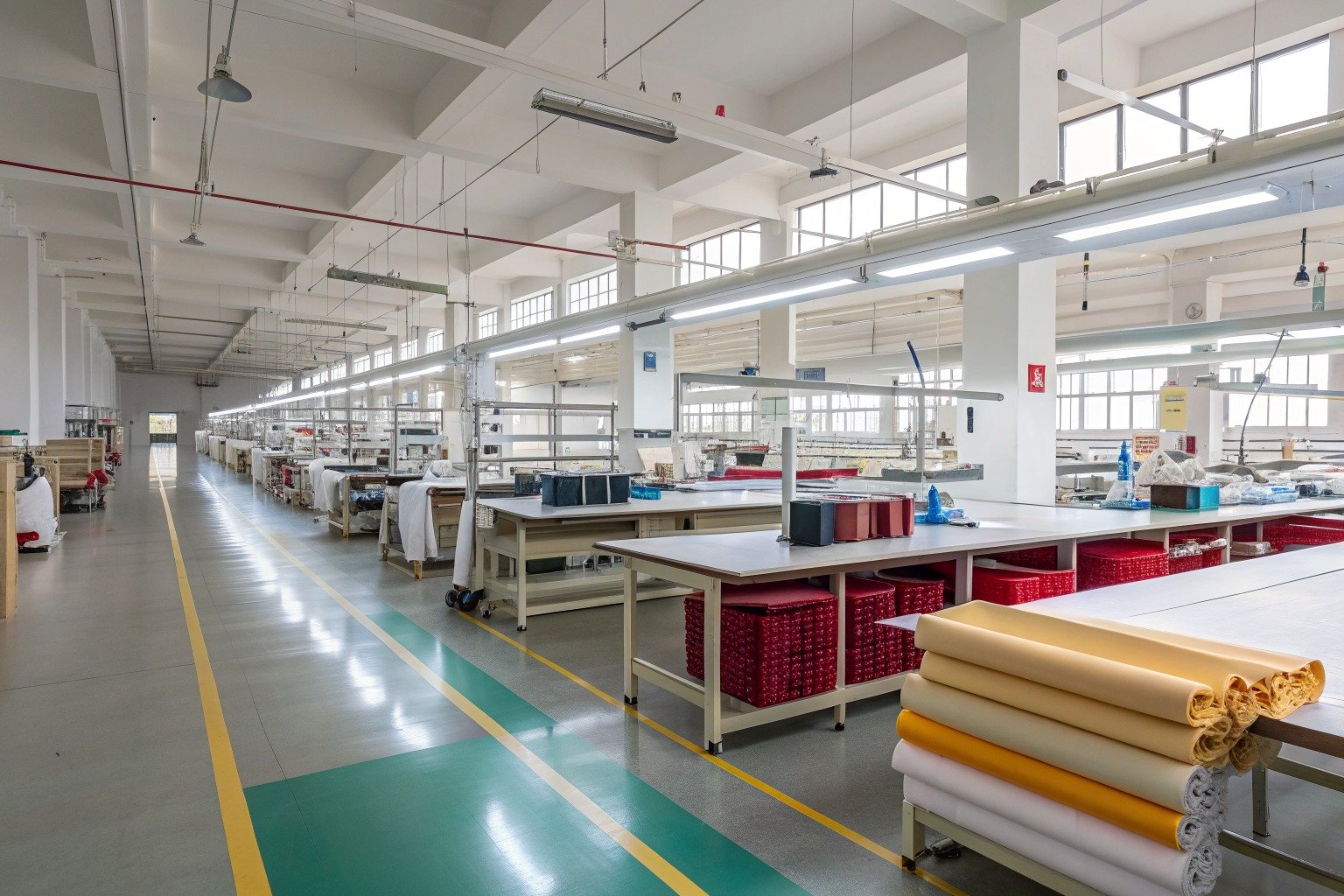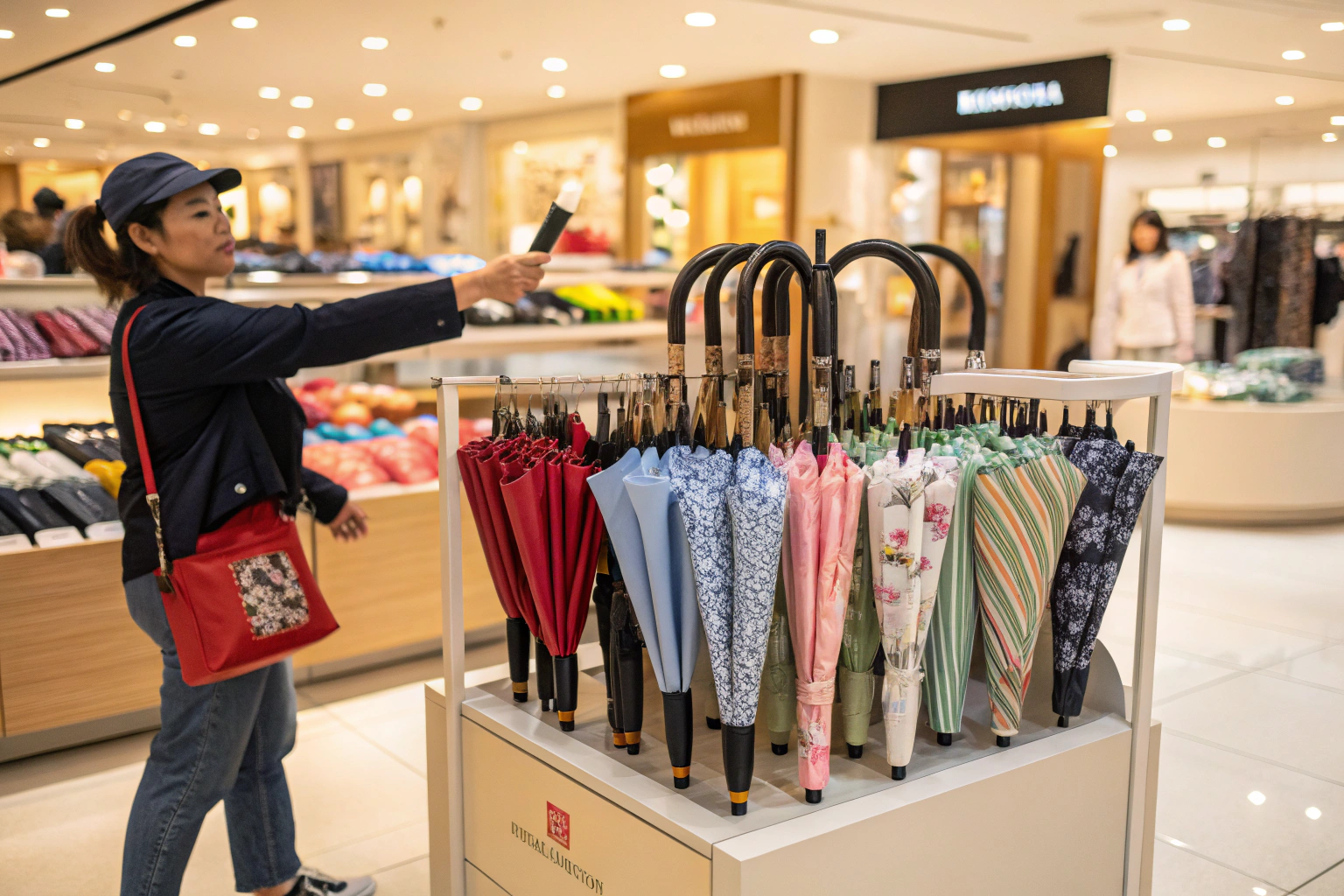
I stood in the accessories aisle of a major department store in Frankfurt last spring, watching shoppers interact with a display of our umbrellas. What struck me was not that they were buying them. It was how they were buying them. A woman picked up a compact travel umbrella, tested the auto-open button twice, felt the weight in her hand, checked the canopy fabric between her fingers, and then put it in her cart without even looking at the price tag. Across the aisle, another shopper did almost exactly the same thing with a full-size fashion umbrella in a muted floral print. I realized then that umbrella buying behavior is remarkably consistent across markets. Customers evaluate the same things: mechanism smoothness, perceived durability, fabric quality, and whether the design matches their personal style. The retailers who stock our umbrellas know this, and they order accordingly.
Our umbrellas are selling well in both US and European chain stores because we deliver a combination that addresses the core requirements of both markets simultaneously. Retail-tested functionality with auto-open and close mechanisms that meet the durability expectations of American consumers accustomed to generous return policies. Design restraint that satisfies European buyers who favor understated elegance and avoid loud branding. Regulatory compliance that clears both US and EU chemical and safety standards without requiring separate production runs. Consistent quality control that keeps in-store defect rates low, protecting the retailer’s margin and the brand’s shelf space. And a supply chain that hits seasonal delivery windows for both spring in the Northern Hemisphere and the back-to-school and holiday gifting periods that drive umbrella sales on both continents. I will explain each of these factors so you can see what makes a factory genuinely capable of serving both markets from a single production base.
What Product Features Make an Umbrella Appeal to Both American and European Buyers?
An umbrella that sells in both Chicago and Copenhagen cannot be designed solely for one market’s preferences and hope the other market tolerates the mismatch. There are fundamental product characteristics that both American and European chain store buyers evaluate, and the overlap between their requirements is larger than most suppliers realize. The umbrella that wins on both continents is the one that gets the functional basics right while exercising enough design discipline to avoid alienating either taste culture.
How Does Auto-Open and Close Mechanism Quality Drive Repeat Purchases?
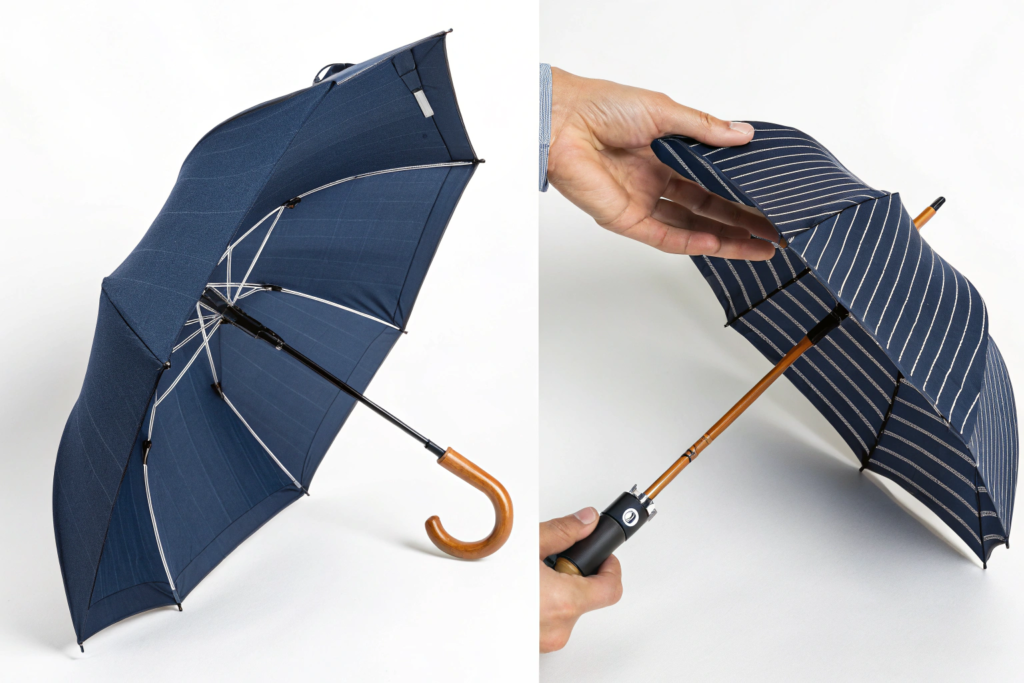
The mechanism is the heart of an umbrella, and it is the feature that generates the most customer complaints when it fails. American consumers, accustomed to generous return policies at major chains, will return an umbrella without hesitation if the auto-open button sticks or the shaft does not lock securely in the open position. European consumers are slightly less likely to return a product for a minor mechanism issue, but they are far more likely to tell friends and leave online reviews, which damages the retailer’s brand perception over time.
A high-quality auto-open mechanism uses a tempered steel spring that is neither too stiff nor too soft. Too stiff, and the customer struggles to close the umbrella or feels unsafe when it deploys with excessive force. Too soft, and the umbrella does not fully lock open, collapsing unexpectedly in a gust of wind. The mechanism we specify for our chain store umbrellas is tested for a minimum of 500 open-and-close cycles without failure. This is not a number we made up for marketing. It is the threshold that major retailers require based on their warranty claim data. A mechanism that fails at 300 cycles generates returns within the first season of use. A mechanism that passes 500 cycles typically lasts the full useful life of the umbrella for a normal consumer.
The auto-close feature, which retracts the canopy with a button press rather than requiring manual collapse, is particularly important for the travel umbrella category. A traveler stepping out of a taxi in the rain wants to close the umbrella with one hand while holding a bag or a phone in the other. An umbrella that requires two hands to close creates frustration at exactly the moment when the user is most inconvenienced by the weather. This feature commands a higher retail price, and both American and European chain buyers are willing to pay the wholesale premium because their data shows that customers who buy a one-hand-close umbrella are meaningfully more satisfied and less likely to return the product than customers who buy a manual-close model.
Why Do Weight and Folded Size Matter More Than Maximum Canopy Width?
Chain store buyers obsess over the weight and folded size of an umbrella because these dimensions drive two critical retail metrics. Shelf space productivity, meaning how many units fit on a standard fixture, and customer carry comfort, meaning how likely the customer is to actually have the umbrella with them when it rains. An umbrella left at home because it is too heavy or bulky to carry is an umbrella that generates no customer satisfaction and no reorder.
The compact travel umbrella segment, defined by a folded length of approximately 28 centimeters and a weight under 350 grams, is the highest-volume category in both the US and European chain store markets. This size slips into a handbag, a briefcase, or a car door pocket. It is light enough that the customer forgets it is there until it is needed. The full-size fashion umbrella segment, with a folded length of around 85 to 90 centimeters and a weight of 450 to 550 grams, serves a different use case. It is a statement accessory carried visibly, often with a curved wooden handle and a fabric sleeve. It sells at a higher price point and in lower volume, typically through department store channels rather than mass-market chains, though large European hypermarkets also do well with full-size umbrellas in regions with frequent, predictable rainfall.
Maximum canopy width is rarely the deciding purchase factor for chain store buyers, though it must meet a minimum threshold of around 100 centimeters for a full-size umbrella to provide adequate coverage. Beyond that threshold, adding more canopy width adds weight, adds cost, and reduces the number of units per shipping carton without meaningfully increasing the customer’s perception of value. A properly engineered umbrella balances these factors.
How Do Design Preferences Differ Between US and European Markets?
American and European consumers do not have completely different tastes, but they do have different default preferences. The baseline from which a design departs is not the same in Dallas as it is in Düsseldorf. A supplier who treats both markets as identical will produce umbrellas that sell adequately in one and poorly in the other. Understanding the nuanced differences allows a factory to create designs that work across both markets or, where necessary, to offer market-specific colorways within the same production framework.
What Colors and Patterns Perform Best in Both Regions?
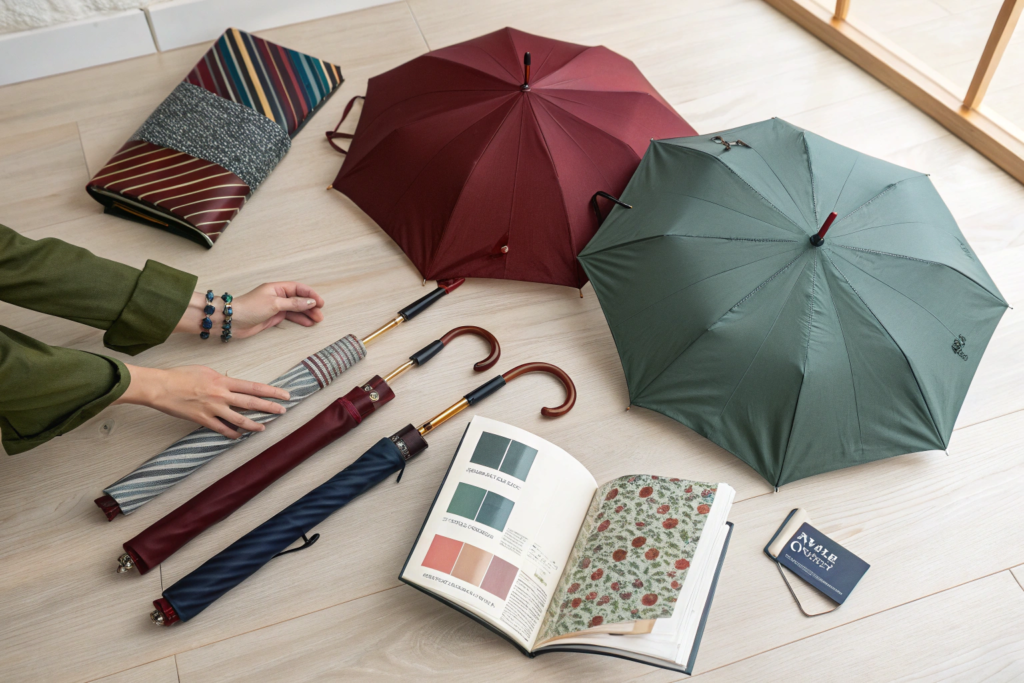
The overlap zone is larger than most brand owners expect. Navy blue is the single best-selling umbrella color in both the US and European markets, and it has held this position for years because it is perceived as classic, versatile, and appropriate for both men and women. Black is the second strongest seller in Europe and performs well in the US, particularly in urban markets. Burgundy and deep wine tones sell well in both markets as a fashion alternative to black, especially for women’s full-size umbrellas. A muted khaki green or olive has emerged as a strong performer in both regions, driven by the broader fashion trend toward utilitarian and outdoor-inspired color palettes.
The pattern divergence is more pronounced. American chain stores sell noticeably more plaid and buffalo check patterns than European chains, where these reads as rustic Americana rather than everyday fashion. European chains sell more fine tonal stripes, small-scale geometric prints, and subtle animal prints such as snakeskin embossing on the handle, patterns that American mass-market buyers often perceive as too subdued or too fashion-forward for their customer base. Floral prints perform in both markets but in different executions. American florals tend toward brighter contrasts and larger blooms. European florals favor muted, tonal, watercolor-style prints with smaller pattern repeats.
Smart chain store buyers in both regions increasingly converge on a core solid-color program supplemented by a small number of seasonal fashion patterns. This hybrid approach maximizes volume on the solids, which sell consistently regardless of trend shifts, while offering enough newness each season to keep the umbrella fixture visually fresh and to give repeat customers a reason to purchase another umbrella. A solid-color umbrella in navy, black, or burgundy with a high-quality mechanism and a premium handle finish is the closest thing to a universal seller in the umbrella category. If you are launching an umbrella program with chain store distribution, lead with the solids and earn the right to experiment with patterns after you have established your baseline sell-through rates.
Why Does Handle Material and Finish Influence Perceived Value?
The handle is the part of the umbrella the customer touches and sees every time they use it. It is also the part that photographs most prominently in ecommerce product images. A handle that looks and feels premium elevates the perceived value of the entire umbrella. A handle that looks and feels cheap drags down the perception of the canopy, the mechanism, and the brand, even if those other components are actually high quality.
Solid wood handles, typically beech or maple with a curved crook shape, are the standard for full-size fashion umbrellas in both markets. The wood must be smoothly sanded with no rough patches or splinters, and it must be sealed with a clear matte or satin varnish that protects against moisture without looking plasticky. A glossy, high-shine varnish on a wood handle reads as inexpensive to both American and European consumers because it looks like the plastic-coated wood handles found on low-cost convenience store umbrellas. The matte finish signals authenticity and craftsmanship.
Rubberized, non-slip handles on compact travel umbrellas are standard across both markets. The handle must be molded cleanly with no visible parting lines or flash from the injection molding process. A parting line that the customer can feel with their thumb is a tactile defect that communicates low quality every time the umbrella is used. The rubberized coating must be firmly bonded to the underlying plastic core. A coating that peels after a few months of use generates warranty returns and damages the retailer’s perception of your brand’s quality standards. These sensory details, which a customer might not consciously articulate, collectively create the impression of a premium product worth the higher retail price that chain stores want to command in their umbrella category. The materials and finishes selection process at AceAccessory involves tactile approval of every handle sample before it is specified into a production run, ensuring the customer’s first physical interaction with the umbrella communicates quality.
What Compliance Certifications Are Required for US vs. EU Umbrella Sales?
Selling umbrellas into US and European chain stores is not just a design and pricing exercise. It is a regulatory exercise. Both markets have chemical safety standards, labeling requirements, and testing protocols, and they are not identical. A factory that is unfamiliar with these differences can produce a shipment of umbrellas that clears customs in one market but is detained or fined in the other. The compliance work must be done before production, not after the goods are at the port.
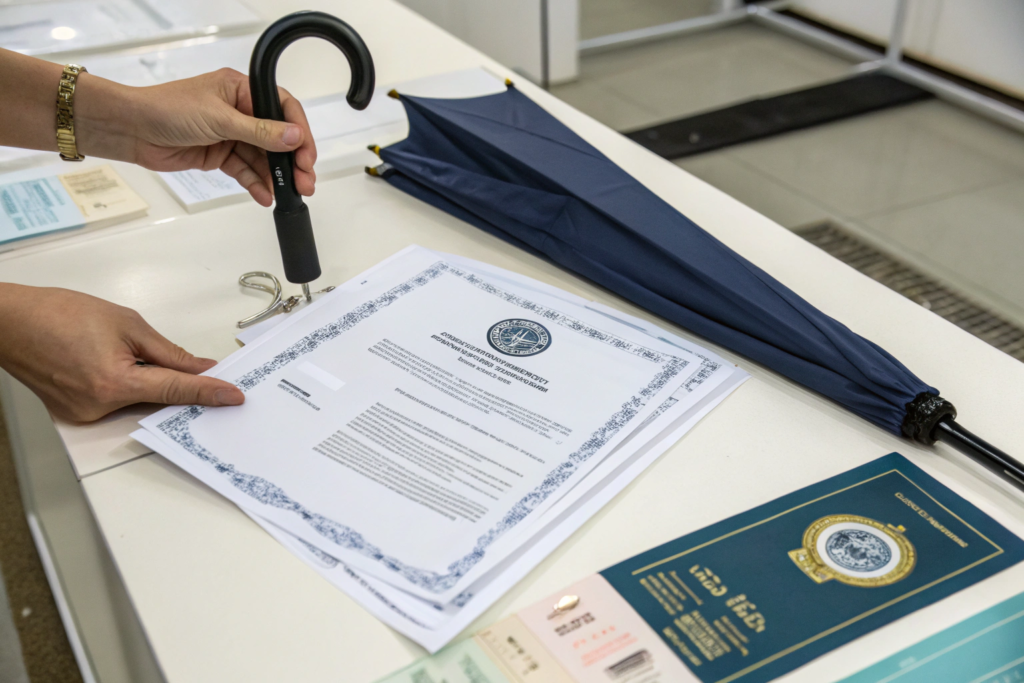
What US Testing Standards Apply to Umbrella Canopy Fabrics and Handles?
The United States regulates consumer products under the Consumer Product Safety Commission, and while umbrellas are not subject to a specific mandatory standard beyond general consumer safety requirements, major chain stores impose their own testing protocols that are effectively mandatory for any supplier who wants shelf space. These retailer-driven standards cover several specific risk areas.
The canopy fabric is tested for flammability under the standard for clothing textiles. While umbrellas are not clothing, the fabric sits close to the body, and retailers treat it under a similar risk profile. The fabric must pass the flammability test with a Class 1 or Class 2 rating, meaning no rapid surface flash. The fabric is also tested for lead content in any applied coatings, prints, or waterproofing treatments. The Consumer Product Safety Improvement Act sets the allowable lead limit in surface coatings at 90 parts per million, and any umbrella with a printed pattern or a colored coating on the canopy must demonstrate compliance through third-party lab testing.
The handle, whether wood, plastic, or rubberized, is tested for lead and phthalate content. Phthalates are plasticizers used to make plastics flexible, and certain phthalates are restricted in children’s products, though chain stores often apply the same restrictions to adult accessories as a matter of corporate policy. Any metal components, including the shaft, the ribs, and the mechanism springs, are tested for sharp points and sharp edges under the mechanical hazard testing protocols that retailers require for general merchandise. A metal rib tip that is not properly capped with a protective plastic cover is a sharp point hazard that can injure a customer when opening or closing the umbrella, and this is a common failure point in low-cost imports that have not been through a retailer’s compliance review.
How Do EU REACH Regulations Affect Umbrella Material Specifications?
The European Union’s REACH regulation, which stands for Registration, Evaluation, Authorisation, and Restriction of Chemicals, is broader and stricter than current US federal consumer product regulations in several categories relevant to umbrella manufacturing. REACH restricts a wide range of chemical substances in consumer products, and the restriction list is periodically updated. A substance that was compliant last year may be restricted this year, and the factory must stay current with these updates or risk a shipment rejection at the EU border.
For umbrellas, the REACH requirements that most frequently affect material choices are the restrictions on certain azo dyes that can break down into carcinogenic aromatic amines. Umbrella canopy fabrics in colors achieved through dyeing, especially dark blues, blacks, and reds, must be tested to confirm they do not contain restricted azo colorants above the 30 parts per million threshold. This test is mandatory for EU market access, and major retailers will not accept a supplier’s self-declaration. They require a test report from an accredited laboratory.
Waterproofing treatments on the canopy fabric are another REACH-sensitive area. Historically, some durable water repellent treatments used perfluorinated compounds that are now heavily restricted under REACH due to their persistence in the environment and their potential for bioaccumulation. Modern waterproofing treatments for EU-bound umbrellas must use PFC-free formulations that achieve adequate water repellency without the restricted chemistry. This is an area where the production formulation may differ between US-bound and EU-bound orders, not because US retailers do not care about environmental chemistry, but because the EU regulatory framework is legally binding and enforced at the border, while US requirements in this specific sub-category are currently driven more by retailer policy than by federal regulation.
The supply chain documentation requirements under REACH are also more extensive. Retailers may require a full material disclosure listing every chemical substance present in the umbrella above a 0.1% concentration threshold by weight. Producing this disclosure requires the factory to have collected chemical composition data from every material supplier in the umbrella’s bill of materials, from the canopy textile mill to the handle coating supplier to the metal plating subcontractor. A factory that has built these supplier documentation relationships over years can produce a REACH compliance package efficiently. A factory encountering the requirement for the first time will struggle for weeks. Referencing the official REACH regulation guidance maintained by the European Chemicals Agency gives you and your factory a clear common reference point for what is restricted and how compliance must be documented.
How Does Production Timing Serve the Seasonal Needs of Both Markets?
Timing a production run for an umbrella that sells in both US and European chains requires the factory to understand two different retail calendars that overlap imperfectly. The same physical product ships on different schedules depending on which side of the Atlantic it is destined for, and a factory that treats every order as if it has the same deadline will miss delivery windows and lose reorder opportunities.

When Do US Chains Plan Their Umbrella Inventory Buildup?
The US chain store umbrella calendar is shaped by two primary selling seasons. The spring rainy season drives the largest umbrella purchase orders of the year. US chains begin taking delivery of spring umbrella inventory in January and February, with the bulk of in-store inventory positioned by early March. The peak selling window for rain umbrellas runs from March through May, with residual sales through the summer thunderstorm months. A supplier whose goods arrive at the retailer’s distribution center in April has already missed the initial shelf set and will receive a reduced allocation, if the order is not canceled entirely.
The back-to-school and holiday gifting period, from August through December, is the second umbrella season in the US. Compact travel umbrellas sell as practical gifts and as student essentials. The order placement for this period typically occurs in May and June, with deliveries scheduled for July and August. Major chains run holiday promotions featuring umbrellas as stocking stuffers or add-on gifts, and inventory for these promotions must be in the distribution centers by October to allow time for allocation to individual stores.
A factory that understands the US retail calendar plans its production capacity accordingly. The spring order production runs through October and November, shipping in December for January arrival. The holiday order production runs through May and June, shipping in July for August arrival. This cadence requires the factory to have umbrella production capacity available during two distinct windows, which is manageable when the factory has a diversified product mix so that umbrella production does not compete for resources with other product categories during their peak seasons.
How Does the European Retail Calendar Differ from the US Pattern?
The European umbrella calendar shares the spring peak but with a slightly different shape. European chains tend to begin their spring umbrella floor sets slightly later than US chains, with inventory positioned in February and March rather than January and February. The peak selling window runs from March through May, similar to the US, but the autumn rainy season in Northern Europe creates a significant secondary peak in September and October that has no direct equivalent in the US market, where autumn umbrella sales are driven more by holiday gifting than by seasonal rainfall patterns.
The summer vacation travel period in Europe, concentrated in July and August, drives a distinct demand spike for compact travel umbrellas. European consumers traveling within Europe or internationally during these months encounter unpredictable summer rainfall and purchase travel umbrellas at airport shops, train station retailers, and travel goods stores. Chains with locations in transportation hubs or tourist destinations plan specific travel umbrella inventory for this window, with deliveries in June.
Production for the European autumn rainy season runs through May and June with July shipping for September shelf placement. The summer travel umbrella orders run through March and April with May shipping for June shelf placement. A factory serving both US and European chains must therefore have umbrella production capability available in a nearly continuous rhythm, with different order batches moving through the factory in what appears to be overlapping cycles. This is achievable when the factory’s production planning team treats umbrella capacity as a managed resource allocated across client orders based on their specific delivery windows rather than as a single seasonal rush. At AceAccessory, our supply chain planning process maps back from each retailer’s required in-store date, building in transit time and customs clearance, to establish an ex-factory date that drives the production schedule.
Conclusion
Our umbrellas sell well in both US and European chain stores because they are built on a foundation of product features, design principles, compliance rigor, and supply chain timing that address the common requirements of both markets while respecting their meaningful differences. The auto-open and close mechanism is tested to 500 cycles, meeting the durability expectations of American return policies and European quality expectations equally. The color and pattern strategy anchors in universal best-sellers like navy and black solids while allowing for market-specific seasonal patterns, plaid for the US and tonal stripes for Europe, without requiring separate production tooling.
The compliance work is done upstream. US flammability and lead testing and EU REACH chemical restrictions and azo dye testing are addressed at the material specification stage, not discovered at the port. The production calendar reflects the distinct seasonal rhythms of both markets. Spring delivery starting in January for the US, February for Europe, and a secondary autumn peak in September for Europe that has no direct US counterpart. A factory that manages these overlapping cycles competently keeps its umbrella production lines running productively across more of the calendar year, which benefits all clients through stable workforce retention and consistent quality.
The umbrella category is deceptively demanding. It combines mechanical engineering, textile performance, chemical compliance, fashion design, and seasonal logistics into a single product that retails for a relatively modest price. The factories that succeed in this category across both US and European chains are the ones that treat each of these dimensions as equally important and build the internal systems to manage them systematically.
If you are developing an umbrella program for US, European, or dual-market chain store distribution and want a manufacturing partner who understands the regulatory, design, and timing requirements of both regions, contact our Business Director Elaine at elaine@fumaoclothing.com. Tell her about your target retailers, your desired price positioning, and whether you need a core solid-color program, seasonal fashion patterns, or both. She can provide our mechanism specifications, compliance documentation, and a seasonal production calendar that aligns with your delivery windows. Your umbrella program should not just survive the requirements of chain store retail. It should thrive in them, and that begins with a factory that has done this before.