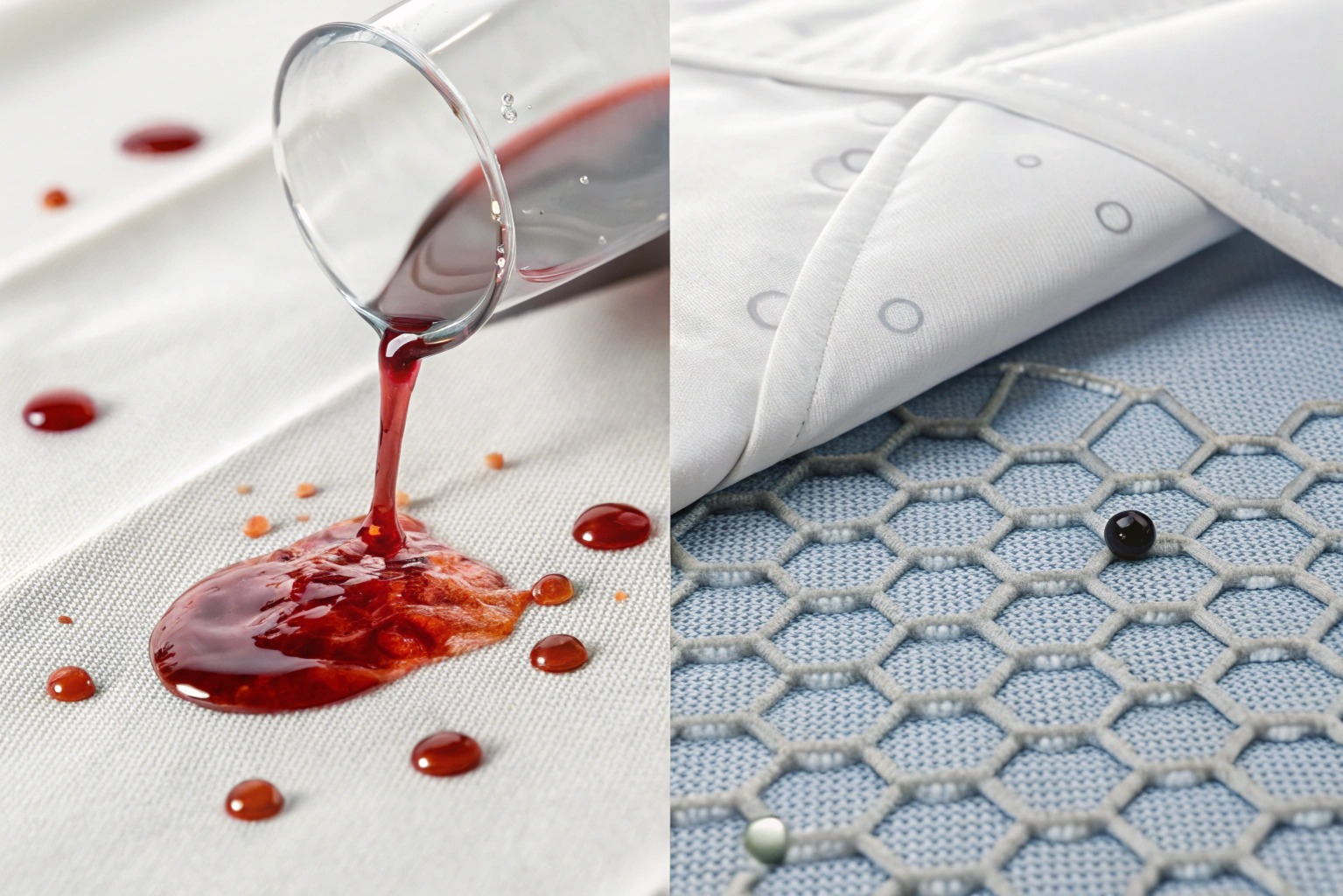
I’ve been in this industry long enough to know that one of the biggest headaches for consumers is keeping their accessories clean. A beautiful scarf gets a coffee stain. A pristine white cap gets a dirt smudge. A pair of gloves gets muddy. These accidents can ruin a beloved item. But what if the accessory could clean itself? What if stains simply couldn’t stick?
This is not science fiction. It’s the reality of self-cleaning fabric technology, and it’s advancing faster than ever. These innovations are poised to revolutionize the accessory market, offering consumers unprecedented convenience and durability. For buyers like Ron, who are always looking for the next big thing, self-cleaning fabrics represent a huge opportunity.
At Shanghai Fumao Clothing, we’ve been closely following these technological advances. We’re working with mills and researchers to understand how we can incorporate these fabrics into the accessories we make for our clients. In this post, I’ll share the latest innovations in self-cleaning fabric technology and what they mean for the future of fashion accessories.
What Is Self-Cleaning Fabric Technology?
Before we dive into the latest innovations, we need to understand the basic principles. "Self-cleaning" doesn’t mean the fabric magically scrubs itself. It means the fabric has been engineered to resist dirt, stains, and liquids, making them easy to remove—or causing them to simply roll off. The most common approach is to create a surface that is highly hydrophobic (water-repellent) and oleophobic (oil-repellent).
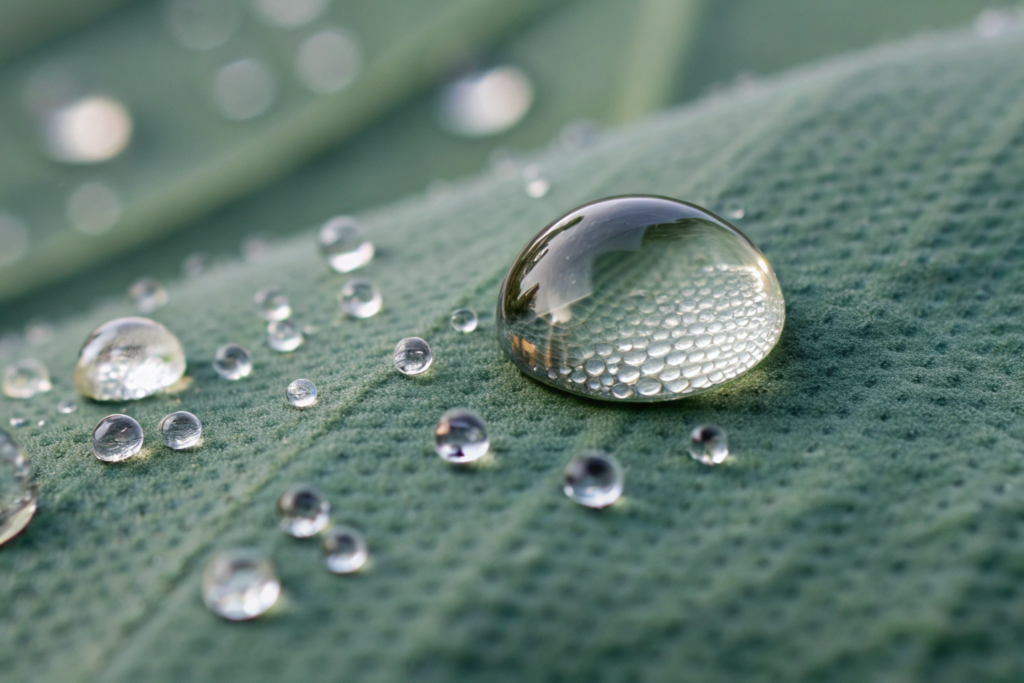
The inspiration for this technology comes from nature, specifically the lotus leaf. The lotus leaf has a microscopically rough, waxy surface that causes water to bead up and roll off, taking dirt and dust with it. This is known as the "lotus effect." Self-cleaning fabrics aim to replicate this effect. For a deeper dive into the science, resources like Nature and Science journals often publish research on biomimicry and materials science.
How does the "lotus effect" work on fabric?
The lotus effect is a combination of two factors: surface chemistry and surface structure.
- Surface Chemistry: The surface is coated with a hydrophobic (water-fearing) material. This means water molecules are more attracted to each other than to the fabric, causing them to form tight, spherical beads rather than spreading out and wetting the fabric.
- Surface Structure: The surface is engineered at a microscopic or nanoscopic level to be rough, with tiny peaks and valleys. This roughness minimizes the contact area between the water droplet and the fabric. The droplet essentially sits on top of these tiny peaks, with air pockets underneath.
When a dirty liquid lands on this type of surface, it forms a bead and rolls off. As it rolls, it picks up any loose dirt particles on the fabric, carrying them away. The result is a fabric that stays clean with minimal intervention.
What are the different approaches to creating self-cleaning fabrics?
There are several technological approaches to achieving this effect on textiles:
- Nanotechnology Coatings: This involves applying a finish to the fabric that contains nanoparticles. These particles create the necessary microscopic roughness and can also be chemically hydrophobic. This is a common and effective method.
- Plasma Treatment: Fabric can be treated with plasma (an ionized gas) to alter its surface chemistry and structure at a very fine level, making it hydrophobic. This is a more advanced, often more durable, but also more expensive technique.
- Incorporating Hydrophobic Fibers: Instead of a coating, the fibers themselves can be engineered to be hydrophobic. This creates a fabric that is inherently water-repellent throughout, not just on the surface. This can be more durable but also more complex to produce.
- Photocatalytic Coatings: Some advanced coatings use materials like titanium dioxide that, when exposed to light, break down organic dirt and stains through a chemical reaction. This is a true "self-cleaning" mechanism that can actually decompose stains.
Each approach has its own advantages and is suited to different applications and price points.
What Are The Latest Nanotechnology Innovations?
Nanotechnology is at the heart of most recent advances in self-cleaning fabrics. By manipulating materials at the scale of atoms and molecules, scientists can create coatings and treatments with incredible precision and effectiveness. The latest innovations are focused on making these treatments more durable, more environmentally friendly, and more versatile.
These are not just lab curiosities anymore. They are becoming commercially viable for a wide range of textile applications, including the accessories we make. For more on nanotechnology in textiles, resources like the Nanotechnology Industries Association and academic journals are excellent.
What are nano-whiskers and how do they work?
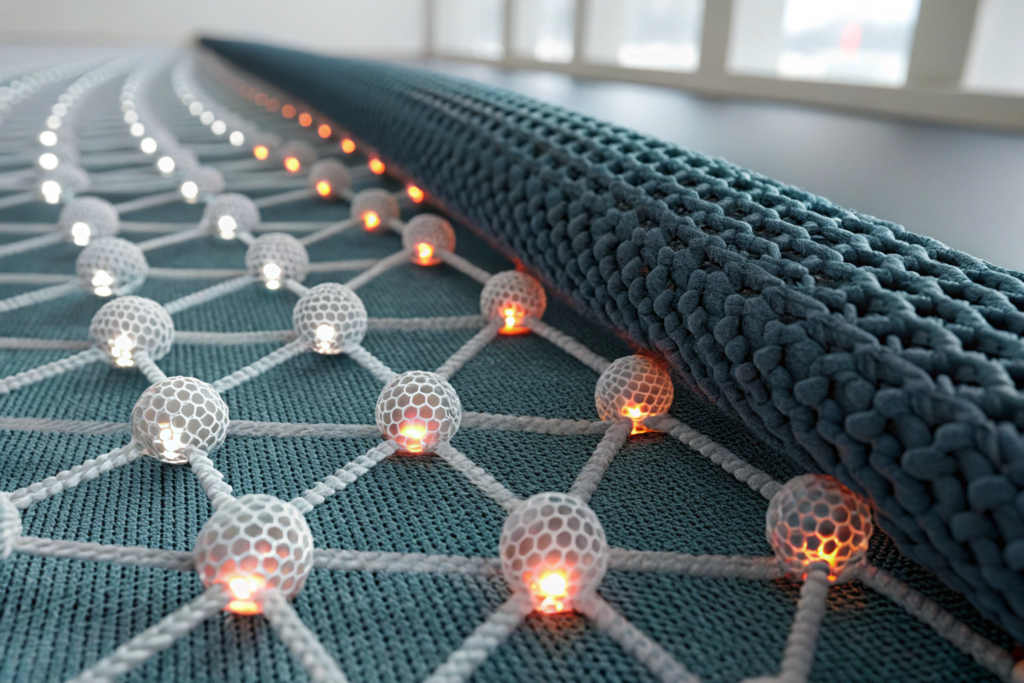
Nano-whiskers are tiny, hair-like projections that can be grown on the surface of fabric fibers. They are incredibly small—thousands of times thinner than a human hair. When applied to a fabric, these nano-whiskers create a rough, textured surface at the nanoscale, mimicking the structure of the lotus leaf.
This nanoscale roughness prevents liquid droplets from being able to wet the fabric. Combined with a hydrophobic chemical treatment, the result is a super-hydrophobic surface. Liquids bead up and roll off, taking dirt with them. Nano-whisker technology has been around for a while, but recent advances have made the whiskers more durable and the application process more consistent and cost-effective. This makes it a viable option for a wider range of accessory fabrics.
What are the latest developments in fluorocarbon-free repellents?
Traditional water-repellent treatments for fabrics often relied on long-chain fluorocarbons, sometimes called PFCs (perfluorinated chemicals). These are very effective, but they have raised environmental and health concerns because they are persistent and can accumulate in the environment and in living organisms.
The latest and most important innovation is the development of high-performance, fluorocarbon-free (C0) repellents. These new formulations use different chemistries—often based on dendrimers, hydrocarbons, or silicones—to achieve excellent water and oil repellency without the environmental persistence of PFCs.
- Dendrimer Technology: Dendrimers are highly branched, tree-like molecules that can create a very dense, hydrophobic layer on the fabric surface. They are effective and more environmentally friendly.
- Hydrocarbon and Silicone-Based Repellents: These are also being improved to offer performance that rivals traditional fluorocarbon treatments.
For brands with strong sustainability commitments, using a fluorocarbon-free repellent is now a major selling point. Consumers are increasingly aware of the issues with PFCs, and they want products that are both high-performance and environmentally responsible. A stain-repellent scarf treated with a C0 finish is a great example of this innovation.
How Durable Are Self-Cleaning Finishes?
A self-cleaning finish is only useful if it lasts. A coating that washes off after a few cycles or wears away with normal use is a gimmick, not a real innovation. Durability is the key challenge that researchers and manufacturers are working to overcome. The latest advances are focused on creating finishes that are bonded more strongly to the fibers and can withstand the rigors of wear and washing.
At our factory, we are very focused on this issue. We test every new fabric and finish for its durability. We want to be sure that the self-cleaning properties will last for a reasonable lifetime of the product. For standards on testing durable water repellency, organizations like AATCC have specific test methods (e.g., AATCC 22, AATCC 35).
How do you test the durability of a self-cleaning finish?
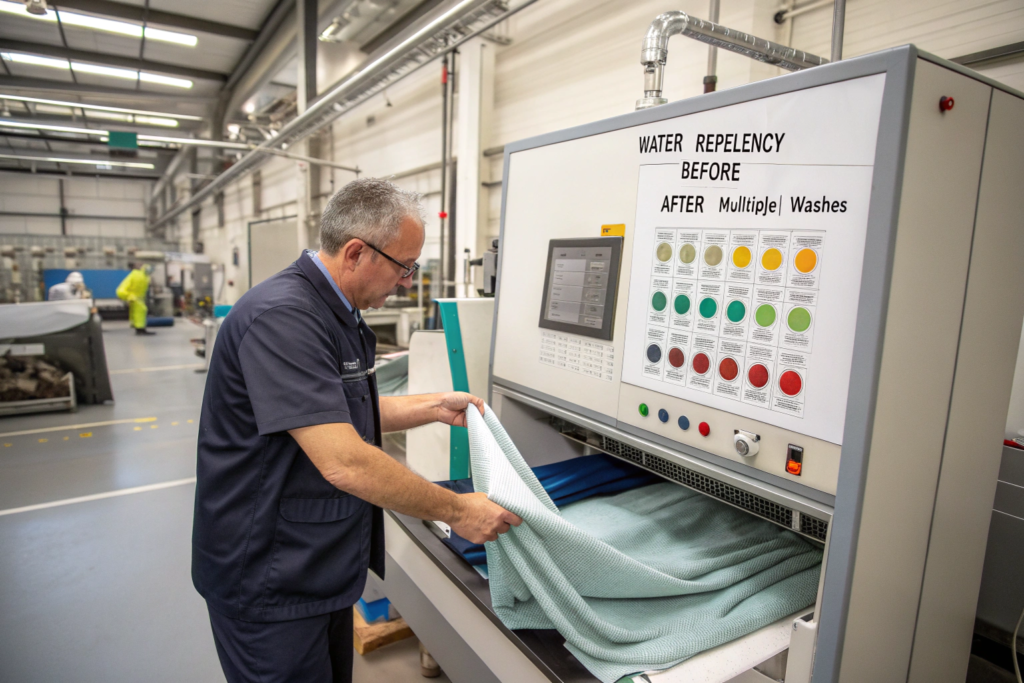
We use a multi-step process to test the durability of self-cleaning finishes:
- Initial Test: We first test the fabric’s water repellency using a spray test (AATCC 22). We spray a specific amount of water on the fabric and rate how well it beads up and rolls off.
- Laundering Cycles: We then put the fabric through multiple standard washing and drying cycles. We might test after 5, 10, 20, or even 50 washes.
- Retest: After a set number of washes, we repeat the spray test to see how much of the water repellency has been lost. A high-quality, durable finish should maintain a high level of performance even after many washes.
- Abrasion Testing: We also test the fabric’s resistance to abrasion, as rubbing can also wear away the finish.
This testing gives us a clear picture of the finish’s durability and allows us to choose the best options for our clients’ products.
What is the difference between durable and non-durable finishes?
- Non-Durable Finishes: These are often simple, inexpensive treatments that provide good initial water repellency but wash out very quickly. They might be fine for a product that will be dry-cleaned only or worn infrequently, but they are not suitable for everyday, washable accessories.
- Durable (DWR) Finishes: Durable Water Repellent (DWR) finishes are engineered to be more robust. They are bonded more strongly to the fibers and are designed to withstand multiple washes. The latest innovations in DWR technology, especially the fluorocarbon-free options, are focused on maximizing durability while maintaining performance.
For most fashion accessories that will be worn and washed regularly, a durable finish is essential. Customers expect the stain resistance to last.
What Are The Applications For Fashion Accessories?
Self-cleaning fabric technology has enormous potential for fashion accessories. These are items that are often exposed to the elements, to spills, and to dirt. They are also items that people want to keep looking nice. A stain on a favorite scarf or a dirty mark on a pristine white cap can be devastating. Self-cleaning technology offers a solution.
The applications are vast and growing as the technology becomes more accessible and affordable. At our factory, we are exploring ways to integrate these finishes into a wide range of our products. For more on textile applications, industry publications like Textile World and WWD often feature articles on new technologies.
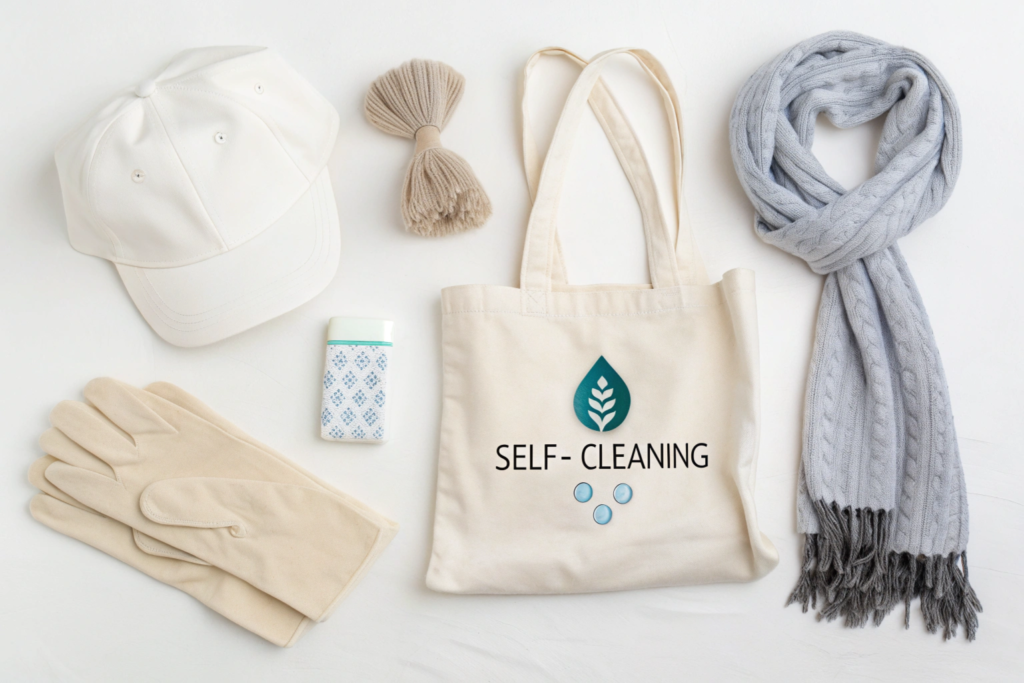
What accessories benefit most from stain-resistant technology?
- Scarves: Especially light-colored or silk scarves, which are highly vulnerable to stains from coffee, food, or makeup. A self-cleaning finish would make them much more practical for everyday wear.
- Caps and Hats: White baseball caps are a classic style, but they are notorious for getting dirty. A stain-resistant finish would keep them looking fresh much longer.
- Gloves: Gloves are constantly exposed to dirt, grime, and whatever we touch. Self-cleaning technology would make them easier to keep clean.
- Bags and Totes: A tote bag that resists stains from spills or from being set down on dirty surfaces would be a huge advantage.
- Hair Accessories: Scrunchies and headbands that resist product buildup and stains would be very appealing.
These are just a few examples. Any accessory that is prone to getting dirty is a candidate for this technology.
How can brands communicate the value of this technology to consumers?
The technology is invisible. The consumer can’t see it. So it’s essential to communicate its value clearly and effectively. This is a marketing challenge as much as a technical one.
- Clear and Simple Language: Use terms like "stain-resistant," "easy-clean," "water-repellent," and "protects against spills." Avoid overly technical jargon.
- Demonstration Videos: A short video showing a liquid (like coffee or juice) being spilled on the fabric and simply beading up and rolling off is incredibly powerful. This visual proof is much more effective than text.
- Hang Tags and Care Labels: Include a special hang tag that explains the technology and its benefits. Include simple care instructions, noting that the fabric is easy to clean.
- Storytelling: Connect the technology to the consumer’s lifestyle. "Our new stain-resistant scarf means you can enjoy your morning coffee without worry."
- Highlight Sustainability: If you are using a fluorocarbon-free finish, highlight that as a key benefit for environmentally conscious consumers.
By communicating the value effectively, you can turn a technical innovation into a powerful selling point. A stain-resistant cap is not just a cap; it’s a worry-free, long-lasting essential.
Conclusion
The latest innovations in self-cleaning fabric technology are truly transformative. From nanotechnology coatings that replicate the lotus effect to the development of durable, environmentally friendly fluorocarbon-free repellents, these advances are making it possible to create accessories that are easier to care for and last longer. The key is to ensure that these finishes are durable enough for real-world use and to communicate their value effectively to consumers.
At Shanghai Fumao Clothing, we are excited about the potential of these technologies. We are actively working with our mill partners to source fabrics with advanced, durable, and responsible self-cleaning finishes. We believe that this is the future of many fashion accessories, offering consumers a new level of convenience and performance. Our experienced project managers can help you navigate these options and select the right technology for your product line.
If you’re ready to explore how self-cleaning fabrics can elevate your accessory collection, let’s talk. Please contact our Business Director, Elaine, at elaine@fumaoclothing.com. We’ll help you create products that are as innovative as they are beautiful.