As a brand owner like Ron, you’re developing a new collection of printed scarves. You have the vision—the colors, the patterns, the overall aesthetic. But now you’re faced with a critical technical decision that will fundamentally impact the final product’s look, feel, and cost: which printing method should you use? Your factory has asked if you want "screen printing" or "sublimation." To you, these might just be technical terms, but to a manufacturing professional, they represent two completely different worlds of technology, materials, and creative possibilities. How do you make the right choice for your brand?
The core difference between screen printing and sublimation lies in how the ink interacts with the fabric. Screen printing lays a layer of thick, opaque ink on top of the fabric, creating a bold, tactile, and vibrant print that is best suited for natural fibers like cotton and silk with simple, graphic designs. Dye-sublimation, on the other hand, uses heat to turn ink into a gas that permanently infuses into the fibers of synthetic fabrics like polyester, resulting in a soft, seamless, and photorealistic print with unlimited colors that you cannot feel.
I’m the owner of Shanghai Fumao Clothing, and this is a conversation I have with brand owners every single day. There is no "better" method; there is only the "right" method for your specific design, your chosen fabric, and your target customer. Choosing the wrong process can lead to a washed-out design, a stiff and unpleasant feel, or a much higher cost than you anticipated. Understanding the fundamental differences between these two technologies is the key to unlocking your design’s true potential. Let’s put on our lab coats and dive into the science of scarf printing.
What is Screen Printing and When Should You Use It?
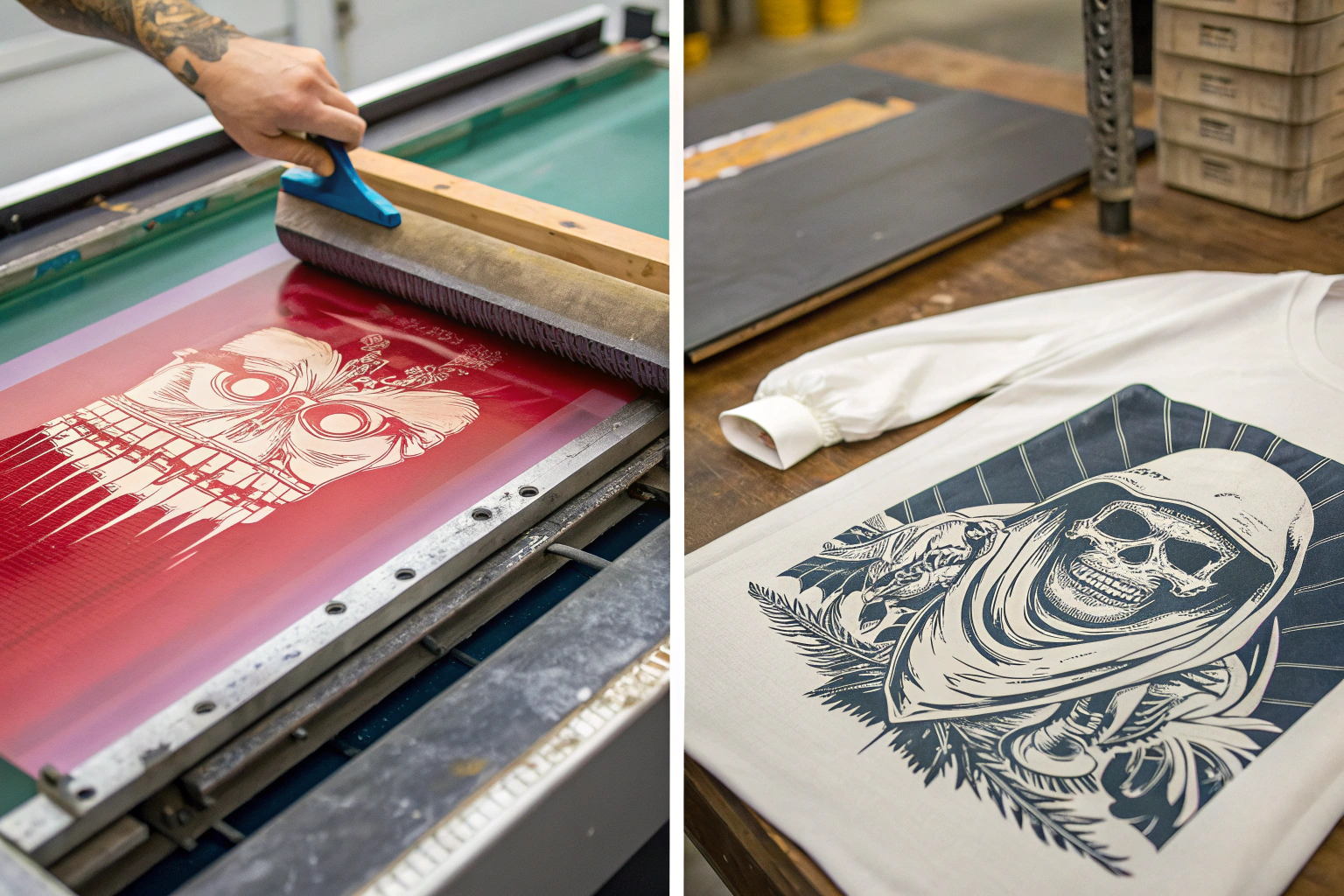
Screen printing is the classic, time-honored workhorse of the textile printing industry. It’s a craft-based, analog process that has been used for centuries to create bold, graphic designs. Think of a classic band t-shirt or a graphic tote bag—that’s the iconic screen printing look.
Screen printing is a "stencil" method where a mesh screen is used to transfer a thick layer of ink onto the surface of the fabric. A separate screen must be created for each color in the design. This process excels at producing simple, bold, graphic designs with a limited number of solid colors on natural fiber scarves (like cotton, linen, or silk). It is the ideal choice when you want a vibrant, slightly raised, tactile print and are working with 1-5 distinct colors. It is also highly cost-effective for very large production runs.
Let’s break down the process and its best use cases:
- The Process:
- Your design is separated into its individual colors.
- A separate screen (a fine mesh stretched over a frame) is created for each color. The screen is coated with an emulsion, and your design is "burned" into it with UV light, creating a stencil.
- The scarf fabric is laid flat. The first screen is placed on top, and a thick, opaque ink is pulled across the screen with a squeegee. The ink only passes through the open areas of the stencil.
- The scarf is then dried, and the process is repeated with the next screen for the next color, and so on.
- When to Choose Screen Printing:
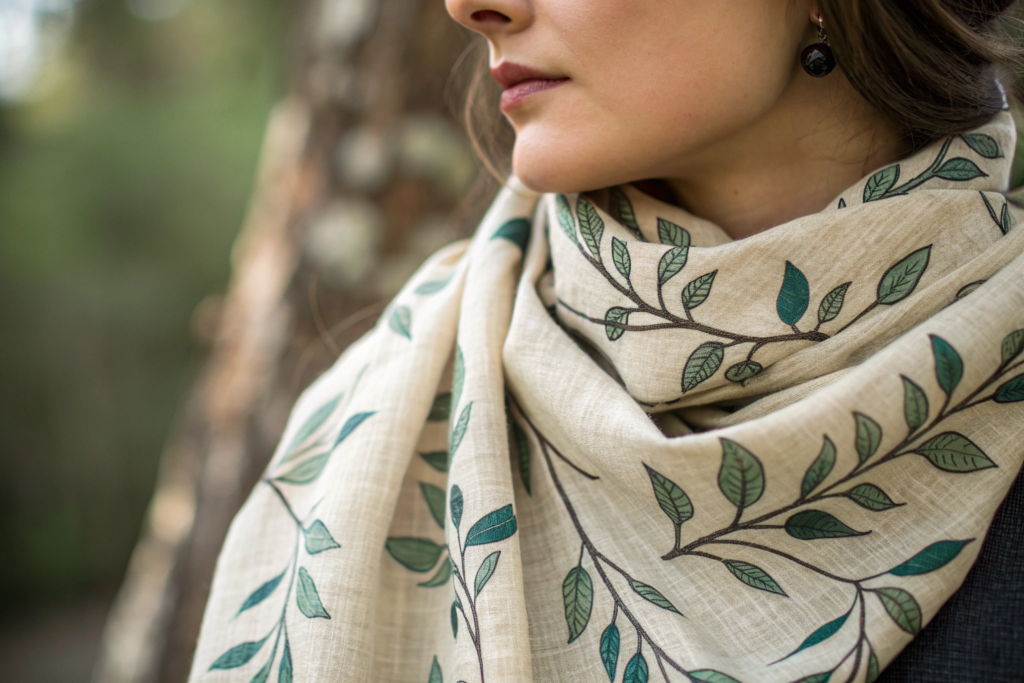
- Natural Fiber Fabrics: Screen printing inks are formulated to adhere beautifully to natural fibers like cotton, silk, linen, and viscose. If you want to print on a 100% silk scarf, screen printing is one of your best options.
- Simple, Graphic Designs: It’s perfect for logos, typography, geometric patterns, or any design with distinct, solid blocks of color.
- Limited Color Palette: The process is most efficient for designs with 1-5 colors. Every additional color requires a new screen and a new setup, which adds cost.
- Vibrant, Opaque Colors: Screen printing inks are thick and opaque. This means you can print a bright white or light yellow design onto a black scarf and it will be incredibly vibrant.
- Large Production Runs: The initial setup cost (creating the screens) can be significant, but once the screens are made, the per-scarf printing cost becomes very low. This makes it very economical for runs of 500+ pieces.
What are the disadvantages of screen printing?
The main limitations are the complexity of the design and the feel of the print. It is not suitable for photorealistic images or designs with gradients and millions of colors. Because the ink sits on top of the fabric, a very large print can feel heavy or stiff and can affect the drape of a delicate fabric like silk.
What is "hand-feel"?
"Hand-feel" is a term used in the textile industry to describe how a fabric or a print feels to the touch. A screen print has a noticeable "hand-feel"—you can feel the slightly raised layer of ink. A sublimation print, as we’ll see, has zero hand-feel.
What is Dye-Sublimation and When is it the Right Choice?
Dye-sublimation is a modern, digital printing technology that works on a completely different principle. It’s less of a "print" and more of a "transfusion," where the ink becomes a permanent part of the fabric itself.
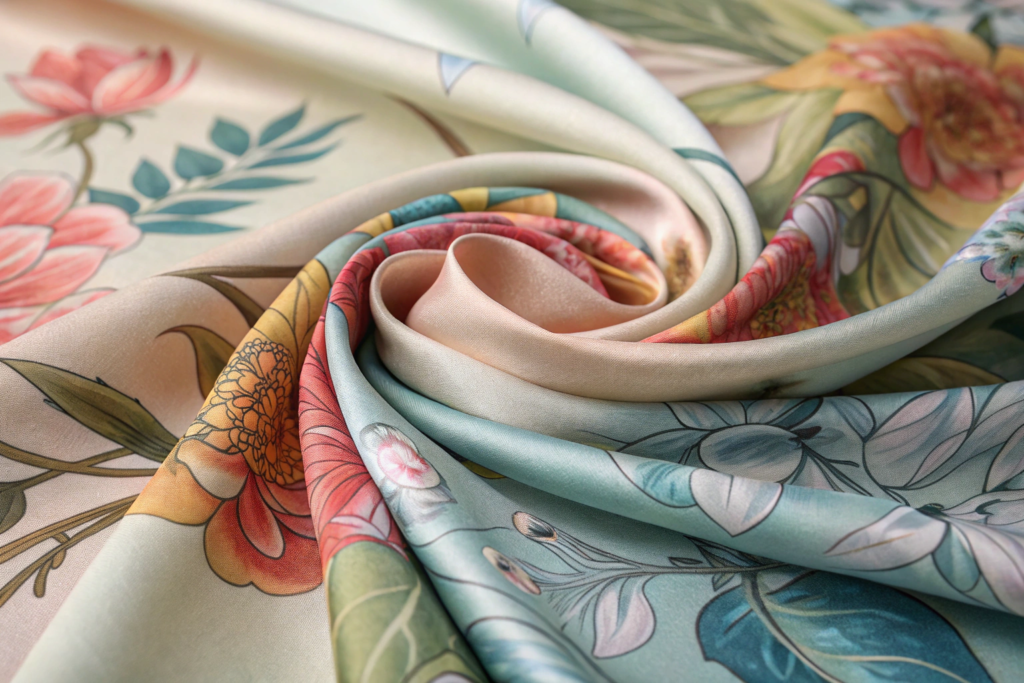
Dye-sublimation is a digital printing process where a design is first printed onto a special transfer paper using sublimation inks. This paper is then placed on top of a synthetic fabric (polyester) and subjected to high heat and pressure. The heat turns the ink into a gas, which then permeates and bonds with the polyester fibers on a molecular level. This process is ideal for creating complex, full-color, photorealistic designs on polyester scarves. The resulting print has zero "hand-feel," is incredibly durable, and will never crack, peel, or fade.
Let’s look at the magic of sublimation:
- The Process:
- Your digital design file (a JPEG, TIFF, etc.) is printed onto a sheet of special transfer paper using a large-format inkjet printer with sublimation inks.
- The printed paper is placed face-down on a piece of white or light-colored polyester fabric.
- This "sandwich" is placed in a heat press, which heats it to around 200°C (400°F).
- The heat causes the solid ink on the paper to turn directly into a gas (this is "sublimation"). The gas is forced into the polyester fibers, which have opened up due to the heat.
- As the fabric cools, the fibers close, trapping the ink permanently inside the fabric. The ink is now in the fabric, not on it.
- When to Choose Dye-Sublimation:
- Synthetic Fabrics: Sublimation chemistry only works with polyester or fabrics with a very high polyester content (at least 60-70%). It does not work on natural fibers like 100% cotton or silk.
- Complex, Full-Color Designs: This is where sublimation shines. You can print photographs, intricate paintings, designs with millions of colors, and smooth gradients with perfect clarity. There is no limit to the number of colors.
- Soft, Seamless Feel: Because the ink is infused into the fabric, the printed area feels exactly the same as the unprinted area. There is zero "hand-feel." This is ideal for a delicate, flowing scarf where the drape and feel are paramount.
- Small to Medium Production Runs: Sublimation is a digital process with no screen setup costs. This makes it very cost-effective for producing small batches, custom orders, or samples.
- Edge-to-Edge Printing: Sublimation allows for "full bleed" or edge-to-edge printing, covering the entire surface of the scarf with your design.
Can you sublimate on dark fabrics?
No. Because the sublimation process infuses the fabric with translucent dye, it can only be done on white or very light-colored fabrics. The color of the fabric will affect the final color of the print. Think of it like using a watercolor paint on colored paper. For the most vibrant, true-to-design colors, you must start with a white base fabric.
What about polyester blends?
Sublimation works best on 100% polyester. If you sublimate on a 50/50 polyester/cotton blend, the ink will only bond with the 50% polyester fibers. This will result in a faded, "vintage" or "heathered" look. This can be a cool aesthetic if it’s what you’re going for, but it will not produce a vibrant, saturated print.
How Do Cost, Durability, and Feel Compare?
Now that you understand the basic technology, let’s put them head-to-head on the three factors that matter most to you and your customer: cost, durability, and the final feel of the product.
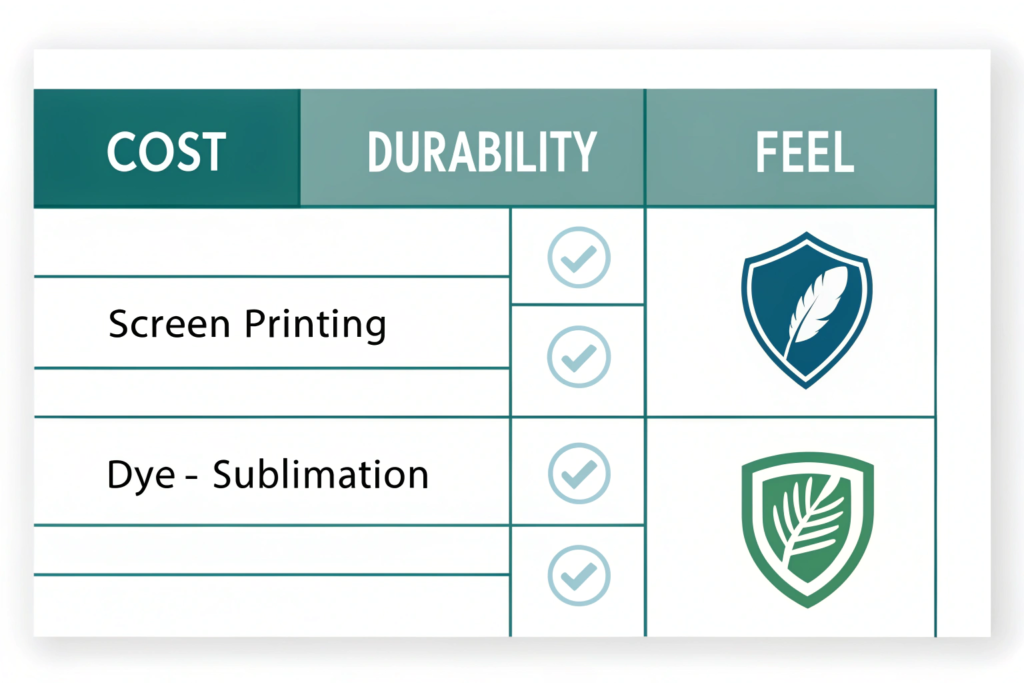
When comparing the two methods, a clear trade-off emerges. Screen printing is more cost-effective for large runs of simple designs on natural fibers, but the print has a noticeable, tactile "hand-feel." Dye-sublimation is more cost-effective for small runs of complex, full-color designs on polyester, and it offers superior durability and a completely seamless, undetectable "hand-feel." The "better" choice depends entirely on your design’s complexity, your choice of fabric, and your production volume.
Here is a direct comparison table:
| Feature | Screen Printing | Dye-Sublimation |
|---|---|---|
| Best Fabric | Natural fibers (Cotton, Silk, Linen) | Synthetic fibers (Polyester) |
| Design Complexity | Best for simple, graphic designs with solid colors. | Excellent for complex, photorealistic designs with unlimited colors and gradients. |
| Color Palette | Limited. Cost increases with each additional color. | Unlimited colors at no additional cost. |
| "Hand-Feel" | Noticeable. Ink sits on top of the fabric. Can feel thick or heavy with large prints. | Zero. Ink is infused into the fabric. The print cannot be felt. |
| Durability | Good. High-quality ink will last a long time but can crack or fade after many washes. | Excellent. The print is permanent and will not crack, peel, or fade. It lasts as long as the garment. |
| Cost Structure | High initial setup cost (for screens). Low per-unit cost on large runs (>500). | No setup cost. Consistent per-unit cost, making it ideal for small to medium runs. |
| Color Vibrancy | Excellent, especially on dark fabrics, as the ink is opaque. | Excellent on white/light fabrics, but the dyes are translucent. |
Which method is more "eco-friendly"?
This is a complex question with no simple answer.
- Screen Printing: Traditional plastisol inks are plastic-based. However, water-based inks are a more eco-friendly alternative. The process also uses a lot of water for cleaning the screens.
- Dye-Sublimation: This is a "dry" process that uses no water. However, it requires polyester, which is a petroleum-based synthetic fiber. Using a polyester made from recycled plastic bottles (rPET) can make sublimation a very sustainable option.
Many brands focused on sustainability will opt for screen printing with water-based inks on organic cotton, or dye-sublimation on recycled polyester.
What about a silk-like polyester scarf?
This is a very popular and effective combination. Modern polyester fabrics can be made to have an incredibly soft, silky, and luxurious feel. A brand like Echo New York often uses polyester to create beautiful, complex, and affordable printed scarves. By using a high-quality polyester and the dye-sublimation process, you can achieve a product that has the visual appeal of a designer silk scarf but with the durability and cost-effectiveness of sublimation.
How Do I Prepare My Artwork for Each Process?
The final quality of your print depends heavily on the quality of the digital artwork you provide to your manufacturer. Each printing process has its own specific artwork requirements. Providing the wrong type of file will lead to delays and a poor-quality print.
For screen printing, you must provide your artwork as a "vector" file (e.g., an Adobe Illustrator .AI or .EPS file). Vector art is made of mathematical lines and shapes, which allows each color to be cleanly separated onto its own screen. For dye-sublimation, you must provide your artwork as a high-resolution "raster" file (e.g., a Photoshop .TIF or .JPG file, at least 300 DPI at the final print size). Raster art is made of pixels, which is necessary to capture the fine details and color gradations of a photograph or complex illustration.
Here’s your artwork checklist:
- For Screen Printing:
- File Type: Vector (.AI, .EPS, .SVG, or a layered .PDF).
- Colors: All colors should be solid and defined as specific Pantone "spot" colors. This ensures the factory mixes the exact ink color you want. Do not use gradients or transparencies.
- Fonts: All text should be converted to "outlines" or "curves" so that the factory doesn’t need to have the specific font you used.
- Line Thickness: Ensure that your lines are thick enough to print cleanly. A line that is too thin might not show up. Your factory can give you their minimum line thickness requirement.
- For Dye-Sublimation:
- File Type: High-Resolution Raster (.TIF, .PSD, or high-quality .JPG).
- Resolution: The file must be at least 300 DPI (Dots Per Inch) at the final, full-size dimensions of the scarf. A low-resolution image from a website will look blurry and pixelated when printed.
- Color Mode: The file should be in CMYK color mode, as this is the color space that most digital printers use.
- "Bleed": If you want your design to go all the way to the edge of the scarf, you must include a "bleed"—an extra area of the design that extends beyond the final cut line. This ensures that there are no unprinted white edges after the scarf is cut.
Providing your factory with a "print-ready" file in the correct format is a sign of professionalism and will ensure your project starts off on the right foot.
What is a Pantone color?
The Pantone Matching System (PMS) is a standardized color library. Each color has a unique number (e.g., "PANTONE 185 C" is a specific shade of red). By specifying a Pantone number, you and your factory can be sure you are talking about the exact same color, regardless of how it looks on your different computer screens. It’s the professional standard for color specification in printing.
What happens if I only have a JPG for my screen print design?
If your design is simple enough, the factory’s art department can often "vectorize" it for you by tracing it in a program like Adobe Illustrator. However, they will likely charge a fee for this service, and it can introduce small inaccuracies. It is always best to create the artwork in the correct format from the beginning if possible.
Conclusion
The choice between screen printing and dye-sublimation is a strategic decision that should be driven by your design, your fabric choice, and your business goals. There is no universally "better" option. If your brand’s vision is centered on bold, graphic designs on natural, organic fabrics like cotton or silk, then screen printing is your trusted, time-honored partner. If your vision is to create stunning, photorealistic, and infinitely colorful designs on modern, silky, and durable polyester fabrics, then dye-sublimation is the revolutionary technology that will bring your ideas to life. By understanding the fundamental differences in their process, cost, feel, and artwork requirements, you can work with your manufacturing partner to make a confident, informed decision that will result in a beautiful, successful, and profitable scarf collection.
At 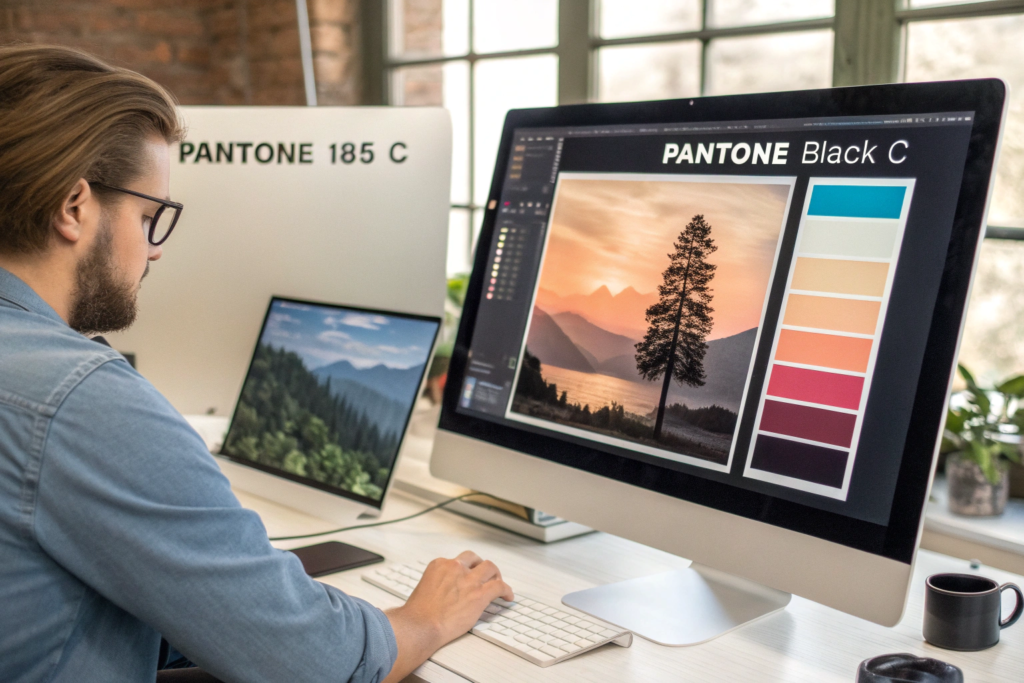 , we are experts in both technologies. Our team can look at your design and instantly know the best way to produce it. We can guide you on the fabric choices, help you prepare your artwork, and manage the entire production process to ensure a flawless result. We believe in educating our partners, so they can make the best possible decisions for their brands. If you are ready to create your next collection of printed scarves, please reach out to our Business Director, Elaine, at elaine@fumaoclothing.com.