As a brand owner like Ron, you’ve just approved the final production sample of your stunning new collection of delicate straw hats. They are perfect—the weave is intricate, the shape is elegant, the trim is flawless. You’ve invested heavily in the design and the materials. But now, a critical and often overlooked phase begins: the period after the hats are made but before they are packed for their long ocean journey. A crucial question should be forming in your mind: How is my supplier protecting my investment during this storage period? How do I ensure that the perfect hat I approved is the same hat that gets shipped, not one that has been crushed, warped, or discolored by improper storage?
The best practices for storing delicate straw hats before shipping are centered on a core principle: preserving the hat’s shape and protecting the straw’s integrity. This involves a multi-layered system that includes: 1) Using individual, custom-shaped crown supports to prevent crushing; 2) Storing hats individually on well-ventilated shelves in a climate-controlled environment to prevent mold and warping; 3) Implementing strict handling protocols, such as the use of gloves, to prevent stains; and 4) Conducting a final, rigorous quality control inspection immediately before packing to catch any damage that may have occurred during storage.
I’m the owner of Shanghai Fumao Clothing, and I can tell you that a factory’s storage practices are a true litmus test of their professionalism. Any workshop can make a hat. But only a truly professional manufacturer understands that their responsibility doesn’t end when the last stitch is sewn. The final, crucial steps of storage and packing are where a factory’s commitment to quality is truly revealed. A crushed brim or a spot of mold is not just a damaged product; it’s a broken promise to you and your customer. Let’s walk through the professional methodology for ensuring every hat remains perfect from the production line to the shipping container.
How Do You Protect the Hat’s Shape from Crushing and Warping?
The number one enemy of a delicate straw hat is pressure. The weight of another hat, the pressure of a misplaced hand, or even just the pull of gravity over time can deform the crown and warp the brim, causing irreversible damage. Protecting the hat’s three-dimensional structure is the most important job during storage.
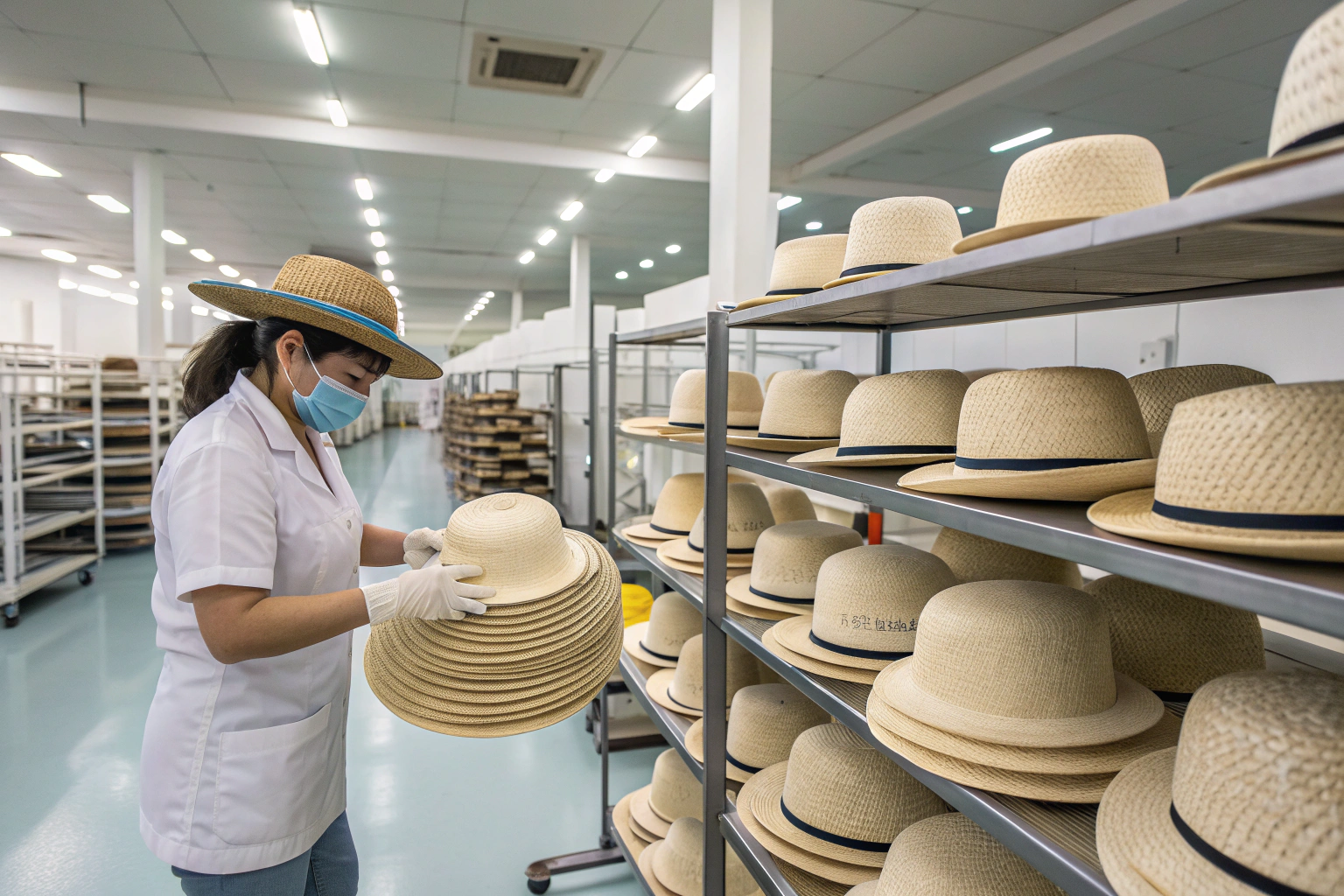
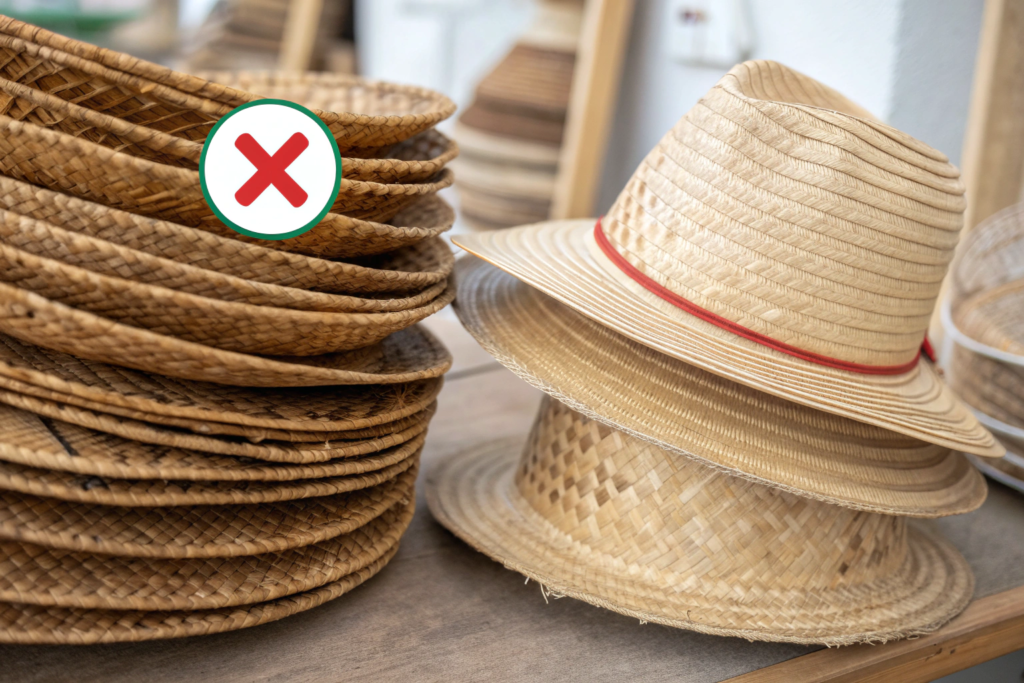
To protect a straw hat’s shape, you must use individual crown supports and completely avoid stacking. The best practice is to insert a custom-molded plastic or paper pulp "crown mold" into each hat immediately after it passes its initial QC. This internal support structure bears all the pressure and maintains the intended shape of the crown. The hats must then be stored individually on shelves, never stacked directly on top of one another, as stacking will inevitably crush the brims of the hats at the bottom of the pile.
Let’s break down the essential components of shape preservation:
- Individual Crown Supports (The "Hat Skeleton"):
- What they are: These are custom-molded forms, typically made from clear, lightweight PET plastic or molded paper pulp. They are designed to perfectly match the interior shape of the hat’s crown.
- Why they are critical: The support acts like an internal skeleton. It prevents the crown from collapsing, creasing, or being dented. It’s the single most important tool for shape preservation. A factory that doesn’t use these is not serious about quality.
- The "No Stacking" Rule:
- The Problem: Stacking is the cardinal sin of hat storage. It might seem efficient, but it is a death sentence for the brims. The weight of the stack will cause the brims of the lower hats to flatten, curl, or break.
- The Solution: Each hat needs its own "personal space." They should be placed individually on flat, clean shelves. For hats with very wide, flat brims, they should be stored flat. For hats with downward-sloping brims (like a cloche), they can sometimes be stored upside down on their crowns (as long as the crown is supported) to protect the brim’s angle.
- Proper Shelving and Spacing:
- The shelves should be wide enough to accommodate the full brim without it being bent or pushed against a wall.
- There should be enough vertical space between shelves so that the crowns are not being compressed.
When you are vetting a supplier, ask them to send you photos of their hat storage area. If you see tall, wobbly stacks of hats, that is a massive red flag. If you see neat rows of individually supported hats on clean shelves, you are dealing with a professional.
What are the different types of crown supports?
- Clear Plastic Molds: These are excellent because they are durable, reusable, and allow you to see the inside of the hat. They are the professional standard.
- Molded Paper Pulp: A great, eco-friendly option that offers good support.
- Acid-Free Tissue Paper: For very short-term storage or for filling out odd shapes, stuffing the crown with acid-free tissue paper is a basic but acceptable method. However, it does not provide the rigid structural support of a mold.
How is the crown support mold made?
It’s made from a mold that is based on the original wooden or metal block that the hat was shaped on. A professional hat factory will have a library of these supports that correspond to the hat blocks they use for production, ensuring a perfect fit.
How Do You Protect the Straw from Environmental Damage?
The straw itself is a natural, organic material. This is what makes it beautiful, but it’s also what makes it vulnerable. Its greatest enemies are moisture, which causes mold, and excessive dryness or sunlight, which can make the straw brittle and cause it to crack or fade.
To protect the straw material, the hats must be stored in a dedicated, climate-controlled environment where temperature and humidity are kept within a stable range. The ideal is a cool, dry, and dark room with a relative humidity of 50-60% and a temperature of 15-25°C (60-77°F). This environment is stable enough to prevent the straw from absorbing excess moisture (which leads to mold) or drying out completely (which leads to brittleness). The hats should also be protected from direct sunlight, which can cause fading and UV degradation of the fibers.
Here are the key elements of environmental protection:
- Humidity Control (The Most Critical Factor):
- The Danger of High Humidity (>70%): Straw is hygroscopic, meaning it absorbs moisture from the air. In a humid environment, the straw will absorb water, creating the perfect breeding ground for mold and mildew. Once mold starts to grow, the hat is usually ruined.
- The Danger of Low Humidity (<40%): In a very dry environment, the straw will lose its natural moisture. This causes the fibers to become brittle and prone to cracking and breaking.
- The Solution: A professional factory must use dehumidifiers (in humid climates) or humidifiers (in dry climates) to maintain a stable humidity level, monitored by a device called a hygrometer.
- Temperature Control:
- Extreme heat can accelerate the drying out process and make the straw brittle. A stable, cool-to-room-temperature environment is ideal. This usually requires air conditioning.
- Protection from Light:
- Direct sunlight is a killer. The UV rays will bleach the color out of the straw (and any fabric trims) and will degrade the straw fibers themselves, making them weak. The storage area should be a dark room or have no direct window exposure.
- Ventilation and Cleanliness:
- Good air circulation helps to prevent pockets of stagnant, humid air where mold can start. The room should be well-ventilated.
- The storage area must be kept spotlessly clean. Dust and dirt can settle on the hats and can also attract moisture and pests.
A factory that stores your expensive straw hats in a damp, uncontrolled corner of the main factory floor is not a suitable partner. You must insist on a dedicated, clean, climate-controlled storage area.

What if a hat gets a little bit of mold? Can’t it be cleaned?
While minor surface mildew can sometimes be cleaned with a mixture of alcohol and water, it’s very risky. The cleaning process itself can leave a stain, and it’s very difficult to kill all the mold spores within the woven straw. For quality control purposes, any hat with visible mold should be considered a "defect" and rejected. Prevention is the only real solution.
What about different types of straw, like raffia or toyo?
The principles are the same for almost all natural fiber hats. Raffia, which has a higher natural resin content, is slightly more flexible and forgiving than a fine paper braid (like Toyo), but both are susceptible to mold in high humidity and cracking in low humidity. The storage protocols should be applied universally.
What Handling Protocols Prevent Stains and Accidental Damage?
Every time a hat is touched, there is a risk of damage. A worker’s hands, even if they look clean, carry natural oils, dirt, and moisture that can easily stain a delicate, light-colored straw. A proper storage system must be supported by strict handling protocols.
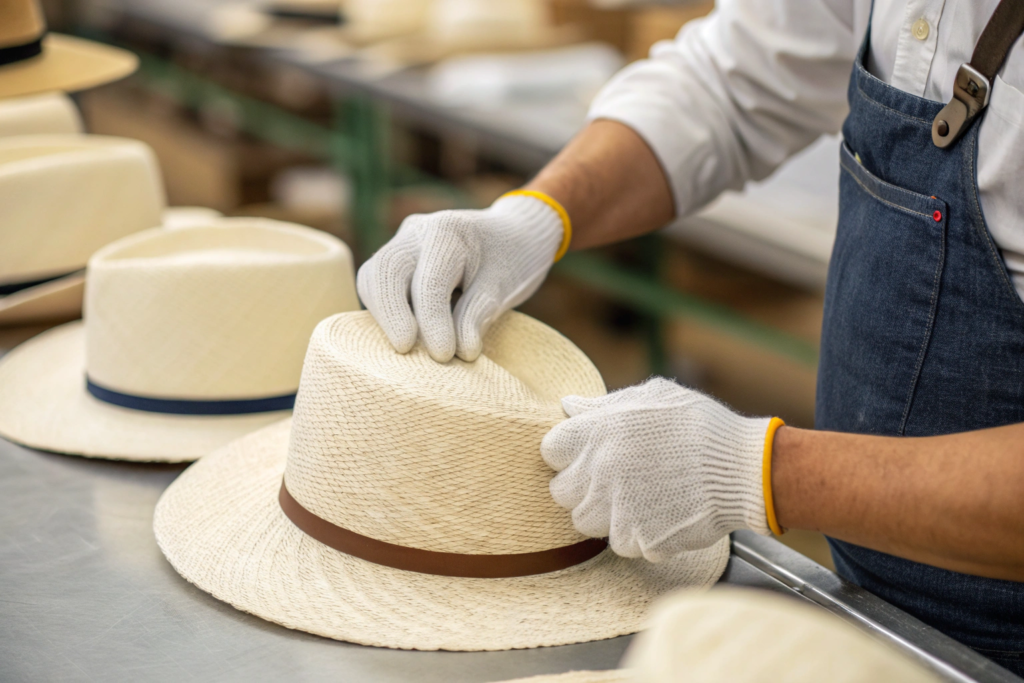
To prevent stains and accidental damage, a factory must implement a strict "gloves-on" handling protocol for all finished hats. Workers involved in moving, inspecting, or packing the hats should be required to wear clean, white cotton gloves. This prevents the transfer of skin oils and dirt, which can cause yellowing and dark spots over time. Furthermore, workers should be trained to handle the hats by the brim or by the internal crown support, never by pinching the crown, which can cause a permanent crease.
Here are the essential handling rules for your factory’s storage team:
- The Glove Mandate:
- Clean, white cotton gloves should be mandatory for anyone touching a finished hat. This is a simple, low-cost, and incredibly effective way to prevent the most common type of staining.
- Proper Handling Technique:
- Train workers to pick up the hat with two hands, holding it by the outer edges of the brim.
- If the hat has a crown support, it can also be handled by holding the internal support.
- The one place you should never pinch is the "pinch" on a fedora-style crown. This is the weakest point and is easily creased.
- A "Clean Zone" Policy:
- The hat storage area should be a designated "clean zone." No food, no drinks, no smoking. This minimizes the risk of accidental spills and contamination.
- Limited Access:
- Only trained personnel responsible for QC and packing should have access to the finished goods storage area. The less traffic, the lower the risk of accidental bumps and damage.
These protocols might seem obsessive, but for a high-quality, light-colored product, this level of discipline is what separates a professional operation from an amateur one.
Why cotton gloves?
Cotton gloves are ideal because they are soft, breathable, and they absorb any moisture or oil from the worker’s hands. They are also washable and inexpensive. Plastic or rubber gloves are not suitable as they can cause sweating and don’t have the right soft texture.
What about fabric trims, like ribbons?
The glove rule is just as important for protecting fabric trims. A silk or grosgrain ribbon can be easily stained by fingerprints. The handling protocols protect the entire product, not just the straw.
Why is a Final Pre-Shipment Inspection Crucial?
Even in the best-run storage facility, accidents can happen. A hat might be bumped, a small leak might go unnoticed, or a defect that was missed in the initial post-production QC might become more apparent over time. The final moment before the hat is placed into its shipping carton is your last chance to catch a problem.
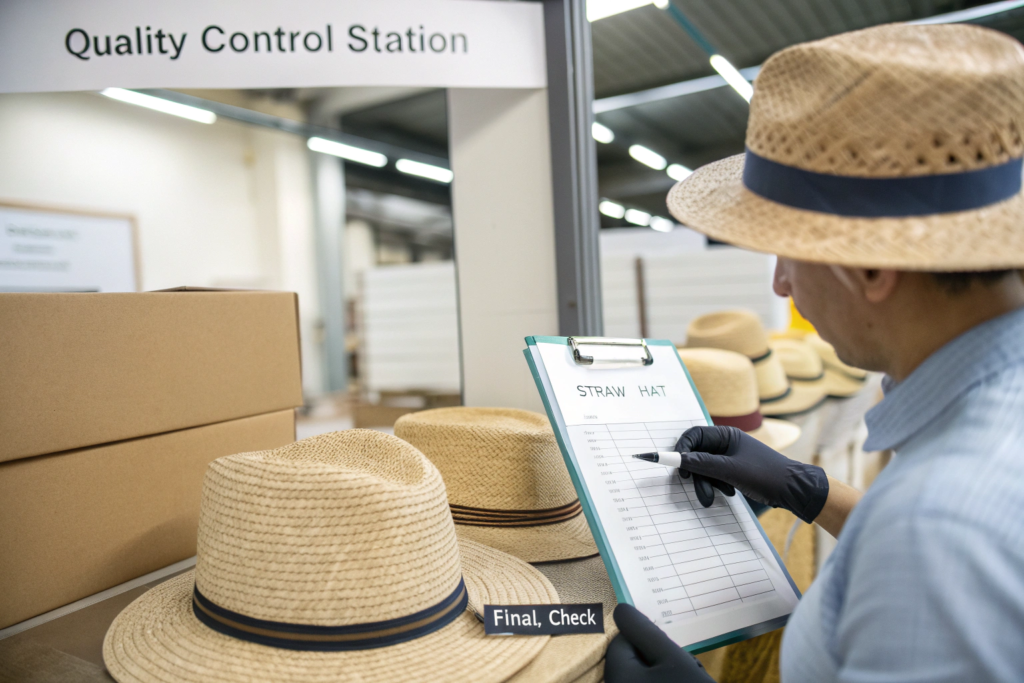
A final, 100% visual inspection immediately before packing is a crucial, non-negotiable step. This is not a random spot check. Every single hat must be individually removed from storage, taken out of its protective support, and thoroughly inspected one last time by a trained QC inspector. This final check ensures that any damage that may have occurred during the storage period—a new stain, a warped brim, a sign of mold—is caught before the defective product is shipped to the customer. It is the final quality gate that protects your brand’s reputation.
Here’s what the final pre-shipment inspection should cover:
- The "Sniff Test": The inspector should literally smell the hat. A musty or mildewy smell is the first sign of a moisture problem, even if visible mold hasn’t appeared yet.
- A Full 360-Degree Visual Check: Under bright, neutral lighting, the inspector should examine every part of the hat:
- Crown: Are there any dents, creases, or asymmetries?
- Brim: Is it flat and even? Has it warped? Are there any cracks in the straw?
- Color: Is the color uniform? Are there any faded or yellowed spots?
- Stains: Check for any dark spots from fingerprints, water marks, or dirt.
- Trim: Is the ribbon, band, or other trim still securely attached and clean?
- Reference Against the "Golden Sample": The inspector should have the approved "golden sample" (the perfect pre-production sample) at their station for comparison. This ensures that they are checking against the correct standard for shape, color, and trim placement.
This final inspection might seem redundant, but it’s the most important one. It’s the last time anyone from the factory will see the product before your customer does. At Shanghai Fumao Clothing, this final pre-pack inspection is a mandatory part of our Standard Operating Procedure for all high-value, delicate items.
Who should perform this final inspection?
Ideally, this should be done by a dedicated QC team that is separate from the production and packing teams. This ensures they are impartial. If you have hired a third-party inspection service, this is a key checkpoint that you should ask them to witness or perform.
What happens if a defect is found at this stage?
The defective hat must be immediately removed from the shipment and replaced with a perfect one (if available) or deducted from the final packing list and invoice. The factory should then investigate the cause of the defect. Was it a one-off accident, or is there a systemic problem in the storage environment that needs to be addressed?
Conclusion
The journey of a delicate straw hat from the artisan’s block to your customer’s head is fraught with peril. The quiet, unglamorous period of post-production storage is one of the most critical stages, where value can be either preserved or destroyed. A professional manufacturing partner understands that their job is to be a guardian of that value. By implementing a comprehensive system of individual shape support, a stable, climate-controlled environment, strict, "gloves-on" handling protocols, and a final, rigorous pre-shipment inspection, a factory can ensure that every hat arrives in perfect, ready-to-sell condition. When you choose a supplier, you are not just choosing a hat-maker; you are choosing a custodian for your brand’s quality and reputation. Choose the partner who obsesses over these details as much as you do.
At Shanghai Fumao Clothing, we have built our reputation on this obsession. We have dedicated, climate-controlled storage facilities and a team trained in the art and science of preserving delicate materials. We believe that the care we take after the product is made is just as important as the skill we use to make it. If you are looking for a partner who will protect your investment and deliver the flawless quality your brand deserves, please reach out to our Business Director, Elaine, at elaine@fumaoclothing.com.