

You’ve designed the perfect hat. It looks amazing on the shelf. But when the shipping invoice arrives, you’re shocked: the freight costs are astronomical, and half your storage space is consumed by air. Then, you see your competitor’s similar hat priced 20% lower on the shelf, with crisp packaging that hasn’t been crushed in transit. The difference isn’t just design or material cost—it’s often in the packaging strategy. For modern retailers, from giant supermarkets to boutique online stores, flat-pack efficiency has become a non-negotiable priority, transforming how hats are shipped, sold, and stored.
Retailers prioritize flat-pack efficiency for hats to drastically reduce shipping and storage costs (dimensional weight), minimize in-transit damage, optimize shelf space in stores, and meet sustainability goals by cutting down on packaging waste. This strategic shift moves beyond traditional "presentation-ready" packaging that ships hats in their final, bulky 3D form. Instead, it employs clever design that allows hats to be shipped flat and assembled easily at the point of sale or by the end customer. At Shanghai Fumao Clothing, we’ve adapted our manufacturing and packaging processes to help our clients win on this critical operational front, turning a logistical challenge into a competitive advantage.
Let’s unpack the financial, logistical, and commercial drivers behind this trend and how it’s reshaping the entire accessory supply chain.
How Does Flat-Pack Design Slash Logistics Costs?
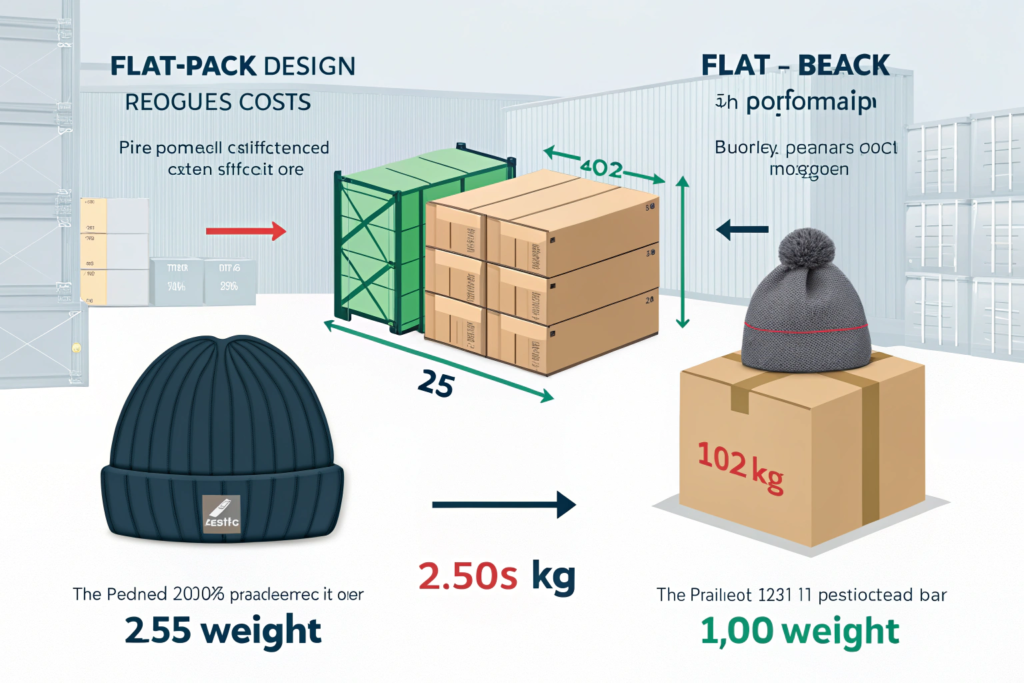
The single biggest driver for flat-pack efficiency is the brutal economics of modern logistics. Freight carriers—whether ocean, air, or ground—charge based on dimensional weight (DIM weight), not just actual weight. DIM weight is calculated from a package’s volume. A traditionally packaged hat in a rigid box might be 90% air, but you pay to ship that air. This inefficiency compounds across thousands of units, eroding profit margins before a single hat is sold.
Flat-pack design slashes logistics costs by reducing package volume by 50-80%, directly lowering DIM weight charges for air and ground freight, enabling more units per shipping container (optimizing FCL shipments), and reducing warehouse storage fees through higher-density stacking. For example, a beanie shipped in a pre-formed rigid gift box might have a DIM weight of 1.5 kg, while the same beanie in a flat polybag has a DIM weight of 0.2 kg. When multiplied by a 10,000-unit order, the savings on international air freight can be tens of thousands of dollars. This cost saving can be passed on to consumers or reinvested into better materials, making your product more competitive.
What is DIM Weight and Why is it a "Silent Tax"?
Dimensional Weight (DIM Weight) is a pricing technique used by all major carriers (FedEx, UPS, DHL, etc.). The formula is: (Length x Width x Height) / a DIM Divisor. For instance, if a rigid hat box is 30x30x15cm, its volume is 13,500 cubic cm. With a standard divisor of 5,000, the DIM weight is 2.7 kg. Even if the actual weight is 0.3 kg, you are billed for 2.7 kg. This is the "silent tax" on inefficient packaging. Flat-pack designs minimize the three dimensions, especially height (thickness), bringing the DIM weight much closer to the actual weight. Understanding and planning for this is a core part of supply chain management for savvy brands.
How Does It Optimize Container and Shelf Space?
Beyond per-package costs, flat packing transforms bulk shipping. A 40-foot high-cube shipping container has fixed internal dimensions. Bulky boxes leave vast amounts of unused "cubic air." Flat, uniform packages can be stacked tightly with minimal void spaces, allowing you to ship significantly more units per container. This reduces the cost per unit for ocean freight (the Cost Per Freight Ton). Similarly, in a retail backroom or distribution center, flat packs can be stored on shelves like books, while bulky boxes require deep, wasteful shelving. This space efficiency directly translates to lower storage costs per SKU, a critical metric for retailers with thousands of products.
Does Flat-Pack Reduce Damage and Improve Product Presentation?
A common fear is that shipping hats flat will lead to more crushed and misshapen products. Ironically, the opposite is often true. Traditional rigid boxes are strong but can be crushed under heavy weight in transit, permanently deforming the hat inside. They are also prone to "scuffing" as boxes rub against each other.
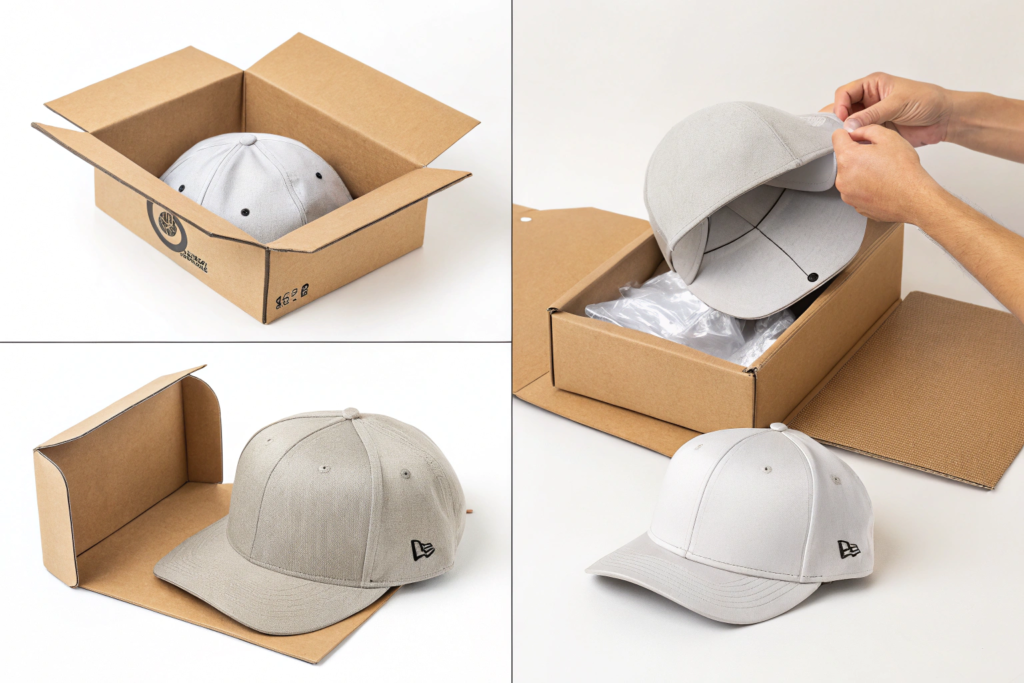
Well-designed flat-pack systems often reduce in-transit damage by using flexible yet protective materials that absorb impact without transferring force to the hat, and by eliminating void spaces where the product can shift and tumble. The key is in the construction. For example, a cap with a pre-curved brim can be shipped flat with a corrugated cardboard insert that holds its crown shape. The entire pack can flex under pressure without creasing the brim. Upon arrival, the hat is removed and regains its perfect form. Furthermore, because flat packs arrive compact and undamaged, the final unboxing or shelf presentation is cleaner and more professional, as the outer package hasn’t been battered during shipping.
What Are Common Flat-Pack Protection Methods?
Protection in flat packing is about intelligent design, not just less material. Key methods include:
- Die-Cut Corrugated Inserts: Precision-cut cardboard or E-flute corrugated sheets that fold around the crown of a cap or the brim of a sun hat, holding its critical shape.
- Internal Paperboard Bands: For beanies and slouch hats, a simple paperboard band can prevent the knit from over-stretching and maintain its intended silhouette.
- Multi-Layer Flexible Mailers: Using layers of bubble wrap or foam laminated inside a poly mailer provides cushioning without rigidity.
- Vacuum Sealing (for certain styles): Knit hats can be vacuum-sealed into ultra-flat, brick-like packages that are incredibly space-efficient and protected from dust and moisture.
These methods often use less overall material than a rigid box while providing targeted, superior protection for the parts of the hat most prone to damage.
How Does "Assembly at Point-of-Sale" Work?
For some hat styles, particularly structured ones like fedoras or wide-brim sun hats, the final assembly is done in-store. The hat is shipped in its component parts (e.g., separate crown and brim) or folded with a crease-less folding technique. Retail staff then quickly shape it using steam or simple hand-forming, often following a short instructional guide. This ensures the customer sees a perfect, fresh hat on the shelf, not one that has been crushed in a box for months. It shifts the final quality check and "finishing" to the last possible moment, guaranteeing peak presentation. This model is common in large apparel retailers and requires clear instructions and, ideally, a simple tool (like a shaping ring) included in the pack.
How Does This Trend Align with Sustainability and Retail Trends?
The push for flat-pack efficiency isn’t just driven by cost; it’s powerfully aligned with two major macro-trends: the global mandate for sustainability and the explosive growth of e-commerce. Consumers and regulators are demanding less waste, while the economics of online returns make durable, compact packaging essential.
Flat-pack efficiency directly supports sustainability by significantly reducing material usage (less cardboard, plastic, and filler) and cutting the carbon footprint of transportation through higher load efficiency. It also caters perfectly to e-commerce by creating a better "unboxing experience" in a compact form and reducing return rates due to shipping damage. A flat polybag or slim envelope uses up to 70% less plastic and cardboard than a rigid box with filler. When millions of units are shipped, this reduction is monumental. Furthermore, for DTC (Direct-to-Consumer) brands, a flat package fits neatly in a home mailbox, reducing the risk of "porch piracy" and failed delivery attempts.

Can Flat-Pack Be Both Sustainable and Premium?
Absolutely. The perception that "premium" requires a heavy box is outdated. Sustainable flat-pack can feel premium through:
- Material Choice: Using FSC-certified recycled paperboard, seeded paper tags, or compostable bioplastic mailers.
- Design and Printing: High-quality, minimalist graphic design printed with soy-based inks on uncoated, recyclable paper.
- User Experience: A clever, intuitive unfolding or assembly process that feels engaging and thoughtful.
Brands can communicate this with messaging like "Our flat pack saves 65% in shipping emissions" or "Packaged with less, designed for more." This turns the efficiency story into a brand value proposition, appealing to the eco-conscious consumer. Resources like the Sustainable Packaging Coalition offer guidelines for this approach.
Why is Flat-Pack Essential for E-Commerce Fulfillment?
For e-commerce and omnichannel retailers, fulfillment speed and cost are king. In an Amazon FBA or similar warehouse, storage fees are based on cubic volume per month. Flat packs slash these fees. Additionally, during order picking and packing, a flat, uniform package is faster and easier for automated systems and workers to handle, reducing labor costs. Most importantly, it leads to lower return rates. A hat damaged in a bulky box is likely to be returned. A well-protected flat pack arrives intact, leading to a positive customer experience and fewer costly reverse logistics. This operational efficiency is a key reason why giants like [large online retailers] have stringent packaging requirements for their vendors.
What Are the Manufacturing and Design Implications?
Adopting a flat-pack strategy isn’t just a packaging decision; it requires forethought in product design and manufacturing. A hat that is designed from the start to be shipped flat will perform far better than one that is forced into a flat pack as an afterthought.
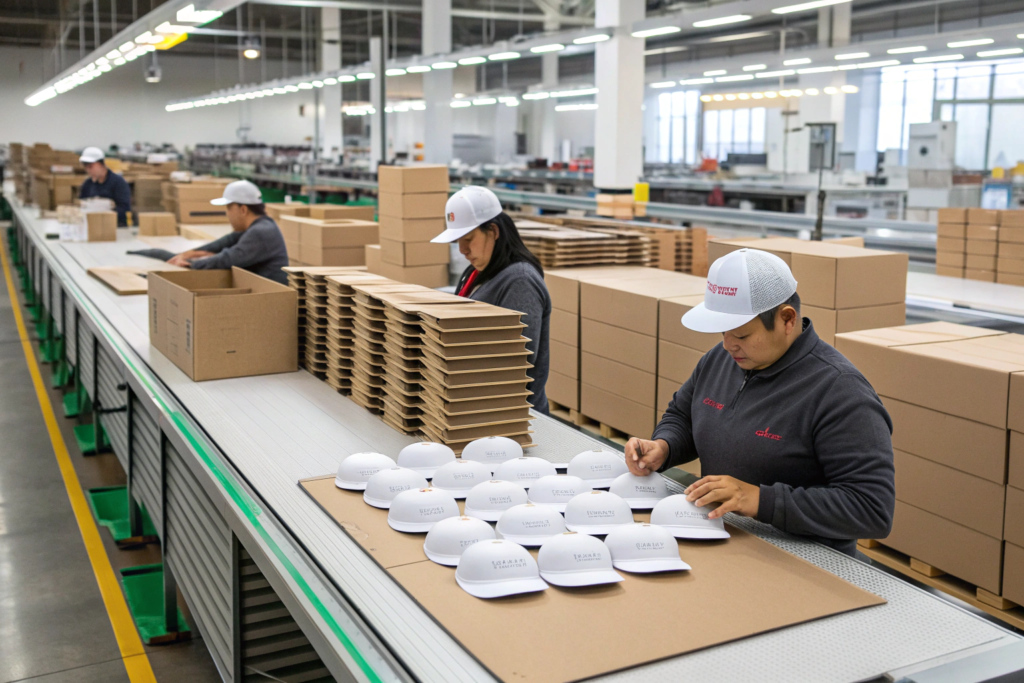
Manufacturing for flat-pack requires designing hats with materials and constructions that recover well from compression (e.g., resilient felts, memory fabrics), simplifying or modularizing components for assembly, and potentially integrating flat-pack shape retainers into the production process. At Shanghai Fumao Clothing, we work with clients during the sampling phase to test recovery—how well a hat returns to its intended shape after being folded and compressed for a set period. We also source or produce custom die-cut inserts that become part of the final packaged product.
Which Hat Styles Are Best Suited for Flat-Pack?
Not all hats are created equal for this strategy. Suitability varies:
- Excellent Candidates: Beanies, knit caps, visors, unstructured bucket hats, and fabric sun hats. These are naturally flexible or can be folded without permanent creasing.
- Good Candidates with Design Tweaks: Baseball caps (with a pre-curved brim held by an insert), fedoras (using a "center dent" folding technique), and straw hats (made from pliable, woven materials).
- Poor Candidates: Extremely stiff or heavily structured hats (like some formal men’s hats or hats with permanent, complex wired brims).
The key is collaboration: informing your manufacturer of your flat-pack intent early allows them to advise on material choices and construction techniques that enable it.
How to Specify Flat-Pack Requirements to Your Supplier?
Clear communication is vital. Your tech pack should include a "Packaging & Shipping" section specifying:
- Packaging Type: "Flat-pack for e-commerce. Final retail shape to be achieved by customer."
- Maximum Packaged Dimensions: Specify the target thickness (e.g., "Must not exceed 2.5cm thickness when packed").
- Shape Retention Method: "Include a die-cut 2mm E-flute corrugated insert to crown shape."
- Recovery Test: "Hat must return to intended shape within 1 hour after removal from 30-day compressed state."
- Sustainability Requirement: "All packaging materials must be recyclable and FSC-certified."
Providing a physical sample of your desired flat-pack is the best way to ensure alignment. A capable supplier will then provide a packaging prototype for your approval before bulk production.
Conclusion
Retailers prioritize flat-pack efficiency for hats because it is a powerful lever to control costs, protect products, meet sustainability targets, and thrive in the e-commerce era. It represents a holistic shift from viewing packaging as merely a decorative container to treating it as a critical component of the supply chain and brand experience. The savings in logistics and storage can be the difference between a profitable line and a struggling one, while the reduced environmental impact strengthens brand equity.
Successfully implementing this strategy requires a partnership with a manufacturer who understands both the construction of hats and the mechanics of efficient logistics. By designing with flat-pack in mind from the outset, you can create products that are not only stylish and high-quality but also operationally superior and environmentally responsible.
Ready to optimize your hat line for cost, sustainability, and market success? Contact our Business Director, Elaine, at elaine@fumaoclothing.com to discuss how we can engineer your hats and their packaging for flat-pack efficiency. Let Shanghai Fumao Clothing help you compress costs, not your style.




