A buyer from a UK department store once called me in a panic. She had received 10,000 beautifully printed silk scarves from another supplier. They arrived folded in tight, flat cartons, stacked on pallets. The shipment was perfect on paper. But when her team opened the cartons to prepare the scarves for retail display, they found deep, stubborn creases pressed into every single scarf. The creases had set during the six-week sea voyage. Her team spent hundreds of hours trying to steam the creases out. Some came out. Many did not. The scarves that could not be restored were sold at a loss to a discount outlet. She asked me how to store bulk scarves so this never happened again.
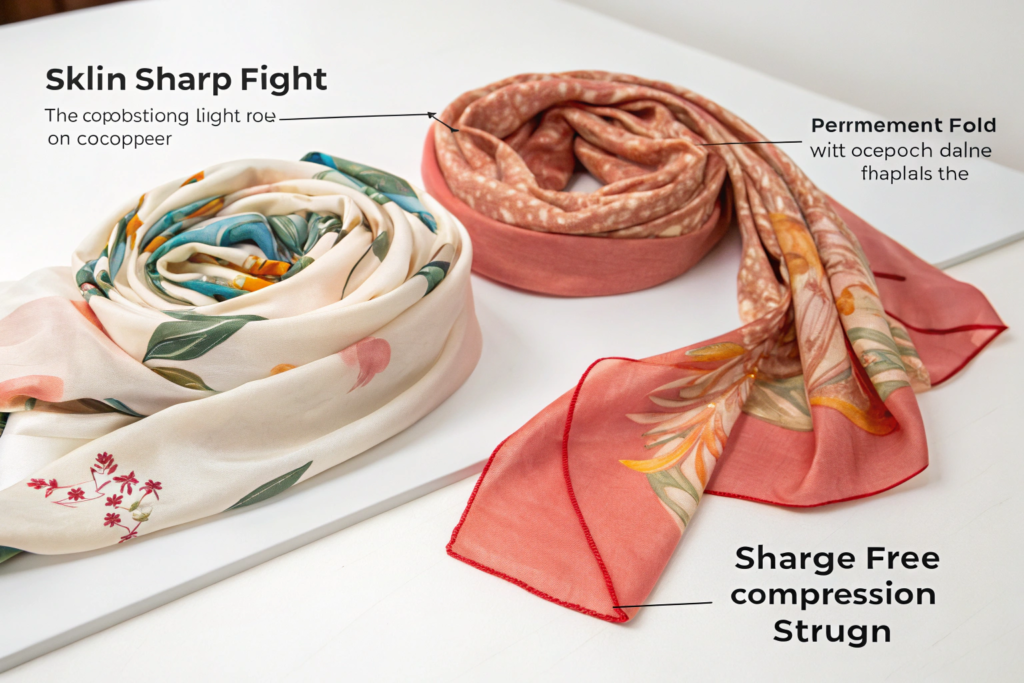
The best way to store bulk scarves to avoid creases is to hang them on padded hangers or wide-diameter tubes in a climate-controlled environment, with each scarf hanging freely and not compressed against others. If hanging is not practical due to volume, scarves should be rolled, not folded, around acid-free tissue cores and stored in breathable, non-compressive containers. The fundamental principle is to avoid sharp folds under pressure, particularly for natural fibres like silk, wool, and cashmere that can develop permanent crease memory.
At Shanghai Fumao, we produce and ship hundreds of thousands of scarves every year. We have learned that how a scarf is stored between production and retail display is just as important as how it is made. A beautifully printed silk scarf with a permanent fold line is a damaged product. Let me explain exactly how to store bulk scarves so they arrive at the retail floor as flawless as they left our factory.
Why Do Folded Scarves Develop Permanent Creases?
A crease is not just a temporary wrinkle. It is a deformation of the fabric structure. When a scarf is folded sharply and then subjected to pressure and time, the fibres at the fold line are compressed and bent. In natural fibres like silk, wool, and cotton, the fibre’s internal structure can actually shift under sustained pressure. The hydrogen bonds that give the fibre its shape reform in the folded position. The crease becomes part of the fabric’s memory.
Heat and humidity accelerate this process. A shipping container can reach 50 degrees Celsius internally during a tropical voyage. The combination of heat, humidity, and the pressure of being stacked under other cartons creates ideal conditions for permanent crease formation. A silk scarf folded and packed at the bottom of a carton, under the weight of dozens of other cartons, for 30 days in a hot container, will almost certainly develop permanent fold lines. The creases are not a manufacturing defect. They are a storage and transit injury. Understanding textile fibre properties and crease formation is the first step to preventing the damage.
How Do Different Fibres Respond to Folding and Pressure?
Silk is the most vulnerable to permanent creasing. Silk fibres have a triangular cross-section and a smooth surface. They bend easily but do not recover well from sustained pressure. Once a silk fibre is compressed into a fold, it tends to stay there. The crease can often be seen as a lighter or shinier line where the fibre surface was flattened. Steam can sometimes relax silk creases, but a crease that has been heat-set during weeks in a hot container may be permanent.
Wool and cashmere are more resilient. Wool fibres have a natural crimp and elasticity. They can recover from short-term folding, but they will develop permanent creases under sustained pressure, especially in humid conditions. Cotton and linen are moderately resilient. They wrinkle easily but can usually be steamed back to smoothness. Synthetic fibres like polyester and acrylic are the most crease-resistant. They have good elastic recovery and rarely develop permanent fold lines. However, synthetics can develop shiny iron marks if pressed with heat while folded. The storage method should be chosen based on the most delicate fibre in the inventory. If you store silk and polyester scarves together, the storage method must protect the silk. Professional textile conservation storage practices provide guidance for long-term storage of delicate fabrics.
What Role Does Carton Weight and Stacking Play?
The pressure on the folded scarf at the bottom of a carton stack is significant. A single carton of scarves weighs 15 to 25 kilograms. On a pallet, cartons are stacked six to eight high. The carton at the bottom supports 100 to 200 kilograms of weight above it. Every scarf inside that bottom carton is subjected to this compressive force.
The folds in the scarf act as stress concentrators. All the compressive force is focused on the narrow line of the fold. The fibres at that line are crushed. The pressure is maintained for the entire duration of the storage and transit period, which can be weeks or months. The longer the pressure is maintained, the more permanent the crease becomes. This is why simply folding scarves less sharply is not enough. The pressure must be managed as well. Understanding compression damage in textile storage explains why the storage system must address both the fold geometry and the compressive load.
What Are the Correct Storage Methods for Different Scarf Types?
The correct storage method depends on the fibre, the quantity, and the available space. There is no single method that works for every situation. A warehouse with high ceilings and garment racks can hang scarves. A small stockroom with limited space may need to use rolling and boxing. The key is to match the method to the fibre’s vulnerability and the practical constraints of the storage environment.
For high-value, delicate scarves made from silk, cashmere, or fine wool, hanging is the gold standard. For medium-value scarves in larger quantities, rolling is the most practical method that avoids sharp folds. For sturdy, crease-resistant scarves made from polyester or cotton blends, careful folding with wide, soft radii may be acceptable for short-term storage. The method must be specified in the storage and handling procedure for the warehouse team.

How Should Silk and Delicate Scarves Be Hung for Bulk Storage?
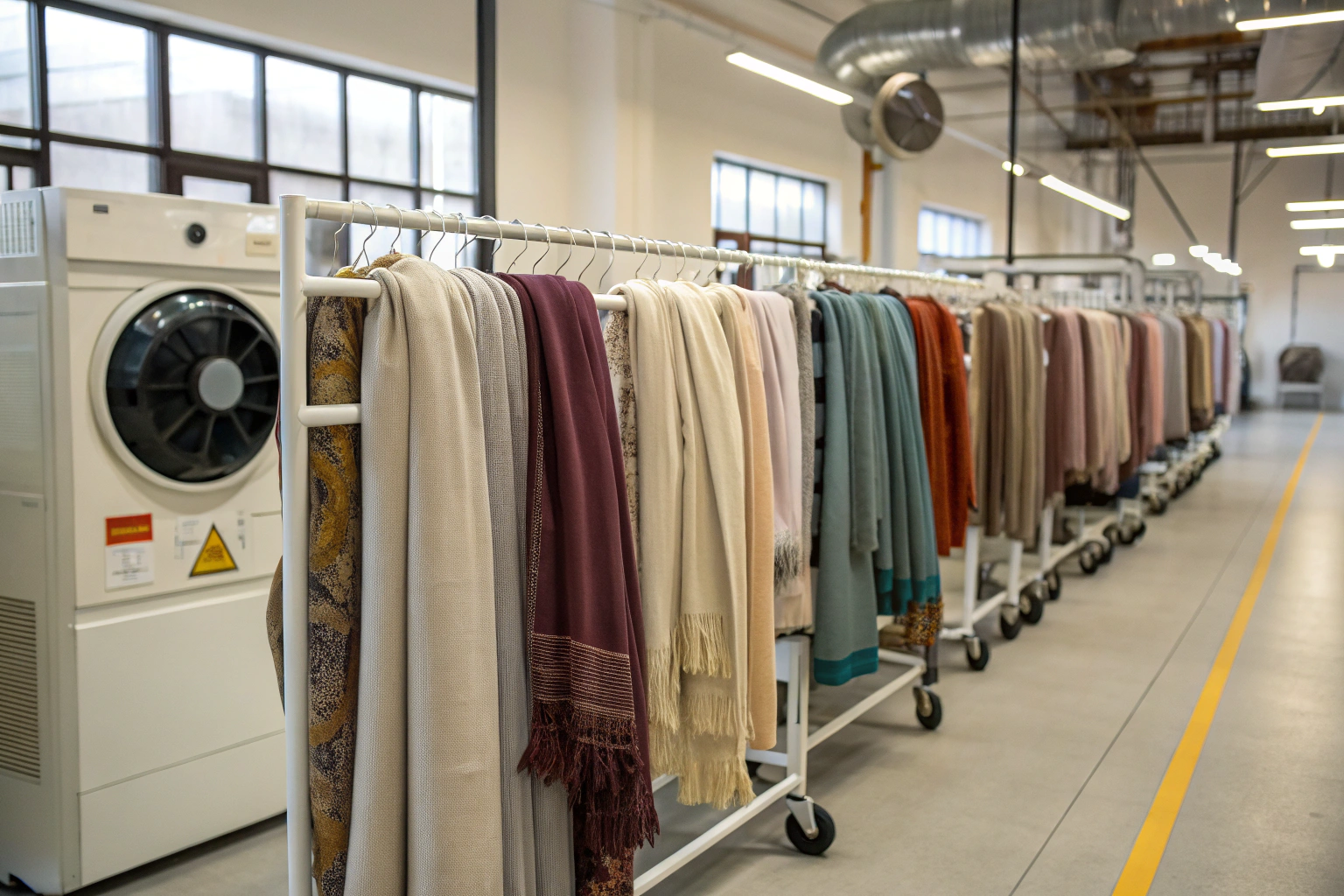
Silk scarves should be hung on padded hangers. The padding, typically a layer of foam or quilted fabric over the hanger bar, prevents the scarf from developing a sharp fold at the hang point. The hanger bar should be wide and smooth. Narrow wire hangers concentrate the weight of the scarf on a tiny area and will create a crease. The scarf is draped over the hanger bar, with half the length hanging on each side. The scarf should hang freely without touching the floor or other scarves.
For bulk storage, padded garment racks on wheels are ideal. The racks can hold dozens of scarves each and can be moved easily within the warehouse. The scarves should be spaced so they do not press against each other. Each scarf should have enough room to hang without contact with its neighbour. The hanging area should be dust-free and protected from direct sunlight, which can fade colours and degrade silk fibres. A cotton dust cover over the rack provides additional protection. Understanding museum textile hanging methods is relevant for high-value commercial scarf storage.
Why Is Rolling Better Than Folding for Wool and Cashmere?
Rolling distributes the fabric around a curve rather than concentrating it at a sharp fold. The curve has a radius, typically 3 to 5 centimetres, that is large enough to prevent fibre compression damage. The scarf is laid flat, a length of acid-free tissue paper is placed on top, and the scarf and tissue are rolled together around a tube. The tissue provides a slip layer that prevents the fabric layers from rubbing against each other and causing abrasion.
The tube should be made from acid-free cardboard or inert plastic. The tube diameter should be at least 5 centimetres. Smaller diameters create a tighter curve that can still crease delicate fibres. The rolled scarf is then stored horizontally on a shelf, not standing on end, which would concentrate the weight on one edge. Multiple rolled scarves can be stored in a breathable cotton storage box. The box protects from dust and light while allowing air circulation. The scarves are not compressed. Each roll supports its own weight. This is the recommended method for long-term storage of wool and cashmere scarves. Professional textile rolling and storage techniques are standard practice in museum collections and are equally applicable to commercial inventory.
How Should Scarves Be Prepared for Long-Term or Seasonal Storage?
Scarves that will be stored for more than a few weeks, such as seasonal inventory held for next year’s selling season, require additional preparation. The goal is to protect the scarves from dust, light, pests, humidity, and temperature extremes for the entire storage duration. A scarf that is put away in good condition should come out of storage in the same good condition.
The preparation steps include ensuring the scarves are clean and completely dry, using acid-free tissue interleaving, selecting appropriate storage containers, and controlling the storage environment. These steps require time and materials, but the cost is negligible compared to the value of the inventory and the cost of damaged goods.
Why Must Scarves Be Completely Dry and Clean Before Storage?
Moisture is the enemy of stored textiles. A scarf that is stored with even slight residual moisture from steaming or handling can develop mildew during storage. The moisture provides the water that mould spores need to germinate. A scarf that appears dry to the touch may still contain moisture absorbed from humid air.
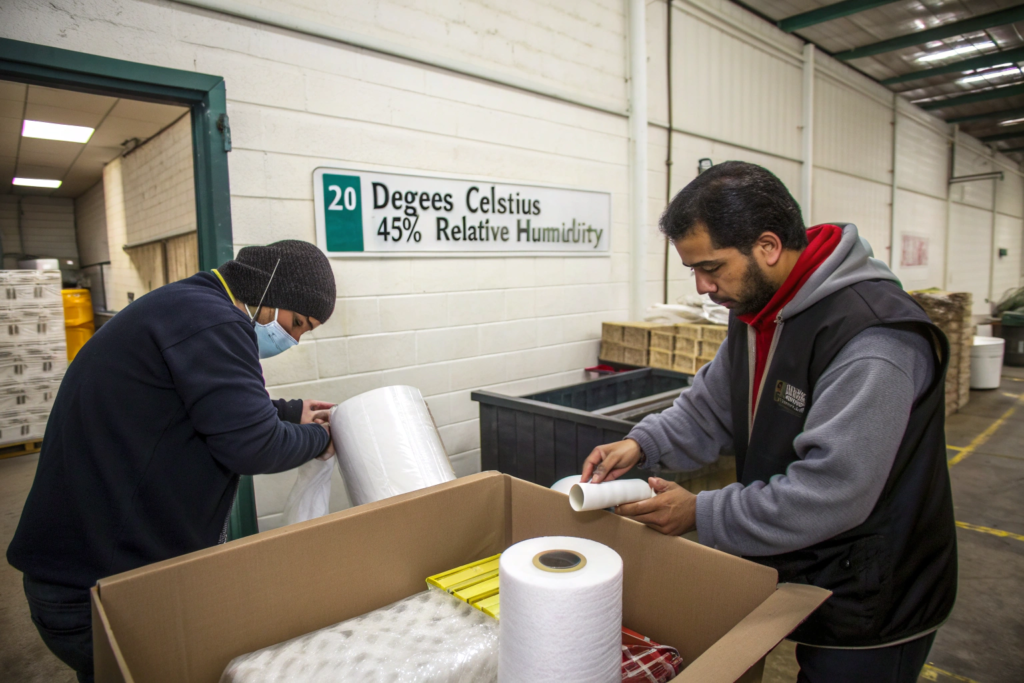
Scarves should be conditioned in a climate-controlled environment at 45% to 55% relative humidity for at least 24 hours before packing. This allows the fibres to equilibrate to a safe moisture content. Scarves should also be clean. Body oils, food residues, and other contaminants can attract pests and provide nutrients for mould. A scarf that has been handled should be gently steamed or dry-cleaned before long-term storage. The storage area itself should be clean, dry, and pest-free. Professional textile conservation cleaning and storage guidelines provide detailed procedures for preparing textiles for storage.
What Is the Ideal Storage Environment for Bulk Scarf Inventory?
The ideal storage environment for textiles is a stable temperature between 18 and 22 degrees Celsius, with a relative humidity between 45% and 55%. Fluctuations in temperature and humidity are more damaging than a stable environment that is slightly outside the ideal range. Cycling between high and low humidity causes fibres to swell and shrink, stressing the fabric and accelerating degradation.
The storage area should be dark or lit with low-intensity, UV-filtered light. Light, especially sunlight and fluorescent light, fades dyes and weakens fibres over time. The storage containers should be breathable. Sealed plastic containers trap moisture and can create a micro-environment that encourages mould. Cotton storage boxes, acid-free cardboard boxes, or ventilated plastic containers are appropriate. Silica gel desiccant packets can be placed inside the storage container to absorb any residual moisture. The packets should be checked and replaced periodically. A temperature and humidity data logger placed in the storage area provides a continuous record of the environment. Understanding museum environmental standards for textile storage provides the benchmark for commercial best practice.
Conclusion
The best way to store bulk scarves to avoid creases is to treat each scarf as a delicate textile that can be permanently damaged by sharp folds under pressure. Hang silk and delicate scarves on padded hangers with adequate space. Roll wool and cashmere scarves around wide-diameter acid-free tubes with tissue interleaving. Fold sturdy synthetic and cotton scarves loosely over wide inserts in shallow cartons, never compressing them with heavy stacking.
Prepare scarves for storage by ensuring they are clean, completely dry, and conditioned to the correct humidity. Store them in a climate-controlled environment with stable temperature and humidity, protected from light and dust. Use breathable containers and monitor the environment with a data logger. These practices are standard in museum textile conservation. They are equally applicable and commercially sensible for a business that holds valuable scarf inventory.
At Shanghai Fumao, we advise all our clients on correct scarf storage and we apply these principles in our own warehouse. The scarves we ship are packed in a way that minimises transit creasing, and we provide care and storage guidelines with every order. Your scarves are an investment. Store them in a way that protects that investment.
If you are sourcing scarves and want to discuss packaging and storage options that protect your product from factory to retail floor, please contact our Business Director Elaine at elaine@fumaoclothing.com. She can explain our packing methods, provide storage recommendations for your specific scarf types, and ensure your scarves arrive in the pristine condition that your customers expect.