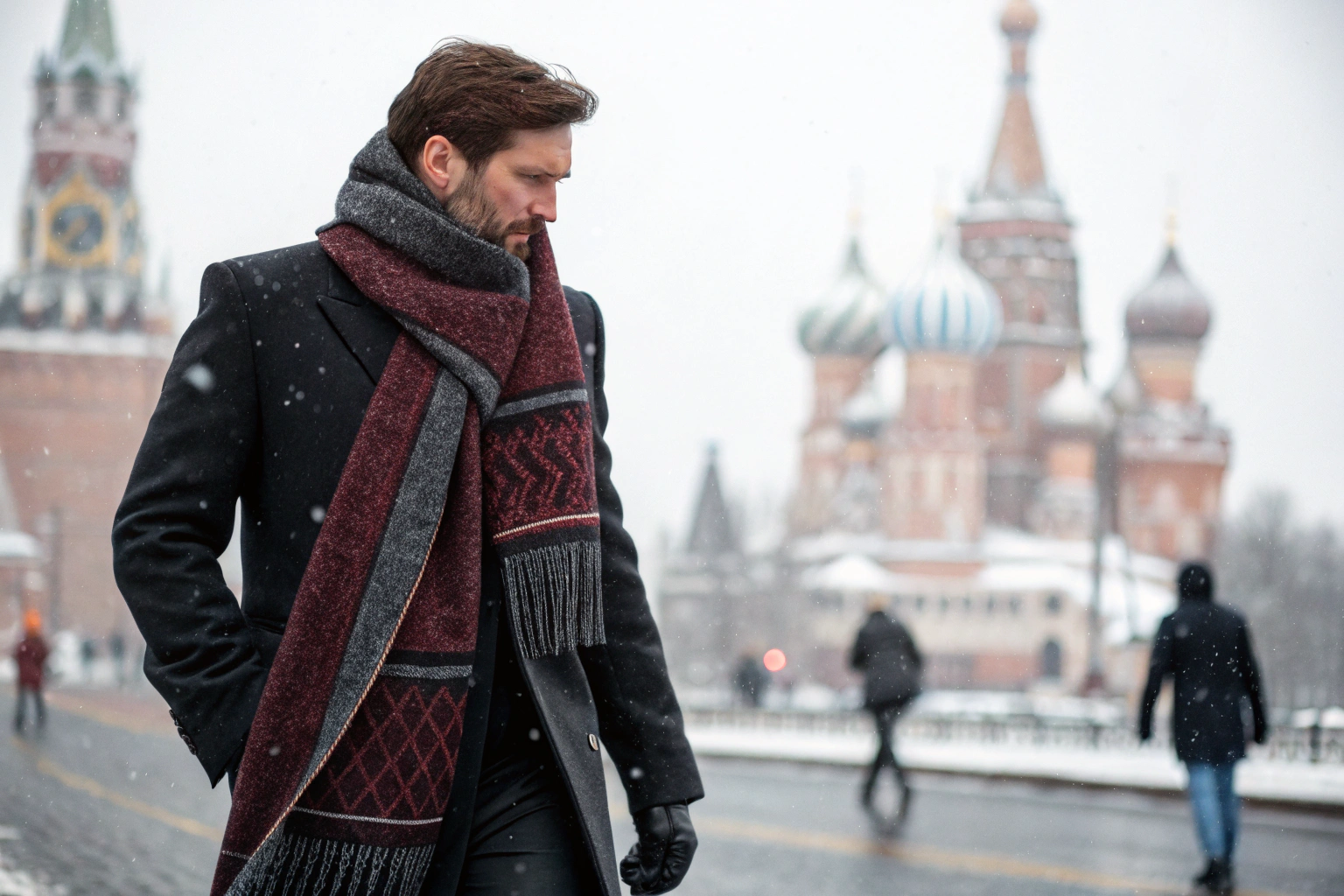
I remember sitting with a buyer from a Moscow-based men’s boutique chain at a trade show in Frankfurt two years ago. He picked up a beautifully soft, lightweight cashmere scarf from our display and shook his head. "This is for Paris or Milan," he said. "My customer needs a scarf that fights a minus-twenty-degree wind. He needs weight. He needs density. He needs a scarf that feels like armor against the cold." That conversation rewired my thinking about the Russian men’s market. It is not just a colder version of the European market. It is a distinct market with its own aesthetic codes, its own material requirements, and its own seasonal rhythms that demand a specialized product approach.
The 2026 scarf trends for men’s fashion in Russia are defined by four dominant movements. The "Architectural Plaid" trend uses oversized, bold geometric jacquard patterns in charcoal, oxblood, and deep forest green that reference Soviet-era constructivist art while feeling utterly contemporary. The "Siberian Utility" trend focuses on maximal thermal performance with double-faced wool-cashmere blends, hidden zip pockets, and convertible balaclava-scarf hybrid constructions. The "Quiet Oligarch" trend embraces tonal, logo-free luxury in dense, heavy-gauge cashmere and yak wool blends in moody neutrals. The "Digital Nomad" trend brings technical performance fabrics, water-resistant nano-coatings, and modular designs to the young, urban professional who splits his time between the office and the ski slopes.
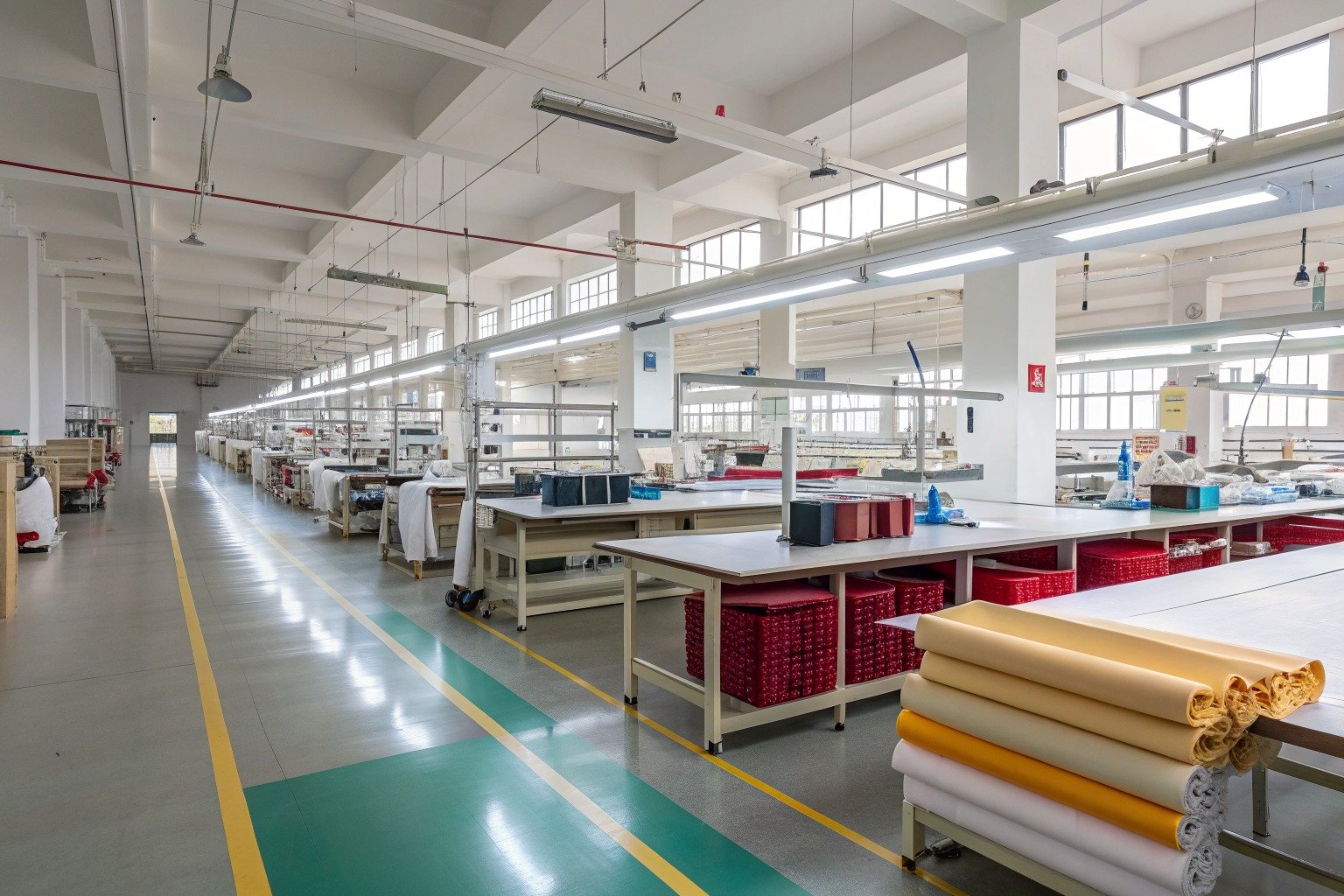
In our Zhejiang facility, I have developed a dedicated Russian-market production line that understands the specific technical demands of this customer. The stitches must be tighter to block the wind. The fiber density must be higher. The colors must hold their saturation through months of heavy wear in wet snow conditions. The scarf is not an accessory in Russia. It is a survival tool that also signals taste, status, and cultural awareness. I want to walk you through the exact trends, materials, construction methods, and market dynamics that will define the Russian men’s scarf market in 2026.
What Materials Are Russian Men Demanding for Scarves in 2026?
The Russian male consumer evaluates a scarf first by its weight and density. He picks it up. He feels the heft in his palm. He squeezes the fabric to test its resilience. If it feels light and insubstantial, he puts it down, regardless of the brand name or the price point. This tactile evaluation is the critical first filter that separates products destined for the Russian market from those designed for milder European winters. The material must communicate warmth, durability, and substance before any aesthetic consideration enters the picture.
The 2026 material trends reflect a deepening sophistication in the Russian market. Consumers are moving beyond the simple "100% wool" label and seeking specific fiber blends that deliver measurable performance advantages. The key materials driving the market are high-micron merino and lambswool blends for everyday urban wear, cashmere-yak wool blends for the luxury segment, and technical performance wools with water-resistant finishes for the growing active-lifestyle segment. Each material category serves a distinct use case and price point within the Russian men’s wardrobe.
Why is lambswool still the backbone of the Russian men’s scarf market?
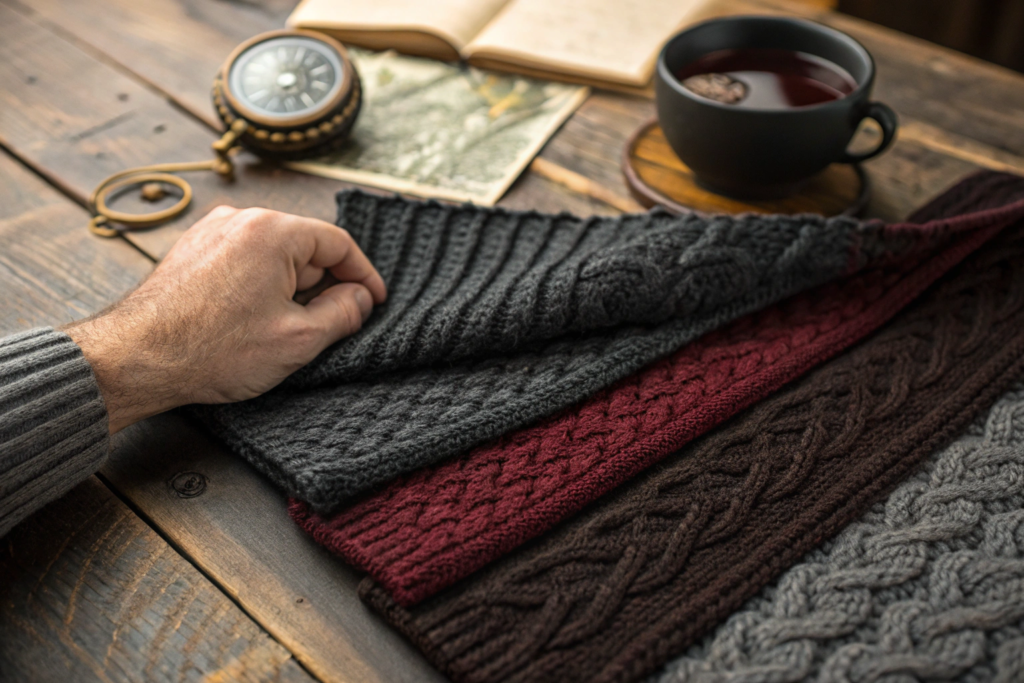
Lambswool is the first shearing from a sheep at approximately seven months of age. The fibers are finer, softer, and more elastic than wool from an older sheep, yet they retain the density and crimp that create insulating air pockets within the fabric structure. For the Russian market, this combination of softness against the skin and genuine thermal protection is non-negotiable. A scarf that is warm but scratchy will be rejected. A scarf that is soft but thin will be mocked. Lambswool hits the sweet spot. We source our lambswool from certified Responsible Wool Standard suppliers in Australia and New Zealand. The fiber diameter is specified at 19 to 21 microns, which is fine enough for next-to-skin comfort on the neck, a surprisingly sensitive area for many men. We knit the lambswool scarves at a dense gauge, typically 12 to 14 stitches per inch, to create a wind-resistant fabric structure. The resulting scarf has a substantial drape, weighs approximately 250 to 300 grams for a standard 70-inch length, and provides genuine thermal protection down to approximately minus-fifteen degrees Celsius when worn properly wrapped. This lambswool material properties profile makes it the volume driver for any brand targeting the Russian mid-to-premium market.
How is yak wool positioning itself as the new luxury fiber for Russian winters?
Yak wool is the emerging luxury story for the 2026 Russian market. It comes from the undercoat of the domestic yak, which lives at altitudes above 4,000 meters on the Tibetan Plateau and in the Mongolian steppes. The fiber has evolved over millennia to insulate an animal against temperatures that routinely drop below minus-thirty degrees Celsius. It is warmer than merino wool by weight, softer than cashmere by micron measurement, and significantly rarer. The supply chain is limited, which creates natural exclusivity. We blend yak wool with cashmere in a 60-40 or 70-30 ratio to create a scarf fabric that combines yak’s extreme warmth and softness with cashmere’s drape and luster. The natural color palette of yak wool, which ranges from a rich chocolate brown to a silvery grey, aligns perfectly with the "Quiet Oligarch" trend for understated, logo-free luxury. A yak-cashmere blend scarf requires specialized handling in production. The fibers are shorter than lambswool, so the spinning tension and the knitting gauge must be adjusted to prevent pilling. We use a tight-twist spinning method and a tumble-finishing process that removes any loose fibers before the scarf leaves the factory. The yak wool fiber characteristics command a price point that positions the scarf at the very top of the market. For a Russian consumer who already owns a cashmere scarf, yak wool represents the next step up the luxury ladder.
What Patterns and Colors Are Defining Russian Men’s Scarves in 2026?
Color and pattern in the Russian men’s market operate within a narrower band than in Western Europe or North America. The Russian male consumer tends to be more conservative in his color choices, preferring depth and saturation over brightness. A neon accent that might work in a Tokyo street-style look is a non-starter in Moscow or St. Petersburg. This does not mean the market is boring. It means the sophistication is expressed through subtle tonal variation, complex pattern geometry, and texture contrast rather than through bold color blocking.
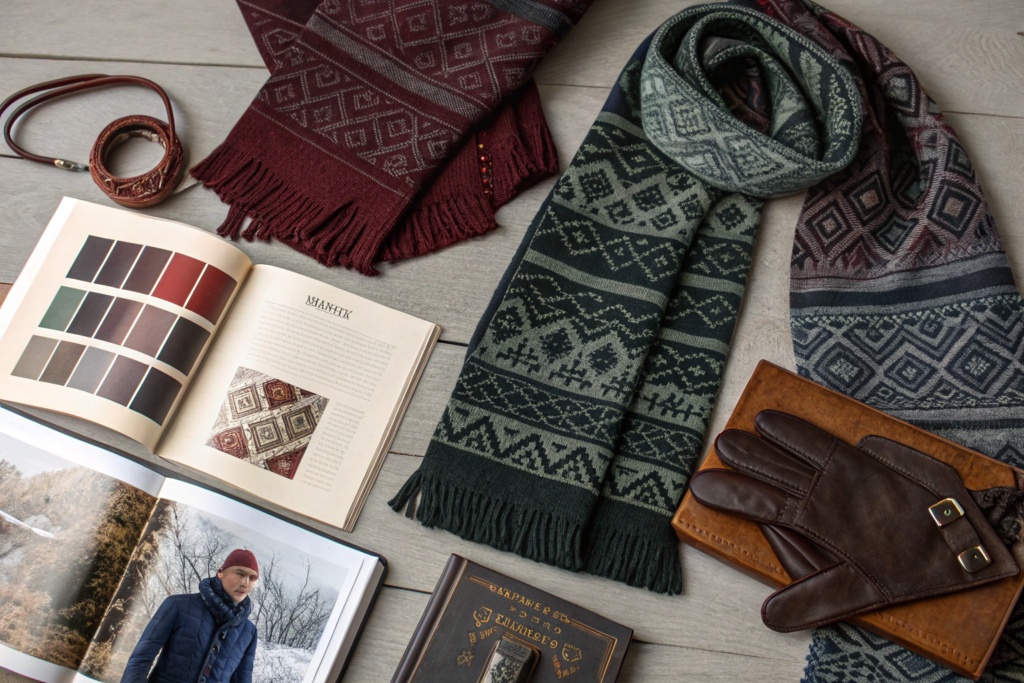
The 2026 pattern trends show a fascinating convergence of heritage and modernity. Traditional Slavic and Orthodox geometric motifs are being reinterpreted through a minimalist, architectural lens. Oversized houndstooth, broken herringbone, and abstract plaid patterns reference both Russian constructivist art and classic menswear codes. The color palette is anchored in four families: charcoal and graphite greys, deep burgundy and oxblood reds, forest and pine greens, and a new entry, a cold slate blue that mirrors the winter sky over the Neva River. Within each family, the consumer looks for subtle heather effects and melange yarns that create visual depth without a loud pattern.
Why are oversized geometric jacquard patterns resonating with Russian men?
The oversized geometric pattern trend draws directly from Russia’s rich visual heritage of constructivism, suprematism, and industrial design. These are bold, angular patterns that use squares, rectangles, and diagonal lines arranged in dynamic, asymmetrical compositions. They reference the work of early twentieth-century Russian artists like Malevich and Rodchenko, but they are executed in a thoroughly modern jacquard knit technique that makes the pattern an integral part of the fabric structure, not a surface print that can fade or peel. The scale is important. A small, fussy geometric reads as a generic department store scarf. An oversized pattern, where a single repeat can be six or eight inches across, reads as a deliberate design statement. It communicates confidence and cultural awareness. We produce these patterns on electronic jacquard knitting machines that allow us to program complex, non-repeating geometries. The pattern is created by the stitch structure itself, a combination of knit and purl stitches, color changes, and float yarns on the reverse side. This jacquard knitting technology produces a fabric that is fully reversible in many cases, a practical feature that the Russian consumer values. The color combinations for these geometric patterns are typically high-contrast within a dark palette. Charcoal and black. Oxblood and deep navy. Forest green and graphite. The contrast allows the geometry to read clearly from a distance.
How are tonal, textured scarves capturing the "quiet luxury" segment?
At the opposite end of the aesthetic spectrum from the bold geometric jacquard is the tonal textured scarf. This is a scarf in a single, deep color with no pattern at all. The visual interest comes entirely from the texture of the knit. A chunky cable knit. A fine ribbed structure. A honeycomb stitch. A basket weave. This scarf is the ultimate expression of the "if you know, you know" luxury mindset that has become dominant among affluent Russian men. There is no logo. There is no recognizable pattern. The quality speaks through the density of the fabric, the richness of the dye saturation, and the perfection of the finishing. A tonal textured scarf in pure cashmere, in a deep slate blue or a warm tobacco brown, signals wealth and taste more effectively than any branded item. The manufacturing challenge with a tonal scarf is that every imperfection is visible. A dropped stitch, a tension inconsistency, a slight color variation between dye lots. All of these become glaringly obvious when there is no pattern to distract the eye. We run tonal scarves on our most precisely calibrated knitting machines, with continuous tension monitoring and post-knit inspection under bright, color-corrected lighting. The dyeing process uses a single-bath technique where the entire production batch of yarn is dyed simultaneously to eliminate lot variation. The tonal luxury scarf is the fastest-growing category in our Russian export orders for 2026.
What Functional Innovations Are Russian Men Seeking in Winter Scarves?
The Russian male consumer lives a significant portion of his life outdoors in genuinely harsh conditions. He walks to the metro in minus-fifteen. He stands on the sidelines of his son’s hockey practice for an hour. He clears snow off his car before the morning commute. A scarf that provides only aesthetic warmth does not meet his needs. He requires functional innovation that solves real problems. The 2026 market reflects this with a surge in performance-oriented scarf designs that borrow technologies from the outerwear and active sportswear categories.
Three functional innovations are driving purchase decisions in the Russian men’s market. Convertible construction that allows a single scarf to be worn in multiple configurations for changing conditions. Integrated storage solutions like hidden pockets for transit cards, keys, or disposable hand warmers. And technical fabric treatments that provide water resistance, wind blocking, and anti-odor performance without compromising the natural hand-feel of wool. These features transform the scarf from a passive accessory into an active piece of outdoor gear.

Why are convertible balaclava-scarf hybrids gaining popularity?
The convertible scarf-balaclava hybrid addresses a specific Russian winter scenario. A man leaves his apartment wearing his scarf wrapped loosely around his neck for the heated building lobby. He steps outside into a minus-twenty wind chill. He needs immediate face protection without carrying a separate balaclava or pulling his collar up awkwardly. The hybrid scarf solves this. It is constructed as an extra-wide, elongated tube with a hidden zip system running along the back seam. In scarf mode, it is worn as a thick, plush neck wrap. When the wind picks up, the wearer unzips the back panel, lifts it over the head, and it becomes a full balaclava with an adjustable face opening. A separate hidden zip at the crown allows ventilation when the balaclava mode feels too warm. This convertible winter accessory is especially popular with the 25 to 40-year-old urban professional demographic that commutes via a combination of walking and public transit. The manufacturing requires precision zipper installation. The zipper must operate smoothly at sub-zero temperatures, which means we use a nylon coil zipper with a silicone-lubricated tape rather than a metal zipper, which can freeze and jam. The fabric is a merino wool-polyester blend with four-way stretch to accommodate both the neck wrap and the balaclava configurations without losing shape.
How are hidden pockets and tech integration changing scarf design?
The hidden pocket is a deceptively simple innovation that Russian male consumers have embraced enthusiastically. A vertical zip pocket concealed within the scarf’s ribbing or along the fringe edge provides secure, accessible storage for a transit card, a hotel key card, or a disposable hand warmer packet. The pocket is invisible when closed, with the zipper pull tucked discreetly behind a fabric flap. This feature solves the problem of fumbling with gloves and pockets in freezing conditions. The transit card can be tapped directly through the scarf fabric using contactless NFC technology, eliminating the need to remove gloves or unzip a jacket. We construct the pocket from a moisture-wicking mesh lining to prevent condensation buildup from body heat. The pocket is sized to fit the standard Russian Troika transport card and the Mir payment card. This wearable tech integration is a practical, low-cost feature that provides a strong point of differentiation on the retail floor. The consumer immediately understands the value when the salesperson demonstrates tapping a card through the scarf. It converts functional need into a memorable selling moment.
How Does the Russian Retail Calendar Affect Scarf Production and Buying?
The Russian retail calendar is compressed and unforgiving. The winter accessories selling season begins in earnest in late October when the first sustained cold weather arrives in Moscow and St. Petersburg, and it peaks during the New Year and Orthodox Christmas gift-giving period in late December and early January. This means the buying, production, and shipping timeline must be orchestrated with precision. A scarf that arrives in a Moscow warehouse on November 15th has missed the critical early-season floor set and will spend its retail life on the sale rack.
Brands and importers targeting the Russian market must plan their production calendar backward from an October 1st delivery date to the retailer or distribution center. This dictates a factory production window in August and September, with fabric sourcing and sample approval happening in June and July. The timeline is significantly earlier than the equivalent timeline for the Western European market, where winter floor sets can extend into November. Understanding and respecting this calendar is essential for any supplier who wants to be taken seriously by Russian buyers.

Why is the August-September production window critical for Russian deliveries?
The August-September production window is non-negotiable for sea freight delivery to Russia. Ocean transit from Shanghai or Ningbo to the port of St. Petersburg or Vladivostok takes approximately 35 to 45 days, depending on the route and transshipment. Add another week for customs clearance and another week for domestic trucking to the retailer’s central warehouse, and the total transit time from factory gate to retail-ready inventory is approximately eight to nine weeks. Counting backward from an October 1st on-shelf date, the goods must be loaded into a container by late July or early August. This means production must be in full swing by August and completed by early September. If production slips into October, the only option is air freight, which for heavy wool scarves can easily exceed the product cost. We advise our Russian-market clients to finalize their designs and place their purchase orders by June 15th at the latest. This allows July for yarn sourcing, lab dip approval, and pre-production sampling, and opens the August production window cleanly. This seasonal production planning discipline is the difference between a successful season and a warehouse full of scarves that arrive just in time for the post-holiday markdown cycle.
How does Orthodox Christmas create a second peak demand window?
The Russian retail calendar has a unique feature that does not exist in the Western market. Orthodox Christmas falls on January 7th, and it is a major gift-giving holiday. This creates a sustained demand window from the New Year holiday through the first week of January, effectively extending the peak selling season by a full week beyond the Western Christmas cutoff. For a well-stocked retailer, this means scarves continue to sell at full price into early January, rather than being marked down on December 26th. However, this also means that out-of-stock situations during this period are especially costly. A retailer who sells through a popular scarf style in late December has no ability to restock in time for Orthodox Christmas. We work with our Russian clients to plan a safety stock buffer specifically for this post-New Year window. We also offer a split-shipment strategy. The main production batch ships by sea in September. A smaller top-up batch of the best-selling colors, typically 10% to 15% of the total order quantity, is produced in October and shipped by air in early December. This arrives in time to fill the January gift-giving demand. The air freight cost is offset by the full-price sales it enables. This Russian retail seasonality strategy has proven highly effective for our long-term brand partners.
Conclusion
The Russian men’s scarf market in 2026 is not for the faint-hearted supplier. It demands technical excellence, cultural fluency, and logistical precision. The consumer knows what he wants. A scarf with genuine weight and density, capable of standing up to a Siberian wind. A material that feels substantial and luxurious against the skin, whether it is lambswool, cashmere, or the emerging yak wool blends. A pattern that speaks to a sophisticated visual heritage, whether through bold constructivist geometry or through the quiet, tonal textures of understated luxury. And functional features that solve real winter problems, from convertible balaclava designs to hidden transit card pockets.
The brands and importers who succeed in this market are the ones who respect its distinctiveness. They do not try to sell a lightweight European fashion scarf to a Russian customer and hope for the best. They develop product specifically for this consumer, with the weight, the features, and the seasonal timing that he demands. They work with a factory that understands the tight production calendar, the dense gauge requirements, and the specific color palette that resonates from Moscow to Vladivostok.
If you are developing a men’s scarf collection for the Russian market in 2026, I invite you to discuss your requirements with us. We can send you our Russian-market sample kit, which includes lambswool, cashmere, and yak wool swatches in the trending color palette, along with examples of our geometric jacquard and tonal textured knits. Our Business Director Elaine manages our Russian-market accounts and understands the specific logistics and quality demands of this region. Reach out to her directly at elaine@fumaoclothing.com. Let’s build a scarf collection that Russian men will reach for every cold morning.