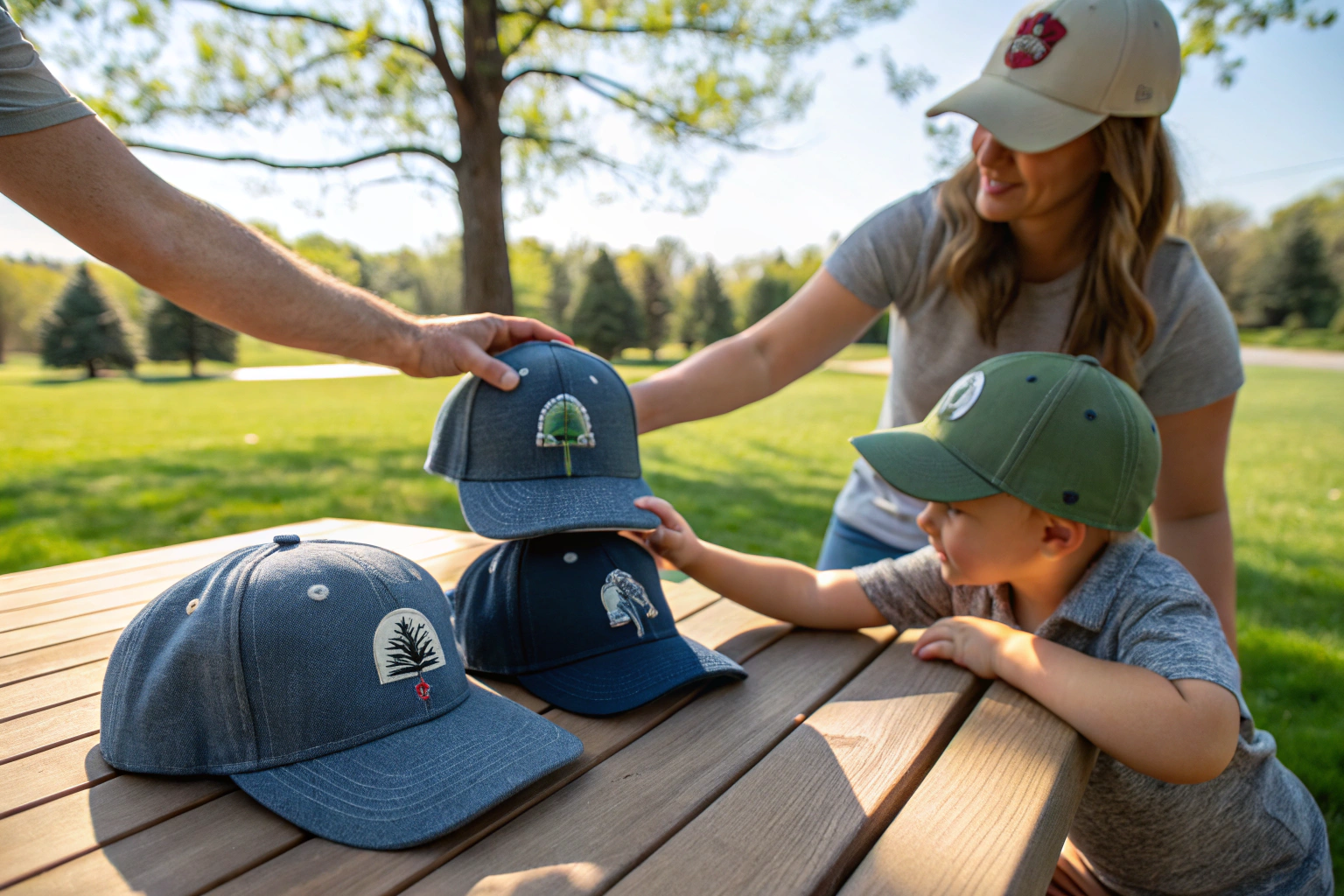
A children’s clothing brand owner once sat across from me, visibly exhausted. She had just spent weeks negotiating with two separate suppliers: one for her adult line of caps, and another for the matching kids’ versions. The adult factory was great with structured fits; the kids’ factory couldn’t match the exact shade of "Dusty Rose" on the cotton twill. Her collection, which was supposed to be a coordinated "mommy and me" moment, arrived looking like two different brands. She told me she felt like a logistics coordinator rather than a designer. She never wanted to split an order again.
Yes, our factory can absolutely produce both adult and child sizes of baseball caps within a single purchase order. We treat them as a unified production batch with a shared material preparation stage, a shared cutting session from the same fabric dye lot, and a parallel sewing assembly for the different size blocks. This approach guarantees that the color, the fabric hand-feel, and the logo embroidery are perfectly consistent across the adult and youth sizes, and it simplifies your logistics into a single consolidated shipment.
At our factory in Zhejiang, we maintain a full library of graded patterns for both adult and child headwear. I want to explain how we manage the pattern grading differences, the safety requirements unique to children’s products, and the logistics of packaging mixed-size orders for retail-ready distribution.
How Are Patterns Graded for Adult Versus Child Baseball Caps?
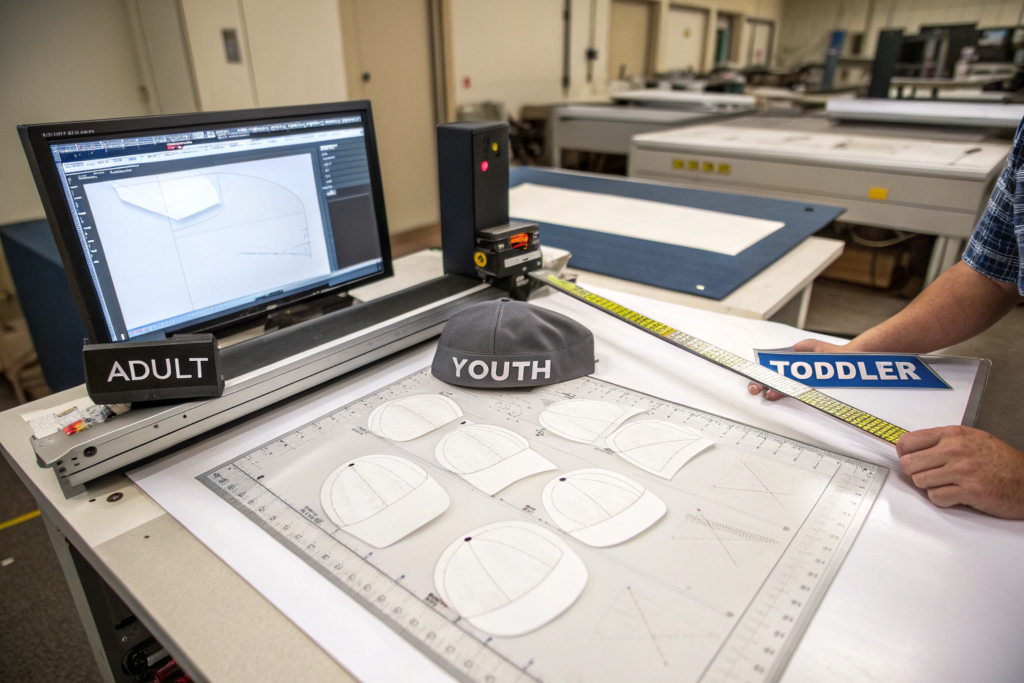
A child’s cap is not simply an adult cap shrunk to 80%. The proportions of a child’s head differ from those of an adult. A child’s head is larger in proportion to their body, and the shape is less elongated and more rounded. A simple uniform scale-down would produce a cap that is too shallow, pinches at the temples, and fails to cover the forehead adequately. Proper grading involves adjusting specific pattern points independently to match the anthropometric data of the target age group.
Our pattern library contains graded blocks for three distinct age groups based on international anthropometric standards. The adult block fits a head circumference of roughly 58 to 60 centimeters. The youth block fits approximately 53 to 55 centimeters. The toddler block fits approximately 49 to 51 centimeters. For each block, the crown depth, the brim width, and the sweatband thickness are adjusted proportionally but not uniformly. The crown panel shapes are recalculated to maintain the correct dome profile for the target head shape. This ensures that the cap sits correctly on the head, provides adequate sun protection, and feels comfortable for extended wear.
Why does a child’s cap crown need to be cut shallower than an adult’s?
The crown is the dome-shaped fabric piece that covers the top of the head. An adult head is taller from the ear to the crown. A child’s head is proportionally shorter. If a child wears a cap with an adult crown depth, the excess fabric bunches up, the cap sits too low over the eyes, or the child pushes it back awkwardly. A shallower crown depth ensures the cap sits snugly and comfortably on a child’s head without impeding their vision. This depth adjustment is a specific grading calculation, not a simple percentage reduction.
How does the brim length differ between adult and toddler caps?
The brim, or visor, protects the face from the sun. On an adult, a standard brim length is appropriate and proportionate. On a toddler, that same brim length would look comically oversized and could be a safety hazard, obscuring the child’s peripheral vision or causing them to trip. The brim length is shortened for toddler sizes, and the brim is often made from a softer, more flexible material to prevent injury during play. This children’s product safety design guidelines resource provides further context on proportional design for children’s products.
What Safety Considerations Are Unique to Children’s Caps?
Producing caps for children is a regulated activity. In the US, children’s products are subject to the Consumer Product Safety Improvement Act (CPSIA), which imposes specific testing and certification requirements. In Europe, the EN 71 standard governs toy and children’s product safety. A factory that produces adult accessories cannot simply assume they can produce children’s versions without understanding and implementing these safety protocols.
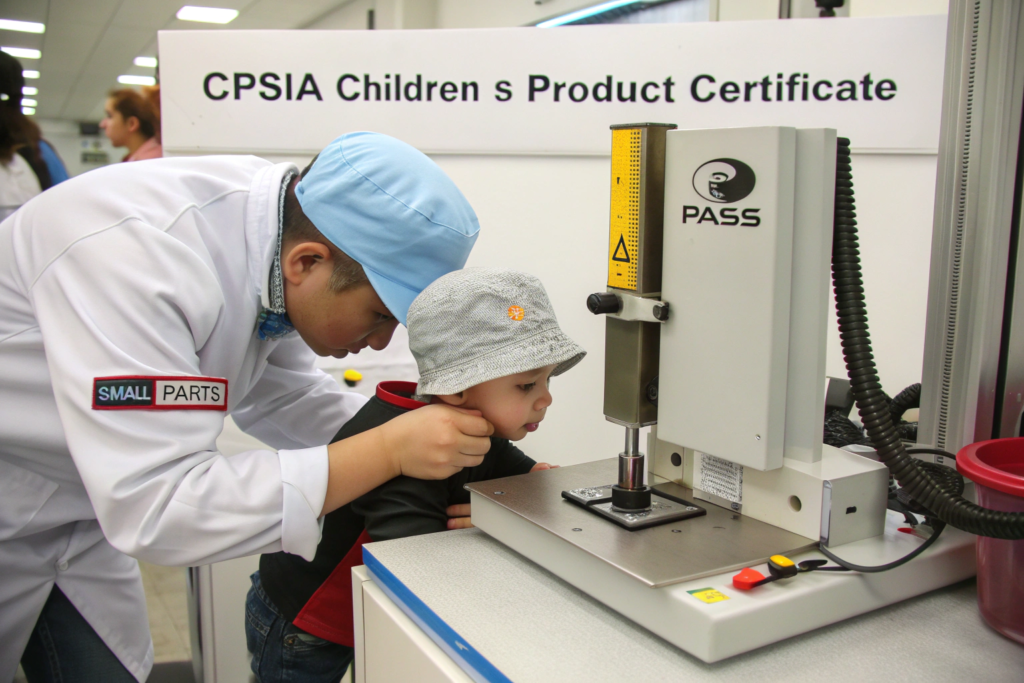
The primary safety concerns for children’s caps are the small parts hazard, the strangulation and entrapment risk from drawstrings and long straps, and the chemical safety of the materials. A decorative button, a metal logo plate, or a plastic eyelet on a toddler cap is a potential choking hazard if it detaches. The CPSIA requires that any component that can fit entirely within a small parts test cylinder must withstand a pull force without separating. Our children’s caps are engineered with these requirements from the design stage.
How do we test snaps and decorative buttons for the small parts regulation?
The small parts regulation, 16 CFR Part 1501 in the US, defines a small part as any object that fits completely into a truncated cylinder that simulates a child’s mouth. For a toddler cap, the metal snap closure, any decorative buttons, and even the plastic tip of the adjustable strap must either be too large to fit into the cylinder or must withstand a pull test force without detaching. We perform this testing using a calibrated force gauge. The component is pulled in multiple directions. If it detaches at a force below the threshold, the design is rejected and re-engineered. This small parts testing for children’s apparel is a mandatory regulatory requirement.
Why do we avoid drawstrings on toddler hats for the European market?
The European standard EN 14682 specifically restricts cords and drawstrings on children’s clothing to prevent strangulation and entrapment hazards. A decorative drawstring or a long chin strap on a toddler cap can catch on playground equipment, posing a serious risk. Our standard design for toddler caps destined for the European market uses a soft, flat elastic or a short, securely anchored velcro closure instead of any functional or decorative drawstring. This EU drawstring safety standard compliance is built into our pattern library.
How Are Mixed-Size Orders Packed and Shipped for Retail?
A mixed-size cap order presents a specific logistics challenge: the receiving team at the retail distribution center needs to quickly and accurately separate the adult caps from the children’s caps without opening every carton. If the packing is ambiguous, the wrong caps end up on the wrong store shelf, generating returns and chargebacks.
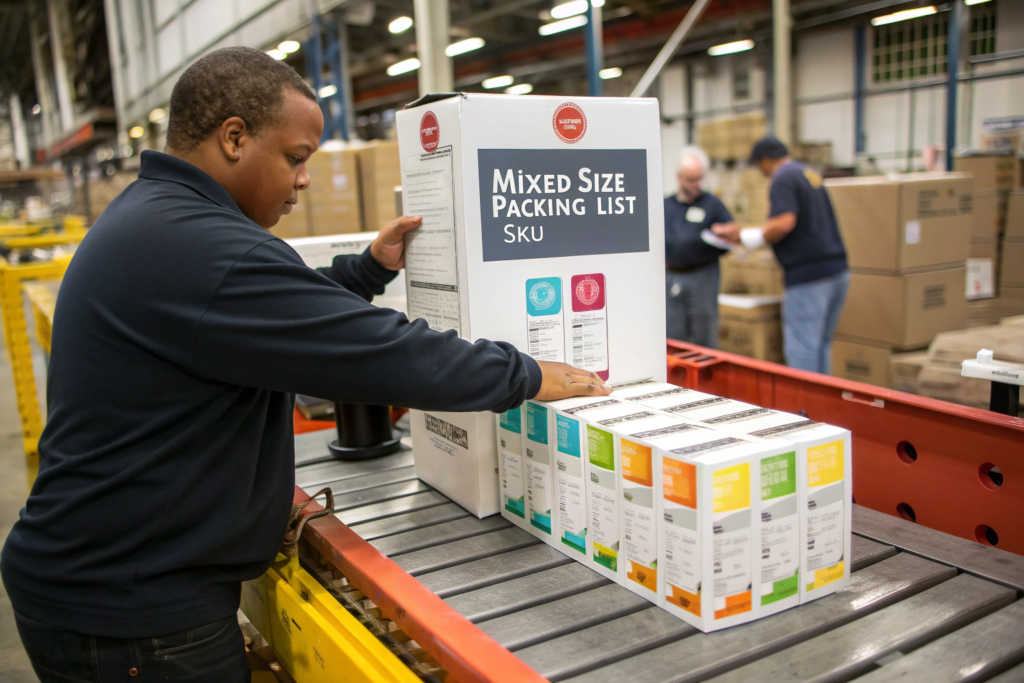
We solve this with a destination-specific labeling and packing protocol. Adult and child caps are sewn and finished on parallel lines, but they are packed into separate, clearly labeled cartons. Each carton is marked with a large, distinct color-coded label—for example, a blue label for Adult and a yellow label for Child. The cartons are palletized together, but the packing list and the commercial invoice clearly separate the two size categories by SKU, quantity, and carton number. The container is loaded so that the pallets can be easily separated at the destination.
What is a split packing list and how does it help the receiving warehouse?
A split packing list is a single document that is internally divided into two clear sections. Section A lists all SKUs, quantities, and carton numbers for the adult caps. Section B lists the same data for the child caps. The warehouse team can scan the barcode on a carton, and the system will immediately identify it as an adult or child carton. The document eliminates the guessing game that occurs when two sizes of a similar-looking product are mixed randomly in a container.
Why should child caps be packed in separate cartons from adult caps?
The visual difference between a youth cap and a small adult cap can be subtle, especially when the caps are folded and bagged. A receiving team member in a hurry might easily mistake one for the other. By packing the two size categories into physically separate, clearly marked cartons, we prevent this cross-contamination. The carton label, not the visual inspection of the cap, becomes the primary sorting mechanism. This retail carton labeling standards resource explains the industry expectations.
Conclusion
Producing both adult and child sizes of baseball caps in a single order is a capability built on precise pattern grading, rigorous children’s product safety compliance, and organized retail logistics. The adult cap and the toddler cap share the same fabric lot, the same color, and the same logo, ensuring a perfectly coordinated collection. The differences are in the pattern dimensions, the safety testing protocols, and the carton labeling.
We have explored the anthropometric grading that adjusts crown depth and brim length for growing heads, the CPSIA and EN 71 safety requirements that protect the youngest wearers, and the split packing strategies that keep the distribution center organized. A mixed-size family collection is a powerful retail concept, and it is entirely achievable with a partner who understands the technical requirements.
If you are developing a family or parent-child cap collection and want a single-factory solution that manages both the sizing and the safety compliance, we can provide a graded size sample set and a compliance documentation package. Our Business Director Elaine manages our headwear programs and can coordinate the development and testing timeline. Contact her directly at elaine@fumaoclothing.com. One order, one shipment, one perfect color match. That is the power of a unified production approach.