
A brand owner from London once forwarded me an email thread from her previous supplier. The factory had written, "The goods will send maybe next week we hope weather good." She was trying to plan a £20,000 launch, and that was her status update. She said the ambiguity was more stressful than the delay itself. She didn’t know if the shipment was on a truck, on a boat, or still on the cutting table. When she started working with us, her first email from our project manager included a specific vessel name, a confirmed sailing date, and a PDF of the bill of lading. She told me later, "I didn’t realize a factory email could sound like a partner instead of a puzzle."
Our clients say our English communication is better than other factories because we have invested in three specific areas that most Chinese manufacturers neglect: native-level technical vocabulary specific to fashion accessories, a "no ambiguity" communication protocol that replaces vague reassurances with specific data and dates, and a cultural alignment that understands the Western buyer’s need for proactive updates, direct answers, and documented accountability. This is not accidental. It is a deliberate, trained capability that we treat as a core part of our product quality.
At our factory in Zhejiang, I have made communication training a priority for every project manager who interacts with international clients. I want to explain exactly how we built this capability, what specific communication practices our clients notice and appreciate, and why clear English communication directly reduces costly production errors and shipment delays.
What Specific English Language Capabilities Do Our Project Managers Possess?
The English language gap in Chinese manufacturing is rarely about basic conversation. Most factory salespeople can manage a simple greeting, a price quote, and a "thank you." The gap emerges when the conversation moves into technical specifications, quality control protocols, and logistics coordination. This is where vocabulary becomes critical and where ambiguity becomes costly.
Our project managers possess domain-specific technical English vocabulary in three core areas: textile and accessory construction terms, quality control and compliance terminology, and international logistics and payment language. They can discuss the difference between a French seam and a flatlock stitch, explain an AQL 2.5 inspection protocol, and confirm that the container has been gated in at the Ningbo terminal with a specific vessel cut-off date. This vocabulary is not learned in a standard English class. It is learned through years of hands-on work with international clients, formal industry training, and a deliberate effort to master the language of the trade.

How does technical vocabulary in textiles prevent costly misunderstandings?
A buyer who requests a "soft scarf" might receive anything from a brushed cashmere to a limp polyester if the factory does not understand the distinction. A project manager who understands the terms "hand-feel," "drape," and "GSM," or grams per square meter, can respond with a specific question: "Should the hand-feel be similar to our sample BC-202, a brushed finish with a GSM of 180?" This specificity eliminates the guesswork. The buyer confirms the reference, the factory documents it, and the production proceeds with a shared, objective standard. The vocabulary bridges the gap between a subjective sensory experience and a verifiable specification. This technical textile vocabulary for manufacturing is the foundation of accurate communication.
Why does confident logistics terminology build buyer trust?
When a buyer asks about the shipment status and the project manager responds with "the container was gated at Ningbo terminal yesterday, the vessel CMA CGM estimated departure is Thursday, and here is the booking confirmation and the forwarder’s contact details," the buyer knows the order is under control. This language conveys competence and transparency. It tells the buyer that there is a person on the other side of the world who is managing the details with precision. Trust is not built by saying "don’t worry, I will handle it." Trust is built by providing specific, verifiable information that allows the buyer to independently confirm the status.
What Is Our "No Ambiguity" Communication Protocol?
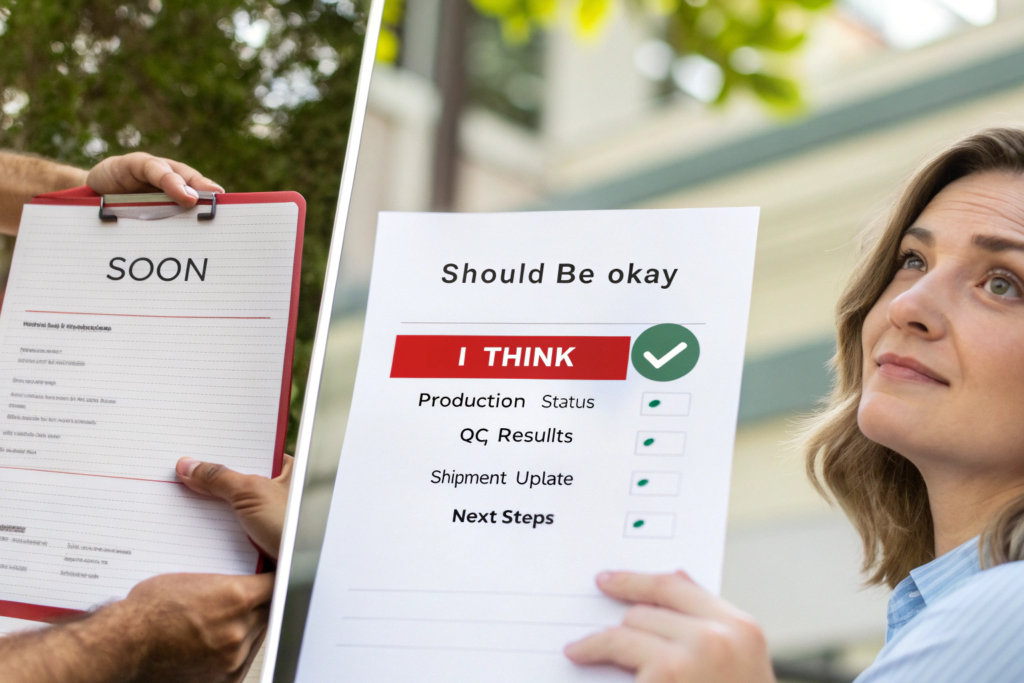
Ambiguity is the primary source of frustration in international sourcing. Vague phrases like "it will be ready soon," "the color is more or less the same," or "there is a small problem but we are fixing" create anxiety and force the buyer to send follow-up emails requesting clarification. Each clarification cycle adds time and frustration to the process.
Our "no ambiguity" protocol requires that every client communication include specific, measurable data wherever possible. A status update does not say "production is almost done." It says "cutting is 100% complete, sewing is 80% complete (4,000 of 5,000 units sewn), and finishing will begin on Tuesday." A color concern is addressed with a spectrophotometer reading and a Delta E value, not a subjective judgment. A problem is communicated immediately, accompanied by the current status, the root cause, and the proposed solution. This protocol transforms communication from a source of anxiety into a tool for project management.
How do we structure a weekly production update email?
Our standard weekly update email follows a consistent template with four sections. The "Production Status" section lists each production stage—cutting, sewing, finishing, quality control, packing—with a percentage complete and the estimated completion date. The "QC Results" section summarizes the latest inspection findings, including the AQL sample size, the number of defects found, and the acceptance decision. The "Shipment Update" section provides the vessel name, the estimated departure date, the transit time, and the estimated arrival date. The "Next Steps" section lists the actions required from the client, such as "approve the enclosed lab dip photo by Wednesday" or "confirm the packaging label layout." This consistent structure allows the buyer to find the information they need in seconds. This project status reporting for manufacturing is a standard practice we have adapted for our industry.
Why do we send photos with date stamps instead of saying "production is ongoing"?
A statement without visual evidence is an opinion. A photo of the cutting table with a handwritten card showing the date and the client’s order number is a fact. We train our project managers to include a date-stamped photo of the production floor in every weekly update. The client sees the actual fabric being cut, the actual scarves being sewn, and the actual cartons being packed. This visual transparency eliminates the "are they really working on my order" anxiety that haunts international sourcing. It also documents the production progress for future reference, creating a visual audit trail. This visual progress reporting in manufacturing is a powerful trust-building practice.
How Does Our Cultural Understanding of Western Business Practices Reduce Friction?
Communication is not just about vocabulary. It is about cultural expectations. A communication style that is perfectly acceptable in one business culture can be perceived as rude, evasive, or confusing in another. Many Chinese factories communicate in a way that is natural to their local business culture—indirect, relationship-focused, and hesitant to deliver bad news directly. This style often clashes with the Western business preference for directness, proactivity, and documented accountability.
Our project managers are trained in the specific communication expectations of Western importers. They understand that a direct "no" followed by an alternative solution is more valued than an ambiguous "maybe" that avoids confrontation. They understand that a problem reported immediately is seen as responsible, while a problem hidden until the last minute is seen as a betrayal. They understand that the Western workday does not overlap with the Chinese workday, so emails sent during the day in China must be clear and complete to enable the client to make decisions overnight without waiting another 24 hours for a follow-up answer.

Why do we provide direct "no" answers with alternative solutions?
In many Asian business cultures, a direct refusal is considered impolite. The speaker might say "it is difficult" or "we will try" to avoid the discomfort of a direct no. A Western buyer interprets "we will try" as a commitment, and when the factory fails, the buyer feels deceived. Our team is trained to say "no" clearly when a request cannot be fulfilled, and to immediately follow the no with a specific alternative. For example: "We cannot achieve a 2-week delivery on this order because the custom yarn dyeing requires 10 days. However, if you can accept a stock color from our yarn library, we can ship in 3 weeks." This directness respects the buyer’s time and allows them to make a fast, informed decision. This cross-cultural business communication skill is explicitly taught and practiced.
How does proactive problem notification build long-term trust?
A factory that hides a production delay until the day before the shipment is due has destroyed the buyer’s ability to mitigate the problem. A factory that reports the delay the moment it is identified, explains the cause, and proposes a recovery plan—air freight instead of sea freight, a partial shipment, or a renegotiated delivery date—empowers the buyer to manage their own business. Our team is trained to report problems within one hour of identification, not one week. This "no surprises" policy is consistently cited by our long-term clients as the single most valuable aspect of our communication. They know that they will never be blindsided by bad news, and therefore they can trust the good news when we report it.
What Continuous Improvement Systems Do We Have in Place for English Communication?
A strong communication capability is not built once. It is maintained and improved continuously. The English skills that served our team five years ago are not sufficient for today’s increasingly sophisticated buyer expectations. We have institutionalized several systems to ensure our communication quality continues to improve over time.
These systems include a quarterly communication audit, where a native English-speaking consultant reviews a random sample of client emails and provides feedback on grammar, clarity, and cultural appropriateness. We maintain an internal technical glossary, updated regularly, that standardizes the English terminology used by all project managers for accessory components, defects, and processes. We conduct monthly role-playing sessions where project managers practice difficult conversations—delivering bad news, negotiating a price increase, or clarifying a complex technical issue—in a safe environment with a coach.

How does an external communication audit work and what does it catch?
Every quarter, we engage a native English-speaking consultant with experience in the fashion manufacturing industry. The consultant randomly selects 50 client emails sent by our project managers over the past quarter. Each email is reviewed against a rubric that scores clarity, technical accuracy, tone, and cultural appropriateness. The consultant identifies patterns—a specific grammar error that repeats, a phrase that sounds unintentionally abrupt, or a technical term used incorrectly—and conducts a group training session to address these patterns. This external audit catches the small communication habits that internal reviewers, who share the same language background, might miss. This supplier communication audit process is a best practice we have adopted.
Why is an internal technical glossary critical for consistent vocabulary?
Without a glossary, one project manager might refer to a "hair clip spring," another to a "hair claw mechanism," and a third to a "metal clasp." The client receives inconsistent terminology and is unsure whether these refer to the same component. Our internal glossary standardizes the English names for every component, material, finish, and defect across the entire organization. When a new project manager joins the team, the glossary is their primary training document. When a new component is introduced, the team agrees on the English term and adds it to the glossary. This standardized terminology in manufacturing eliminates a subtle but persistent source of confusion.
Conclusion
The superior English communication our clients experience is not a happy accident or the result of hiring one particularly talented individual. It is the product of a deliberate, systematic investment in three areas: domain-specific technical vocabulary that eliminates ambiguity in product specifications, a "no ambiguity" communication protocol that replaces vague reassurances with specific data, and a cultural training program that aligns our communication style with Western business expectations of directness, proactivity, and documented accountability. This capability is maintained and continuously improved through external audits, an internal glossary, and ongoing training.
The return on this investment is measured not in words, but in reduced production errors, faster approval cycles, fewer costly delays, and client relationships built on trust rather than anxiety. A factory that communicates clearly is a factory that can be trusted with complex, high-value orders. Our clients tell us this is why they stay with us year after year, even when they receive slightly lower price quotes from competitors.
If you have been frustrated by communication gaps with previous suppliers and want to experience the difference that professional, technical English communication makes in your sourcing process, we welcome the opportunity to demonstrate it. Contact our Business Director Elaine at elaine@fumaoclothing.com with any inquiry. The clarity of our response will be the first proof point.