A long-time client from Berlin called me last March with an urgent problem. His bank had frozen his wire transfer to us for two weeks, demanding documentation about the source of funds and the nature of the goods. Our production was ready, our shipping container was booked, and his payment was sitting in a bank's compliance department with no release date in sight. He asked me if we could accept cryptocurrency. At the time, I said no. We lost two weeks of shipping time, and he almost lost his retail launch window. That experience made me rethink everything.
The best payment method for a factory that accepts cryptocurrency is a stablecoin transfer using USDT or USDC on a low-fee blockchain network like TRC-20 or Solana, combined with a written purchase agreement that references the specific wallet addresses, the exchange rate, and the refund policy. This method eliminates chargeback fraud risk for the factory, settles within minutes instead of days, and protects the buyer from the price volatility of traditional cryptocurrencies like Bitcoin.
After that Berlin incident, I spent months researching crypto payment systems. I talked to other factory owners who had adopted it, consulted with our bank about compliance, and ran a series of test transactions with small, trusted clients. Our Zhejiang factory now accepts crypto payments for sample fees and production orders. Let me explain exactly how this works, why a stablecoin setup is the safest path for both parties, and what you need to have in place before you send the first transaction.
Why Are Stablecoins Like USDT and USDC the Safest Crypto Option for Trade Payments?
The single biggest barrier to using cryptocurrency for factory payments is price volatility. Bitcoin can move five percent in an hour. A buyer who sends Bitcoin worth ten thousand dollars at noon might have a payment worth nine thousand five hundred dollars by the time the transaction confirms. That is an unacceptable risk for a business transaction. Stablecoins solve this problem completely. They are cryptocurrencies designed to maintain a one-to-one peg with a fiat currency, usually the US dollar. This gives you the speed and finality of crypto with the price stability of traditional money.

How Does the Pegging Mechanism Protect Both Buyer and Factory?
USDT, issued by Tether, and USDC, issued by Circle, are the two dominant stablecoins in trade payments. Each token is supposed to be backed by an equivalent amount of real US dollars or equivalent assets held in reserve. When a buyer sends one thousand USDT, the factory receives a value that should be, within a fraction of a percent, one thousand US dollars. The factory does not need to rush to a crypto exchange to convert volatile coins. The buyer does not need to worry about overpaying or underpaying due to market swings. The price stability means the purchase order total, the invoice amount, and the received amount all match. This is essential for accounting, for customs declarations, and for the basic trust required in a business relationship. The peg is maintained by the issuing company's reserve management and market arbitrage mechanisms. While no peg is absolutely perfect, USDT and USDC have both demonstrated resilience through multiple market cycles. For further information on how stablecoins maintain their peg, you can review educational resources from CoinDesk.
What Are the Key Differences Between USDT and USDC for Factory Payments?
Both are widely accepted, but they have practical differences. USDT has the highest trading volume and the deepest liquidity across exchanges worldwide. This means it is easier to convert into local currency in almost any country. For a Chinese factory, converting USDT to CNY through a peer-to-peer marketplace or an exchange is a well-established path with tight bid-ask spreads. USDC is issued by a US-regulated entity and positions itself as the more compliant, transparent option. It is often preferred by US and European buyers who want the highest level of regulatory clarity. In practice, our factory accepts both. I tell clients to use whichever one they already hold or can acquire most easily. The blockchain network you choose matters more than the specific stablecoin. A USDT transfer on the Ethereum network can cost twenty dollars or more in gas fees and take several minutes. The same USDT transfer on the TRC-20 network, which runs on the Tron blockchain, costs one or two dollars and settles in seconds. We default to USDT on TRC-20 for sample fees and smaller production deposits because the speed and low cost make it ideal for business payments.
How Should a Crypto Payment Agreement Be Structured for a Factory Order?
A crypto payment without a written agreement is a recipe for a dispute. The blockchain transaction itself is irreversible, which protects the factory but creates risk for the buyer if something goes wrong. A clear, signed agreement that references the specific transaction details is the bridge between the immutability of the blockchain and the practical realities of international trade. This agreement does not need to be a fifty-page legal document. It needs to cover a few specific, critical points that a traditional wire transfer agreement might not address.
What Specific Clauses Should a Crypto Payment Purchase Order Include?
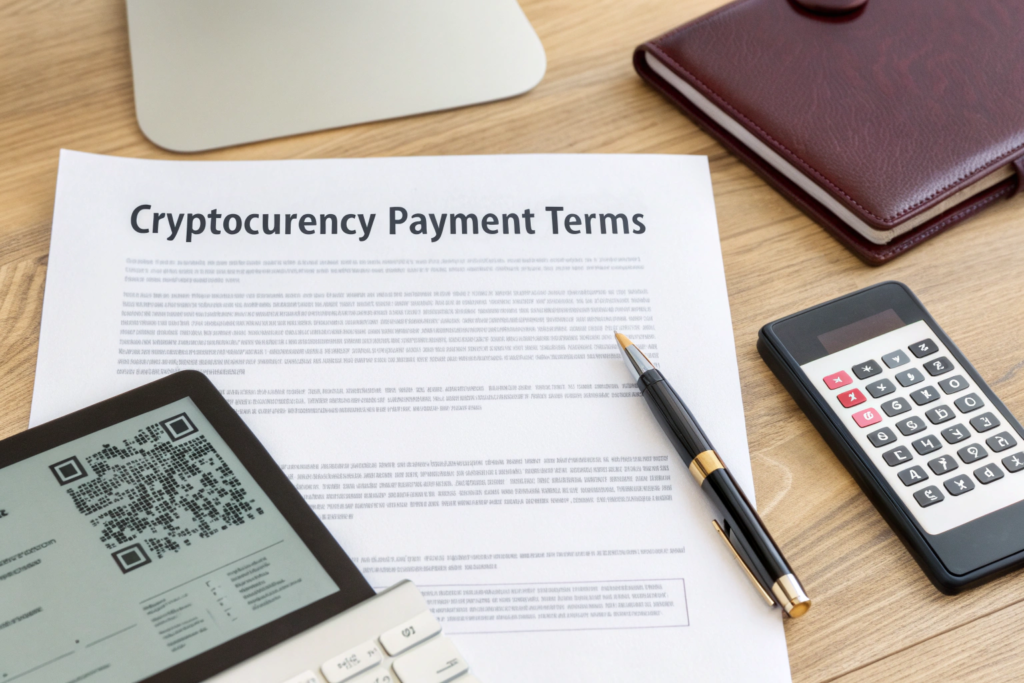
The purchase order or sales agreement must include four crypto-specific clauses. First, the exact wallet addresses. The agreement must state the factory's receiving wallet address and the buyer's refund wallet address. These long alphanumeric strings must be copied and pasted, not typed manually, and verified character by character. A single wrong character sends the funds to an unrecoverable void. Second, the exchange rate basis. The agreement must state that the payment will be calculated at the USDT or USDC to USD rate of one-to-one, or specify a reference exchange rate source and time for volatile cryptocurrencies. Third, the transaction confirmation requirement. The agreement must state that payment is considered received after a specified number of blockchain network confirmations. For TRC-20, we consider payment confirmed after a single confirmation, which takes seconds. For more congested networks, we may require more. Fourth, the refund policy in case of order cancellation. Since the transaction is irreversible, the refund mechanism must be clearly defined. Typically, if the factory cancels, we agree to send the exact crypto amount back to the buyer's provided refund address within a specified number of business days. If the buyer cancels, we agree on whether the deposit is forfeited or partially refunded. Having these four points in writing protects both sides.
How Do You Verify and Document the Wallet Addresses to Prevent Errors?
Address verification is the most security-critical step in the entire process. Malware exists that can change a copied wallet address in your computer's clipboard to a hacker's address. If a buyer copies our wallet address and pastes it without verifying, they could send tens of thousands of dollars to a thief. Our protocol is this. We send the wallet address in two separate communication channels. For example, we email the address and also send it by WhatsApp message. The buyer must compare the two addresses character by character. We also provide a QR code for the wallet address, which can be scanned directly by a phone wallet app, reducing the risk of manual typing errors. Before sending a large amount, we require the buyer to send a test transaction of a small amount, such as ten USDT. We confirm receipt of the test, and only then does the buyer send the full payment. This test transaction takes an extra two minutes and costs almost nothing on TRC-20, and it eliminates the risk of catastrophic address errors.
What Are the Speed and Cost Advantages Over Traditional Wire Transfers?
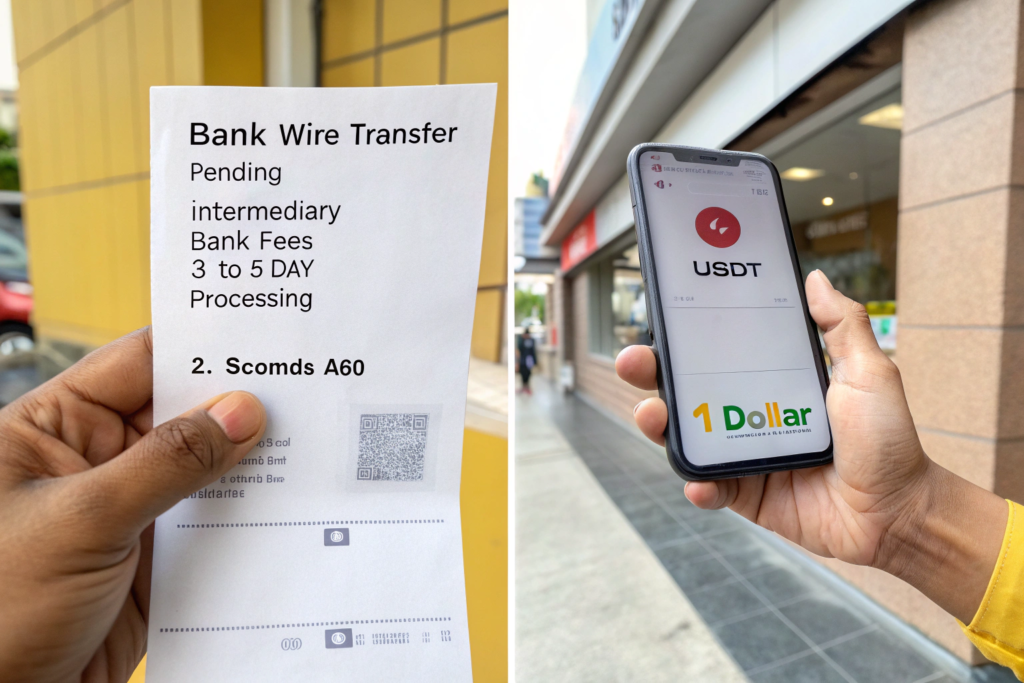
The reason factories and importers are adopting crypto payments is not ideological. It is brutally practical. A traditional SWIFT wire transfer from a US bank to a Chinese factory takes two to five business days. It involves intermediary banks that each take a cut. The sender pays a wire fee, the receiver pays an incoming wire fee, and the exchange rate spread at the receiving bank shaves another percentage point off the total. A crypto transfer on a modern blockchain settles in seconds to minutes, costs a fraction of a dollar to a few dollars, and arrives at the exact amount sent. The time and cost savings are not marginal. They are transformative for cash flow.
How Much Do International Wire Fees Cost Compared to Blockchain Network Fees?
Let me break down a real comparison. A US importer sending a thirty percent deposit of fifteen thousand dollars on a fifty thousand dollar order. A bank wire might charge the sender a thirty-five to fifty dollar outgoing wire fee. The intermediary bank takes another fifteen to twenty-five dollars. The Chinese receiving bank charges a ten to fifteen dollar incoming wire fee. The currency conversion from USD to CNY applies a spread of one to two percent, which on fifteen thousand dollars is another one hundred fifty to three hundred dollars. The total cost of sending that deposit can easily reach two hundred fifty to four hundred dollars. The same deposit sent as USDT on TRC-20 costs a network fee of approximately one to two dollars, total. The conversion from USDT to CNY through a peer-to-peer marketplace has a spread of roughly zero point two to zero point five percent, or thirty to seventy-five dollars. The total cost is under eighty dollars. The savings on one deposit alone can cover the cost of a round of samples.
Why Does Instant Settlement Matter for Production Scheduling?
Time is not just money. Time is production capacity. When a buyer wires a deposit, the money vanishes from their account but does not appear in ours for up to a week. During that week, the order is in limbo. We cannot responsibly purchase raw materials or schedule production line time because the funds have not cleared. A crypto deposit confirms in under a minute. Our project manager sees the transaction on the blockchain explorer, verifies the wallet address and amount, and immediately releases the material purchase order. That lost week of waiting time is eliminated. For an order on a tight timeline, such as a back-to-school shipment or a corporate event with a fixed date, that recovered week can be the difference between on-time delivery and a missed deadline. The production team can start working while the traditional wire transfer would still be sitting in an intermediary bank in Frankfurt or New York.
What Compliance and Accounting Challenges Come with Crypto Factory Payments?
Crypto payments are fast and cheap, but they come with a new set of compliance and accounting responsibilities. A factory cannot simply receive crypto into a personal wallet and ignore it on the books. Tax authorities in China and in the buyer's country are increasingly focused on cryptocurrency transactions. Proper record-keeping and legal conversion paths are essential. A factory that treats crypto as a way to hide income is inviting a future audit disaster. A factory that treats crypto as a legitimate payment rail with proper documentation can use it transparently and sustainably.

How Is Cryptocurrency Payment Recorded in Factory Accounting?
Every crypto payment we receive is recorded with the same rigor as a bank wire. We generate a formal commercial invoice that states the order total in US dollars, the cryptocurrency used, the exchange rate applied, the wallet addresses involved, and the blockchain transaction ID. This transaction ID is a permanent, public record that the payment occurred. We attach a screenshot of the blockchain explorer page showing the confirmed transaction to the invoice file. When we convert the USDT to CNY through a licensed exchange or a peer-to-peer marketplace, we retain the conversion receipt. The accounting entry records the dollar value of the order as revenue, the crypto conversion as a cash inflow, and any minor exchange rate difference as a currency gain or loss. This creates a clean audit trail that satisfies our annual financial review. The transparency of the blockchain actually makes the audit trail stronger than a bank wire in some ways, because the transaction can be independently verified by anyone with the transaction ID.
What Are the Regulatory Considerations for Factories Accepting Crypto?
The regulatory landscape is evolving, and it differs by country. In China, cryptocurrency trading is restricted for financial institutions, but peer-to-peer transactions and holding crypto as property exist in a legal grey area. Many factories use over-the-counter desks or peer-to-peer marketplaces to convert crypto receipts into CNY. This is common practice but requires careful partner selection to ensure the conversion platform is reputable and compliant with anti-money laundering requirements. For the buyer's side, US and European importers must consider their own tax obligations. Sending crypto is a disposition of an asset that may trigger a capital gains or loss event. The buyer should consult their accountant. From the factory's perspective, our responsibility is to provide accurate transaction documentation that the buyer can use for their own tax reporting. We do not provide tax advice, but we provide the receipt. Resources on cryptocurrency regulation and compliance can be found through organizations like the Financial Action Task Force.
Conclusion
The best payment method for a factory that accepts cryptocurrency is a stablecoin transfer, specifically USDT or USDC, sent on a low-cost, high-speed blockchain like TRC-20 or Solana. This method eliminates the volatility risk of traditional cryptocurrencies, settles in seconds to minutes, costs a few dollars in network fees, and provides an irreversible, verifiable transaction record. It must be accompanied by a written purchase agreement that specifies the wallet addresses, the exchange rate basis, and the refund policy. A small test transaction before the full payment is a non-negotiable security step that prevents catastrophic address errors.
The cost comparison is stark. A bank wire for a fifteen thousand dollar deposit can cost two hundred fifty to four hundred dollars and take a week. A USDT transfer on TRC-20 costs under two dollars and settles in under a minute. That recovered week of waiting time allows the factory to purchase materials and start production immediately, which shortens the overall order lead time.
Crypto payments are not a way to avoid taxes or regulations. They must be recorded with proper invoices, blockchain transaction IDs, and conversion receipts. A factory that implements crypto payments with transparent accounting and clear buyer agreements positions itself as a modern, efficient, and financially flexible partner.
At AceAccessory, we made the decision to accept stablecoin payments because our buyers asked for it, and because we saw the clear operational advantages. We treat every crypto payment with the same documentation discipline as a traditional wire transfer. Our project managers are trained to guide buyers through the wallet verification and test transaction process securely.
If you are interested in paying for your next sample order or production run with USDT or USDC, I invite you to discuss it with us. We can walk you through our wallet verification protocol and provide our payment agreement template for your review.
To start a conversation about paying with cryptocurrency for your accessory order, please contact our Business Director, Elaine. You can reach her directly at elaine@fumaoclothing.com. Let us make your next payment fast, cheap, and transparent.