A streetwear buyer from a cult-favorite Tokyo brand sat in my showroom last month, holding three beanie samples in his hands. He kept flipping the cuffs, folding and unfolding them, trying each one on, taking selfies in the mirror. He was not just looking at the color or the knit pattern. He was obsessed with the cuff. "The cuff is the face of the beanie," he said. "It is the first thing you see in a fit pic. If the cuff is wrong, the whole silhouette collapses." He was absolutely right. The cuff is not a minor detail. It is the single most defining design element of a streetwear beanie. It determines how the beanie sits on the head, how it frames the face, and how it photographs for social media. He spent forty minutes comparing cuff styles before making his decision. That is how seriously the best streetwear brands take this detail.
The top three beanie cuff styles for streetwear brands in 2026 are the oversized chunky fold-up cuff, a deliberately exaggerated, thick folded band that extends four to six inches up from the brow line and creates a dramatic, top-heavy silhouette that dominates the profile. The micro cuff, a barely-there, finely ribbed edge that sits close to the head and creates a sleek, skull-hugging silhouette that contrasts sharply with oversized outerwear. And the raw laser-cut edge with no traditional fold-over cuff at all, an unfinished, deconstructed look where the beanie body terminates in a cleanly cut edge that is left unhemmed, often with a slight curl that adds texture and a sense of intentional imperfection. These three styles represent a spectrum from maximalist to minimalist to deconstructed, giving streetwear brands clear aesthetic lanes to choose from based on their brand identity.
Streetwear is a category driven by silhouette, attitude, and detail. The difference between a beanie that sells out and one that sits on shelves often comes down to a few centimeters of ribbing at the forehead. At AceAccessory, we produce beanies for streetwear brands ranging from small independent labels to major global players. Our design team tracks cuff style trends as closely as we track color and material trends. The 2026 season is shaping up to be one of the most diverse in recent memory for beanie cuff design. Let me walk you through each of the three dominant styles and what makes them work.
Why Is the Oversized Chunky Cuff the Leading Streetwear Style for 2026
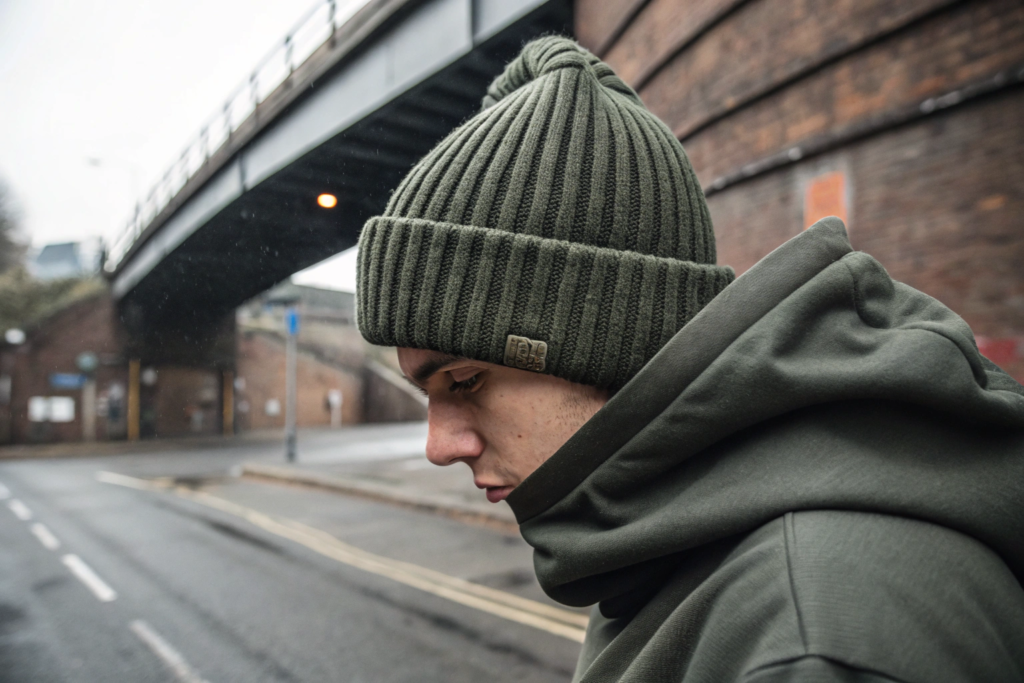
The oversized chunky cuff is the maximalist expression of beanie design. It is not subtle. It is not trying to blend in. It is a deliberate statement piece that alters the wearer’s entire head profile. The cuff is typically a fold-up band of thick, heavy-gauge rib knit, measuring four to six inches in height when folded. The knit is substantial, often a 3-gauge or 5-gauge chunky knit using thick, plied yarns. The ribbing is deep and pronounced, with wide vertical channels that create strong shadow lines. When worn, the cuff sits high on the forehead, adding visible height and volume to the top of the head. The body of the beanie above the cuff is generously proportioned, allowing it to slouch backward or stand upright depending on the wearer’s preference.
The oversized chunky cuff is the leading streetwear beanie style for 2026 because it delivers maximum visual impact on social media, where exaggerated silhouettes photograph dramatically and create a recognizable brand signature. The chunky cuff frames the face in a way that smaller cuffs cannot, drawing the eye upward and creating a balanced proportion with the oversized outerwear, puffer jackets, oversized hoodies, and boxy coats, that dominates streetwear fashion. The cuff also provides a large, visible canvas for branding. A wide cuff can carry a substantial embroidered logo, a jacquard-knit brand name, or a contrast stripe detail that is visible from a distance. From a manufacturing perspective, the chunky cuff uses more yarn and requires more labor to knit, which allows brands to command a higher retail price and positions the beanie as a premium statement piece rather than a basic accessory.
The chunky cuff trend is closely linked to the broader fashion movement toward exaggerated proportions. Just as sneakers have grown chunkier and outerwear has grown more voluminous, the humble beanie has been supersized. It is a logical evolution of the silhouette-driven streetwear aesthetic. Let me explore what makes a chunky cuff successful from a design and manufacturing standpoint.
What Knit Gauge Creates the Perfect Chunky Cuff Structure?
The gauge of the knit is the technical foundation of the chunky cuff. Gauge refers to the number of needles per inch on the knitting machine. A lower gauge means fewer, thicker needles and a chunkier, more open knit. A higher gauge means more, finer needles and a tighter, smoother knit. For the oversized chunky cuff, the ideal gauges are 3-gauge and 5-gauge. A 3-gauge knit uses approximately three needles per inch and produces a very thick, heavy fabric with a pronounced rib texture. Each rib is wide and deep, creating a sculptural, almost architectural look. The fabric has significant natural stiffness due to the thick yarns, which helps the cuff hold its shape and stand upright without collapsing. A 3-gauge beanie cuff is a true statement piece. It feels substantial in the hand, almost like a piece of protective gear. The weight communicates quality and luxury. A 5-gauge knit is slightly finer, with five needles per inch. It produces a chunky but more flexible fabric. The ribbing is still pronounced but less extreme. A 5-gauge cuff has a bit more drape and conforms more closely to the head, making it slightly more wearable for everyday use while still delivering the oversized look. The yarn choice interacts with the gauge. For 3-gauge cuffs, we typically use a thick, plied yarn such as a 2/8 or 3/8 worsted weight acrylic-wool blend. The yarn must have enough body to hold the rib structure and enough softness to be comfortable against the forehead. A 100% acrylic yarn can achieve the look at a lower cost, but an acrylic-wool blend, typically 50/50 or 80/20, provides superior warmth, breathability, and a more premium hand feel. The cuff height when fully extended, before folding, is typically 8 to 12 inches, which folds down to a 4 to 6 inch cuff on the head.
How Should a Chunky Cuff Be Attached to the Beanie Body?
The attachment between the chunky cuff and the beanie body is a critical construction detail that affects both the appearance and the durability of the beanie. There are two main construction methods, and each produces a different look. The first method is the knit-on cuff. The cuff is knitted continuously with the beanie body on the same knitting machine. The machine starts by knitting the cuff as a long tube of ribbing. It then transitions to the body stitch, usually a jersey or a half-cardigan stitch, and continues knitting upward to form the crown. The transition is seamless. There is no seam line between the cuff and the body. This construction is clean, streamlined, and very strong. The cuff will never separate from the body because they are one continuous piece of fabric. The knit-on cuff is the preferred method for premium streetwear beanies. The downside is that it is slower to produce and requires a knitting machine with the capability to transition between stitch types. The second method is the sewn-on cuff. The cuff is knitted as a separate tubular piece, and the beanie body is knitted separately. The two pieces are then joined together with a linking machine or an overlock stitch. This construction leaves a visible seam on the inside of the beanie where the cuff meets the body. The seam can sometimes create a slight ridge that is visible on the outside, especially in thinner knits. For chunky knits, the ridge is usually hidden by the thickness of the fabric. The sewn-on cuff is faster and cheaper to produce, and it allows for more design flexibility. A contrast color cuff, for example, can be easily achieved by knitting the cuff and body in different yarns and sewing them together. For the oversized chunky cuff trend, the knit-on construction is the premium choice. The seamless transition enhances the sculptural quality of the beanie. The absence of an internal seam improves comfort against the forehead. And the continuous knit structure ensures the cuff maintains its shape through repeated wear and folding.
How Does the Micro Cuff Create a Sleek Streetwear Silhouette
The micro cuff is the polar opposite of the chunky cuff. Where the chunky cuff is maximalist and aggressive, the micro cuff is minimalist and precise. It is a finely ribbed edge, typically only one to two centimeters wide, that sits almost flat against the forehead. The cuff is folded up just once, or in some designs, not folded at all but knitted as a finished edge band. The knit gauge is fine, typically 7-gauge to 12-gauge, producing a smooth, dense fabric with subtle ribbing. The body of the beanie fits closely to the head, following the skull’s natural contour without excess slouch or volume. The overall silhouette is sleek, clean, and almost technical.
The micro cuff has emerged as a top 2026 streetwear beanie style because it represents a reaction against the oversized trend that has dominated for several seasons. Streetwear is fragmenting into multiple aesthetic lanes, and one of the most influential is a refined, minimalist approach that borrows from luxury fashion and technical outerwear. The micro cuff beanie fits perfectly into this aesthetic. It pairs seamlessly with tailored coats, technical shells, and clean, unbranded looks. It does not compete with other elements of the outfit. It complements them. The micro cuff also photographs beautifully in a different way than the chunky cuff. The chunky cuff dominates a photo. The micro cuff frames the face subtly, allowing the wearer’s features and the rest of the outfit to remain the focus. For streetwear brands that position themselves as elevated, refined, or luxury-adjacent, the micro cuff is the definitive beanie silhouette for 2026.
The micro cuff is deceptively difficult to execute well. Because there is so little fabric at the cuff, every stitch is visible. Every imperfection is exposed. The quality of the knitting, the evenness of the ribbing, and the precision of the edge finish are all under a magnifying glass. Let me explain the technical requirements for a perfect micro cuff.

What Ribbing Patterns Work Best for a Minimal Cuff Edge?
The ribbing pattern on a micro cuff must achieve a specific balance. It needs enough elasticity to hold the beanie securely on the head without being tight. It needs enough visual texture to look intentional and designed, not like an afterthought. And it needs to lie flat against the skin without curling or rolling. The most effective ribbing pattern for a micro cuff is a 1×1 rib. This is the classic knit-one, purl-one rib that alternates single columns of knit and purl stitches. A 1×1 rib has excellent elasticity in the horizontal direction, allowing it to stretch comfortably around the head. It has a clean, uniform appearance with narrow, even vertical lines. The fabric lies flat and does not curl at the edges, which is critical for a cuff that sits directly against the forehead. A 2×2 rib, knit two, purl two, is the next most popular choice. It creates wider rib columns and has a slightly chunkier appearance while still functioning well as a minimal cuff. A 2×2 rib is a good choice for beanies that sit between the micro and chunky categories. For a truly technical, performance-oriented micro cuff, a 1×1 rib with a small percentage of elastane, typically 2 to 5 percent, can be used. The elastane provides additional recovery, ensuring the cuff never stretches out or loses its grip over time. This is popular for beanies marketed as active streetwear, worn for skating, biking, or urban commuting. The edge finish of the micro cuff is crucial. A simple cast-on edge, the natural edge created when the knitting begins, can look unfinished on a premium product. We finish our micro cuffs with a tubular cast-on or a folded hem edge. The tubular cast-on creates a smooth, rounded edge that looks polished and feels comfortable. The folded hem edge involves knitting the cuff twice as long, folding it over, and stitching it down to create a clean, double-thickness band. This adds structure and a subtle premium detail that is visible upon close inspection.
How Does a Micro Cuff Affect the Overall Beanie Fit?
The micro cuff fundamentally changes how the beanie wears on the head. A traditional beanie with a standard cuff has a certain amount of built-in adjustability. The wearer can fold the cuff more or less, changing the amount of fabric over the ears and the height of the beanie on the crown. A micro cuff beanie has very little adjustability. The cuff is a fixed, narrow band. The beanie fits the way it fits, and the wearer cannot significantly alter it. This means the fit must be precise from the start. The beanie body must be engineered to sit correctly on the head without relying on the cuff for adjustment. The total length of the beanie, from the bottom of the cuff to the crown, must be calculated to create the intended silhouette. For a true micro cuff beanie that sits close to the head, the total length is typically shorter than a traditional slouch beanie. The crown shaping, the decreases at the top of the beanie, must be designed so that the beanie hugs the skull rather than forming a slouchy pouch of fabric at the back. The crown is often finished with a shallow dome and minimal excess fabric. The tension of the knit is also critical. A micro cuff beanie must have enough negative ease, meaning the fabric circumference is slightly smaller than the head circumference, to stay securely in place. But too much negative ease will create a tight, uncomfortable squeeze. The ideal stretch for a micro cuff beanie is a fabric that stretches comfortably from a flat width of about 20 to 22 centimeters to fit a head circumference of 55 to 58 centimeters, the standard adult size range. The micro cuff beanie is a precision product. It rewards careful pattern engineering and high-quality knitting.
What Makes the Raw Laser-Cut Edge a Top 2026 Streetwear Detail
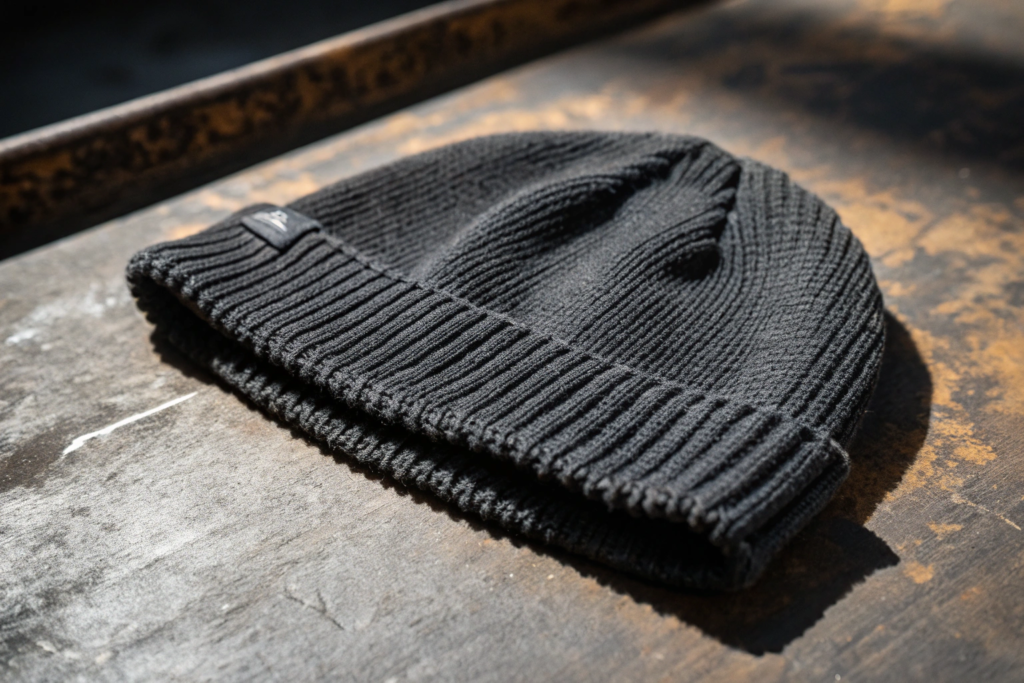
The raw laser-cut edge is the most avant-garde and disruptive of the 2026 beanie cuff styles. It is not a cuff in the traditional sense because there is no folding, no ribbing, and no hem. The beanie body simply ends in a cleanly cut edge, created by a laser cutting machine that fuses the yarn ends as it cuts, preventing unraveling. The edge is left exposed. It has a slight texture where the yarns are fused, often with a subtle, barely perceptible darkened line along the cut. Over time and with wear, the edge may develop a slight curl, adding to the deconstructed, work-in-progress aesthetic. This style is the ultimate expression of the anti-finish trend that has been building in streetwear for several seasons.
The raw laser-cut edge is a top 2026 streetwear beanie style because it captures the DIY, deconstructed, and anti-perfectionist mood that is influencing the avant-garde end of streetwear. This style rejects the traditional notion of a finished garment. The beanie does not pretend to be a polished, precious accessory. It presents itself as a raw textile object, honest about its construction and materials. The laser-cut edge creates a striking visual contrast with the knitted body. The knit is soft, textured, and organic. The cut edge is precise, slightly melted, and industrial. This tension between the handmade and the machine-made is a recurring theme in contemporary streetwear. The raw edge beanie also offers practical benefits. It eliminates the bulk of a folded cuff entirely, creating the absolute lowest profile possible. It sits completely flat against the forehead, with zero extra fabric. This makes it ideal for layering under hoods or helmets. For streetwear brands that position themselves at the cutting edge, that collaborate with artists and designers from outside traditional fashion, the raw edge beanie is the definitive statement piece for 2026.
The raw edge is not a design that can be achieved with traditional cut-and-sew methods. Cutting a knitted fabric with scissors leaves a raw edge that will immediately unravel. The laser cutting process is essential to the viability of this style. Let me explain how the manufacturing process works and how the edge holds up over time.
How Is a Laser-Cut Edge Finished to Prevent Fraying?
A knitted fabric, unlike a woven fabric, is made from continuous loops of yarn. If you cut a knitted fabric with scissors, the loops are severed and the entire structure can unravel from the cut point, like a pulled thread on a sweater. To prevent this, the raw edge beanie must be cut with a laser. The laser cutting machine uses a focused beam of high-energy light to vaporize the fabric along the cut line. The intense heat melts the yarn fibers at the point of the cut, fusing them together into a solid edge. This fused edge prevents the loops from pulling apart. The fabric cannot unravel because the yarns are essentially welded together at the cut. The specific laser settings, power, speed, and frequency, must be carefully calibrated for the particular yarn blend. A synthetic yarn like acrylic or polyester melts cleanly and forms a strong, uniform fused edge. A natural yarn like wool or cotton burns rather than melts. The fused edge on a natural yarn can be brittle, discolored, or weak. For this reason, raw edge beanies are almost always made from synthetic or high-synthetic-content blends, typically 80 percent acrylic or higher, or a polyester-acrylic blend. The laser cutting process also seals the edge against fraying during wear and washing. However, the fused edge is not as durable as a traditional hem or cuff. Over many wash cycles, the edge can gradually soften and some minimal fraying may occur. This is generally considered part of the aesthetic. The beanie evolves over time. It looks different at six months than it did on day one. Brands that market this style often include care instructions that recommend hand washing or washing on a gentle cycle in a garment bag to preserve the edge. The color of the fused edge is another consideration. The laser typically creates a slightly darker line along the cut, especially on lighter colors. On a black or charcoal beanie, the darker edge is invisible. On a white or pastel beanie, the edge may have a visible tan or brown line. Some brands embrace this as a design detail. Others choose dark colors specifically to avoid it. We always produce a pre-production sample and show the client exactly how the edge will look.
Does the Raw Edge Style Work for All Knit Beanies or Only Specific Fabrics?
The raw edge style is not universal. It works exceptionally well on certain knit constructions and fails on others. The ideal fabric for a raw edge beanie is a fine-gauge, tightly knitted jersey or a fine rib. The tight knit structure provides enough density for the laser to create a strong, clean fused edge. A 12-gauge or 14-gauge knit produces excellent results. The fine yarns melt uniformly and create a crisp, durable edge. A loose, chunky knit, such as a 3-gauge or 5-gauge, is much more challenging. The gaps between the thick yarns mean the laser has less material to fuse. The resulting edge can be uneven, with visible gaps where the laser passed through an open space in the knit. The edge may also be structurally weak because the thick yarns, even when fused, can separate under tension. For chunky knit beanies, the raw edge is generally not recommended. A folded cuff or a ribbed band is a more practical choice. The fiber content is the other critical variable. Synthetic fibers, acrylic, polyester, nylon, melt and fuse well. Natural fibers, cotton, wool, cashmere, burn and do not fuse. A 100 percent cotton beanie cannot be raw edge cut because the cotton will simply burn away, leaving a charred, weak edge that will disintegrate. Blends can work if the synthetic content is high enough. An 80 percent acrylic, 20 percent wool blend will produce a fused edge where the acrylic melts and encapsulates the wool fibers. A 50/50 blend will have a weaker edge because there is not enough synthetic material to create a continuous fused seal. We test the laser cut on a swatch of the exact yarn and knit structure before committing to production. The test swatch is cut, washed five times, and inspected for fraying, discoloration, and edge integrity. Only if the swatch passes the test do we proceed with the raw edge design. This testing is an essential part of our product development process for raw edge products.
Conclusion
The 2026 beanie cuff style landscape reflects the fragmentation and diversification of streetwear itself. There is no single dominant look. There are three distinct aesthetic lanes, each with its own design language, manufacturing requirements, and brand identity. The oversized chunky cuff is the maximalist choice, a sculptural, social-media-dominating statement piece that requires heavy-gauge knitting and seamless construction to achieve its dramatic silhouette. It speaks to brands that want to be seen, that trade on boldness and presence. The micro cuff is the minimalist counterpoint, a precision-engineered, close-fitting band that demands flawless knitting and a refined, luxury-adjacent sensibility. It speaks to brands that value subtlety, quality, and the quiet confidence of perfect fit. The raw laser-cut edge is the avant-garde disruptor, a deconstructed, industrial-inspired finish that rejects traditional garment conventions and requires specialized laser cutting technology and synthetic yarn blends. It speaks to brands at the cutting edge, the collaborators, the ones who treat fashion as an experimental art form.
At AceAccessory, we produce all three cuff styles, and we work with our streetwear clients to match the right style to their brand identity and target customer. Our knitting workshop in Zhejiang has the machinery range, from 3-gauge chunky knitters to 14-gauge fine knitters, and the laser cutting equipment to execute each style at the highest quality level. Our design team understands the nuance of cuff proportion, the millimeter-level adjustments that separate a perfect chunky cuff from an awkward one, a sleek micro cuff from a flimsy one, an intentional raw edge from a mistake.
If you are developing your 2026 streetwear beanie collection and you want to nail the cuff style that defines your brand, I invite you to work with us. Contact our Business Director, Elaine, at elaine@fumaoclothing.com. Tell her about your brand aesthetic, the silhouette you are chasing, and the cuff style that caught your attention. She can arrange for samples of all three styles, in your chosen colors and materials, so you can see and feel the difference for yourself. Let us build the beanie that your customers will reach for every morning, the one that completes the fit and makes the photograph.