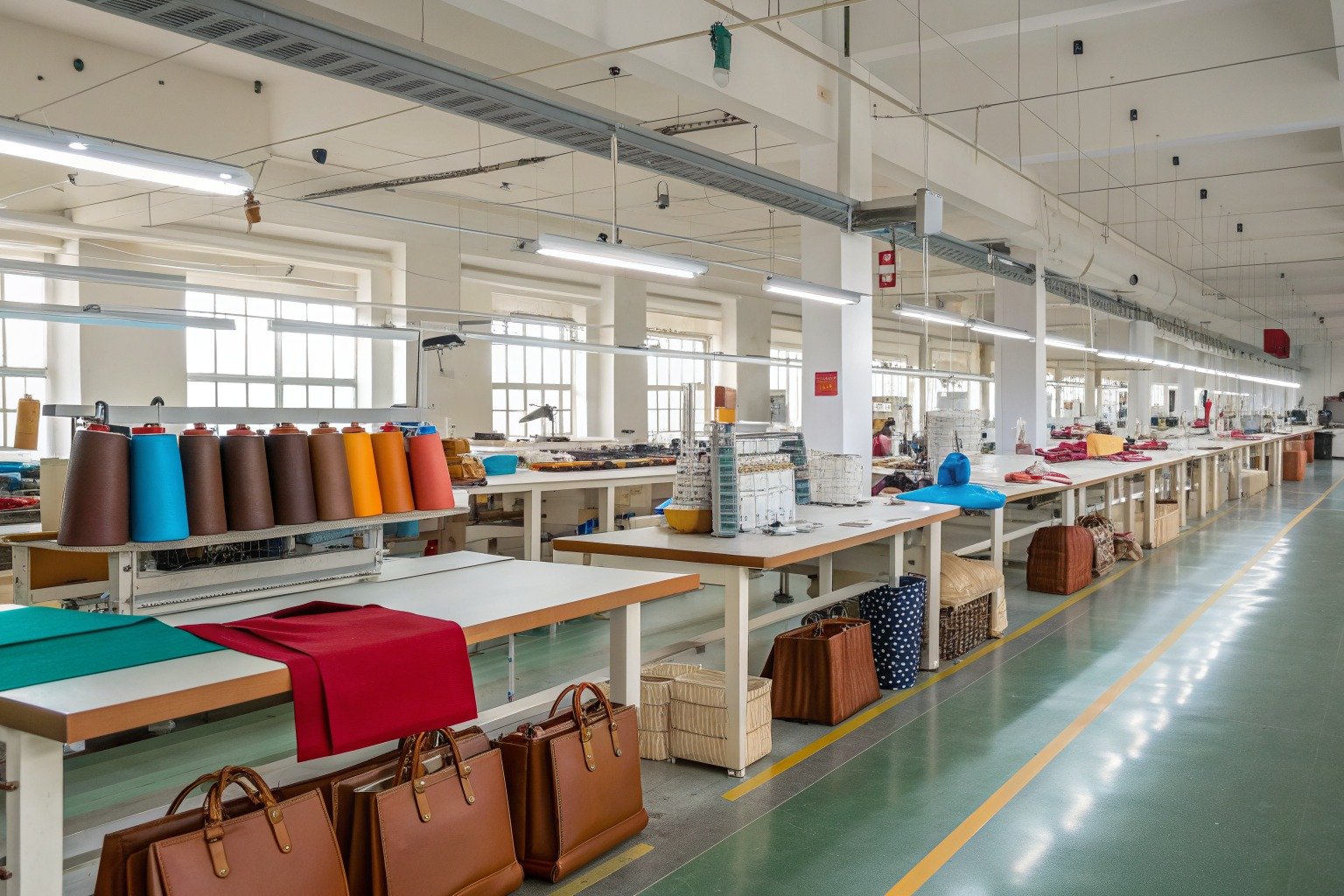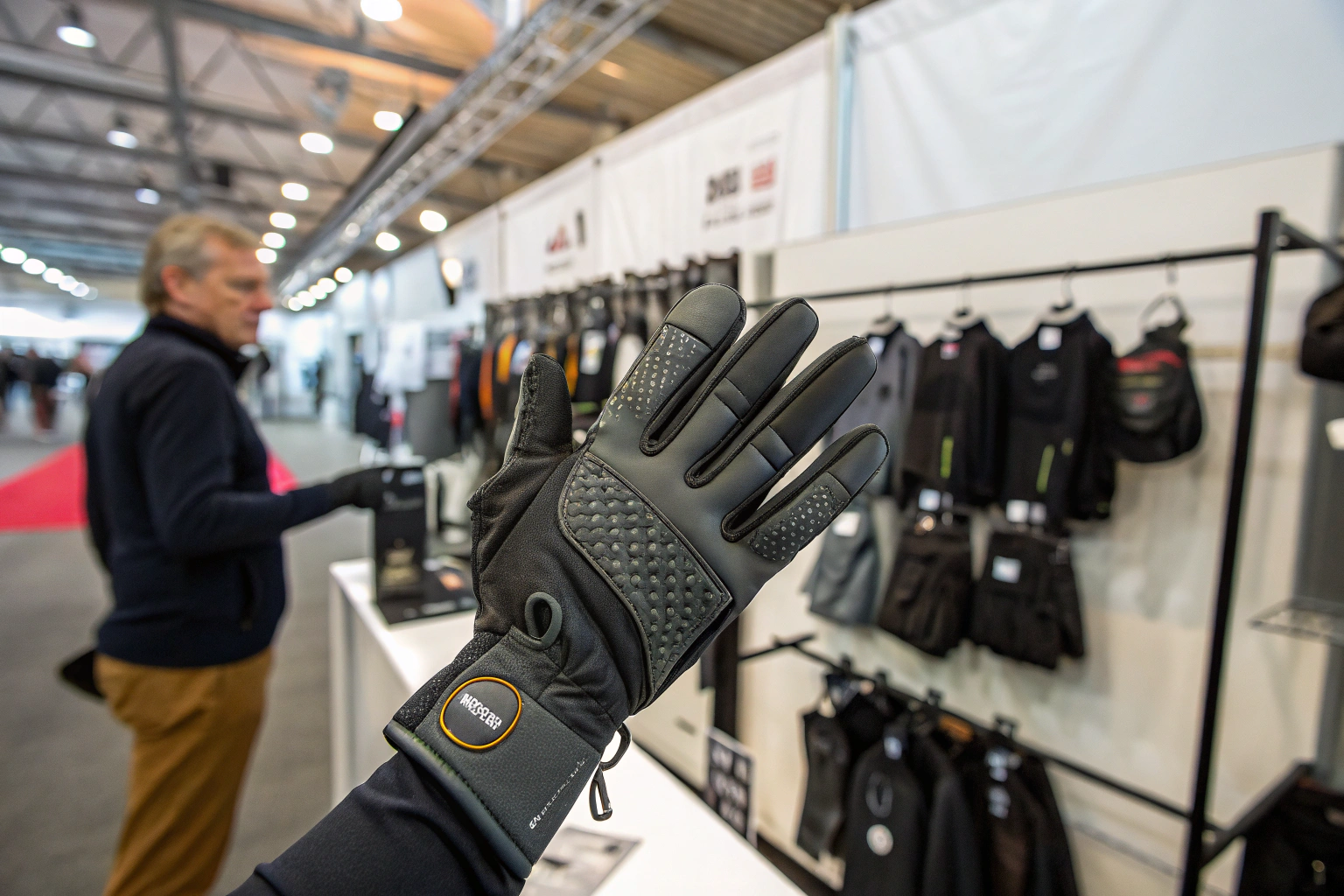
Last autumn, I walked through an equestrian trade show in Europe and stopped at a booth where a frustrated buyer was flipping through a rack of riding gloves. She turned to me and said, "Every supplier shows me the same black synthetic glove with a silicone palm. I need something new. My customers are asking for gloves that actually perform better and look like they belong in 2026, not 2016." That conversation stuck with me. I went back to our design team at AceAccessory and we started a deep dive into where equestrian gloves are headed. We interviewed riders, analyzed competition footage, and tested new materials in our Zhejiang development center. What we found was that the riding glove market is in the middle of a quiet revolution. Riders are no longer satisfied with basic grip and durability. They want smart textiles, sustainable materials, and a tailored fit that feels like a second skin.
The dominant 2026 glove trends for equestrian and riding sports are a shift toward lightweight, precision-fit technical fabrics with integrated touchscreen conductivity across all five fingers, the rise of plant-based and recycled material construction for sustainability-conscious riders, the adoption of impact-absorbing gel and foam padding mapped to rein contact zones, and the emergence of smart glove technology with embedded sensors that track rein tension and hand position for competitive training.
These trends are not just cosmetic. They reflect a fundamental change in how riders think about their equipment. Gloves are no longer just about warmth or blisters. They are now a critical interface between the rider and the horse. A glove that slips on a wet rein during a cross-country round is a safety hazard. A glove that cannot connect to a training app is a missed opportunity for data-driven improvement. At AceAccessory, we are already producing gloves that hit these trend points for major equestrian brands in Europe and North America. Let me walk you through what is coming and how you can get ahead of the curve for the 2026 season.
What Materials Are Trending in 2026 Equestrian Gloves
The material story for 2026 is about shedding weight without losing durability. The old model of equestrian gloves was built around thick, stiff leather that took weeks to break in. Riders are now demanding gloves that feel broken in right out of the box. This is pushing manufacturers toward advanced synthetics and ultra-thin performance leathers that were previously only seen in elite motorsports or medical device industries. At the same time, sustainability has moved from a niche concern to a mainstream demand. Riders who spend their days outdoors caring for horses feel a strong connection to the environment, and they want their gear to reflect that.
The trending materials for 2026 equestrian gloves include perforated microfiber leather with moisture-wicking properties, plant-based tannage full-grain goat leather for eco-conscious premium lines, recycled polyester power mesh for back-of-hand flexibility, and bio-based gel compounds for palm grip zones. These materials offer a combination of reduced weight, increased breathability, and environmental responsibility that synthetic leather and chrome-tanned leather from previous generations cannot match.
The shift in materials is also driving a shift in supply chains. Brands are asking for full traceability on their leather and synthetic components. I have had buyers request the tannery name and certification for every batch of leather used in their gloves. This level of transparency was unheard of five years ago. Now, it is table stakes for the premium segment.
Why Is Microfiber Leather Replacing Traditional Cowhide?
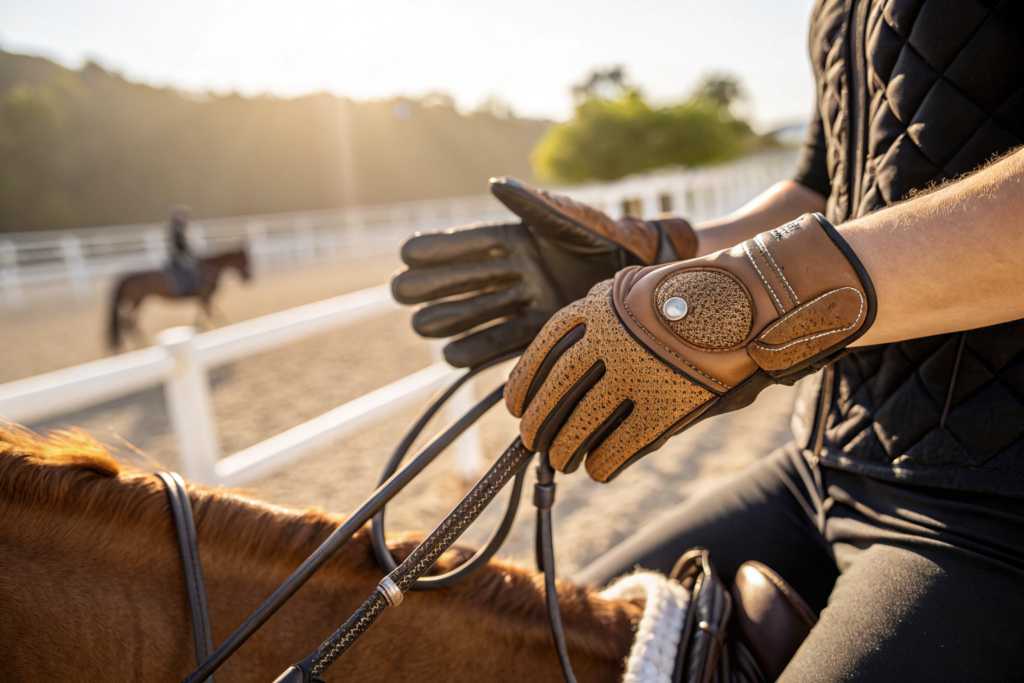
Traditional cowhide has served riders well for centuries, but it has real drawbacks. It is heavy when wet, it stiffens after drying, and it requires significant maintenance to prevent cracking. Microfiber leather, which is a non-woven fabric made from ultra-fine polyester and polyamide fibers coated with polyurethane, solves many of these problems. It is significantly lighter than cowhide, often 40 to 50 percent lighter for the same thickness. It does not absorb water the way natural leather does, so it does not become heavy and slippery during a rainy training session. It is also machine washable, which is a huge selling point for riders who put their gloves through mud, sweat, and horse slobber. I have tested our microfiber equestrian gloves by soaking them in a bucket of water, wringing them out, and wearing them immediately. They perform nearly as well wet as dry. Cowhide in the same test becomes a soggy, stretched-out mess. Another advantage is consistency. Natural leather hides have scars, stretch marks, and variable thickness. Our QC team spends hours grading hides to find clean, uniform pieces for premium gloves. Microfiber arrives on rolls with perfectly uniform thickness and zero defects. This reduces waste and lowers production cost without lowering quality. For 2026, we are seeing a strong trend toward combining microfiber leather palms with lightweight mesh backs. This hybrid construction puts the durability and grip where it is needed, on the rein contact surface, and puts maximum breathability and flexibility on the back of the hand.
Can Plant-Based Leathers Perform in Wet Riding Conditions?
This is the question every eco-conscious brand is asking. Plant-based leathers, meaning leather tanned using vegetable extracts like mimosa bark, quebracho, or chestnut instead of chromium salts, have been around for centuries. But historically, they did not perform well in wet conditions. Vegetable-tanned leather absorbs water readily and can leach tannins that stain light-colored riding breeches. The new generation of plant-based performance leathers is different. We have been working with a tannery in Italy that has developed a hybrid vegetable-synthetic tanning process. The base tanning is done with plant extracts, which satisfies the requirement for a high percentage of bio-based content. Then, a light polymer treatment is applied to the grain side to provide water repellency and color fastness. The result is a glove leather that is 85% plant-based, looks and smells like a premium natural product, and can handle a sudden downpour during a cross-country course without turning into a sponge. The grip performance is excellent. Vegetable-tanned leather has a naturally grippy, waxy feel that becomes even tackier when slightly damp. For dressage riders who need a super-sensitive connection to the rein, this is ideal. The challenge is cost and scale. Vegetable tanning takes weeks, compared to hours for chrome tanning. The raw material cost is higher. But for the premium segment of the 2026 equestrian market, where riders are willing to pay for sustainability and performance, plant-based leather gloves are a compelling trend. I expect to see them in the collections of at least three major European equestrian brands by next season.
How Are Smart Technologies Changing Riding Gloves
Technology is entering the equestrian glove market faster than most people predicted. Riders and trainers are hungry for data. Dressage riders want to know if their hands are perfectly still and symmetrical. Jumpers want to know if they are pulling on the left rein harder than the right during a tight turn. Eventers want biometric data to manage their own physical performance across three demanding phases. Gloves are the perfect sensor platform because they sit at the exact point of contact between rider and horse. For 2026, smart glove prototypes are moving out of the lab and into elite competition stables.
Smart technologies transforming equestrian gloves for 2026 include haptic feedback systems that vibrate to correct hand position in real-time, conductive fiber sensors woven into the palm to measure rein tension bilaterally, and Bluetooth connectivity that syncs glove data to training apps on the rider’s smartphone. These technologies are becoming lighter, more washable, and more affordable, making them accessible beyond the elite professional market.
I have held these prototypes in my hands, and I can tell you they feel like normal gloves. The battery is a slim, flexible strip sewn into the cuff. The sensors are conductive threads that are indistinguishable from regular stitching. This is not bulky, awkward wearable tech from a decade ago. This is invisible integration.
How Do Rein Tension Sensors Help Competitive Riders?
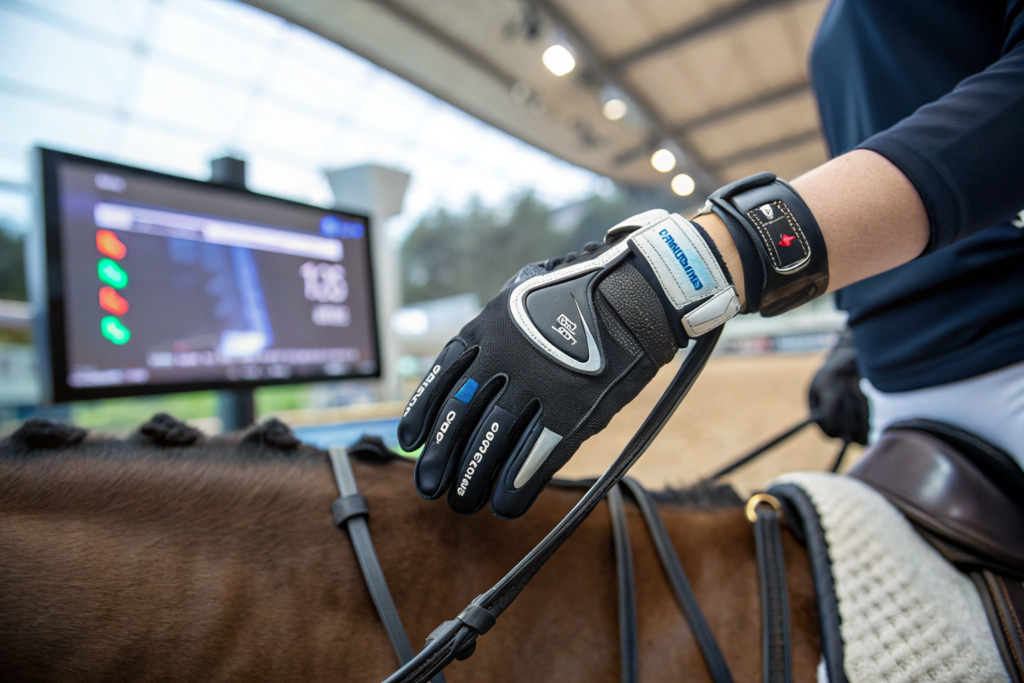
Rein tension is one of the most critical and most difficult metrics for a rider to self-assess. A rider may feel like they have an even, soft contact, but a sensor can reveal that they are applying 20% more force through their left hand than their right. Over time, this asymmetry can confuse the horse and degrade performance. Sensor-equipped gloves measure the tension on each rein independently, in real time. The data is transmitted to a phone app mounted on the horse’s saddle or the rider’s arm. The app displays a live graph showing left rein tension and right rein tension as two separate lines. The goal is to keep the lines smooth, low, and symmetrical. If the rider’s hand becomes heavy or uneven, the app can be set to give a gentle haptic buzz on the wrist of the offending hand. This immediate feedback allows the rider to correct their position in the moment, not after the ride when reviewing video. Trainers love this because it provides objective proof of what they have been telling a student verbally for months. "Your left hand is too rigid" becomes "Look at the data spike here, here, and here." We are working on integrating these sensors into the fabric of the glove palm without adding any thickness. The challenge is durability. A sensor thread must survive thousands of grip-release cycles, sweat, and washing. We are testing conductive silver-coated nylon threads that are flexible enough to move with the glove and durable enough to last the life of the product.
Are Washable Smart Gloves a Realistic 2026 Trend?
The early smart gloves were hand-wash only, or worse, not washable at all. Sweat and horse grime would build up, and the electronics were sealed but the fabric became unsanitary. That was a dealbreaker for most riders. The 2026 generation of smart equestrian gloves is designed to be fully machine washable. The key innovation is a detachable, potted electronics module. The actual sensors woven into the glove fabric are passive threads with no active electronics. They can be submerged and washed without damage. The Bluetooth transmitter, battery, and haptic motor are housed in a small, waterproof module that snaps into a sealed pocket on the glove cuff. Before washing, the rider pops the module out. The textile glove goes into the washing machine on a gentle cycle and air dries. Then the module is snapped back in. This modular design solves the hygiene problem and also allows for future upgrades. A rider could buy a new module with better battery life or new sensors without replacing the entire glove. We have tested this snap-in module system through 50 wash cycles in our lab. The connector pins remain corrosion-free, and the snap mechanism stays secure. This is the kind of practical engineering that turns a cool prototype into a commercial product that riders will actually use and love.
What Ergonomic Features Do 2026 Riding Gloves Need
Ergonomics in riding gloves has evolved far beyond "small, medium, large." Riders are demanding a fit that mimics the natural shape of a relaxed, slightly curved hand holding reins. A flat, boxy glove fights against the rider’s anatomy, causing bunching in the palm and pressure points on the fingers. For 2026, the trend is toward 3D-engineered patterns and articulated designs that eliminate material resistance between the rider and the horse. This is where our pattern-making expertise at AceAccessory really shines. We have digitized hundreds of hand scans to build a block library that reflects real rider hand postures, not just flat measurements.
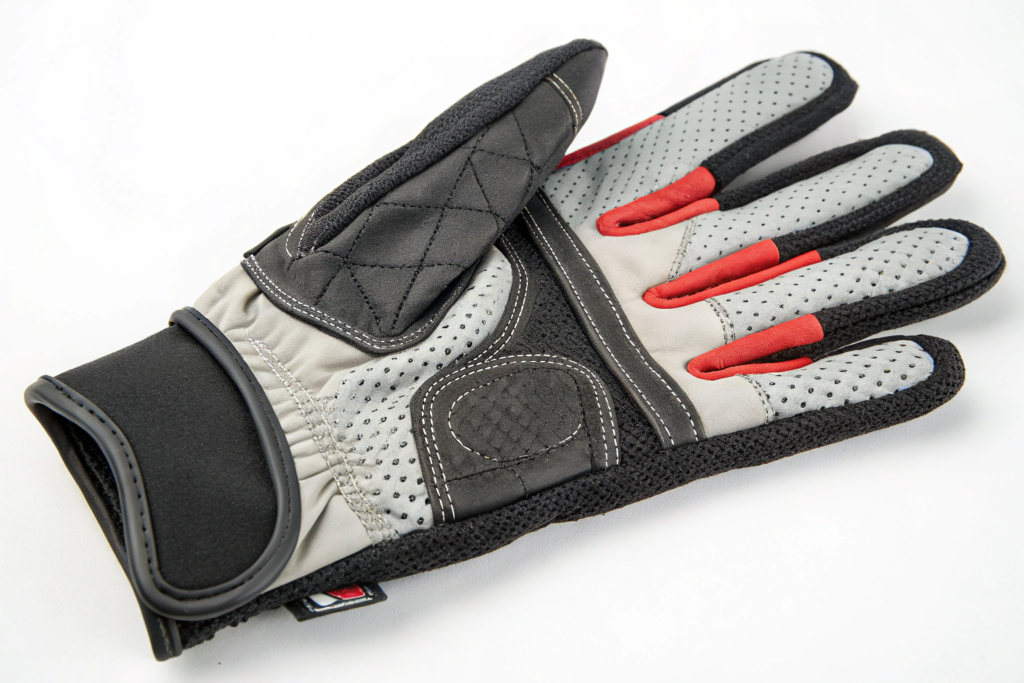
The essential ergonomic features for 2026 equestrian gloves include pre-curved finger construction that matches the natural riding grip angle, seamless palm panels that eliminate blister-causing seams in the rein contact zone, targeted perforation mapping for ventilation without compromising structural integrity, and adjustable wrist closures with low-profile, snag-free fasteners. These features collectively reduce hand fatigue, improve rein feel, and prevent the bunching and slipping that plague poorly designed gloves.
A glove that fits perfectly disappears from the rider’s conscious awareness. That is the goal. When a rider stops thinking about their gloves, they can focus entirely on their horse. Let me break down two of the most impactful ergonomic innovations for the coming season.
How Does Pre-Curved Finger Design Improve Rein Feel?
A flat glove is like a flat shoe. It only fits correctly when you are not using it. The moment you wrap your fingers around a rein, a flat glove’s fabric bunches in the palm and pulls tight across the knuckles. This creates a layer of material resistance between your skin and the rein. You lose sensitivity. Pre-curved gloves are cut and sewn in the shape your hand naturally assumes when holding a rein. The fingers are bent forward at roughly a 30-degree angle. The palm panel is not a single flat piece but a three-dimensional shape with a curved, slightly cupped form. To achieve this, we use a multi-piece pattern with strategic seam placement. The seams run along the sides of the fingers, not across the palm or the gripping surface. This keeps the rein contact area completely smooth. We also add a small dart at the base of the thumb, called an ergonomic thumb gusset, that allows the thumb to wrap around the rein without pulling the palm material sideways. The material choice matters here too. A pre-curved glove made from stiff, unyielding fabric will hold its shape on the shelf but fight the rider’s hand on the horse. We use four-way stretch mesh on the back of the hand and a flexible, broken-in leather or microfiber on the palm. The combination of stretch and pre-curvature means the glove moves with the hand like a second skin. Riders report feeling rein vibrations and subtle mouth movements much more clearly through a pre-curved glove.
What Palm Padding Zones Prevent Blisters Without Bulk?
Padding is a balancing act. Too much, and the rider loses contact with the horse’s mouth. Too little, and long training sessions cause painful blisters, especially at the base of the ring and pinky fingers where the rein exerts maximum pressure. The 2026 trend is toward anatomically mapped padding that is thick where pressure is high and completely absent where sensitivity is critical. We have analyzed pressure maps of hands holding reins, and the data shows clear hot spots. The highest pressure points are on the proximal phalanx of the ring finger and the distal palmar crease. These areas need cushioning. The areas between the thumb and index finger, where rein feel is most critical, need zero padding. The padding material itself is changing. Old-school foam padding compresses over time and loses its protective qualities. The new standard is a viscoelastic gel, similar to what is used in high-end cycling gloves. This gel distributes pressure evenly across its surface and recovers its shape instantly when the hand relaxes. It is also thin. A 1.5mm gel pad can provide as much pressure relief as 3mm of standard foam. This keeps the glove sleek and close-fitting. We apply these gel pads using a silicone printing process that bonds directly to the palm material. There is no stitching and no edge that can irritate the skin. The silicone printing also serves a dual purpose as a grip enhancer. Riders get cushioning and non-slip grip from the same precisely placed pattern.
How to Source Custom Equestrian Gloves for Your Brand
Sourcing custom equestrian gloves is fundamentally different from sourcing generic fashion gloves. The performance requirements are unforgiving. A seam failure on a fashion glove is an inconvenience. A seam failure on a riding glove during a gallop is a safety incident. This is why equestrian brands are extremely careful about factory selection. They need a partner who understands the biomechanics of riding, the durability standards of competition gear, and the aesthetic language of the equestrian market. At AceAccessory, we have developed a specialized equestrian division within our glove production line. We treat riding gloves as technical sport equipment, not just as accessories.
Sourcing custom equestrian gloves for a 2026 brand collection requires a factory partner who offers complete ODM and OEM services specifically for riding sports, including in-house testing for seam strength and abrasion resistance, access to certified equestrian-grade materials like REACH-compliant leather and OEKO-TEX certified synthetics, and the ability to execute complex ergonomic patterns with pre-curved fingers and mapped gel padding. The factory must also provide low MOQ options for boutique equestrian brands and rapid sampling using 3D digital prototyping.
I have seen too many brands try to adapt a general glove factory to equestrian needs and fail. The knowledge gap is too wide. You need a team that knows what a dressage judge looks for and what a cross-country rider puts their gear through.

What Certifications Should a Glove Factory Hold for Equestrian Products?
Certifications are the proof behind the promises. For equestrian gloves sold in the European and North American markets, certain certifications are non-negotiable. REACH compliance is the baseline for Europe. It ensures that no restricted chemicals are present in the leather, synthetic materials, dyes, or adhesives. A glove that gives a rider a skin reaction due to residual chromium VI from improper tanning is a lawsuit waiting to happen. We test every batch of leather for chromium VI content before it enters our production floor. For the North American market, California Proposition 65 compliance is critical. The glove must not contain chemicals known to cause cancer or reproductive harm above safe harbor levels. We run annual audits through a third-party testing lab to maintain our compliance documentation. Beyond chemical safety, physical performance certifications matter. We test our gloves to the EN 388 standard for mechanical risks, which covers abrasion resistance, blade cut resistance, tear resistance, and puncture resistance. While riding gloves are not industrial safety gloves, the EN 388 framework provides a recognized, objective measure of durability. For premium equestrian brands, we also offer bluesign or OEKO-TEX Standard 100 certification on the textile components. These environmental and safety labels are increasingly featured on retail packaging and brand websites. They give the end consumer confidence that the product was made responsibly.
Can Your Factory Handle Both Leather and Technical Synthetic Glove Production?
Many factories specialize in one or the other. A leather glove factory has expert cutters and sewers who know how to handle hides, but they may struggle with the heat-sealing and bonding techniques needed for technical synthetics. A synthetic sport glove factory may have advanced machinery for laser cutting and silicone printing but no experience with leather grading and stitching. We invested in both capabilities under one roof. Our leather workshop has traditional walking-foot sewing machines for heavy topstitching on cowhide, and our synthetic workshop has ultrasonic welding machines for seamless synthetic bonds. A single equestrian brand can order a premium leather dressage glove and a lightweight synthetic cross-country glove from us, and both products benefit from specialized production expertise. This dual capability also allows for hybrid designs, which are a major 2026 trend. A glove with a leather palm and a synthetic mesh back requires both skill sets. The leather palm is cut and stitched in our leather room, while the mesh back is laser-cut and bonded in our synthetic room. The two components are then assembled on a dedicated hybrid assembly line. The seam where leather meets synthetic must be carefully engineered to avoid stiffness or irritation. We use a flatlock stitch with a soft, low-profile thread that lies smooth against the skin. This kind of integrated production is rare, and it gives our brand clients a significant competitive advantage in speed and design flexibility.
Conclusion
The 2026 equestrian glove market is converging on a clear set of demands. Riders want gloves that are lighter, smarter, and more sustainable than anything they have worn before. Materials are shifting from heavy, maintenance-intensive cowhide to lightweight microfiber leather and plant-based tanned goat leather that performs beautifully in wet conditions. Smart technology, once a gimmick, is becoming practical with washable, modular designs that provide real-time rein tension data and haptic coaching feedback. Ergonomic features like pre-curved fingers and mapped gel padding are no longer premium add-ons but baseline expectations for a glove that disappears on the hand and lets the rider feel every nuance of the horse’s mouth. And behind all of this, the sourcing landscape is changing. Brands need factory partners with deep equestrian-specific expertise, the right certifications, and the ability to produce both traditional leather and advanced synthetic gloves under the same quality management system.
At AceAccessory, we have positioned ourselves at the center of these trends. Our design team studies rider biomechanics, our material sourcing team scours tanneries and textile mills for the latest sustainable innovations, and our QC team tests every batch as if a competition medal depends on it, because sometimes it does. We ship to major equestrian retailers and boutique riding brands across Europe and North America. Our Zhejiang factory is clean, modern, and equipped with the specialized machinery needed for high-performance glove production. Our project managers understand the seasonal rhythm of the equestrian market and can turn a concept into a delivered product with speed and precision.
If you are developing your 2026 equestrian glove collection and you want a manufacturing partner who speaks the language of riding sports, I invite you to reach out. Contact our Business Director, Elaine, at elaine@fumaoclothing.com. Tell her about your brand, your riding discipline focus, and your vision for the next generation of equestrian gloves. She will connect you with our equestrian product specialist and get your first samples into development. Let us build the future of riding gloves together.