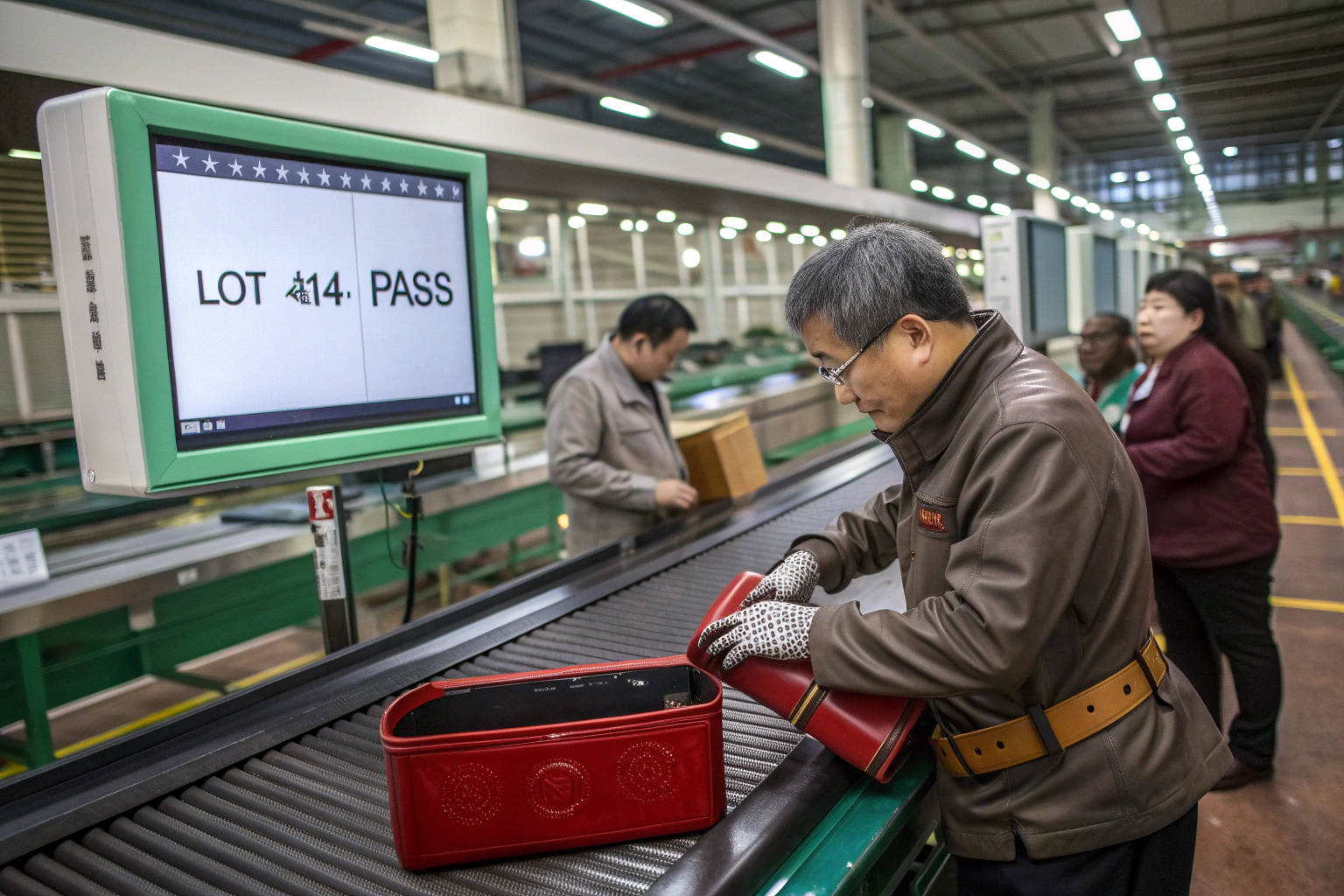
You are a buyer for a chain of 200 stores. You just placed a 15,000-unit order for genuine leather belts. The supplier agreement is clear: your receiving team will inspect using the AQL 2.5 standard. They will pull 200 belts at random from the container. If they find 11 or more belts with a crooked keeper stitch, a tarnished buckle, or a rough edge, the entire pallet gets red-tagged. It does not go to your stores. It goes back. But here is what keeps you up at night: a 5% defect tolerance sounds like a safety net, but it’s actually a minefield. In a batch of 10,000 belts, 500 can be defective. If the factory is just aiming for "good enough," you will drown in returns, and your store managers will demand to know why they have to lock up a fire hazard.
Our QC team does not see 5% as a target. We see it as a catastrophic ceiling. To ensure we never touch it, we operate on a zero-defect mentality driven by a "rolling yield" buffer. Instead of inspecting at the end, we break the 15,000-unit order into 15 micro-lots of 1,000 units each. After every 1,000 units are cut, stitched, and finished, our team conducts a mini-AQL inspection on that micro-lot. If the defect rate in that small batch hits 2%, we stop the entire line, quarantine the batch, and fix the root cause before the other 14,000 belts are even assembled.**
This is not about being picky. It’s about physics. A sewing machine needle dulls, a leather hide has a hidden scar, a new worker rushes. These variables change hourly. You cannot inspect your way to quality at the end of the line. You have to stop the machine the moment it drifts. I want to explain how we catch a loose rivet before it becomes a statistic, and how our reporting system gives you the confidence that a 5% tolerance is a distant threat, not a probability.
What Is a "Micro-Lot" Inspection Buffer and How Does It Prevent Mass Failure?
The traditional factory model is linear. You make 10,000 belts. You inspect 200. It fails. You just lost the labor and leather for 10,000 belts. It is a gamble. The micro-lot system turns a marathon into a series of sprints. You cannot fix a car after it’s driven off a cliff. You fix it at the first check-engine light.
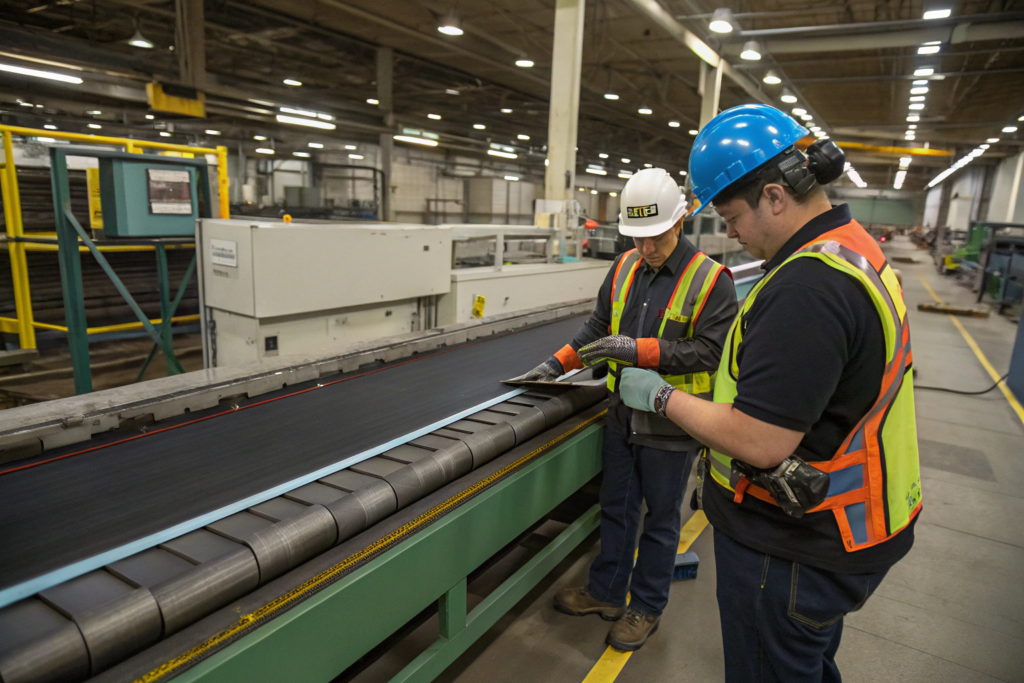
A micro-lot inspection buffer prevents mass failure by segmenting the purchase order into manageable blocks that allow for immediate corrective action. If a full 15,000-unit order runs unchecked, a dull blade on the splitting machine could ruin 2,000 straps before anyone notices. By checking the thickness and edge finish of 125 straps in a 1,000-unit micro-lot, we catch the dull blade after it ruins maybe 20 straps, not 2,000. The rejected micro-lot is reworked immediately. The production line continues with a sharp blade.
We divide the order based on time, not just quantity. A 15,000-belt order might take three days. We inspect at the end of Day 1, at the midpoint, and at the start of Day 2. This rhythm aligns with shift changes. If the night shift’s defect rate rises because the lighting is slightly dimmer, we catch it in the morning micro-lot audit and adjust the lamps, rather than discovering the issue two days later.
How is the sample size calculated for a 1,000-unit micro-lot?
We don’t guess. We follow the same AQL table logic but scaled down. For a lot size of 1,000, the sample size under special inspection level S-3 is 20 units, but we increase this to 80 units internally. We are looking for the "process average." If we find 2 major defects in those 80 belts, the estimated process average is 2.5%. We set our tripwire at 2%. If the micro-lot hits 2%, the line supervisor receives a "Yellow Card" warning and must recalibrate the specific station, polishing, cutting, or stitching, responsible for the drift. This process control keeps the running defect rate on leather belts consistently below 1.5%.
Does splitting the order into micro-lots increase the total inspection time?
It slashes the total time lost, transforming production bottlenecks into manageable hiccups. A full-lot failure, a catastrophic event where every single unit falls short, demands a grueling 100% sorting process—a labor-intensive marathon that stretches over three days, each hour dripping with frustration and mounting costs as workers sift through mountains of product, their hands raw from repetitive motion, the air thick with the tension of salvaging what might otherwise be written off. In stark contrast, a micro-lot stoppage is a minor setback, a brief pause in the rhythm of production.
How Do You Inspect a Belt Edge for Consistency Without a Microscope?
The human eye is drawn to the buckle and the leather grain. But the first place a cheap belt betrays itself is the edge. A wavy edge, a cracked paint film, or a fuzzy, unburnished cut line screams "discount bin." Retail customers run their thumb along the edge before they check the price tag.
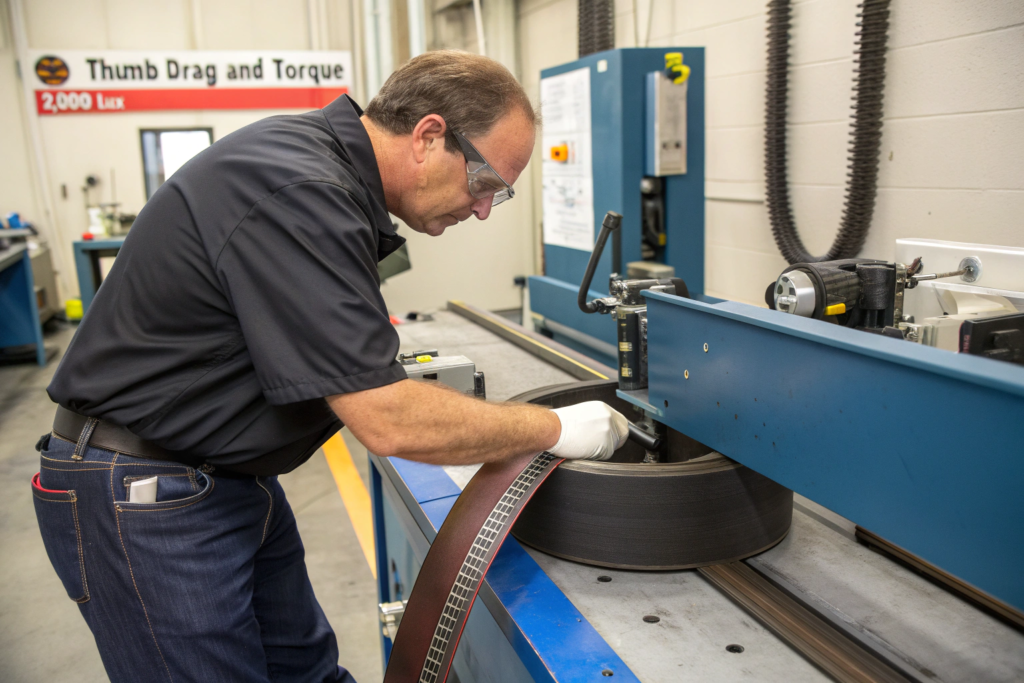
We inspect belt edges without a microscope by using a standardized "Thumb-Drag and Torque" physical test. The inspector runs a dry, clean thumb along the strap edge under 2,000-lux lighting. Any bump, crack, or uneven paint thickness is immediately detectable by the nerve endings in the thumb. We also bend the strap over a 90-degree metal mandrel. The edge paint must not crack or separate from the leather at the bend point.
For objective measurement, we use a digital profilometer, a tool that drags a diamond-tipped stylus across the edge surface. It measures roughness in microns. Our standard is an Ra value of 1.5 microns or lower. A cheap, unburnished belt edge has an Ra of 4.0 or higher, visible to the naked eye as fuzz. Our edge finishing station uses a hot-wax burnishing machine that achieves an Ra of 1.2, smoother than many luxury wallets. We test the profilometer reading on five random belts per micro-lot.
What causes edge paint to crack after a few bends?
Edge paint cracks when the paint film is too thick and not flexible enough. A standard cheap paint is 80 microns thick and hard. We use a water-based polyurethane edge paint that is 40 microns thick and high-elongation. It stretches with the leather fibers when the belt bends rather than resisting the movement.
How do we ensure the edge color matches the strap face?
The eye perceives a "cheap" belt when the edge is a solid, opaque paint color that does not match the dyed leather surface. Our edge paint is tinted with the same aniline dye used for the strap face. The paint penetrates slightly into the leather edge and blends visually, creating a seamless transition from the grain surface to the polished edge.
What Happens When a Major Defect Is Discovered in the Final Audit?
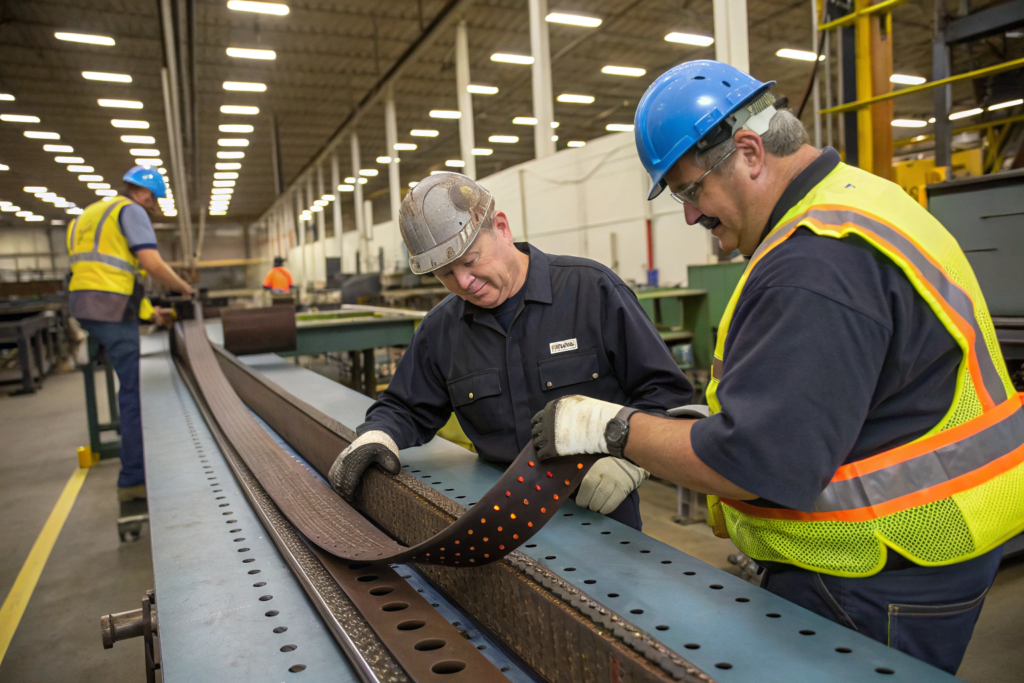
Despite the micro-lot buffers, the final AQL inspection is the absolute gate. The independent QC team arrives at the finished goods pallet. They pull 200 belts. They find a major defect: a rivet that pulls out of the strap under a 5-kilogram force test. The lot does not automatically fail yet, unless it’s a recurring issue, but a single unit failure triggers a specific protocol.
When a major defect is discovered in the final audit, we initiate a "Triage and Containment" protocol. The specific defect, like a loose rivet, is shown to the assembly line supervisor immediately. The QC team then inspects the remaining 199 belts in the sample specifically for rivet pull-out. If zero additional loose rivets are found, the lot passes with a notation of an "isolated incident." If a second loose rivet is found, the entire micro-lot from which that belt originated is 100% re-inspected.
This avoids the "one bad apple spoils the barrel" logic, which is statistically incorrect, while still protecting the buyer from a systemic rivet failure. A loose rivet is usually a one-off from a rivet die that was slightly misaligned for a few hits. We check the die clearance immediately.
How is the rivet pull-out test standardized?
We employ a sleek digital force gauge, its screen glowing softly with precise readings, paired with a custom-engineered clamp that securely grips the rivet head—its serrated jaws ensuring a firm, unyielding hold. The gauge initiates a steady, vertical pull, moving at a constant, deliberate speed of 100 millimeters per minute, a rhythmic motion that hums faintly as it works. The rivet, a small but sturdy anchor, must endure this gentle yet persistent tug, withstanding a pull force equivalent to 8 kilograms for a full 5 seconds.
What documentation does the buyer receive after a final audit finds a defect?
The buyer receives a "Non-Conformance Report" along with the passing AQL certificate. The NCR details the specific defect, the root cause, the containment action taken, and the preventive action implemented to stop recurrence. This transparency builds trust and proves that our QC system is active and honest.
How Are Stitch Density and Thread Tension Checked Across a 10,000-Unit Run?
A loose stitch unravels. A tight stitch puckers the leather. The difference between the two is a few grams of tension on the sewing machine’s tensioner. Mechanical tensioners can drift as the machine vibrates over an eight-hour shift.
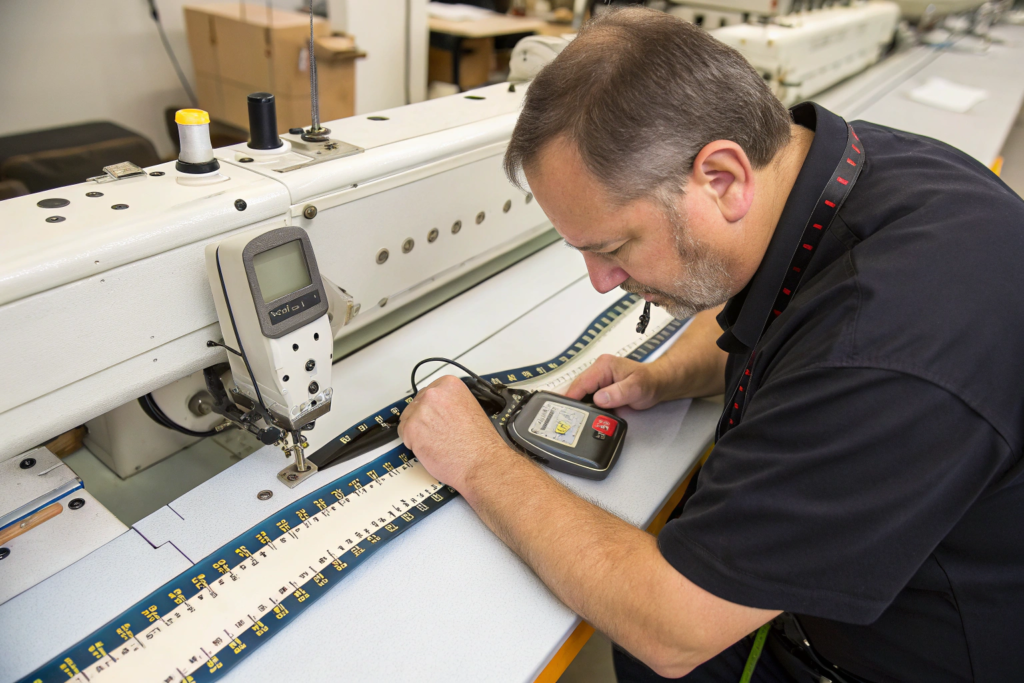
We check stitch density and thread tension using a digital tension meter and a stitch-counting loupe on five belts from the end of every sewing machine’s shift. The upper thread tension must read between 120 and 150 grams on the meter. The stitch density must be 8 stitches per 25 millimeters, plus or minus 1 stitch. Any machine outside this tolerance is immediately locked out and tagged for a maintenance technician.
The stitch-counting loupe is a low-tech but foolproof tool. It’s a magnifying glass with a 25-millimeter scale etched into the lens. The inspector places it on the stitch line and counts the holes. It takes five seconds per belt.
How does thread tension affect the leather’s appearance beyond the stitch line?
Excessive top tension pulls the bobbin thread up, creating a "pebbled" or gathered appearance along the seam, especially on soft nappa leather. Insufficient tension leaves the top thread loose on the surface, prone to snagging. Our tension range is calibrated for each leather type. A stiff vegetable-tanned belt leather needs a tighter bobbin tension than a soft pull-up leather.
Do you use the same thread brand for all production runs?
Yes, we standardize on a single brand of bonded nylon thread from a certified supplier. Changing thread brand changes the coefficient of friction in the needle eye, which shifts the optimal tension settings. Standardization eliminates this variable. We stock the thread in all standard colors required for quality control in accessories.
Conclusion
Handling a 5% defect tolerance on belts is about shrinking the feedback loop so a problem is caught on belt 120, not belt 12,000. Our micro-lot buffer system, the profilometer edge checks, the digital stitch tension meters, and the independent final audit ensure that a 5% defect rate is a theoretical maximum we never approach. We treat every 1,000-unit batch as an opportunity to reset the line to perfection.
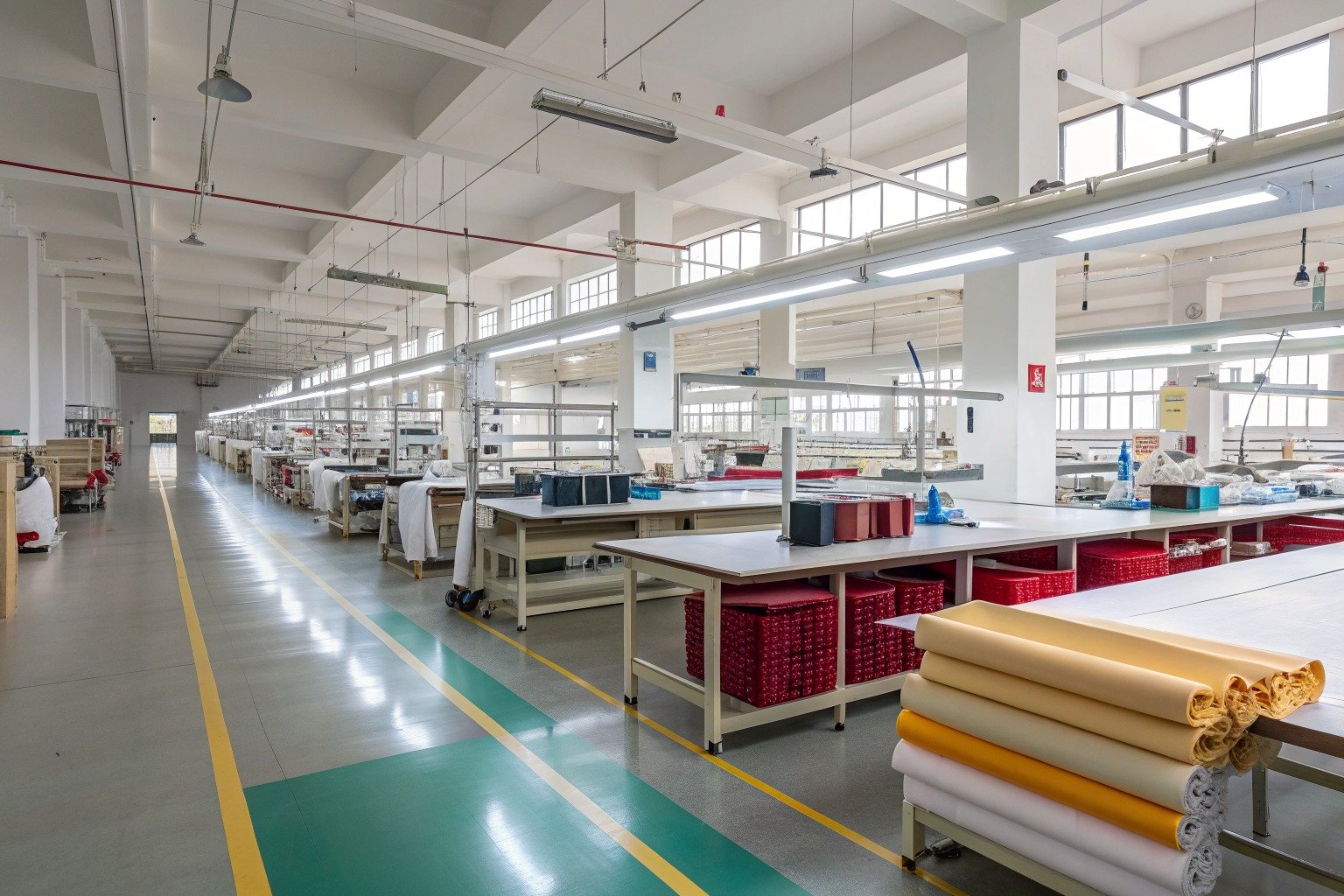
Our Zhejiang factory is set up with these segmented QC gates. We provide full transparency into defect data. Our buyers don’t wait for a container to arrive to know their quality. They see the micro-lot reports weekly.
If you need a production partner that treats your defect tolerance as a floor, not a ceiling, reach out to our Business Director, Elaine. She can share sample QC data packs from recent belt runs and walk you through our micro-lot process via a video call. Write to her at elaine@fumaoclothing.com. Let’s build belts that hit your shelves without a single red tag.