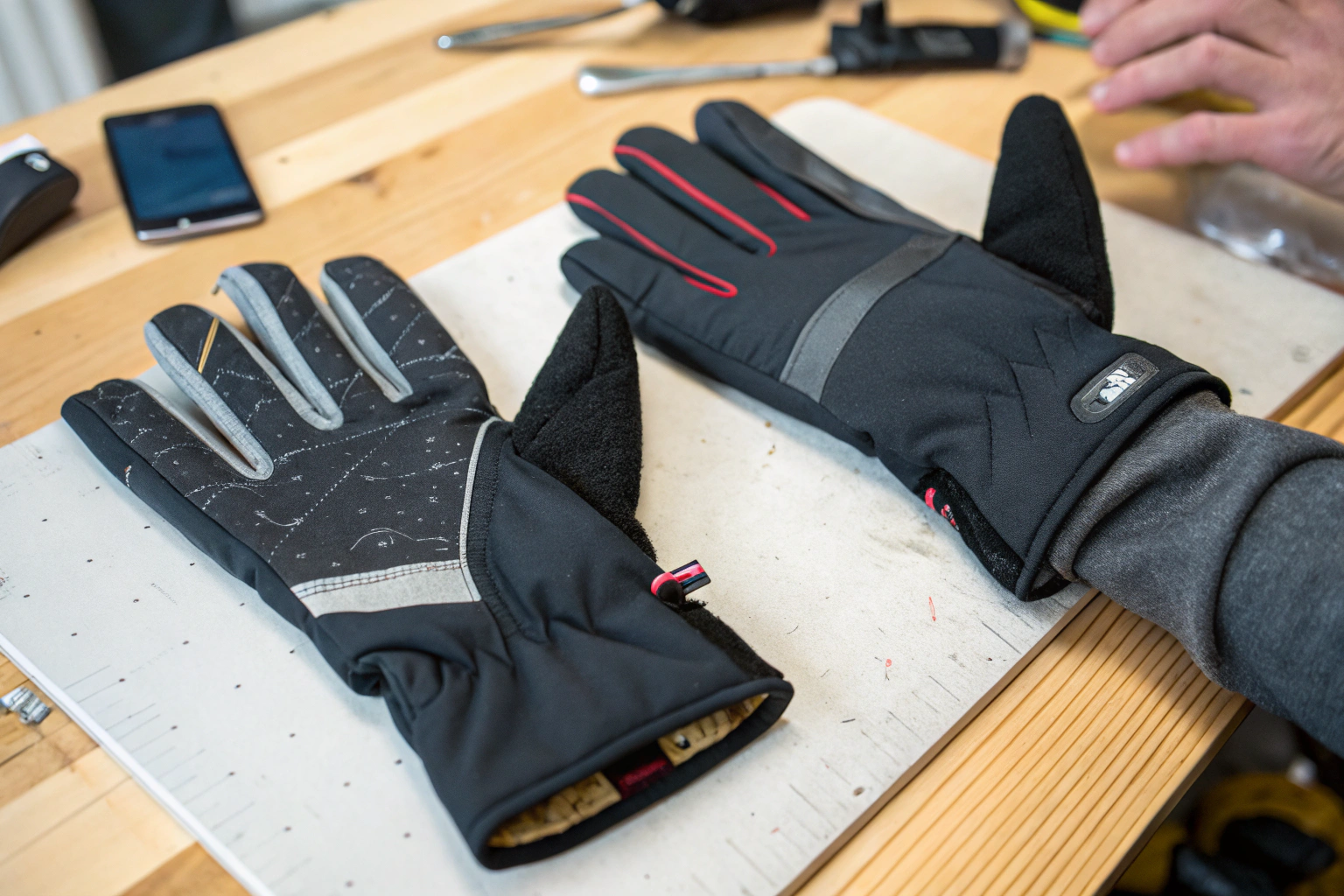
You are a product developer at a premium ski glove brand. You are staring at a prototype glove on your desk. It’s a right hand. You flex the articulated knuckles, feel the soft merino lining, and inspect the sticky silicone grip print on the palm. It is flawless. Then you ask the factory for the left-hand sample. They go quiet for a week. Then they send a photo. The thumb is on the wrong side. The palm reinforcement patch is stitched onto the back of the hand. The factory tried to mirror the pattern, but their cutting team does not understand anatomical asymmetry, and their sewing line is set up to run a single shape over and over. You realize they can produce a "pair of gloves" as long as both gloves are identical. But a human hand is not symmetrical, and a technical ski glove cannot be either.
Yes, we produce both left-hand and right-hand gloves for ski brands with full anatomical accuracy. Our production process begins with a mirrored, asymmetric paper pattern where the left glove is not a reversed copy of the right. The thumb is rotated forward by a specific degree angle, the palm reinforcement zones are laid onto different sides of the fabric panels, and the waterproof membrane is cut and welded with a distinct three-dimensional thumb crotch curve for each hand. The left and right gloves are built on separate, hand-specific aluminum pressing forms.
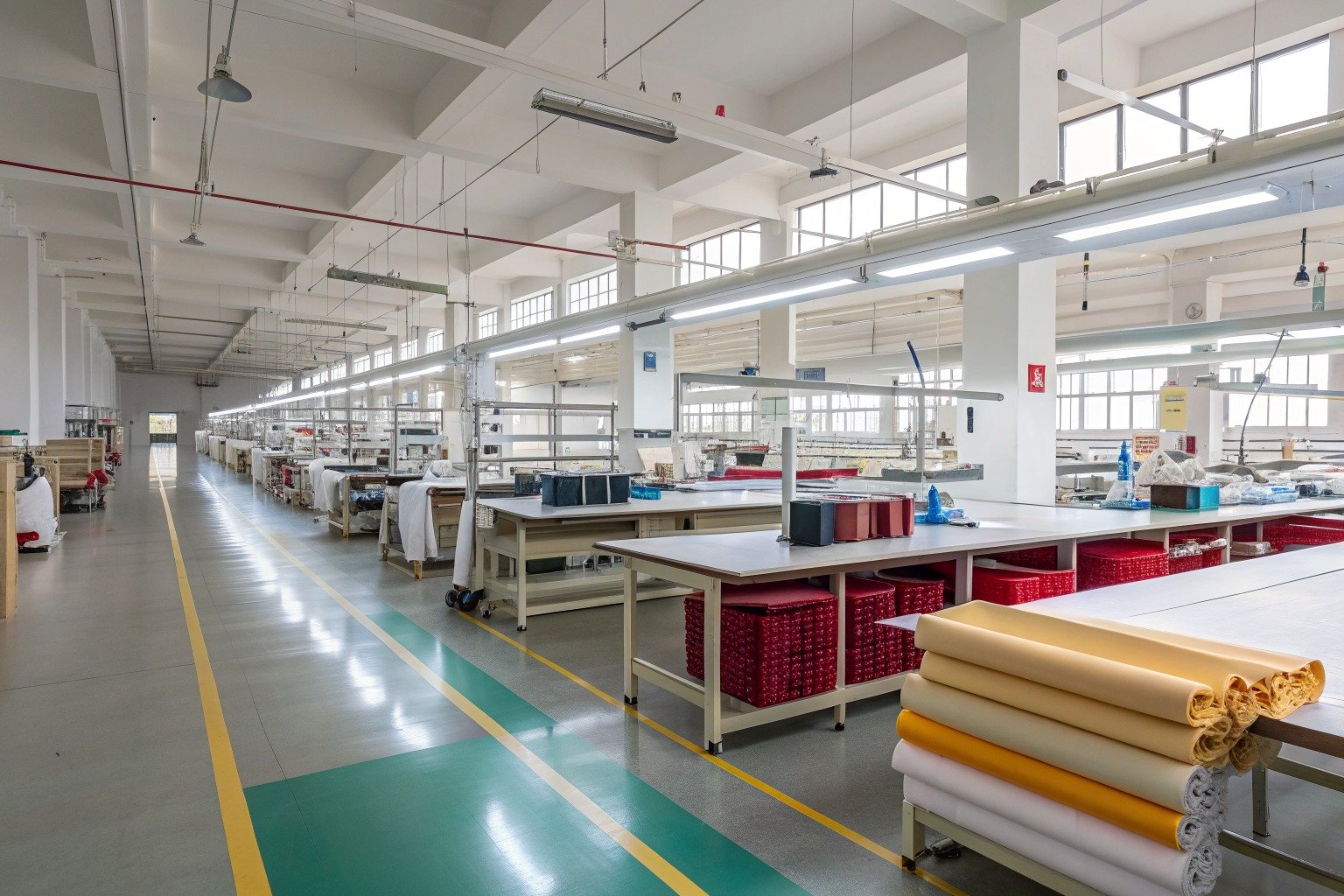
This is not a simple "flip the fabric over" operation. A properly constructed ski glove accounts for the fact that the left thumb rotates outward when gripping a ski pole, while the right thumb wraps inward. The pre-curved fingers are different. The cuff closure strap angles are different. I want to walk you through exactly how we manage left-hand and right-hand production simultaneously on our Zhejiang glove line, and why this capability distinguishes a technical accessory factory from a generic cut-and-sew operation.
Why Can’t You Simply Flip a Pattern to Make a Left and Right Glove?
The cheapest way to produce a glove is to cut two identical flat shapes and sew them together. This makes a tube with a thumb. It fits a flat cartoon hand. A real human hand, especially one gripping a ski pole at high speed, requires a glove that is the opposite of flat.
You cannot simply flip a pattern because the human hand is internally rotated. The thumb does not stick out sideways. It is rotated forward. In a proper technical pattern, the left glove thumb is angled 10 to 15 degrees forward relative to the palm centerline, and the right glove thumb is angled the mirror image. This rotation is built into the seam line where the thumb crotch attaches to the palm. If you flip the pattern, you get a left glove with the thumb angled backward, a biomechanical disaster.
We draft our patterns in a 3D CAD environment specifically designed for technical gloves. The pattern maker works from a digital hand model with a defined grip position, a pole grip diameter of 18 millimeters. The thumb angle, the finger pre-curve, and the knuckle expansion pleats are all generated from this digital model. The left and right pattern files are distinct, with the thumb offset built into the geometry, not applied as an afterthought.
What is the "thumb crotch" and why does it differ between left and right?
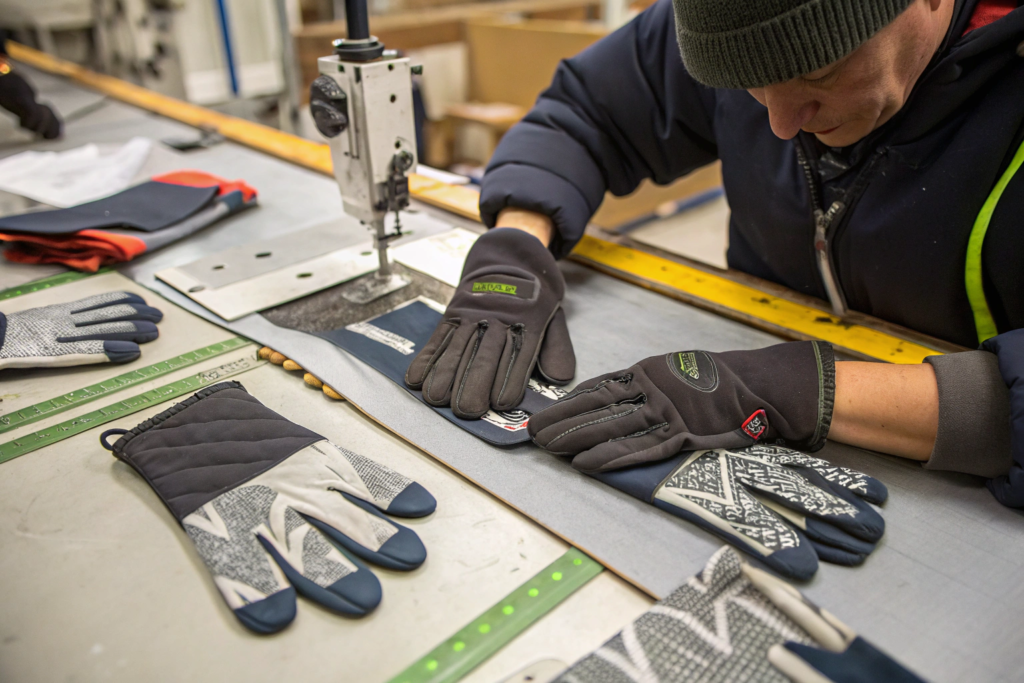
The thumb crotch is the U-shaped piece of fabric that connects the thumb tube to the palm panel. The left hand crotch is biased toward the index finger side. The right hand crotch is a mirror of this. A symmetrical crotch on both gloves restricts thumb mobility, causing the glove to twist when the wearer grips a pole.
How does the palm reinforcement patch differ between the left and right glove?
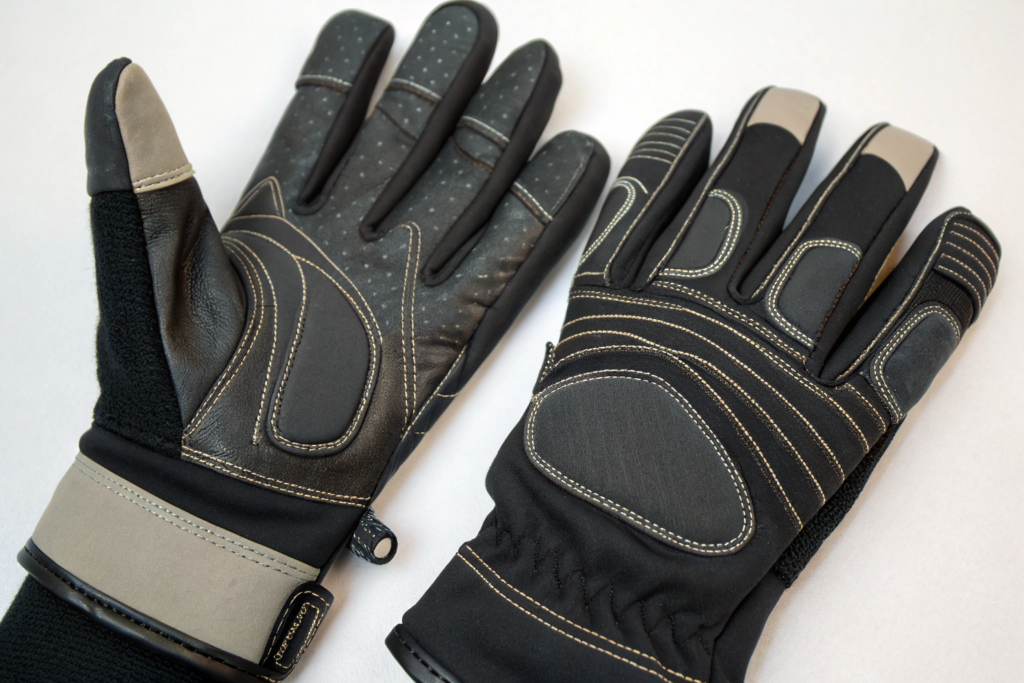
A skier wears down the palm in different zones depending on the hand. The right hand, gripping the pole handle, wears heavily at the base of the thumb and the center of the palm. The left hand, often used for balance, wears at the outer heel of the palm. Our reinforcement patches are cut and placed asymmetrically, denser leather on the right thumb crotch, wider coverage on the left palm heel. This is a detail that a generic factory producing "ambidextrous" gloves cannot replicate.
How Do You Construct a Pre-Curved, Hand-Specific Finger Shape?
A flat glove finger forces the hand to do the work of bending against the fabric tension, which causes fatigue and cold spots. A pre-curved finger matches the hand’s natural resting position, reducing fabric bunching inside the palm and improving blood flow to the fingertips.
We construct a pre-curved, hand-specific finger shape by cutting the finger fourchettes, the long side panels between the fingers, with a built-in curve that matches the natural flex position of a hand holding a ski pole. The left glove fingers curve in a slightly different direction than the right. The left index finger is angled inward, mirroring the right hand’s tendency to wrap over the pole grip.
The finger curve is set during the seam-taping process. We use a shaped aluminum heating form, a separate form for the left hand and the right hand. The sewn glove is pulled onto the heated form. The seam tape melts and bonds the waterproof membrane seams while holding the fingers in their precise anatomical curve. Once cooled, the curve is permanent.
Does the lining also need to be left and right specific?
Yes, and this is a detail many brands overlook. A pre-curved outer shell with a straight-cut lining creates internal friction, making the glove hard to put on. Our merino wool liners are cut from the same left and right specific patterns as the outer shell, with the thumb rotation and finger curve built in. The liner and shell move together as a single unit.
How does the pre-curve hold up after repeated wetting and drying?
A curved shape held only by stitching will relax over time as the thread stretches when wet. Our seam-taped construction and the heat-set finger shape are permanent because they rely on the thermoplastic membrane tape and the heat-set fabric memory, not just thread tension.
What Seam Sealing Technique Is Critical for Asymmetric Waterproof Gloves?
A ski glove must be waterproof, and the waterproofing is only as strong as the weakest seam. A straight seam on a flat panel is easy to tape. The complex, three-dimensional seam around the thumb crotch, especially the left-specific rotated crotch, is notoriously difficult to seal without creating a leak path.
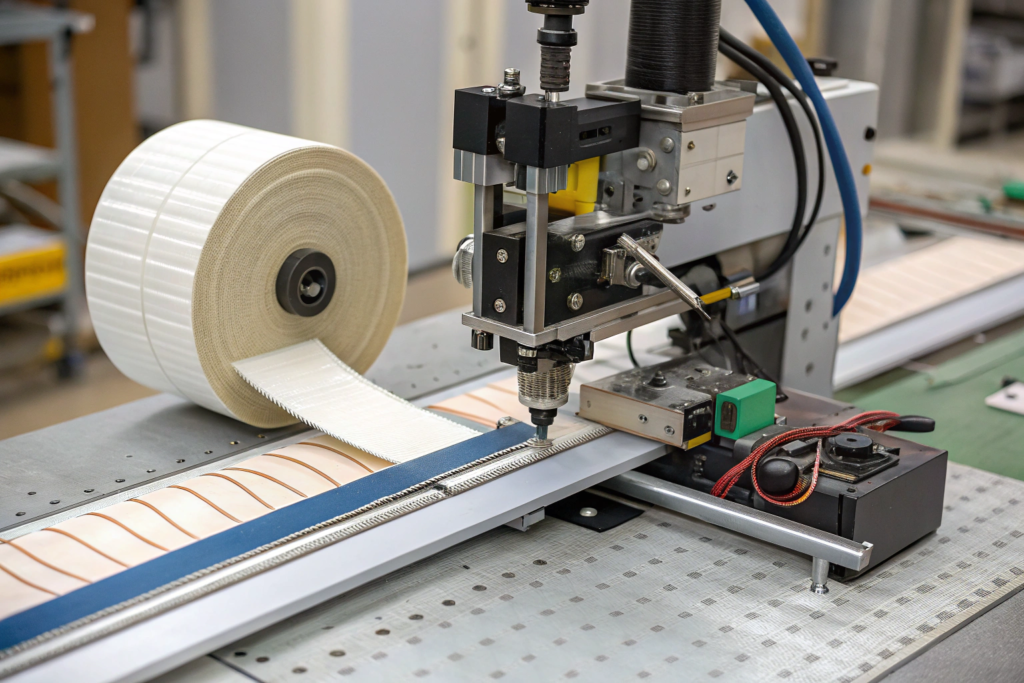
We use a three-dimensional hot-air seam taping machine with an articulating tape applicator head that follows the complex curved seam path around the left and right thumb crotches. A breathable PU seam tape is fed under a controlled tension, heated to 180 degrees Celsius, and pressed into the seam by a shaped silicone roller that conforms to the deep concavity of the crotch curve. The taped seam is then tested on a pressure leak tester at 0.5 bar for 30 seconds.
A generic taping machine with a flat roller will bridge across the concave thumb crotch, leaving a gap between the tape and the fabric. Water seeps through the gap. Our articulating head tilts and rotates to follow the seam path, maintaining positive contact throughout the curve.
How do you test the waterproofing of the left versus right glove?
We have a pair of pressure testing forms, a left aluminum hand form and a right aluminum hand form. Each has a compressed air inlet. The taped glove is clamped onto the form and inflated to 0.5 bar internal pressure. The inflated glove is submerged in a water tank. Any leak, even a single bubble stream, is immediately visible. The left and right gloves are both tested individually.
What membrane material is used in the seam tape?
We use a polyurethane seam tape with a hydrophilic molecular structure. It blocks liquid water droplets but allows water vapor molecules to pass through, maintaining breathability even over the taped seam. This prevents the "boil-in-a-bag" feeling of fully sealed, non-breathable gloves.
What Quality Control Checks Verify Left-Right Pair Integrity?
The final QC step is not just checking for loose threads. It is verifying that a pair of gloves is a true functional pair, not two right hands or two gloves with mismatched thumb geometry. This check catches the error that a tired packer might miss.
Our left-right pair integrity check involves placing the gloves palm-to-palm and verifying that the thumbs align in opposite directions and the finger curves mirror each other exactly. The gloves are then placed on a left-and-right pair of heated hand forms, inflated slightly, and visually inspected to confirm that the pre-curves and thumb angles match the forms precisely. Any glove that does not seat correctly on its hand-specific form is rejected.
The packer then inserts a left-and-right pair into a branded cardboard sleeve with a clear window on both sides, so the consumer can see the anatomically distinct gloves before purchase. The pair is secured with a plastic hangtag that attaches through both cuff loops, ensuring the pair stays together through retail handling.
What happens if a batch has a high count of right gloves versus left?
During cutting, we track the number of left and right panels cut from each fabric roll. The panel count must match within a 2% tolerance. If the right palm panels outnumber the left by more than 2%, the cutting team recalibrates the laser cutter alignment immediately. Any imbalance at the end of the batch is made up by cutting the missing panels before the line starts assembly.
How is the pair integrity labeled for the consumer?
The inner lining of each glove is labeled with a "L" and "R" woven label sewn into the cuff hem. The label is subtle, tone-on-tone, and visible only when the wearer is putting on the glove. This prevents the consumer from accidentally wearing two left gloves and complaining about the fit.
Conclusion
Producing left-hand and right-hand gloves for a ski brand requires a fundamentally asymmetric approach to pattern making, cutting, sewing, and seam taping. The thumb crotch must be rotated forward and mirrored, not just flipped. The palm reinforcement patches must be placed asymmetrically to match wear patterns. The finger pre-curve must be heat-set on hand-specific aluminum forms. The seam taping must follow a complex 3D curve without bridging.
Our Zhejiang glove line runs left and right hand production simultaneously, with separate aluminum pressing forms and a dedicated pair-integrity QC gate. We produce for several European and North American ski brands that demand this level of anatomical precision.
If your ski glove brand needs a production partner that understands asymmetry, contact our Business Director, Elaine. She will send you a pair of left and right sample gloves so you can feel the thumb rotation and finger pre-curve, along with our technical pattern sheet. Write to her at elaine@fumaoclothing.com. Let’s build a glove that fits the hand, not the other way around.