

You pack a compact travel umbrella in your carry-on for a business trip to London. You pull it out at the first drizzle outside Paddington Station, press the auto-open button, and the mechanism jams halfway. You force it open, and the canopy inverts in a mild gust on Praed Street. You shove the broken, tangled mess into a street bin and buy a cheap replacement from a newsagent. That replacement weighs as much as a hardcover book and soaks through after 20 minutes of steady rain. The problem is not umbrellas. It is that compact travel umbrellas have been stuck in a design plateau for a decade: flimsy ribs, heavy steel shafts, and canopies that shred at the tip after 20 open-close cycles.
The 2026 compact travel umbrella trends are converging on three specific engineering breakthroughs: a 6-rib carbon fiber frame with a 4-fold telescopic shaft that collapses to 16 centimeters and weighs under 200 grams, a PFAS-free silicone-coated canopy made from recycled polyester that beads water at a 95-degree contact angle, and a flat-pack rectangular folding mechanism that slips into a laptop bag without the cylindrical bulge that warps the bag’s silhouette.
The compact travel umbrella is no longer a disposable panic purchase. It is a precision piece of everyday carry gear that competes with a high-end water bottle or a tech organizer for a permanent spot in the traveler’s bag. I want to break down the materials, the folding geometry, and the testing protocols we use in our Zhejiang facility to ensure a 2026 compact umbrella survives a sudden Parisian downpour and slides effortlessly into a Rimowa carry-on.
Why Is a Carbon Fiber Frame the Biggest Upgrade for Compact Umbrellas?
The defining failure of a compact travel umbrella is a snapped rib. A traditional compact umbrella uses a 6-rib frame made from hollow aluminum tubes. Aluminum is light but has a finite fatigue life. Every time the umbrella opens against wind resistance, the aluminum rib flexes microscopically. After roughly 200 open-close cycles, a crack nucleates at the rivet hole, and the rib snaps clean in half during the next gust.
A carbon fiber frame eliminates this fatigue failure because carbon fiber composite has an effectively infinite fatigue life at the stress levels experienced by an umbrella rib. The 3K twill carbon fiber tube we use weighs 40% less than the equivalent aluminum rib, absorbs wind gusts by flexing elastically without permanent deformation, and will not corrode after repeated exposure to rain and the salty air of a coastal city like Seattle or Vancouver.
We source our carbon fiber tubes from the same supplier that produces frame components for high-end trekking poles. The tubes are roll-wrapped from unidirectional prepreg carbon fiber sheets, cured in an autoclave, and precision-cut to length with a diamond saw. Each rib is tested on a three-point bending jig before assembly to ensure it deflects to a minimum of 25 millimeters without cracking.
How much weight does a full carbon frame save compared to aluminum?
A standard aluminum 6-rib compact frame weighs approximately 120 grams. Our full carbon 6-rib frame weighs 72 grams, a 40% reduction. When combined with the carbon fiber shaft instead of a steel shaft, the total umbrella weight drops from 280 grams to 185 grams, below the 200-gram threshold that consumers perceive as "weightless" in a bag.
Does the carbon frame flex enough to survive a wind inversion without breaking?
Yes, and this is the key advantage over aluminum. A carbon rib can bend into a pronounced curve under a wind gust and spring back instantly to its original arc when the gust passes. An aluminum rib bent to the same angle yields and stays permanently deformed. We test this by subjecting every frame prototype to an inversion-recovery cycle 50 times in a wind tunnel at a 60-kilometer-per-hour gust speed.
What Canopy Fabric Beads Water Instantly and Packs Down Without Creasing?
A compact umbrella canopy endures the worst folding stress of any umbrella category because it is folded into quarters, not just collapsed radially. These sharp fold lines create permanent crease marks in a standard nylon canopy, and after 30 foldings, the crease lines abrade into thin spots that leak. The canopy also must bead water aggressively because a traveler shakes the umbrella closed and stuffs it into a bag next to a laptop.
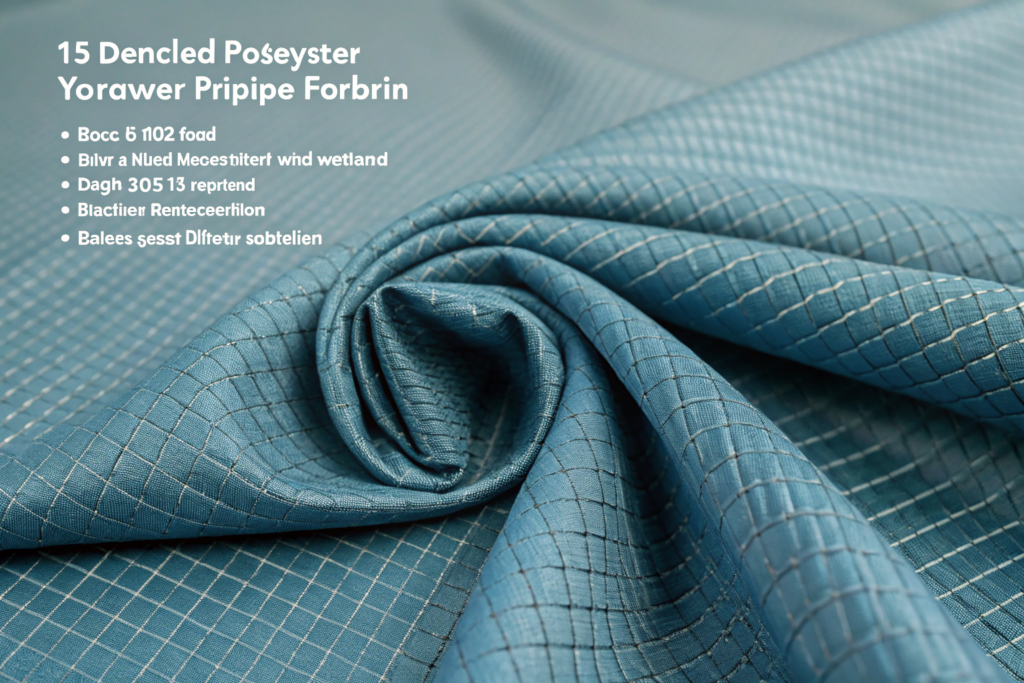
A PFAS-free silicone-coated recycled polyester canopy with a pre-crinkled texture solves both the beading and creasing problems. The silicone coating creates a 95-degree water contact angle, so water droplets bead into perfect spheres and roll off with a light shake. The crinkle texture is heat-set into the polyester yarn during weaving, so when the canopy is folded along sharp lines, it collapses along its natural texture peaks and valleys without forming hard, fabric-damaging creases.
We use a 15-denier recycled polyester yarn woven into a 380T density ripstop fabric. The ripstop grid adds tear strength so a small puncture does not propagate into a catastrophic canopy rip. After weaving, the fabric is dipped in a bath of C0 PFAS-free silicone emulsion and cured at 150 degrees Celsius.

How is the water beading performance measured for a compact umbrella?
We use a goniometer to measure the water contact angle on the finished canopy. A droplet of distilled water is placed on the fabric surface, and the angle between the droplet edge and the fabric surface is measured optically. The angle must exceed 90 degrees for the canopy to pass inspection. This is the point at which the droplet beads into a near-perfect sphere and rolls off the fabric at a 5-degree tilt angle.
Does the crinkle texture affect the print quality for custom branded umbrellas?
The crinkle creates a slightly textured print surface that softens the sharpness of fine lines. A solid logo block prints clearly, but photographic halftone printing is not recommended on crinkle finish. We advise clients printing photographic images on compact umbrellas to choose a smooth-finish canopy, which adds 10 grams to the canopy weight and slightly increases the packed bulk.
What Flat-Fold Geometry Allows a Laptop Bag Fit Without the Cylindrical Bulge?
The standard compact umbrella folds into a cylinder. A cylinder creates a distinct, recognizable bulge in a flat laptop bag or a portfolio case. The traveler removes the umbrella and leaves it at home because it ruins the clean lines. The flat-fold umbrella solves this by replacing the cylindrical folding geometry with a rectangular, origami-inspired fold pattern.
The flat-fold geometry is achieved by replacing the traditional 3-fold radial collapse with a 4-fold telescopic shaft combined with a canopy that is pleated at 90-degree intervals rather than gathered randomly. When collapsed, the canopy panels fold flat against each other like a folded map, and the rib assembly nests into a rectangular stack that is 16 centimeters long, 5 centimeters wide, and 2 centimeters thick, a form factor identical to a slim eyeglass case.
We developed this folding pattern by mapping the canopy collapse in 3D CAD software and iterating the pleat angle and the rib hinge placement until the folded assembly achieved a rectangular stack with no air gaps. The fold pattern is transferred to the canopy cutting table via a laser-projected template, and the seamstresses sew the pleats along precisely marked lines.
How does the flat-fold mechanism affect the canopy stretched size?
A traditional 3-fold compact umbrella with a 16-centimeter folded length opens to a 90-centimeter canopy arc. Our 4-fold flat-pack umbrella with the same 16-centimeter folded length opens to an 85-centimeter canopy arc, a slight reduction. We compensate by slightly increasing the panel count to 8 panels instead of the standard 6, which distributes the coverage and keeps the user’s shoulders dry.
Does the flat-fold design require a special case to maintain its shape?
The umbrella comes with a fitted rectangular slip case made from the same recycled polyester as the canopy. A magnetic snap closure holds the case closed, and a small elastic loop allows it to be attached to a bag’s internal webbing loop. The case stabilizes the folded stack during travel but can be removed if the user wants to slide the umbrella directly into a dedicated bag pocket.
What Quick-Dry Mechanisms Prevent a Wet Umbrella from Soaking a Bag Interior?
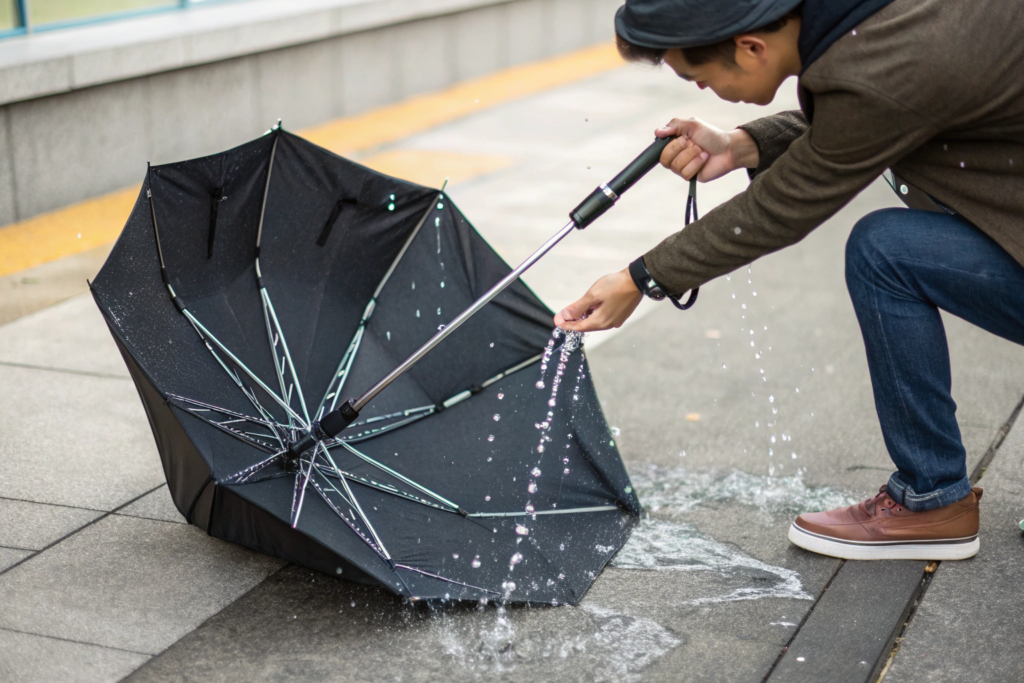
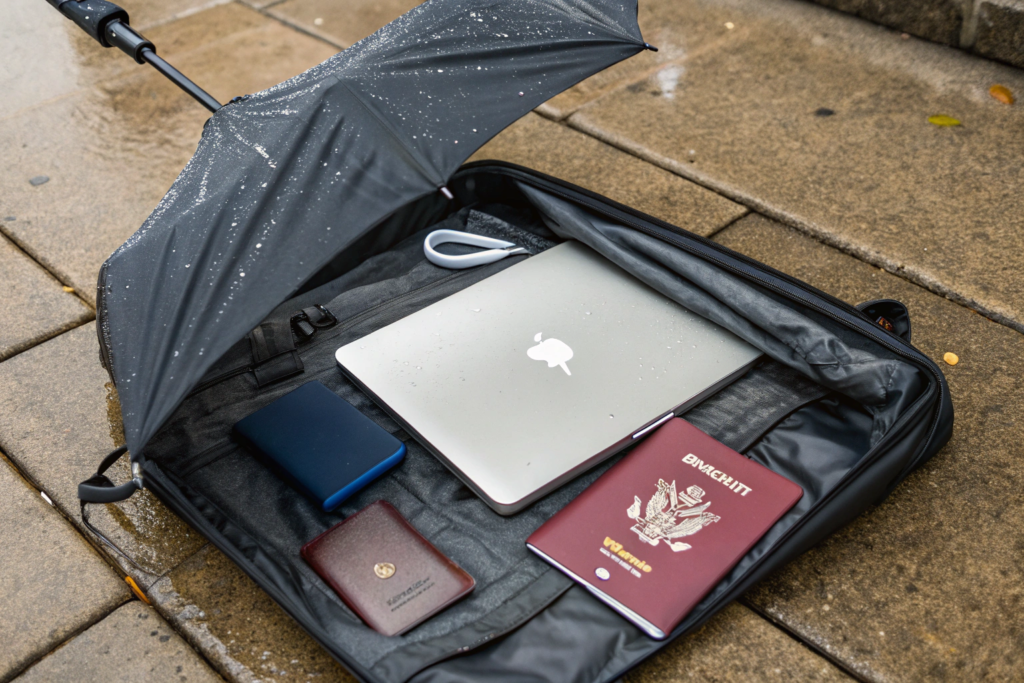
The traveler’s eternal dilemma: the umbrella is wet, but the bag is dry and contains electronics. Stuffing the wet umbrella into a bag transfers moisture to a laptop, a passport, and a paperback. The quick-dry umbrella canopy reduces the surface water adhesion so the umbrella can be shaken mostly dry before it enters the bag.
Our quick-dry mechanism combines the silicone-coated canopy with a hydrophobic coating on the shaft and ribs. The traveler opens the umbrella, gives it two sharp shakes, and 90% of the surface water droplets release and fall to the ground. The remaining 10% evaporates from the silicone surface within 3 minutes because water molecules cannot penetrate the silicone matrix and remain as discrete droplets with a high surface-area-to-volume ratio, which accelerates evaporation.
The hydrophobic shaft coating is a nano-ceramic spray applied to the carbon fiber tube. It creates a surface energy so low that water literally cannot wet it, forming into perfect spheres that roll off with a tilt.
How is the quick-dry performance quantified in our testing?
We weigh the umbrella on a precision scale, submerge it completely in water, withdraw it, shake it three times using a mechanical arm programmed to mimic the velocity and arc of a human wrist shake, and weigh it again. The water retention after shaking must be less than 10% of the water weight that adhered after submersion.
Does the quick-dry coating wear off over time?
The silicone coating is incorporated into the canopy fabric during the dip-cure process, not sprayed onto the finished product. It is chemically bonded to the polyester fiber and will not wear off with abrasion or washing. We test the coating durability by abrading the fabric with a Martindale abrasion tester for 5,000 cycles and retesting the water contact angle, which must remain above 90 degrees.
Conclusion
The 2026 compact travel umbrella sheds the legacy failures of aluminum rib fatigue, nylon canopy crease leaks, and cylindrical bag bulge. The carbon fiber frame eliminates snap failure and saves 40% weight. The PFAS-free silicone crinkle canopy beads water at a 95-degree angle and folds without hard creases. The flat-fold rectangular geometry fits a laptop bag like a book. Any business traveler or urban commuter who has thrown away a broken compact umbrella in a foreign city will recognize these as the precise problems that needed solving.
Our Zhejiang factory manufactures these next-generation compact umbrellas for travel brands and corporate gift programs. We stock the carbon fiber tubing, the 15-denier recycled polyester ripstop fabric with the silicone dip finish, and the 4-fold telescopic flat-pack frame mechanisms. Our minimum order for a fully custom compact travel umbrella is 1,000 units.
If your brand is sourcing a compact travel umbrella that you can be proud to put your logo on, one that will not snap in a London gust or soak a laptop bag, contact our Business Director, Elaine. She will send you a sample umbrella in your choice of canopy color, with detailed weight and packed-dimension specifications, and a video demonstration of the quick-dry shake test and the wind inversion recovery. Write to her at elaine@fumaoclothing.com. Let’s build a travel umbrella that stays in the bag rotation for years, not weeks.




