
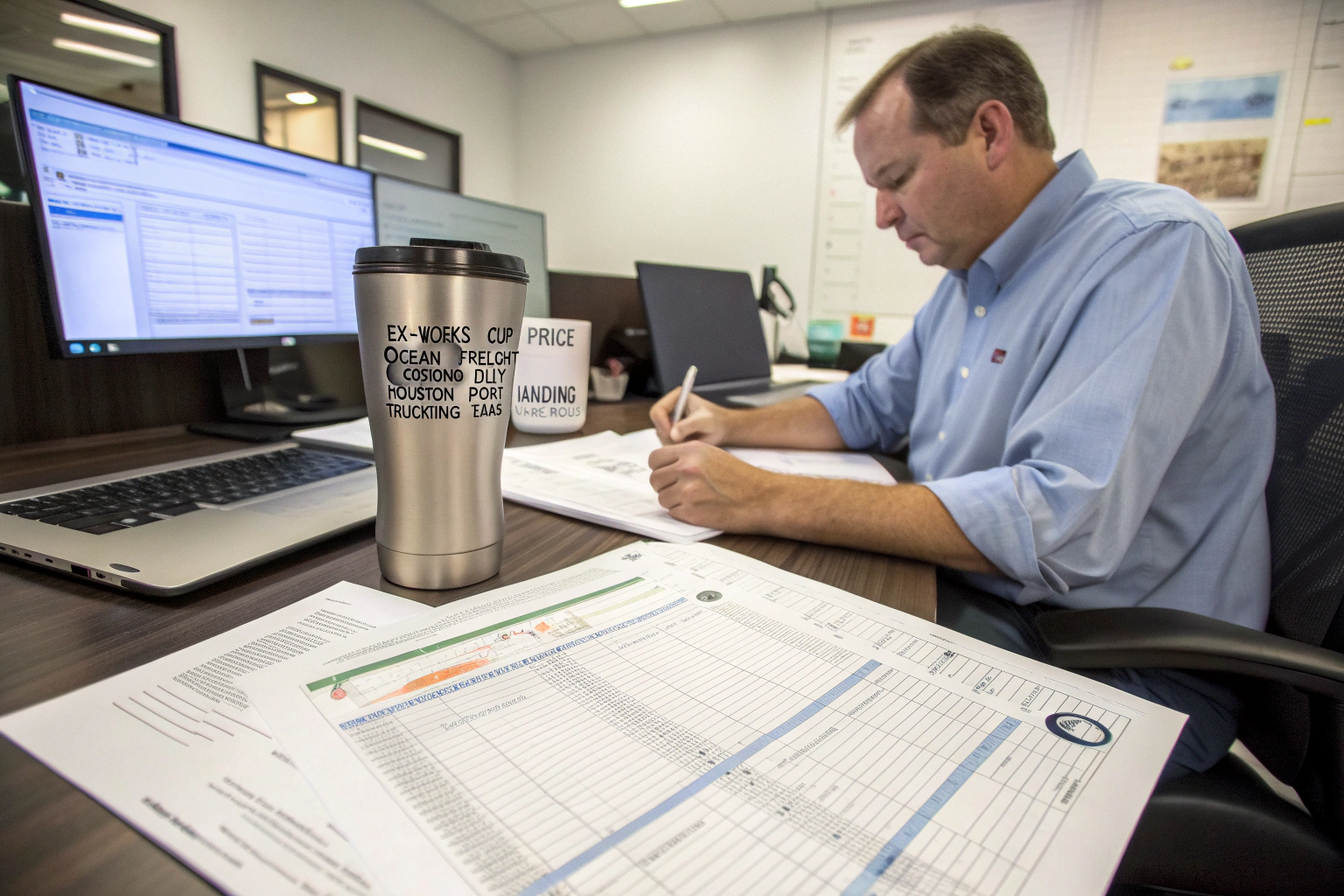
You negotiate a great unit price of $1.20 per custom printed travel cup with a factory in Zhejiang. You multiply 1.20 by your order quantity of 5,000, get an invoice total of $6,000, and mentally calculate your retail margin. The product arrives at your Houston warehouse three months later, and the actual total cost is $9,150. You missed the ocean freight, the customs bond, the port handling charges, the trucking from Houston port to your warehouse, and the import duty. Your "great" unit price just became a 52% cost overrun that destroys your margin. The factory did not lie to you. The factory quoted exactly what you asked for: the ex-works price. You did not ask for the landed cost.
The total landed cost of importing a cup from China to Texas is calculated as: Ex-Works Unit Price plus Ocean Freight per Unit plus US Customs Duty Rate multiplied by the CIF value plus Customs Bond Fee per Shipment plus Port Handling Charges per Container plus Inland Trucking from the Port of Houston to your Warehouse plus any Customs Broker Fee. The formula is Landed Cost = (Ex-Works x Quantity) + Ocean Freight + (Duty Rate x (CIF Value)) + Bond Fee + Port Charges + Trucking + Broker Fee. You then divide the total landed cost by the quantity to get your actual per-unit cost.
I want to give you the exact numbers, line by line, with the actual forms and fee schedules that apply to a container of cups arriving at the Port of Houston. You can take this formula, plug in a factory’s Ex-Works quote, and know your real per-unit cost before you wire a deposit.
What Ex-Works Price Components Are Often Hidden from the Initial Quote?
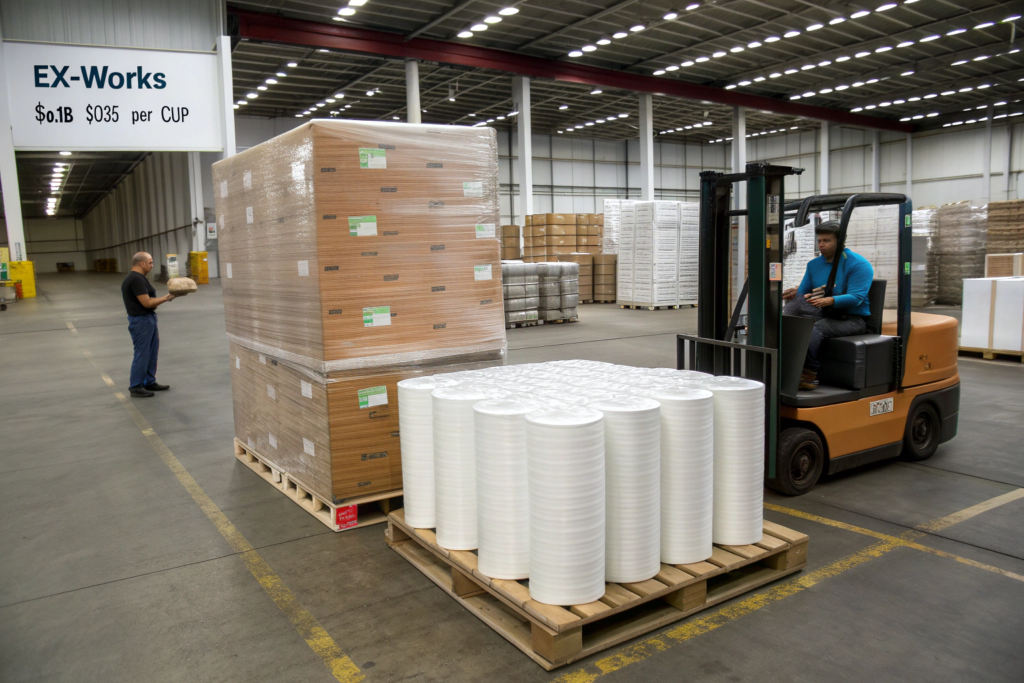
The Ex-Works price sounds comprehensive, you pay the factory, they hand you the goods at their loading dock. But "hand you the goods" is ambiguous. It does not include the export carton cost. It does not include the palletizing cost. It does not include the loading fee. These are Ex-Works components that a factory may treat as "standard" and exclude from the per-unit price, expecting the buyer to pay them separately as a loading surcharge.
The Ex-Works price must be clarified to include the export-grade corrugated carton, a printed master carton for retail distribution, individual polybagging for each cup, a pallet stretch-wrapping fee, and the forklift loading charge at the factory dock. These five components can collectively add $0.18 to $0.35 per cup if they are not included in the initial quote.
We specify these components in our proforma invoice as separate line items under the Ex-Works price so the buyer sees exactly what is included. An export-grade carton costs roughly $0.80 per carton and holds 24 cups. The per-cup carton cost is therefore approximately $0.033. A small number, but across 5,000 cups, it is $166. A polybag for each cup costs roughly $0.02 per cup, $100 across the order. These small costs add up when the buyer assumes they are free.
Does the per-unit price include an individual UPC or barcode sticker?
A UPC sticker applied to each cup is a separate labor charge if the sticker is not part of the factory’s standard packaging workflow. We quote $0.03 per cup for UPC sticker application, which covers the sticker material and the 5 seconds of labor to apply it. A buyer who needs a unique barcode for Amazon FBA or Walmart retail must specify this requirement during quotation.
What about the drop test certification for the export carton?
An export carton must survive a 10-drop sequence from a height of 70 centimeters without the cups inside breaking. We include a drop test certification video with every first-article carton sample at no additional charge. Some factories charge $250 for this certification as an "export packaging engineering fee." We consider it a standard part of export readiness.
How Is Ocean Freight Calculated for Less-Than-Container-Load Cup Shipments?
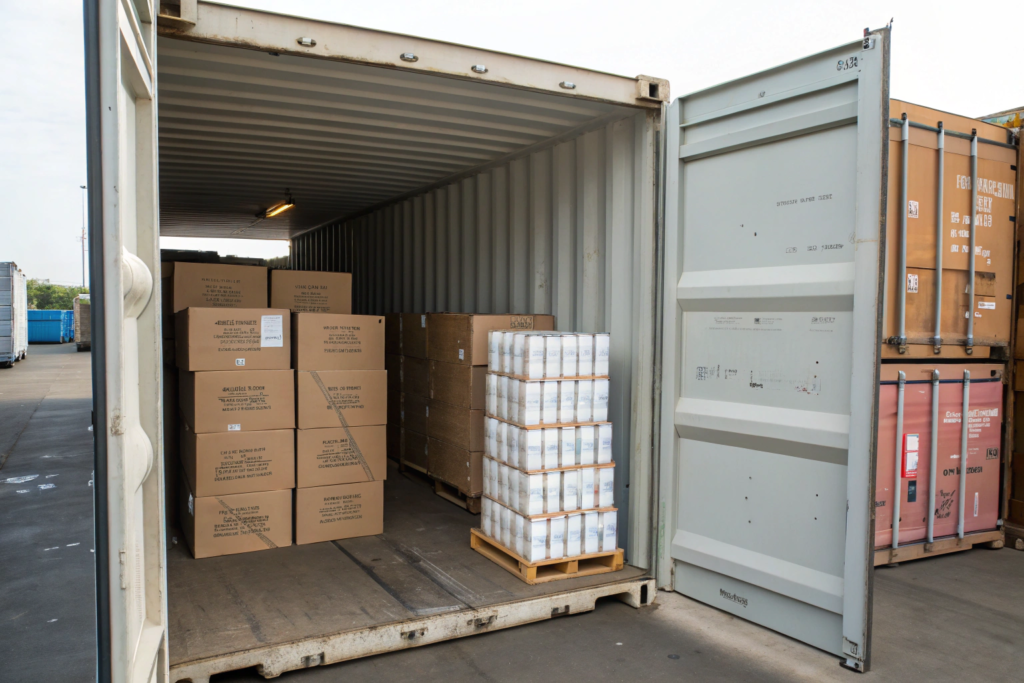
A full 40-foot container of cups is the most cost-effective shipping method. But a small brand ordering 5,000 cups does not fill a 40-foot container. The cups ship via LCL, consolidated with other shippers’ goods in a shared container. LCL pricing is based on cubic meter volume, not weight, because cups are voluminous, lightweight items. A standard travel cup in its polybag and carton occupies roughly 0.003 cubic meters. Five thousand cups occupy 15 cubic meters.
Ocean freight for an LCL cup shipment from Ningbo to Houston is quoted per cubic meter, currently ranging from $95 to $145 per cubic meter depending on the season, plus a documentation fee of $65, a terminal handling charge at the origin port of $45 per shipment, and a destination terminal handling charge at the Port of Houston of approximately $85 per shipment. For a 15-cubic-meter cup shipment, the total ocean freight line item is roughly $1,700 to $2,300.
We consolidate LCL shipments through a freight forwarder who offers weekly sailings from Ningbo to Houston with a transit time of 28 to 32 days. The bill of lading is released electronically, and the US customs broker files the entry summary using the telex release.
What is the peak season surcharge and when does it apply?
From August through October, ocean carriers impose a peak season surcharge of $150 to $300 per TEU on the Asia-to-US Gulf route. For an LCL shipment, this surcharge is prorated per cubic meter, adding roughly $8 to $15 per cubic meter. A buyer importing cups for a holiday promotion should factor this surcharge into the August shipment window.
How does FCL pricing compare for a full container of cups?
A 40-foot container holds roughly 55 cubic meters, equivalent to 18,000 travel cups. The FCL ocean freight rate from Ningbo to Houston is currently approximately $3,800 to $4,500 for a 40-foot container. The per-cup ocean freight cost drops to around $0.22 per cup, compared to $0.38 per cup under LCL. A brand that can consolidate an annual order into a single FCL shipment saves substantially on freight cost per unit.
What US Customs Duty Rate Applies to an Imported Cup?
Cups seem simple. A ceramic mug, a stainless steel tumbler, a plastic travel cup. Each material has a different Harmonized Tariff Schedule code and a different duty rate. Misclassifying a cup can trigger a 25% Section 301 additional duty on Chinese goods or a penalty from US Customs.
A stainless steel travel cup classified under HTS 7323.93.0045 carries a general duty rate of 2.0% ad valorem, plus a Section 301 additional duty of 25% if it is subject to the China-specific tariff list. However, many stainless steel cups and plastic cups are classified under HTS subheadings that are excluded from Section 301 tariffs. A ceramic mug under HTS 6912.00.4500 carries a duty rate of 10.0% ad valorem and may also be subject to an additional 25% duty. A plastic travel cup under HTS 3924.10.4000 carries a duty rate of 3.4% ad valorem, and many plastic cup subheadings are exempt from Section 301.
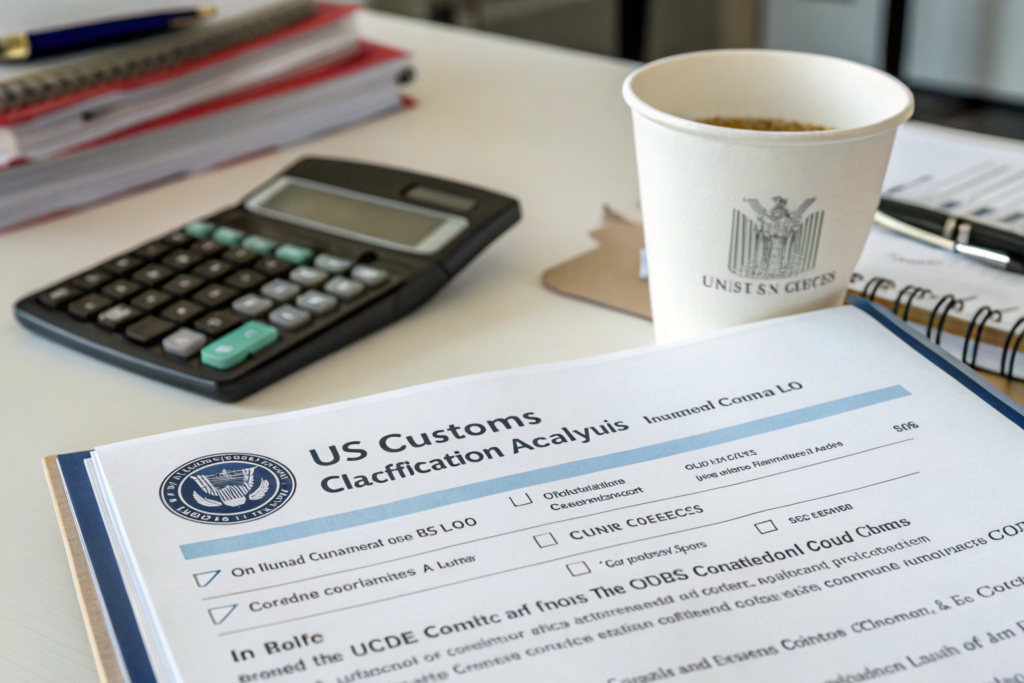
We provide our cup buyers with a US customs classification analysis prepared by a licensed US customs broker before shipment. The analysis confirms the correct HTS code, the ad valorem duty rate, and whether the specific code is subject to Section 301 additional duties at the time of shipment.
How is the duty calculated on the CIF value?
CIF stands for Cost, Insurance, and Freight. It is the sum of the Ex-Works value of the cups plus the ocean freight cost plus the marine insurance cost. Duty is calculated as the duty rate percentage multiplied by the CIF value. For a shipment with a $6,000 Ex-Works value, $1,800 ocean freight, and $60 insurance, the CIF value is $7,860. At a 3.4% duty rate, the duty owed is $267.24. At a 2% duty rate plus 25% Section 301, the duty owed is $212.22 plus $1,965.00 for a total of $2,177.22.
Is a customs bond required and what does it cost?
Yes, a customs bond is required for any import valued over $2,500. A single-entry bond costs approximately $70 to $100 for a $10,000 shipment. A continuous bond for importers shipping multiple times per year costs $275 to $500 annually and covers unlimited entries.
What Inland Trucking and Warehouse Receiving Costs Apply in Texas?
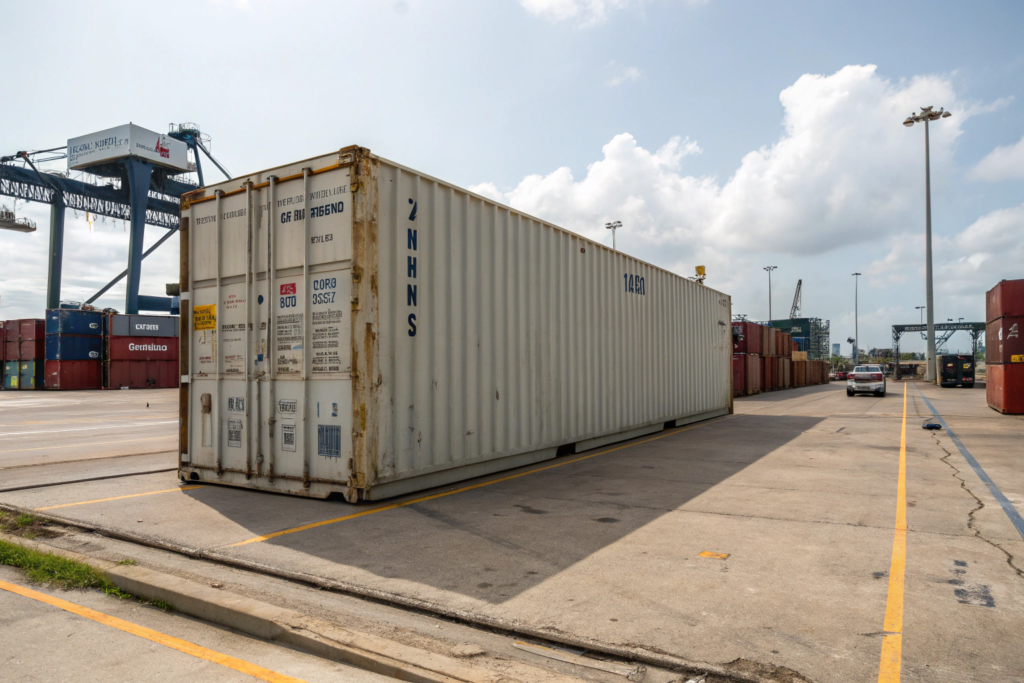
The container arrives at the Port of Houston. The goods are not in your warehouse. They sit in a container yard at the Barbours Cut or Bayport terminal awaiting a trucking appointment. The port releases the container after customs clears it, but moving it from the port to your warehouse incurs significant interior trucking costs.
Inland trucking from the Houston port to a warehouse in the Dallas-Fort Worth area costs between $650 and $950 for a full container load, or a prorated share of an LCL consolidated trucking fee that runs $120 to $200 per cubic meter. A 15-cubic-meter LCL cup shipment would cost approximately $180 to $300 for the Texas interior trucking leg from the Houston forwarder’s consolidation warehouse to the DFW warehouse.
We coordinate the trucking through our freight forwarder’s Houston partner. The forwarder provides a "last-mile" delivery quote that includes the port release fee, the chassis rental, the trucking mileage, and the fuel surcharge.
What are the Houston port handling and chassis fees specifically?
The Port of Houston charges a wharfage fee and a container usage fee. For an LCL shipment, these are billed as a "destination terminal handling charge" by the consolidator, typically $85 to $120 per shipment. Additionally, if the trucker uses a port-owned chassis to haul the container, a chassis usage fee of $25 to $40 per day applies.
Does the trucking cost include a liftgate for residential delivery?
If the final delivery is to a residential address or a small warehouse without a loading dock, a truck with a hydraulic liftgate must be used. This adds $75 to $150 to the trucking quote. Commercial delivery with a dock-level warehouse does not incur this charge.
Conclusion
The total landed cost of importing a cup from China to Texas is the sum of the Ex-Works price with all packaging components, the ocean freight per cubic meter with peak season adjustments, the US customs duty on the CIF value with Section 301 applicability determined by a customs broker, the single-entry bond fee, the Houston port terminal handling charges, and the interior trucking from Houston to your Texas warehouse. Add a customs broker filing fee of $125 to $200 per entry. The formula is straightforward, but each line item requires a specific, verifiable quote attached to your particular cup material, order volume, and destination zip code.
Our Zhejiang factory provides a comprehensive landed cost estimate at the quotation stage. We do not just quote the Ex-Works unit price and leave the logistics to guesswork. Our logistics coordinator calculates the ocean freight, the duty estimate, the port charges, and the trucking to your Texas facility, and presents it as a single-page landed cost summary. You wire the deposit knowing your exact all-in per-unit cost.
If you are sourcing cups, bottles, or any other accessories for import to Texas, request a landed cost breakdown, not just an Ex-Works quote. Contact our Business Director, Elaine. She will prepare a detailed proforma invoice that includes the Ex-Works price broken down by packaging component, the ocean freight quote for your specific volume, a US customs duty estimate from our broker, and the Houston interior trucking cost. Write to her at elaine@fumaoclothing.com. Let’s calculate the real number before a single cup leaves the mold.




