
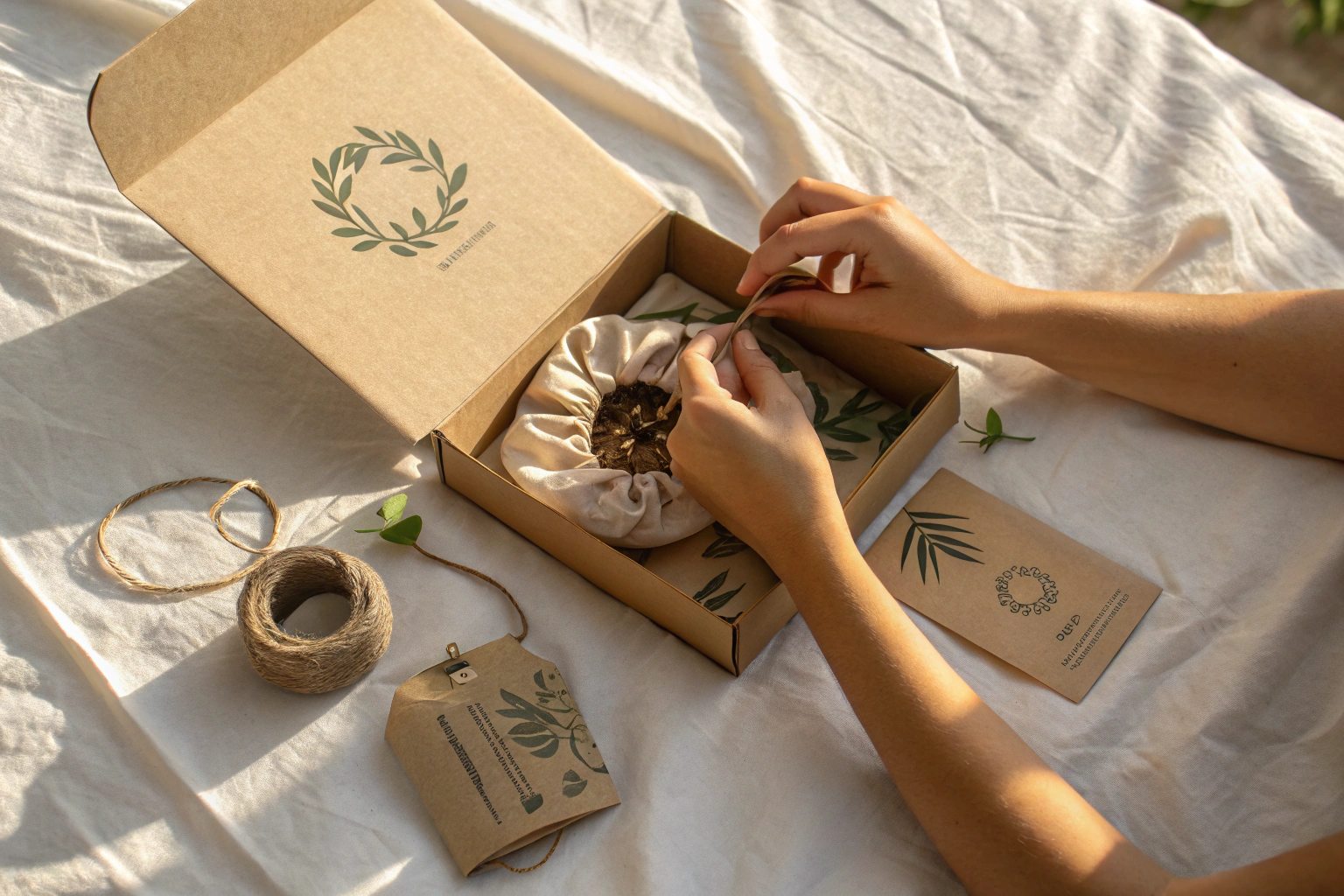
I still remember the exact moment the packaging conversation changed for our industry. A long-time client from Germany called me in 2020, her voice tense. Her largest retail account had just updated its vendor guidelines. By the next fiscal year, all plastic polybags had to be replaced with certified biodegradable alternatives, all paper packaging had to carry FSC certification, and any supplier who could not comply would be delisted. She had six months to transition her entire hair accessories line to sustainable packaging or lose 40% of her annual revenue overnight. I told her we would figure it out together. Today, that client’s product line is fully eco-packaged, and she tells me the sustainability certification on her packaging has actually become a selling point that her competitors cannot easily match.
The answer is yes. AceAccessory can produce eco-friendly packaging for your accessory brand, and we have been doing so for years now across product categories including hair bands, clips, scarves, belts, hats, and gift items. Our packaging development team in Zhejiang has sourced and qualified a supply chain of certified sustainable materials. We offer options ranging from FSC-certified paper boxes to home-compostable polybags, recycled polyester drawstring pouches, soy-based inks for printing, and plastic-free hang tags. I want to walk you through exactly what options are available, what certifications actually matter versus what is just green marketing, and how we structure the transition so it does not destroy your per-unit margins.
What Sustainable Packaging Materials Do You Offer for Accessories?
When a client asks me about eco-friendly packaging, the first thing I clarify is that sustainable packaging is not one single material. It is a family of options with different cost points, different certification standards, different performance during shipping, and different visual aesthetics. The right choice for a luxury silk scarf sold in a boutique is very different from the right choice for a children’s hair clip set sold on a discount store blister card. I will walk through the primary options we offer so you can match the material to your brand positioning, your sales channel, and your budget.
Which Biodegradable Polybag Options Work for Hair Accessories?
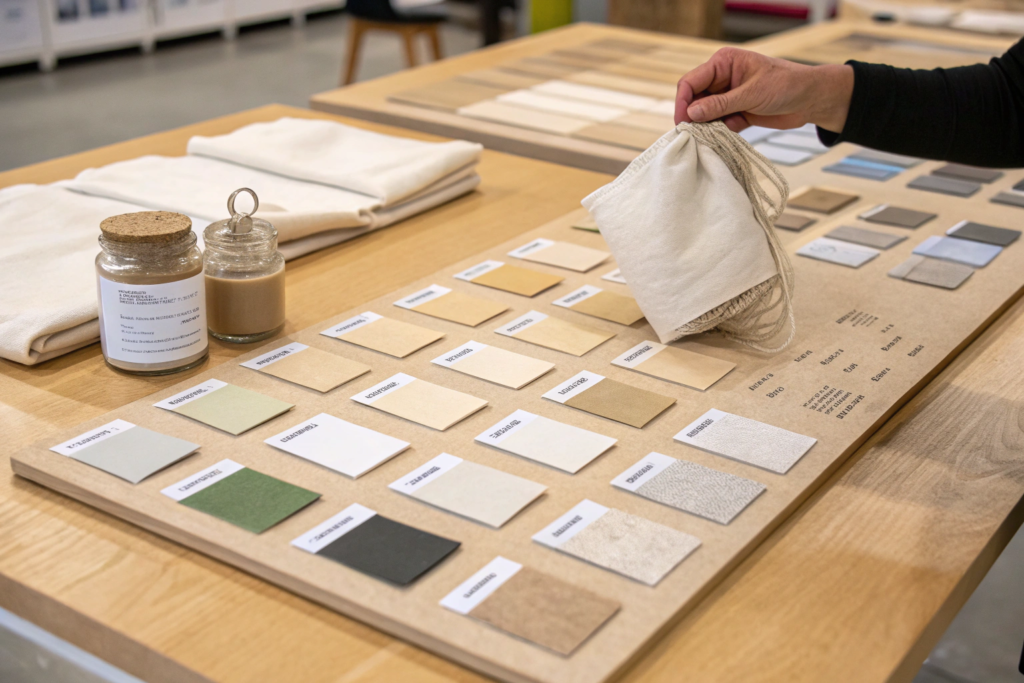
Polybags are the workhorse of accessory packaging. They protect products from dust, moisture, and handling damage during transit, and they keep multiple small pieces together on a retail peg hook. The problem with traditional LDPE polybags is that they persist in landfills for hundreds of years. The solution is not to eliminate polybags entirely, because that leads to damaged goods and higher return rates, but to switch to biodegradable or compostable alternatives that break down into harmless organic matter.
We currently offer two categories of eco-friendly polybags. The first is oxo-biodegradable polybags, which contain an additive that accelerates fragmentation and biodegradation in landfill conditions. These bags look and feel almost identical to standard plastic polybags and cost only slightly more, typically an additional 10% to 20%. The second category is certified home-compostable polybags made from plant-based materials such as corn starch or PBAT. These bags carry certifications like OK Compost HOME from TÜV Austria or the BPI compostable certification for the US market. They are more expensive, roughly 30% to 50% above standard polybag pricing, and they have a shorter shelf life. A compostable polybag stored in a hot warehouse for two years may begin to lose clarity or become slightly tacky to the touch. For most accessory brands, I recommend the home-compostable option if your brand story explicitly revolves around sustainability and you can justify the cost, or the oxo-biodegradable option if your primary goal is compliance with retailer mandates without a significant budget increase.
You can integrate these bags into your existing packaging workflow with no equipment changes. A valid compostable certification should be available from your packaging supplier and can usually be printed as a small reference number directly on the bag, which gives your retail buyer audit-ready documentation at the point of shelf inspection.
What Paper and Cardboard Options Are FSC-Certified?
Paper-based packaging, which includes header cards, gift boxes, shipping cartons, and product inserts, represents the largest visible surface area of your brand’s packaging presence. Using Forest Stewardship Council certified paper means the raw material has been traced through a chain-of-custody system from a responsibly managed forest to the paper mill and finally to our packaging supplier.
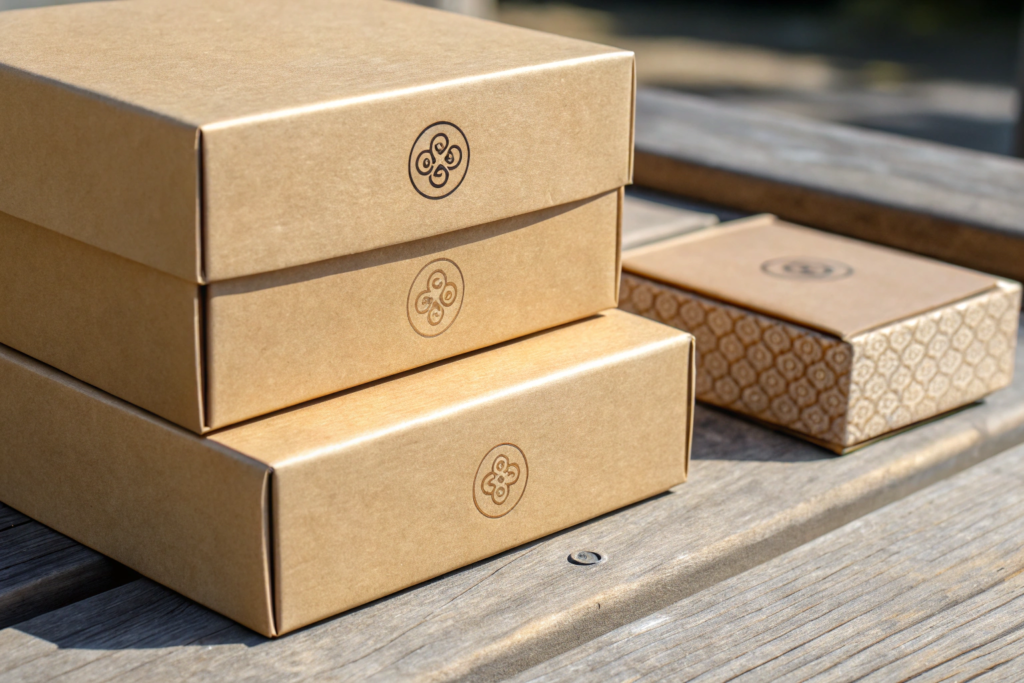
FSC certification comes in three labels you should understand. FSC 100% means all the fiber in the paper comes from FSC-certified forests. FSC Mix means the paper is a blend of FSC-certified fiber, recycled material, and controlled wood from acceptable sources. FSC Recycled means the paper is made entirely from post-consumer reclaimed material. For accessory packaging, FSC Mix and FSC Recycled are the most commonly used because they balance environmental credibility with cost and availability. An uncoated kraft box made from FSC Recycled paper with no plastic lamination looks beautifully natural and is fully recyclable in standard paper waste streams. If you need a more polished retail appearance, we can use an FSC-certified coated paper with a water-based aqueous coating instead of a plastic laminate, creating a box that feels premium but can still be recycled with regular paper.
The price premium for FSC-certified paper over non-certified paper of equivalent quality is modest, usually in the range of 5% to 15%, and this premium has been steadily shrinking as more paper mills achieve certification and competition increases. When we quote your packaging, the FSC certificate number of the paper source is documented so your brand can truthfully print the FSC logo on the finished packaging, a logo that is independently meaningful to consumers and retail buyers who have been trained to look for it on the FSC label as a mark of responsible sourcing.
How Can I Transition to Sustainable Packaging Without a Large Budget Increase?
I understand that budget is not an afterthought. It is usually the first wall a brand owner hits when they start exploring eco-friendly packaging. Quotes come back higher than expected, and suddenly the sustainable option feels like a luxury for bigger companies with deeper pockets. I want to be clear that transitioning does not need to be all-or-nothing, and the smartest transitions I have seen treat this as a phased journey rather than a overnight overhaul that blows up the cost of goods sold.

What Is a Phased Approach to Packaging Transition?
A phased approach means you do not switch every SKU and every packaging component on day one. You prioritize the changes with the biggest environmental impact or the strongest customer-facing messaging value, and you roll the rest out over two or three production cycles.
I recommend starting with the elements that touch the end consumer most directly. If your product currently uses a standard plastic polybag with a glossy coated paper header card and a plastic hang tag string, the first phase might replace just the polybag with an oxo-biodegradable alternative and switch the hang tag string to cotton or hemp twine. These two changes remove the most visible plastic from the consumer experience with a minimal cost increase, and they give your brand a sustainability story you can communicate immediately on your website and social media. Phase two, scheduled for your next seasonal order, might switch the header card to FSC Recycled uncoated paper with soy-based ink printing. Phase three might redesign the gift box structure to eliminate the PET window and replace it with an open die-cut window or simply a beautiful product photo printed on the box instead.
Spreading the transition across three orders also gives you time to test the new packaging in real shipping conditions. A biodegradable polybag might perform perfectly on a short domestic shipment but show unexpected brittleness after four weeks in a humid ocean container. Discovering that on a small-volume Phase One rollout lets you adjust the specification before the Phase Three bulk order, instead of learning it the hard way on your entire seasonal inventory. As you develop these new packaging specifications, your factory should update your packaging specifications in the master tech pack file so accuracy is maintained across every reorder.
Can I Save Cost by Reducing Packaging Layers?
One of the most effective ways to absorb the higher material cost of eco-friendly packaging is to eliminate unnecessary packaging layers at the same time. I often audit a client’s existing packaging and find a gift box inside a polybag inside another polybag, with three separate hang tags attached by two different fasteners. This package was designed by accumulation over years, not by intention.
Consolidating layers reduces material consumption and often partially or fully offsets the premium for switching to certified sustainable materials. For a typical hair accessory set, one well-designed FSC kraft box with a printed interior card and a single compostable outer polybag can replace an elaborate multi-layer package while using fewer total materials and presenting a cleaner, more modern retail appearance. The per-unit material cost may stay flat or even decrease slightly, while the sustainability profile improves dramatically.
Talk to your factory about a packaging audit. Send photos of your current full packaging assembly, and ask the project manager to propose a simplified, eco-friendly alternative that achieves the same retail presentation with fewer material layers. A factory that has experience with lean, sustainable packaging design will typically return with specific reduction suggestions and a cost comparison showing the net financial impact of the redesign. A thoughtful packaging audit often reveals that sustainability and cost savings are not in opposition but can be designed together into a single solution.
What Certifications Should Eco-Friendly Accessory Packaging Have?
Certification is the part of sustainable packaging that separates genuine environmental effort from creative marketing language. I have seen packaging labeled "green," "natural," and "earth-friendly" with absolutely no independent verification behind those words. A certification logo that is registered and traceable is the only way your packaging claims hold up under scrutiny from a retailer’s compliance department or, increasingly, from educated consumers who know how to spot greenwashing. Understanding which certifications apply to your specific packaging materials helps you ask for the right documentation and print the right marks accordingly.
What Does FSC Certification Actually Mean for My Paper Packaging?
FSC certification is the global benchmark for responsible forestry. When a paper product carries the FSC logo with a valid license code, it signals that the wood fiber can be traced through every step of production from the forest to the finished paper sheet. FSC-certified forests are managed with standards for biodiversity protection, indigenous community rights, and long-term forest health.
For your accessory brand, the practical value of FSC certification is twofold. First, many major retailers, particularly in Europe, Australia, and North America, now make FSC certification a mandatory requirement in their supplier codes of conduct, so using FSC packaging removes a potential barrier to stocking your products. Second, the FSC logo on your packaging has measurable consumer recognition among sustainability-conscious shoppers. A box printed with the FSC Mix label tells a story that your brand cares about where materials come from, and that story is backed by an audited chain of custody, not just a marketing claim.
The documentation trail matters. When we source FSC-certified paper for your packaging, you receive the supplier’s FSC chain-of-custody certificate number, which you can verify in the FSC public database. This transparency allows you to print the FSC label on your box with confidence, knowing that if a retail buyer or end consumer challenges the claim, you have the paperwork to back it up instantly.
How Do I Know if a Biodegradable Claim Is Legitimate?
Biodegradable claims sit on a spectrum from rigorously tested to completely meaningless. An unqualified "biodegradable" claim with no reference to a specific standard or testing protocol tells you nothing about where, how quickly, or into what substances the material will degrade. Many standard plastics will technically biodegrade over centuries, which is not a useful claim for a single-use packaging component.
Legitimate biodegradable packaging references a specific testing standard and a defined environment. The most respected standards for accessory packaging applications include EN 13432 for industrial compostability in Europe, ASTM D6400 for compostability in municipal facilities in the United States, and OK Compost HOME from TÜV Austria for materials that will break down in a home compost pile, not just an industrial facility. These standards specify timeframes, typically 90 days for 90% biodegradation under defined temperature and humidity conditions, and they also test for ecotoxicity to ensure the resulting compost does not harm plant growth.
When a packaging supplier makes a biodegradable claim, ask directly, "Which specific certification does this material hold, and can you share the certificate number?" A legitimate supplier answers immediately with the certifying body, the certificate number, and the testing standard. A supplier who responds with vague language like, "It is eco-friendly material, very popular," is likely selling uncertified material. Your accessory factory’s packaging team should be able to present these certificates for every sustainable material option they propose. Reviewing third-party resources like biodegradable product certification standards can help you independently understand which logos and certificate types are recognized in your target retail market so you can confidently validate any claim before it appears on your packaging.
How Do You Ensure Eco-Packaging Performs During International Shipping?
This is the question that separates eco-packaging that works on an Instagram flat lay from eco-packaging that actually protects your products through a real supply chain. A beautiful kraft box that arrives crushed at your customer’s door is worse than a plastic package that arrives intact, because the damaged product generates a return, a refund, a negative review, and replacement shipping that is far more environmentally costly than the original packaging material choice. Performance testing is non-negotiable.
Does Eco-Friendly Packaging Pass the Same Durability Tests?
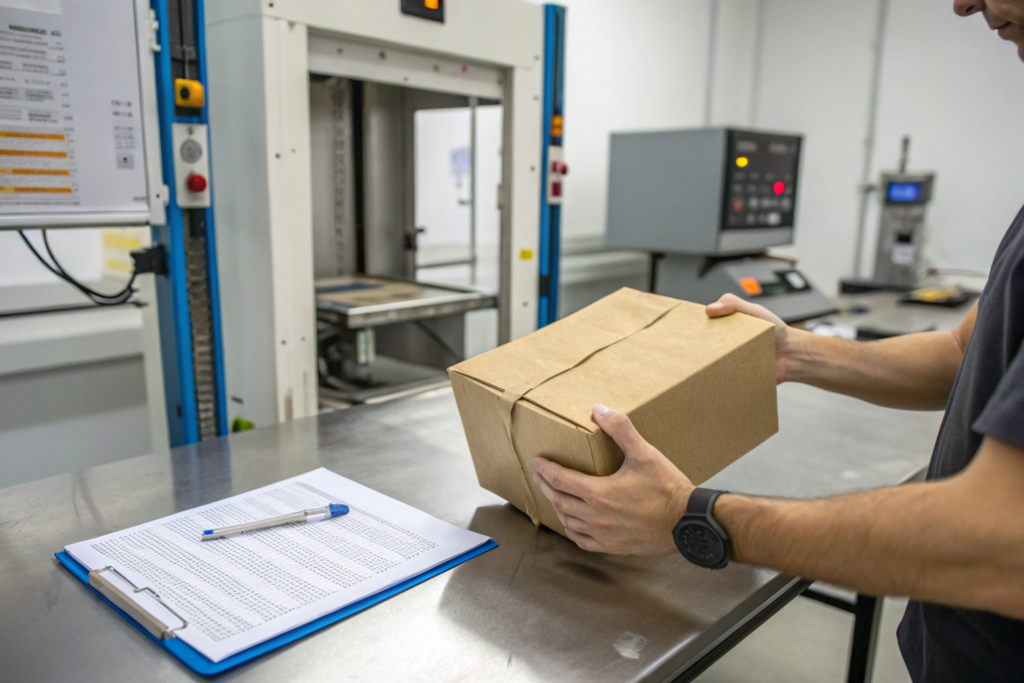
Yes, but it must be designed and tested with the specific properties of the eco-material in mind. Uncoated kraft paper absorbs moisture from humid air more readily than plastic-laminated paper, which can cause box panels to soften during a four-week ocean voyage through tropical latitudes. Biodegradable polybags may have slightly different tensile strength characteristics than standard polyethylene, requiring a marginally thicker gauge to achieve equivalent puncture resistance.
Our packaging team tests eco-friendly packaging using the same protocols we apply to conventional packaging. A packaged sample must survive a one-meter drop test onto concrete on each of its six faces, corners, and edges. It must survive a compression test simulating the weight of cartons stacked during container transit. For moisture-sensitive materials, we test packaging after conditioning the sample in a humidity chamber for 24 hours to simulate an ocean freight environment. If the eco-material fails any of these tests, we adjust the material thickness, the box structure, or the inner cushioning design until the packaged product meets our performance standard.
Put simply, we do not let a package leave our factory simply because it has a nice sustainability story attached. It must first prove it can do its primary job of delivering your product to your customer in retail-ready condition.
What Inner Cushioning Options Are Plastic-Free?
Once the outer packaging is sustainable, the inner cushioning becomes the next area to address. Traditional bubble wrap, foam peanuts, and plastic air pillows are some of the most visible and environmentally problematic packaging components for consumers unpacking an accessory order.
We have transitioned many clients to plastic-free inner cushioning options that perform equivalently in drop and vibration testing. Crinkled kraft paper shreds are a cost-effective filler for gift boxes and shipping cartons, adding a premium unboxing texture while securing the product in place. Corrugated cardboard inserts, die-cut to the exact shape of your hair clip or belt buckle, cradle the product and prevent shifting without any plastic. For fragile resin or ceramic accessories, molded pulp trays made from recycled newspaper provide shock absorption similar to foam inserts. These options are all curbside recyclable and made from recycled content, so the entire packaging package, from outer carton to inner cushion, can go into a single recycling stream without the consumer needing to separate mixed materials.
Your project manager can film a packaging test video for you showing the eco-packaging option with your product inside undergoing a drop test, so you see the performance evidence yourself before approving the new packaging specification for full production.
Conclusion
Eco-friendly packaging for your accessory brand is not a distant future capability that factories are still figuring out. It is a current, operational reality that we produce every day for clients whose retail accounts demand it and whose end consumers reward it with loyalty. The material options span biodegradable and compostable polybags, FSC-certified paper and cardboard across recycled and virgin fiber grades, plastic-free inner cushioning, natural fiber drawstring pouches, and soy-based printing inks. Each option carries different cost premiums, different certification credentials, and different performance characteristics during international shipping, and the right choice depends on your brand positioning, your sales channel, and your budget.
The transition to sustainable packaging works best when you approach it as a phased journey rather than a one-time overhaul. Start with the highest-impact, most visible packaging elements. Reduce unnecessary packaging layers. Test the new materials in real shipping conditions before scaling. Demand proper certifications, including FSC chain-of-custody numbers and compostable certification references, and verify those certifications independently. Ensure the eco-packaging passes the same durability tests as the conventional packaging it replaces, because a crushed sustainable box is still a returned product.
Your packaging is the first physical experience your customer has with your brand, and in an increasingly sustainability-conscious market, it is also a statement of your values.
If you are ready to explore eco-friendly packaging for your hair accessories, belts, scarves, hats, or gift items, I invite you to start the conversation with our team. Contact our Business Director Elaine at elaine@fumaoclothing.com and share your current packaging photos, your sustainability goals, and your target budget range. She can connect you with our packaging development specialist who will prepare a customized proposal showing material options, certification documentation, and a phased transition timeline tailored to your brand. Let us make your packaging something your customers feel good about keeping, not throwing away.




