You open the invoice from your customs broker. The bottom line shows a tariff charge of 25% on your latest shipment of hair clips and belts from China. That is $12,500 on a $50,000 order. Money that comes directly out of your profit. Money that makes you question whether importing from China is still viable. You start searching for factories in Vietnam or India, only to find their prices are higher and their quality control is less reliable. You feel trapped between a rock and a hard place. You need the quality and speed of Chinese manufacturing, but the tariff burden is crushing your margins.
You can reduce tariff costs on Chinese-made fashion accessories through four primary strategies: optimizing Harmonized Tariff Schedule classification, leveraging First Sale Rule valuation, restructuring packaging to reduce dutiable value, and utilizing Section 321 de minimis entry for small shipments.
I have been manufacturing fashion accessories in Zhejiang for many years. The tariff landscape changed dramatically with the Section 301 duties imposed in 2018 and 2019. Many of our product categories, including hair accessories, belts, and bags, were hit with additional tariffs. But we did not just accept this as a cost of doing business. We worked with our clients and their customs brokers to find legal, compliant ways to mitigate the impact. Let me share the strategies that are working right now for buyers like Ron.
How Does Correct HTS Classification Lower Your Tariff Bill?
The Harmonized Tariff Schedule or HTS of the United States is a massive document. It classifies every product imported into the country. Each classification has a corresponding duty rate. A single digit difference in the ten-digit HTS code can mean the difference between a 5% duty rate and a 25% duty rate. This is the lowest-hanging fruit for tariff reduction. It requires no change to your product. It requires no change to your supply chain. It only requires knowledge.
Many importers use a generic HTS code for their accessories. They classify a hair clip as "Other articles of plastic" or a belt as "Other articles of leather." These basket categories often carry higher duty rates than more specific classifications. A professional customs broker who specializes in fashion accessories will review your product line and identify the most favorable legally correct classification.
At Shanghai Fumao, we support this process by providing detailed product specification sheets. We state the exact material composition by weight. For a hair clip, we specify the percentage of plastic, metal, and fabric. For a belt, we specify the percentage of leather, polyurethane, and metal hardware. This information allows your broker to make a precise classification. This HTS code classification optimization for accessories can reduce your duty rate by several percentage points on every single shipment.

What Is the Difference Between Essential Character and De Minimis in HTS?
These are two legal principles that customs brokers use to argue for a lower duty rate. Understanding them helps you ask the right questions.
Essential character means the component that gives the article its primary function or identity. A hair clip with a plastic body and a small metal spring is classified based on the plastic body. The plastic provides the essential character of the clip. The duty rate for plastic articles applies, not the rate for metal articles. We can design products with this principle in mind. By ensuring the lower-duty material is the dominant material, we influence the classification.
De minimis means a component that is so small or insignificant that it does not affect classification. A small metal logo plate on a fabric headband is de minimis. The headband is classified as a textile article, not a metal article. The metal component does not change the duty rate.
I work with clients to review their designs with these principles in mind. A small change in material usage can shift the HTS classification to a more favorable chapter. This is essential character tariff classification strategy in action. It is completely legal and widely used by major importers.
Can Section 301 Tariffs Be Avoided Through Classification?
Section 301 tariffs are additional duties imposed specifically on products originating in China. They are separate from the normal duty rate. They apply to a specific list of HTS codes published by the United States Trade Representative.
If your product falls under an HTS code that is on the Section 301 list, you pay the additional tariff. If your product can be classified under a similar but different HTS code that is not on the list, you avoid the Section 301 tariff entirely. This is the most powerful incentive for careful classification.
For example, certain types of hair accessories made of specific materials might be classified under a heading that was excluded from Section 301. Certain types of belts with specific construction methods might qualify for an exclusion. The list of exclusions changes periodically. You need a customs broker who tracks these changes actively.
At Shanghai Fumao, we provide the product details necessary to evaluate exclusion eligibility. We cannot provide legal advice on classification, but we can provide the material breakdown and construction details that enable your broker to make the strongest case. This Section 301 tariff exclusion classification review is a service that pays for itself many times over.
How Does First Sale Rule Reduce the Dutiable Value of Accessories?
First Sale Rule is a US customs valuation principle that is legal, established, and surprisingly underutilized by small and medium importers. It allows you to pay duty based on the price the factory charged the trading company or intermediary, rather than the price you paid the intermediary. This lowers the declared value and therefore lowers the duty.
Here is how it works in practice. Many importers buy from a trading company or a sourcing agent. The factory sells the goods to the trading company for $2.00 per unit. The trading company sells the goods to you for $2.50 per unit. Normally, duty is calculated on the $2.50 price. Under First Sale Rule, duty is calculated on the $1.50 price. For a 25% duty rate, that is a savings of $0.125 per unit.
To use First Sale Rule, the transaction must be clearly documented. You need the factory invoice to the trading company. You need the trading company invoice to you. You need to prove that the goods were clearly destined for export to the United States at the time of the first sale. Your customs broker must file the entry using First Sale valuation. At AceAccessory, when we sell directly to US importers, we provide a clear invoice that supports First Sale valuation if a multi-tiered structure exists. We understand the documentation requirements and we cooperate fully with First Sale Rule duty valuation compliance requests.
What Documentation Is Required to Claim First Sale Rule?
Customs and Border Protection or CBP will audit First Sale entries. You must have a paper trail that proves the bona fides of the transaction. The required documents are specific.
You need the factory’s commercial invoice to the intermediary. This invoice must list the goods, the quantity, and the unit price. You need the intermediary’s purchase order to the factory. This confirms the order was placed. You need your purchase order to the intermediary. You need proof of payment from the intermediary to the factory and from you to the intermediary. You need shipping documents that show the goods moved directly from the factory to the port of export.
The most critical piece is proving that the goods were destined for the US at the time of the first sale. This is often shown by the factory packing list referencing the ultimate US destination or the factory invoice stating "Goods for export to USA." We at AceAccessory are familiar with these requirements. When a client requests First Sale documentation, we provide a complete package that meets CBP standards. This First Sale Rule required documentation checklist is essential for a successful claim.
Is First Sale Rule Applicable When Buying Directly from AceAccessory?
When you buy directly from our factory, there is no intermediary. The transaction is a single sale. First Sale Rule does not apply because there is only one sale.
However, the principle of accurate valuation still applies. The declared value for customs should be the price you actually paid us, excluding international freight and insurance. Some importers mistakenly include the cost of freight in the declared value. This is incorrect. Freight is not dutiable. Ensure your commercial invoice clearly separates the FOB value of the goods from the freight charges.
Also, ensure that any discounts or rebates are properly documented on the invoice. If we give you a 5% discount for early payment, the invoice should reflect the net price you actually paid. This is the correct dutiable value. We provide clear, detailed commercial invoices that make this direct import valuation and invoice accuracy straightforward for your customs broker.
How Can Packaging and Assembly Strategy Reduce Tariff Exposure?
The way a product is packaged and presented at the time of importation affects its tariff treatment. A fully finished, retail-ready gift set may be classified differently than the same components shipped separately. This strategy is sometimes called tariff engineering.
Consider a gift set containing a hair clip and a matching scarf. If imported as a set in a single gift box, the entire set is classified under the component that gives the set its essential character. This might be the scarf, which carries a higher textile duty rate. If the hair clip and scarf are imported separately in bulk packaging, each is classified under its own HTS code. The hair clip pays the lower plastic article rate. The scarf pays the textile rate. The total duty paid may be lower.
We work with clients to evaluate the duty implications of different packaging configurations. Sometimes, shifting the final assembly of a gift set to a US-based fulfillment center saves significantly on duties, even after accounting for the US labor cost. This tariff engineering through packaging and assembly strategy requires a detailed cost-benefit analysis, but the savings can be substantial.

Does Shipping Components Unassembled Reduce the Duty Rate?
For certain products, yes. An unassembled or unfinished article is often classified the same as the finished article if it has the essential character of the finished article. However, there are exceptions.
A belt buckle and a leather strap shipped separately are classified as a metal buckle and a leather strap. Their combined duty may be lower than the duty on a finished leather belt with a metal buckle. The labor to assemble the belt is performed in the US, not in China. This shifts value from dutiable Chinese labor to non-dutiable US labor.
We can provide the components in separate cartons with clear labeling. We can provide the assembly instructions. You manage the US assembly process. This is not practical for every product or every importer. It requires a US operation capable of assembly or a third-party logistics provider that offers light assembly services. But for high-volume, high-duty items, it is a strategy worth exploring. This unassembled component import tariff reduction strategy is a legitimate form of tariff engineering.
How Does Section 321 De Minimis Entry Work for Small Accessory Orders?
Section 321 of the Tariff Act allows goods valued at $800 or less per person per day to enter the United States duty-free. This is the de minimis exemption. It is the reason why small packages from China purchased online often arrive with no duty bill.
For a business importing commercial quantities, Section 321 can still be used strategically. If you are testing a new product with a small initial order of 500 units valued at $1,500 total, you might split the shipment. Ship 300 units one day and 200 units the next day. Each shipment is under $800. Both enter duty-free.
This strategy has limits. It requires careful coordination with your supplier and your freight forwarder. It increases shipping costs because you are paying for multiple shipments. It is not a long-term solution for bulk orders. But for sample orders, small test runs, or replenishment of fast-selling items, it is a perfectly legal way to avoid duties entirely. At AceAccessory, we can accommodate split shipment requests and provide the necessary documentation for Section 321 de minimis duty free entry compliance filings.
What Role Does the Country of Origin Marking Play in Tariff Costs?
The country of origin marking is a mandatory requirement for almost all imported goods. It must be legible, permanent, and conspicuous. A missing or incorrect origin marking can result in a fine or a customs hold. It does not directly affect the duty rate, but it affects the cost of compliance failures.
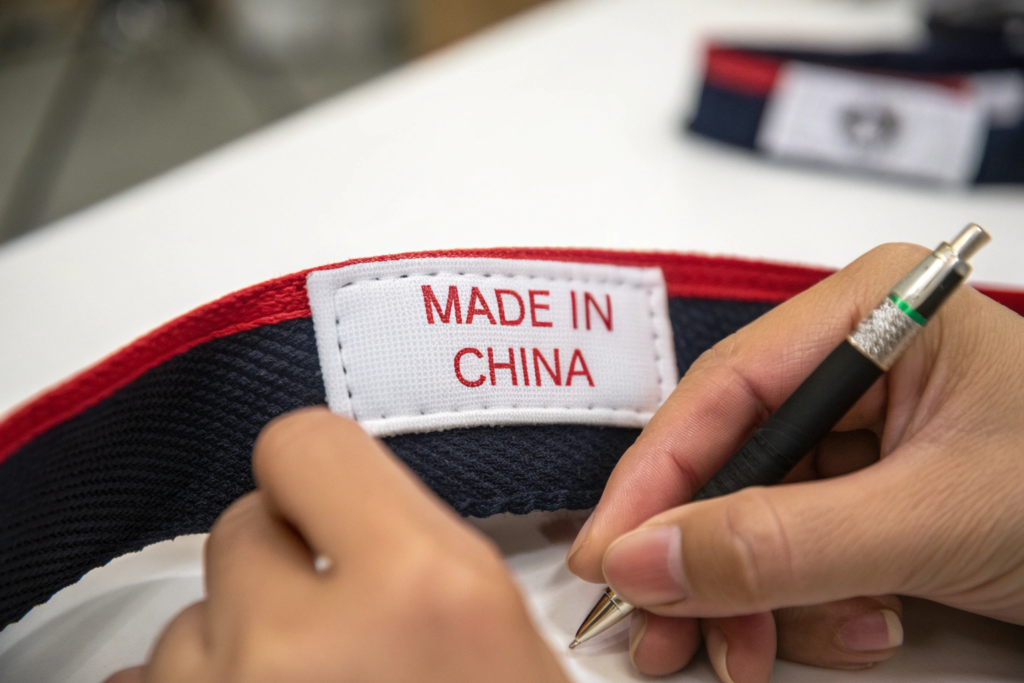
More importantly, the country of origin is what triggers the application of Section 301 tariffs. If the goods are marked "Made in China," they are subject to Section 301 if the HTS code is on the list. This is a fact. It cannot be changed by marking the goods differently. Marking a Chinese-made belt as "Made in Vietnam" is customs fraud. It carries severe penalties.
However, the origin marking requirement does create an opportunity for duty savings on US labor. If a product is further processed in the US, the country of origin may change. A Chinese-made blank tote bag that is screen printed with a design in the US may become a product of the US for marking purposes. The duty is still paid on the imported blank bag, but the value added in the US is not subject to Chinese tariffs. We can provide the blank bags. You add the value in the US. This country of origin marking and substantial transformation rules is a complex area of customs law, but it offers opportunities for importers who are willing to invest in US-based finishing operations.
Can a Factory in China Help with Duty Drawback Programs?
Duty drawback is a program that allows importers to recover 99% of the duties paid on imported goods that are subsequently exported or destroyed. If you import headbands from China, pay the duty, and then ship those same headbands to a customer in Canada, you can claim a refund of the duties paid.
The factory in China does not administer this program. It is a US Customs program. However, the factory plays a supporting role by providing accurate documentation. The import entry must match the export documentation. The HTS code on the way in must match the HTS code on the way out. The quantities must reconcile.
At AceAccessory, we provide detailed commercial invoices and packing lists that make duty drawback reconciliation easier. We understand that our clients may be re-exporting our products. We maintain consistent product codes and descriptions to support their drawback claims. This duty drawback program documentation support is another way we add value beyond just manufacturing the product.
What Is the Impact of US Tariffs on AceAccessory’s Pricing Strategy?
I want to be direct about this. We do not absorb the US tariffs. The tariffs are a tax imposed by the US government on US importers. They are not a cost of manufacturing in China. They are a cost of importing into the United States.
However, we recognize that the total landed cost is what matters to our clients. We work aggressively to control the costs that we can control. Our raw material sourcing is efficient. Our labor productivity is high. Our factory overhead is managed carefully. We keep our FOB prices as competitive as possible to help offset the tariff burden.
We also provide the value-added services described in this article. Accurate HTS classification support. First Sale documentation. Flexible packaging and component shipping. These services do not eliminate the tariff, but they help reduce it. Our goal is to make the total landed cost from AceAccessory competitive with alternative sourcing options, even after accounting for the Section 301 duties. This supplier pricing strategy in high tariff environment is focused on total value, not just the unit price.
Conclusion
Reducing tariff costs on Chinese-made fashion accessories is not about finding a magic loophole. It is about applying a disciplined, multi-faceted strategy that addresses classification, valuation, packaging, and entry methods. The savings are real. An importer who optimizes their HTS classification, uses First Sale Rule where applicable, and structures their packaging intelligently can reduce their total duty bill by ten to thirty percent or more.
These strategies require effort. They require a knowledgeable customs broker. They require a factory partner who understands the documentation requirements and is willing to cooperate. Not every factory in China is willing to provide the detailed material breakdowns or the First Sale documentation. They see it as extra work with no benefit to them. At Shanghai Fumao, we see it differently. We see it as part of our commitment to being a true partner to our US clients. Your success in managing your landed cost is our success in retaining your business.
The tariff landscape will continue to evolve. New exclusions may be granted. New trade agreements may be negotiated. What does not change is the need for careful attention to detail in every aspect of the import process. The importers who manage these details effectively will maintain healthy margins and grow their businesses. The importers who ignore them will see their profits eroded by unnecessary tariff payments.
If you are importing hair accessories, belts, hats, scarves, or other fashion items from China and want to explore strategies to reduce your tariff exposure, I invite you to contact our Business Director, Elaine. She can provide the product specifications and documentation you need to work with your customs broker on a tariff reduction plan. You can email Elaine at: elaine@fumaoclothing.com. Let us help you keep more of your margin in a challenging trade environment.