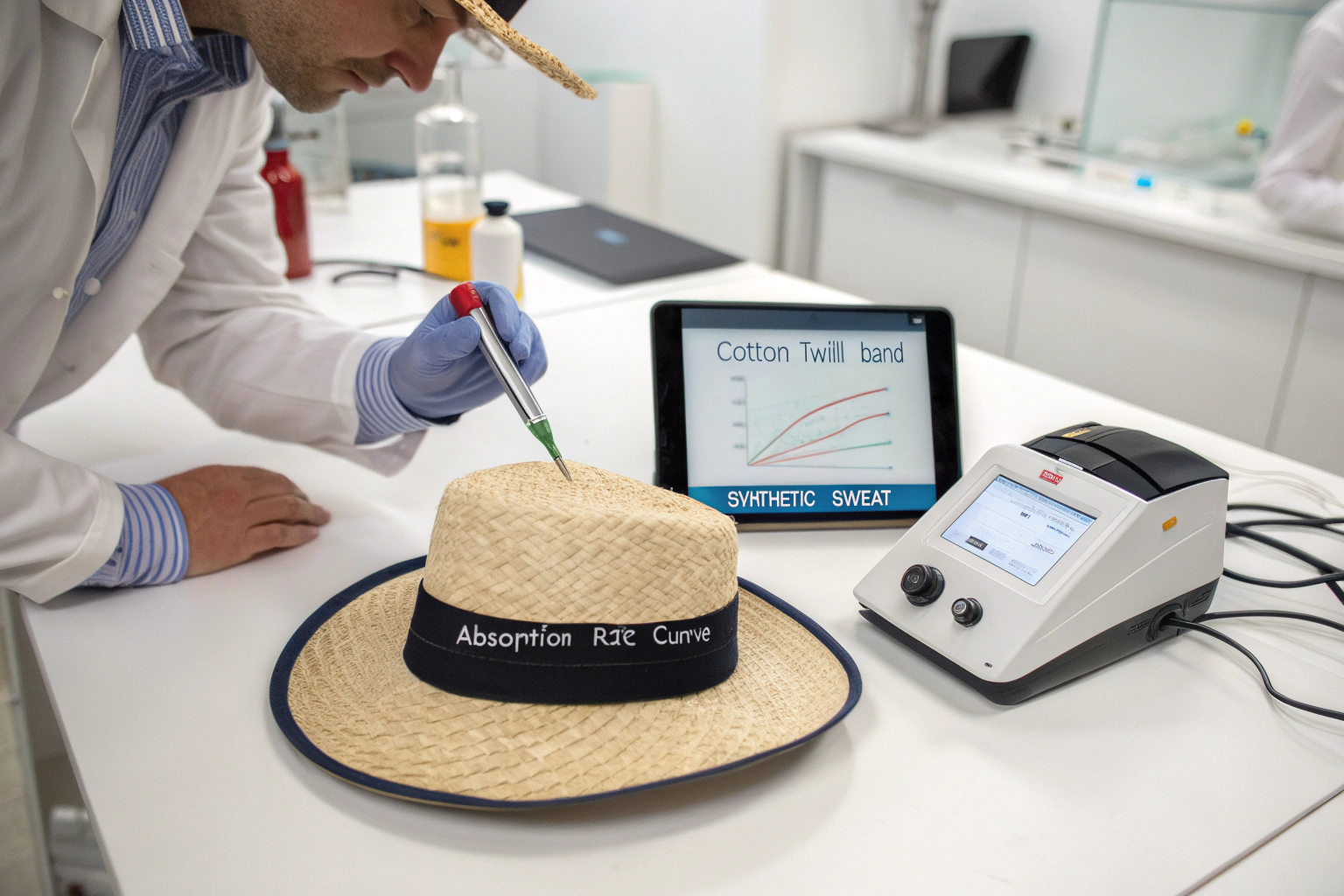
I remember a hotel chain’s purchasing manager emailing me a photograph of one of our resort hats. The straw was perfect, the ribbon was crisp, but the sweatband was stained with a dark, damp ring that had seeped through to the front of the crown. The guest had worn the hat on a hot, humid beach, and the sweatband had simply saturated and transferred the moisture directly to the straw. That photograph was embarrassing. It was also a gift. It forced us to rethink sweatbands not as a hidden strip of fabric, but as a critical performance component that could ruin the entire hat experience.
You get a Chinese straw hat factory to provide a sweatband moisture absorption test by requesting a specific, measurable test protocol rather than a vague promise of quality. You specify the test standard, such as AATCC 79 for absorbency, the test method—a timed drop test or a wicking test—and the minimum acceptable performance threshold. You ask for this data as part of the pre-production sample approval or the final inspection report, making it a contractual deliverable rather than a favor.
At our factory in Zhejiang, we have integrated sweatband moisture testing into our standard quality control process. I want to explain the specific tests available, how to specify the test in language a factory understands, and what sweatband material choices you can make to prevent the dreaded sweat stain on your next order.
What Is a Sweatband Moisture Absorption Test and Why Does It Matter?
A sweatband moisture absorption test measures two things: how quickly the sweatband fabric absorbs liquid from the skin, and how much liquid it can hold before it becomes saturated. These are not the same thing. A cotton sweatband may absorb sweat quickly but reach saturation within an hour of wear in hot weather. Once saturated, it can no longer hold more sweat, and the excess wicks directly into the straw body of the hat, causing discoloration, staining, and fiber degradation.
The test matters because the sweatband is the barrier between the wearer’s skin and the hat. If it fails, the hat fails. The customer sees an ugly stain, feels a damp, uncomfortable band against their forehead, and blames the hat—not the sweatband. For resort, golf, and outdoor brands, sweatband performance is a warranty issue and a brand reputation issue.
What is the difference between a drop test and a wicking test for absorbency?
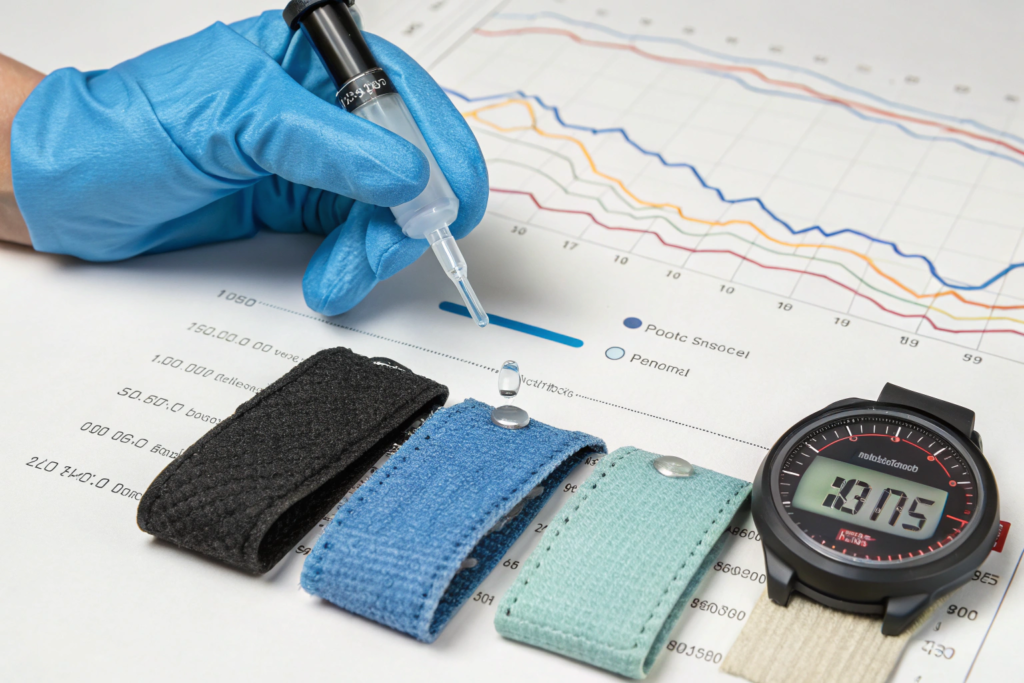
A drop test, such as the AATCC 79 Bleeding Test, is the simplest and most common absorbency test. A single drop of distilled water is placed on the surface of the sweatband fabric from a fixed height using a standardized dropper. A stopwatch measures the time it takes for the droplet to fully absorb and lose its reflective sheen. This test measures the surface absorbency speed. A wicking test, such as AATCC 197, measures vertical wicking. A strip of the sweatband fabric is suspended vertically with its lower end submerged in water. The height the water travels up the strip over a specified time is measured. This test measures the fabric’s ability to transport moisture away from the skin. Both tests provide useful data. The drop test is faster and easier for a factory QC lab to perform. The wicking test provides more complete performance data. This AATCC 79 absorbency test standard is the industry reference.
How does saturation point cause long-term damage to the straw crown?
When a sweatband reaches its saturation point, it can hold no more liquid. Additional sweat is expelled from the back of the sweatband directly into the straw of the crown. The straw, being cellulose, absorbs this salty, acidic moisture. The salt crystals abrade the fibers. The moisture causes the fibers to swell and the stiffening agent to soften. Over repeated wear-saturation cycles, the front of the straw crown above the sweatband develops a permanent dark stain and becomes structurally weakened. The hat sags in that area. This is a classic failure mode of resort hats that are worn daily in humid conditions. A high-absorption, high-capacity sweatband delays the onset of saturation and protects the straw.
How Should You Specify the Test to the Factory?
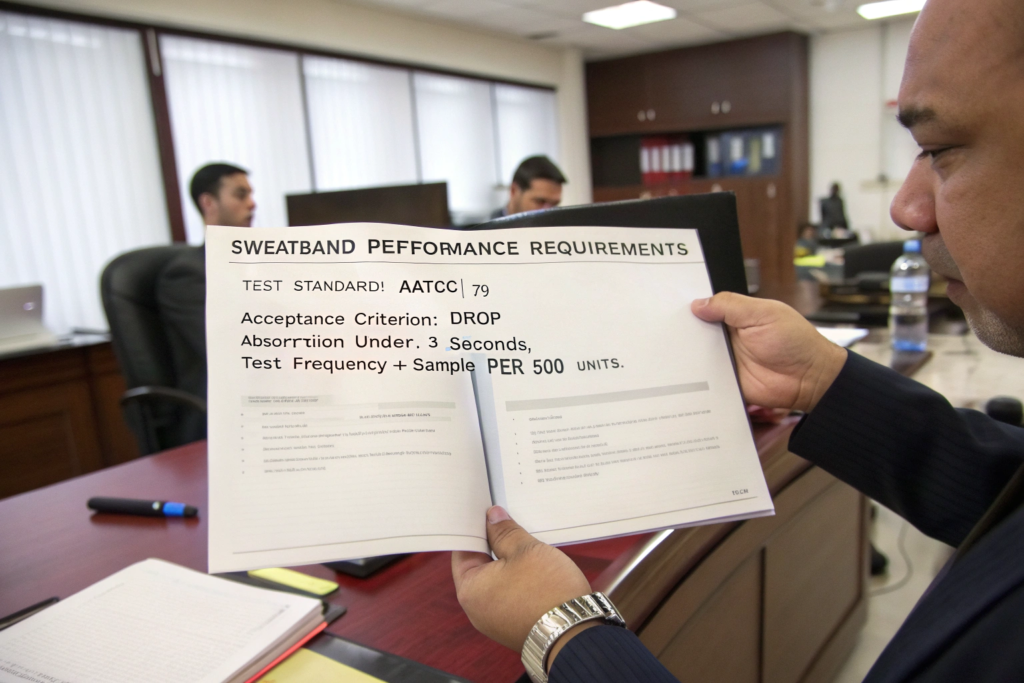
The most common reason a factory fails to provide the sweatband test data you want is that you did not ask for it in a language the factory understands. A request like "make sure the sweatband absorbs sweat" is an aspiration. A request like "conduct AATCC 79 drop test on the sweatband material and provide a test report showing absorption time of less than 3 seconds" is a specification. The factory knows exactly what to do, how to do it, and how to prove they did it.
The specification should be included in the product tech pack or the purchase order attachment. It should name the test standard, the test method, the acceptance criterion, and the sampling frequency. It should also specify the documentation: a one-page test report with a photo of the test in progress and the measured result. This documentation becomes part of the shipment approval package.
What is the standard language for requesting an AATCC 79 drop test?
The precise language you can copy into a tech pack or email is: "Sweatband absorbency shall be tested according to AATCC 79, Absorbency of Textiles. A single drop of distilled water shall be placed on the surface of the sweatband fabric from a height of 10mm. The time for the water droplet to fully absorb and lose its reflective surface shall be recorded. The absorption time shall not exceed 3.0 seconds. The test shall be performed on a random sample of 5 sweatbands per 1,000 units. A test report with photographic evidence shall be included with the final inspection documents." This language is unambiguous and legally binding when included in the purchase order.
How do you ask for a "maximum saturation capacity" measurement?
The drop test measures speed, not capacity. To measure capacity, request a "gravimetric absorption capacity test." The language is: "A 50mm x 50mm swatch of the sweatband fabric shall be weighed dry, then submerged in distilled water at 20 degrees Celsius for 60 seconds, removed, allowed to drip for 30 seconds, and reweighed. The absorption capacity shall be calculated as (wet weight – dry weight) divided by dry weight, expressed as a percentage. The minimum acceptable absorption capacity is 300% (the fabric absorbs at least three times its own weight in water)." This test provides the saturation data that the drop test misses. This gravimetric water absorption test is a standard method.
What Sweatband Material Choices Improve Moisture Performance?
The test verifies performance. The material determines performance. The best testing protocol in the world will not turn a non-absorbent foam-backed polyester sweatband into a moisture-wicking performance fabric. If your hats are destined for hot, humid climates or active outdoor use, the sweatband material itself must be upgraded.
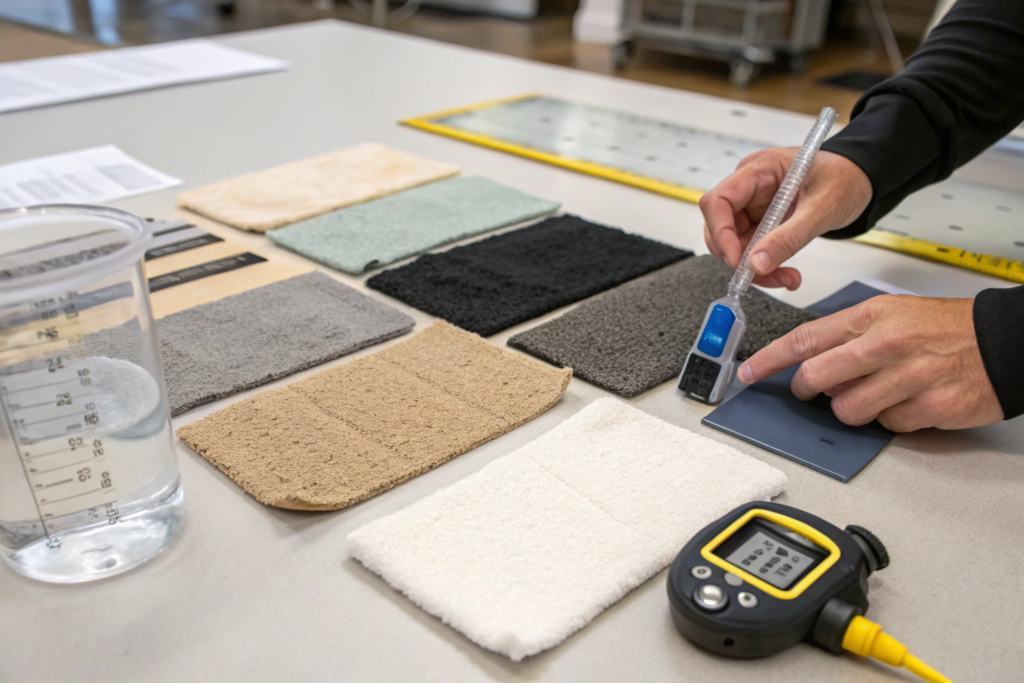
The four common sweatband materials, ranked from least to most moisture-absorbent, are: standard foam-backed polyester, which is cheap, comfortable, and essentially non-absorbent; standard cotton twill, which absorbs moisture but saturates quickly and dries slowly; cotton terry or velour, which has a looped pile that provides high surface area and excellent initial absorption; and engineered moisture-wicking microfiber, which combines rapid absorption with fast drying and high saturation capacity. Bamboo charcoal fabric offers a natural alternative with inherent antimicrobial properties.
Why does cotton terry outperform standard cotton twill for resort hats?
Cotton terry has a looped, uncut pile surface. These loops dramatically increase the surface area of the fabric that is in contact with the skin. More surface area means faster initial sweat absorption. The loops also create air pockets that hold moisture away from the skin, keeping the forehead feeling drier. Standard cotton twill is a flat weave. It has less surface area, absorbs more slowly, and feels wet and clammy against the skin once saturated. For a resort hat that will be worn on a sweaty beach or golf course, upgrading from twill to terry or velour significantly improves the wearer’s comfort and protects the straw crown from saturation damage. This terry versus twill absorbency comparison explains the structural difference.
What is the advantage of a dual-layer sweatband with a moisture barrier?
For the ultimate in straw hat protection, we offer a dual-layer sweatband construction. The inner layer, against the skin, is an absorbent terry or microfiber. The outer layer, against the straw, is a thin, waterproof polyurethane membrane. This membrane allows sweat vapor to pass through but blocks liquid water. The inner layer absorbs the sweat and wicks it to the surface, where it evaporates. The outer barrier prevents any liquid sweat from reaching the straw. This dual-layer system adds a modest cost but provides complete protection against the sweat staining and saturation damage that plague single-layer sweatbands. It is standard on premium outdoor and golf hats. This waterproof breathable membrane technology is adapted from performance outerwear.
How Can You Verify the Test Was Performed Before Shipment?
Requesting a test is one thing. Ensuring the test was actually performed and the results meet your specification is another. The verification mechanism must be built into the pre-shipment inspection process and the documentation package that the factory provides before the balance payment is released.
The most reliable verification method is to require a video of the test being performed on a sample pulled from your actual production lot. A paper test report can be fabricated. A video showing a water droplet being placed on your specific sweatband material, with a visible timer and a lot number tag in the frame, is much harder to fake. This video should be included in the final inspection document package, along with the written test results. For high-value orders, you can also request that your third-party inspection service perform the drop test as part of their on-site final random inspection.

How can a third-party inspector verify the sweatband test on-site?
If you hire a third-party inspection company like SGS, Intertek, or Bureau Veritas, you can add the AATCC 79 drop test to the inspection checklist. The inspector brings a standardized dropper, a stopwatch, and distilled water to the factory. They pull the sweatband samples from the finished goods at random, perform the test on-site, and record the results with photographs and video in the inspection report. This provides independent, objective verification that the sweatband meets your specification. The cost of adding this specific test to a standard final inspection is modest. This third-party garment and accessory inspection service is widely available.
What should a sweatband test video include to be credible?
A credible test video should be a single, uncut shot that includes the following: a clear view of the lot number or carton markings identifying the production batch, the removal of a sweatband sample from a finished hat, the placement of the sweatband on a flat surface, the pipetting of a single water drop from a height of approximately 10mm, a stopwatch running in the frame capturing the absorption time, and a final close-up of the sweatband surface showing the water fully absorbed. The video file name should include the purchase order number and the date. This protocol eliminates the possibility of a staged or recycled video.
Conclusion
Getting a Chinese straw hat factory to provide a sweatband moisture absorption test is not a matter of building a new relationship or finding a more specialized supplier. It is a matter of writing a clear, specific, measurable test requirement into your purchase order. The AATCC 79 drop test is simple, fast, and within the capabilities of any factory with a basic QC department. The key is to specify the test standard, the acceptance criterion, and the documentation requirement in language the factory can execute.
We have explored the difference between absorbency speed and saturation capacity, the specification language that leaves no room for interpretation, the material upgrades that improve sweatband performance at the design stage, and the verification methods that ensure the test was actually done on your production lot.
If you are sourcing straw hats and want to include sweatband moisture absorption testing in your quality control protocol, we can provide our standard test report template, a sample video, and a material swatch card of our performance sweatband options. Our Business Director Elaine manages our straw hat and headwear quality programs. Contact her directly at elaine@fumaoclothing.com. A hat that protects the wearer from the sun should also protect itself from the wearer’s sweat.