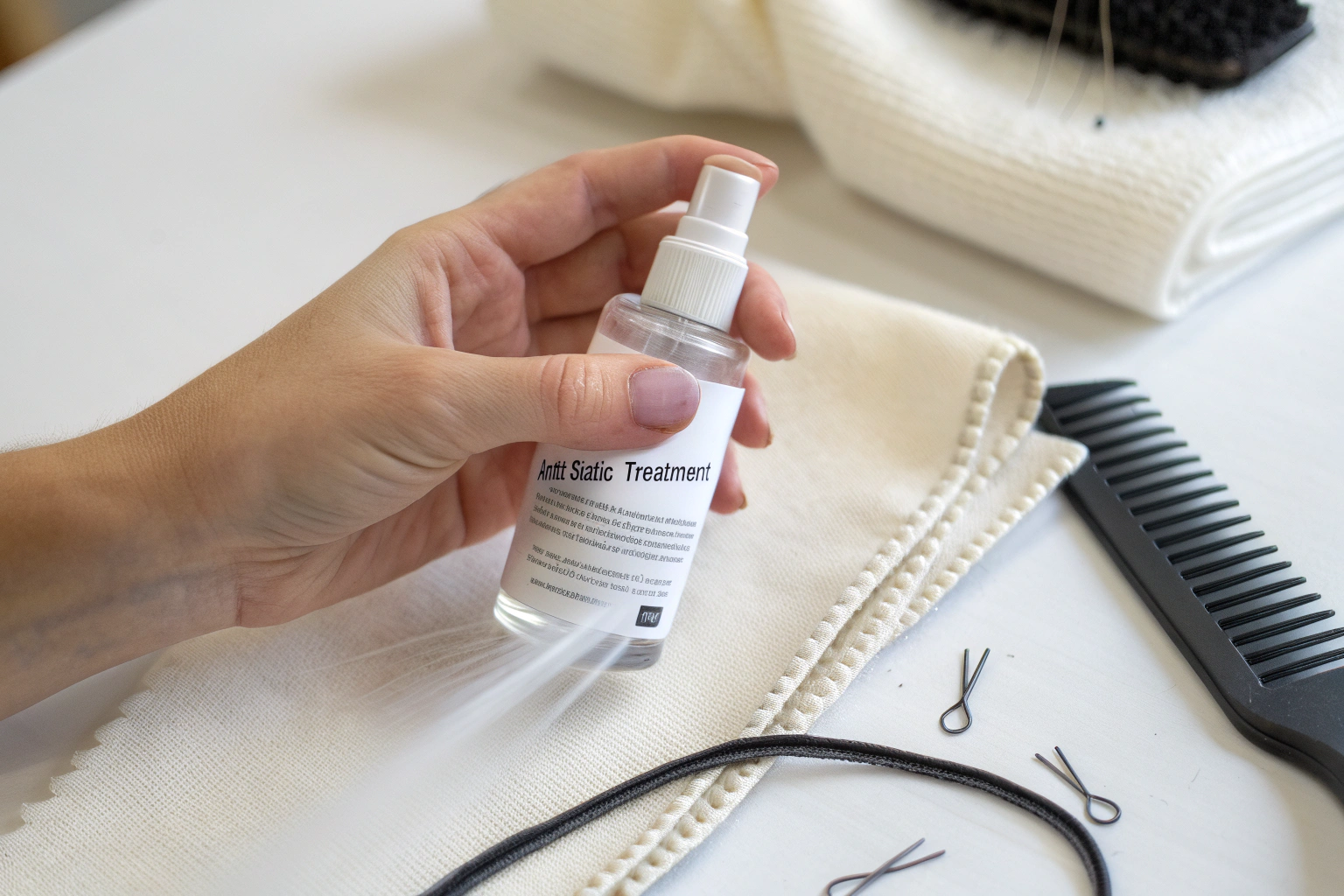
I received an urgent email from a client last winter. She ran a popular online boutique selling colorful, chunky hair bands and cute barrettes. Her customers loved the designs. But her reviews were getting hammered. One review read: "This hair band is adorable, but it makes my hair stand straight up like I rubbed a balloon on my head!" Another said: "Static city! Unwearable in dry weather." She was losing sales because of a problem she could not see or touch. The synthetic fibers in her accessories were generating static electricity. It was ruining the user experience. She asked me, "What can we do to the product to stop this?" The answer was not simple, but it was solvable.
The best anti-static treatments for synthetic hair accessories involve a multi-layered approach combining internal fiber treatments during manufacturing, topical finishing sprays applied post-production, and strategic material selection. Synthetic fibers like polyester, acrylic, and nylon are inherently hydrophobic, meaning they do not absorb moisture from the air. This causes them to build up and hold an electrical charge. Effective treatments counteract this by either adding conductive properties to the fiber surface, attracting microscopic moisture to dissipate the charge, or physically preventing the friction that causes the charge in the first place.
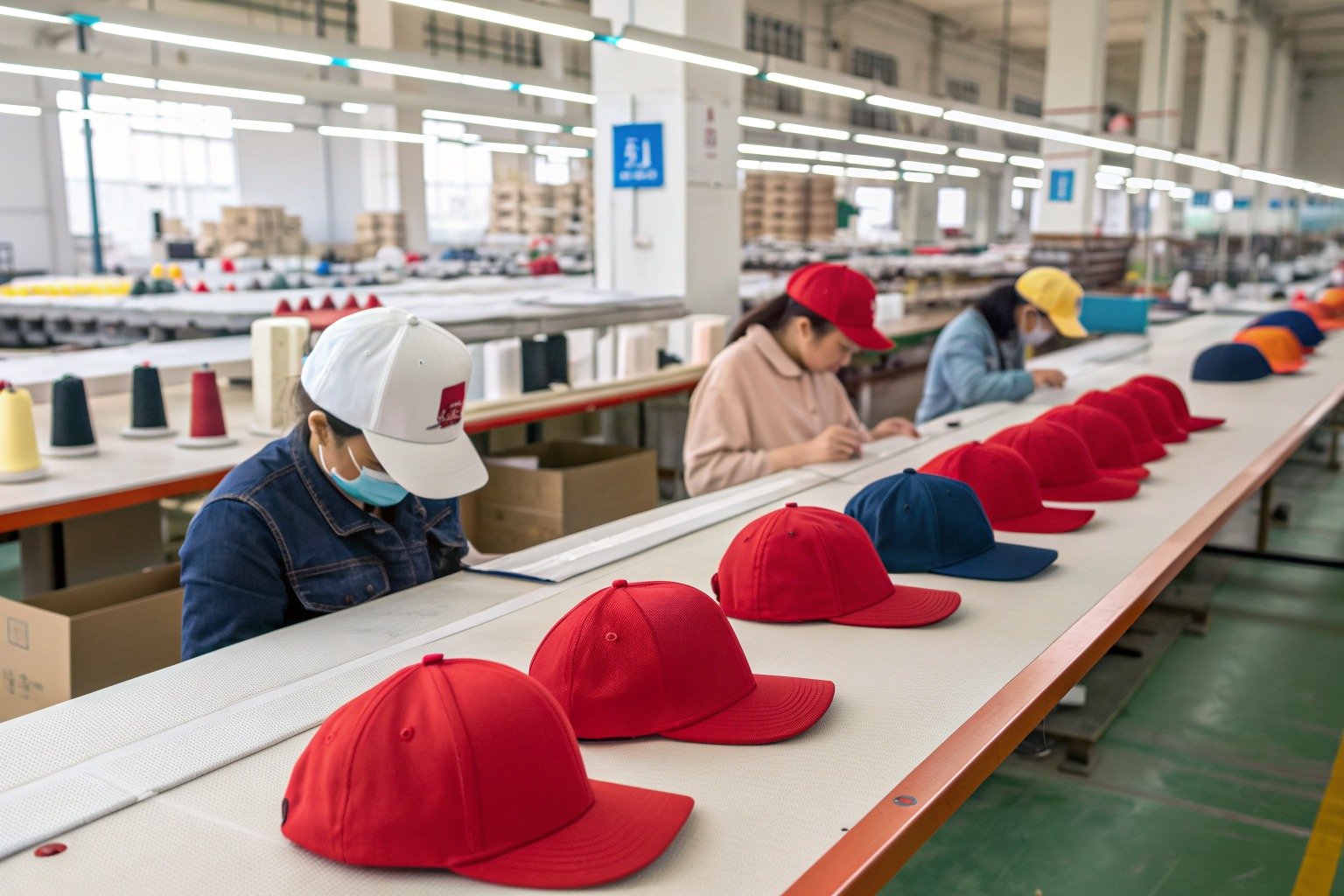
At Shanghai Fumao, we produce thousands of synthetic hair bands, scrunchies, and clips every month. We have dealt with static issues across every type of synthetic material. I want to share the exact methods we use to ensure our clients’ products perform well, even in the dry winter months of North America and Europe. This is a technical detail that separates a professional manufacturer from a generic supplier.
Why Do Synthetic Hair Accessories Generate So Much Static?
To fix a problem, you have to understand it. Static electricity is not magic. It is physics. When two different materials rub together and then separate, electrons move from one surface to the other. One material becomes positively charged. The other becomes negatively charged. This is the triboelectric effect.
Synthetic fibers are prime static generators because they are excellent electrical insulators. Unlike natural fibers like cotton or human hair, which contain moisture and can conduct electricity away, synthetics like polyester and acrylic trap the charge on their surface. When a customer pulls a polyester hair band through their dry hair, the friction transfers electrons. The hair band holds the charge. The customer’s hair then repels itself or clings to the band. The result is flyaways and frustration.
How Does The Triboelectric Series Affect Hair Accessory Design?
Materials can be ranked by their tendency to gain or lose electrons. This ranking is called the Triboelectric Series. Understanding this series is critical for designing anti-static products.
Here is a simplified version of the series relevant to accessories:
| Material Tendency | Material Example | Charge |
|---|---|---|
| Positive (+) | Human Hair (Dry) | Gives up electrons easily |
| Wool | ||
| Nylon | ||
| Silk | ||
| Neutral | Cotton | Minimal charge transfer |
| Paper | ||
| Negative (-) | Polyester | Takes electrons easily |
| Acrylic | ||
| Polyurethane (Spandex) | ||
| Polyethylene (Plastic) | ||
| PVC |
Look at the position of Human Hair (Positive) and Polyester (Negative). They are far apart on the series. This means when a polyester hair band rubs against dry human hair, a large transfer of electrons occurs. The polyester becomes strongly negative. The hair becomes strongly positive. This is the worst-case scenario for static.
Now look at Nylon and Cotton. Nylon is closer to Human Hair on the series. The charge transfer is less intense. Cotton is neutral and acts as a buffer.
This is why a 100% polyester hair band is a static nightmare. A nylon-spandex blend might be slightly better. A cotton-covered elastic band is usually static-free. When we develop products, we use this scientific framework to predict and mitigate static issues before we even cut the fabric. For example, if a client wants a shiny, satin look (which is usually polyester), we know we must incorporate a specific anti-static treatment because the material is inherently problematic.
What Role Does Ambient Humidity Play In The Problem?
You have probably noticed that static is much worse in the winter. This is not a coincidence. Water is a conductor of electricity. Even the tiny amount of moisture vapor in the air (humidity) can help dissipate a static charge.
In the summer, the air is humid. A thin, invisible layer of water molecules settles on the surface of the hair band. This layer provides a path for the electrical charge to leak away into the air before it builds up to a noticeable level.
In the winter, indoor heating systems dry out the air. The relative humidity drops below 30%. The surface of the synthetic fiber is bone dry. There is no conductive path. The charge builds up and stays there until it discharges with a spark or makes your hair stand up.
For our clients selling in North America and Northern Europe, this is a critical consideration. A hair band that performs perfectly in our factory in humid Zhejiang might fail miserably in a heated home in Minnesota in January. We have to design for the worst-case environment. That means building in anti-static protection that works even when the humidity is near zero.
What Chemical Anti-Static Agents Are Applied During Manufacturing?
The most durable and effective way to fight static is to treat the material at the fiber level. This is done during the yarn spinning or fabric finishing process. We do not just spray something on the finished hair band. We start with yarn that has already been engineered to be anti-static.
Chemical anti-static agents applied during manufacturing are typically surfactants that migrate to the surface of the synthetic fiber. These molecules have a hydrophilic (water-loving) head and a lipophilic (fat-loving) tail. The tail anchors into the polyester or acrylic fiber. The head attracts microscopic moisture from the air, creating a conductive pathway on the fiber surface that continuously bleeds off static charges. This internal treatment provides a durable, wash-resistant level of protection.
What Are Quaternary Ammonium Compounds And How Do They Work?
This is the most common class of durable anti-static agents used in the textile industry. You will often see them referred to as Quaternary Ammonium Salts or "Quats."
Here is the technical explanation in simple terms: Polyester is like a plastic rod. It wants to hold onto electrons. A Quat molecule is like a two-sided piece of tape. One side is oily and sticks really well to the plastic (polyester). The other side is electrically conductive and loves water.
When the yarn is treated in a bath of Quat solution, the molecules arrange themselves on the surface of the fiber. The oily side points inward toward the polyester. The water-loving side points outward toward the air. Even in dry air, this outward-facing layer retains a tiny amount of bound moisture. This moisture is just enough to allow electrons to flow along the surface of the fiber and dissipate harmlessly into the air.
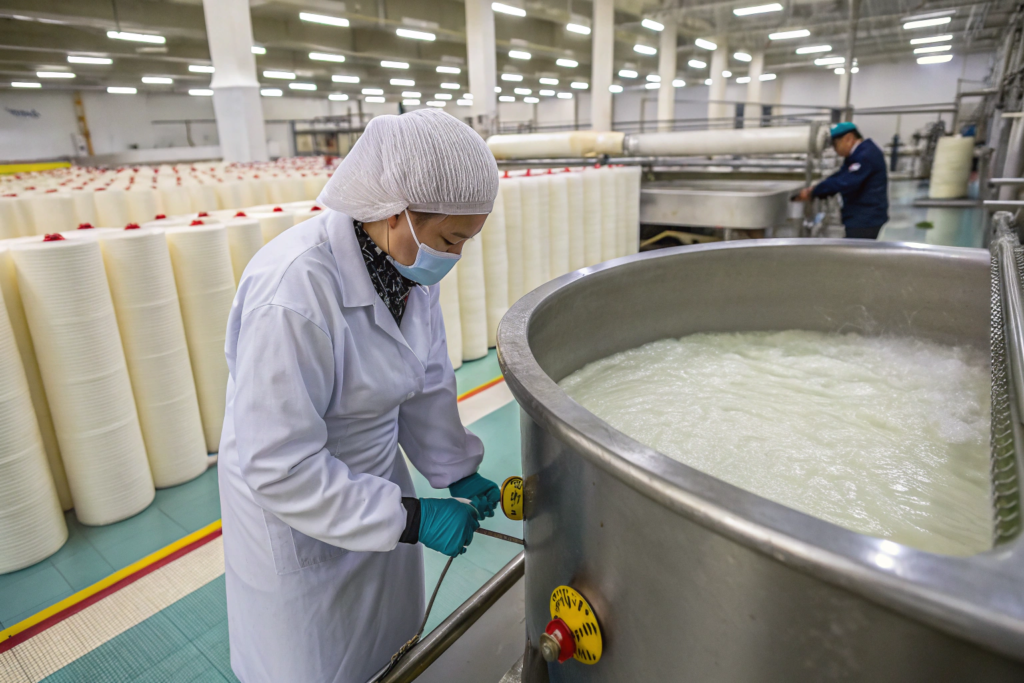
This treatment is applied during the dyeing and finishing stage. The fabric or yarn is run through a foulard or padding mangle—machines that squeeze the chemical solution deep into the material. The fabric is then dried and heat-set. The heat cures the finish, making it bond permanently to the fiber.
The benefit of this internal treatment is longevity. It will survive multiple washes. A hair band made with Quat-treated polyester will still perform well after being worn in the rain or washed in the sink. This is the gold standard for anti-static performance.
What Are Ethoxylated Fatty Amines And Polyglycol Esters?
These are alternative chemistries that are often used in textile softeners and anti-static finishes. While Quats are excellent for durability, these other agents are often used to provide a softer hand feel alongside static protection.
- Ethoxylated Fatty Amines: These are very effective at reducing friction between fibers. Less friction means less static generation. They also provide a soft, slick feel to the yarn.
- Polyglycol Esters: These are often used in combination with other treatments. They act as humectants, meaning they actively pull moisture from the air. They are less durable than Quats but provide a very powerful initial static reduction.
We often specify yarns that use a blend of these agents. The goal is to achieve a balance of properties: low static, soft touch, and bright color retention. Some strong anti-static agents can interfere with dye uptake. A skilled textile chemist knows how to formulate a finish that gives us the anti-static performance we need without dulling the vibrant colors our fashion clients demand.
When we source yarn for a client’s project, we communicate with the yarn supplier about the end use. We say, "This yarn is for hair bands. It needs excellent anti-static performance for the US market." The supplier then adjusts the finishing recipe accordingly. This is a level of detail that a generic trading company cannot provide.
What Topical Sprays And Rinse Treatments Can Be Applied To Finished Goods?
Sometimes, the yarn available in the market does not have the level of internal treatment we need. Or a client has a very specific color requirement, and that dyed yarn loses some of its anti-static properties during the dyeing process. In these cases, we apply a post-production topical treatment. This is done to the finished hair accessory before it is packaged.
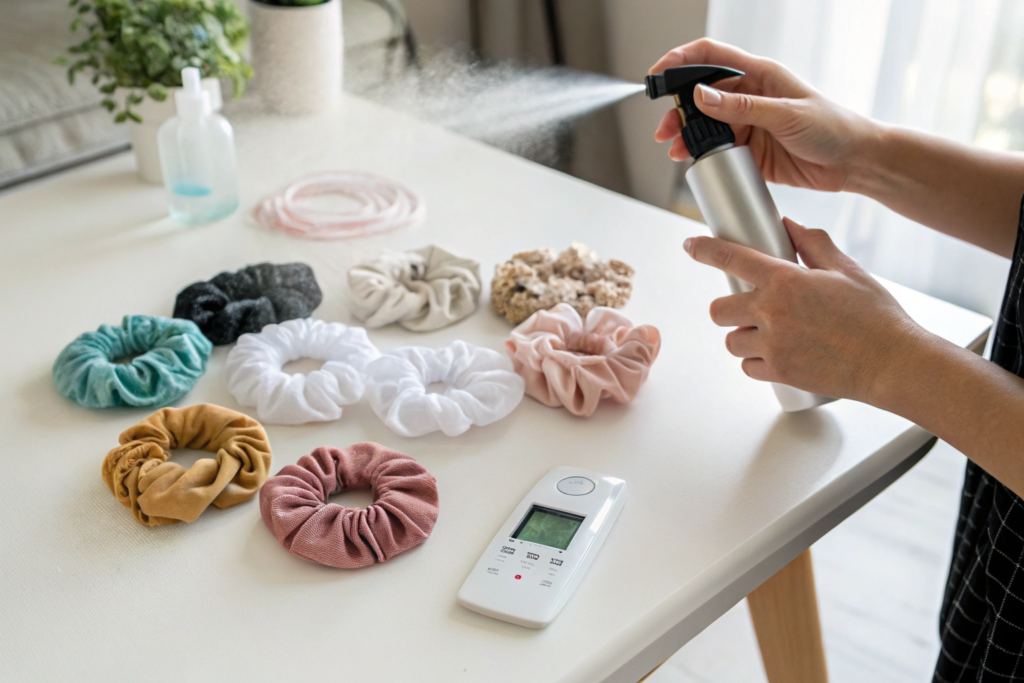
Topical anti-static treatments are water-based or alcohol-based solutions sprayed or rinsed onto the finished product. These solutions deposit a thin layer of conductive surfactant onto the surface of the accessory. While less durable than internal fiber treatments, topical applications are highly effective immediately and are ideal for providing a "just-opened" static-free experience for the end consumer. They are also essential for treating mixed-material items where the internal yarn treatment is not uniform across all components.
What Are The Most Effective Ingredients In Commercial Anti-Static Sprays?
If you have ever used a product like Static Guard on your clothes, you have used a topical anti-static spray. The active ingredients in these commercial products are remarkably similar to the industrial treatments we use.
The primary active ingredient is usually a Quaternary Ammonium Compound (the same as the internal treatment) or a Fatty Amine derivative dissolved in a solvent.
The key to effective application is even coverage and proper drying. If you spray too much, the accessory feels damp or sticky. If you spray too little, the effect is spotty.
In our factory, we use a misting system in a controlled environment. We lay out the finished hair bands on mesh trays. They pass under a fine mist nozzle that applies a micro-thin layer of the solution. The trays then pass through a low-temperature drying tunnel. This evaporates the solvent (usually water or isopropyl alcohol) and leaves behind only the active anti-static agent on the surface of the fibers.
This process adds a few cents to the cost per unit. But it provides immediate, tangible quality that the customer feels when they open the package. It eliminates that annoying "static cling" right out of the box. For e-commerce brands, this is crucial. The first impression is everything.
How Can Brands Maintain Anti-Static Properties After Purchase?
We cannot control what happens to the hair band after it leaves our factory. But we can educate the client and the end consumer. If a customer washes a polyester hair band with harsh detergent, they might strip off some of the topical treatment. Over time, static can return.
There is a simple, consumer-friendly solution that works incredibly well: Glycerin and Water.
Glycerin is a humectant. It is safe, non-toxic, and used in cosmetics. A homemade spray of one part glycerin to ten parts water, lightly misted on a hair accessory, will dramatically reduce static. The glycerin attracts moisture and does not evaporate quickly.
We sometimes include a small care card in the packaging for our clients’ brands. The card might say: "To keep your accessory static-free, lightly mist with water or store with a dryer sheet." This small touch adds value and reduces returns. It shows that the brand (and by extension, the factory) cares about the long-term performance of the product.
What Material Choices Naturally Reduce Static Without Chemicals?
The best way to solve a problem is sometimes to avoid it entirely. If a client is extremely sensitive to static issues, we guide them away from 100% polyester and toward alternative materials. There are several excellent options that offer the vibrant colors and durability of synthetics but with significantly lower static potential.
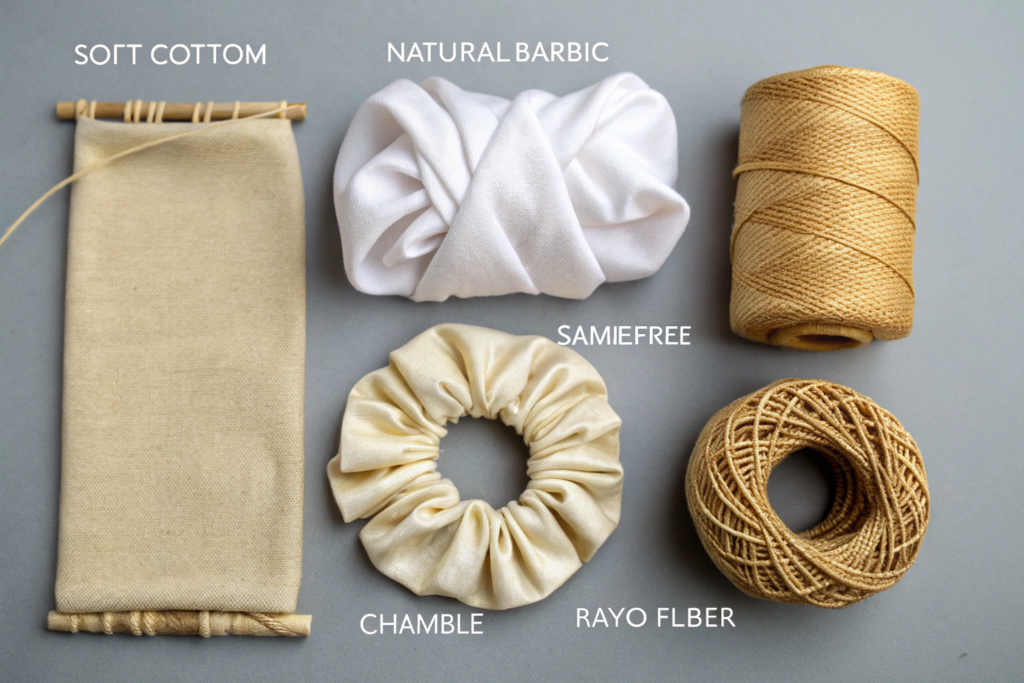
Natural and regenerated cellulosic fibers offer inherent anti-static properties due to their higher moisture regain. Cotton, bamboo viscose, rayon, and Tencel absorb and release moisture from the air, which naturally dissipates static electricity. Blending these fibers with polyester or nylon creates a material that retains the shape and durability of synthetics while dramatically reducing the static charge. Additionally, the inclusion of a small percentage of conductive fiber, such as carbon-coated nylon or stainless steel thread, can provide permanent anti-static performance.
What Are The Benefits Of Viscose And Rayon Blends?
Viscose and Rayon are made from natural cellulose (wood pulp) but are processed into fibers. They are technically "regenerated cellulosic fibers," not fully synthetic. They have a beautiful drape and a silky feel. More importantly, they have a moisture regain of about 11-13%, compared to polyester’s 0.4%.
This means that at normal room humidity, a viscose fiber contains a significant amount of water. That internal moisture makes the fiber conductive. Static charges cannot build up.
We often recommend a Polyester / Viscose blend for hair scrunchies and wide headbands. A blend like 65% Polyester / 35% Viscose gives you the strength and wrinkle-resistance of polyester with the softness and anti-static properties of viscose. The cost is slightly higher than 100% polyester, but the performance improvement is dramatic.
Another excellent option is Tencel (Lyocell) . It is a branded form of lyocell known for its smooth fiber surface. Smooth fibers create less friction than rough fibers. Less friction means less static generation in the first place. Tencel is a premium material, but for high-end hair accessories, it is a compelling choice.
How Do Conductive Fibers Work In A Textile Matrix?
This is advanced materials science applied to fashion. Conductive fibers are filaments that conduct electricity. They are woven or knitted into the fabric alongside the regular polyester or nylon.
Common conductive fibers include:
- Carbon-Coated Nylon: A nylon filament with a microscopic layer of carbon on the surface. Carbon is a good conductor.
- Stainless Steel Filament: A very fine, flexible thread of stainless steel.
These fibers are usually black or gray and are used in very small percentages, typically 1% to 3% of the total fabric weight. They are so fine that they are invisible to the naked eye. You cannot feel them.
When a static charge tries to build up on the polyester fibers, the charge immediately flows to the nearest conductive fiber. The conductive fiber acts like a lightning rod. It carries the charge along the length of the fabric and discharges it safely into the air or into the person holding it.
Fabrics with conductive fibers are permanently anti-static. The performance does not wash out. It does not depend on humidity. It is a function of the physical structure of the textile.
This technology is commonly used in cleanroom garments and military uniforms. It is also available in the fashion accessories supply chain. For a brand that wants to make a "No-Static Guarantee" claim, using a fabric with a certified conductive fiber content is the ultimate solution.
We have sourced fabrics with Belltron or Negastat conductive fibers for clients with specific high-performance needs. The cost per yard is higher, but the marketing claim and customer satisfaction justify the premium.
Conclusion
Managing static electricity in synthetic hair accessories is a technical challenge with several effective solutions. The best approach depends on the price point of the product, the target market, and the performance expectations of the end consumer. There is no single magic bullet. There is a spectrum of strategies.
For budget-friendly items, a topical spray treatment combined with a consumer education card is a cost-effective first line of defense. For mid-tier products, sourcing yarn that has been treated with a durable Quaternary Ammonium finish during manufacturing provides long-lasting protection. For premium brands, the use of viscose blends or fabrics with integrated conductive fibers offers a permanent, chemical-free solution.
At Shanghai Fumao, we do not just sew fabric together. We analyze the material science behind the product. We understand how a hair accessory will perform in the dry winter air of a heated American home or a European office. We use that knowledge to guide our clients toward the best material and treatment choices for their specific needs.
If you have struggled with static issues in your current accessory line or if you are developing a new collection and want to ensure a premium user experience, we are here to help. We can walk you through the material options and treatment processes that will make your products stand out for their quality and comfort. For a technical consultation on anti-static materials for your next production run, please contact our Business Director Elaine directly at elaine@fumaoclothing.com. Let us build products that look great and feel great, without the shock.