As a manufacturer of accessories for over two decades, I’ve seen products evolve based on changing lifestyles. The umbrella is a perfect example. I often talk with buyers like Ron from the US, and a major pain point for his customers is the traditional "compact" umbrella that isn’t actually compact. It’s too long to fit in a small purse and too bulky to slide into a laptop bag pocket. In today’s mobile world, a travel umbrella that isn’t truly portable is a failed product.
So, how do you ensure the umbrellas you source are genuinely compact and perfect for travel? The secret lies in a series of specific design and engineering choices that go far beyond just folding. The key factors are: first, the Number of Folds in the shaft; second, the use of a Flat-Profile Frame and Ribs; third, the design of a Compact, Ergonomic Handle; and finally, the choice of a Thin, High-Performance Canopy Fabric. It’s a total design philosophy focused on eliminating bulk in every component.
This isn’t about making a smaller, weaker umbrella. It’s about using smarter engineering to create a product that is both portable and reliable. At my factory, we specialize in these advanced construction techniques. In this article, I’ll break down each of these critical design elements.
How Does the Number of Folds Impact Size?
The single biggest factor determining the closed length of an umbrella is its shaft. A traditional non-folding golf umbrella can be a meter long. The innovation of the folding umbrella was the telescoping shaft, and the more sections it has, the shorter it gets.
The number of times the central shaft and ribs fold upon themselves directly dictates the final collapsed length of the umbrella. While a basic folding umbrella has two or three folds, a true ultra-compact travel umbrella will have five, or in some rare cases, even more folds. This is the first specification to look at. At Shanghai Fumao Clothing, when a client asks for a "travel" umbrella, our first question is always about the number of folds.
What is a "Three-Fold" vs. a "Five-Fold" Umbrella?
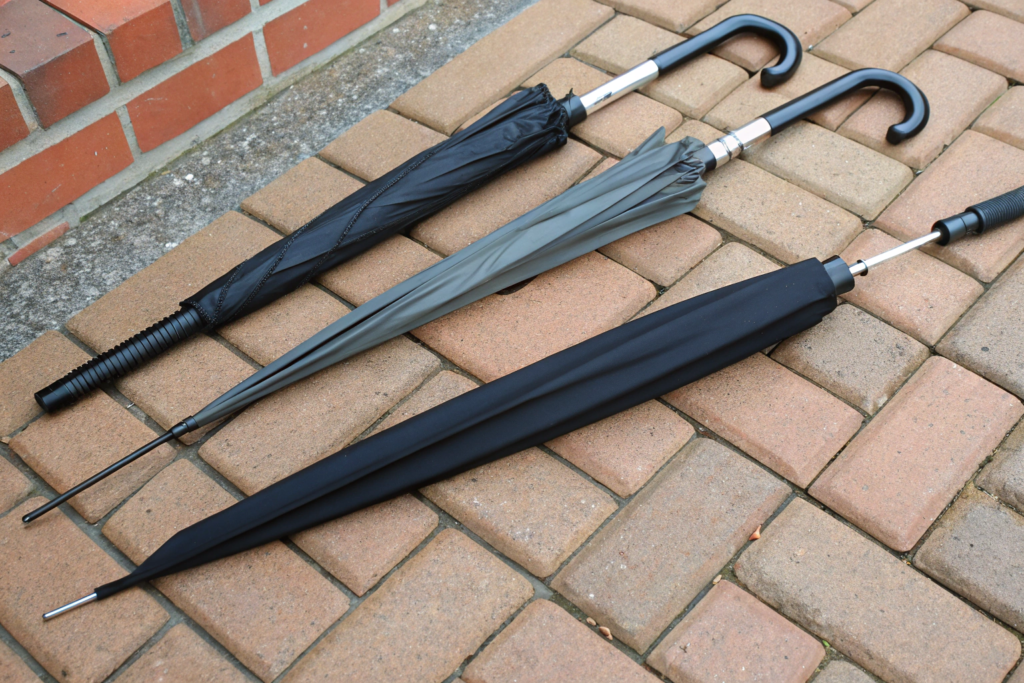
A three-fold umbrella is the most common "compact" umbrella you’ll find. The shaft has three telescoping sections, and the ribs fold twice. This typically results in a closed length of around twenty-five to thirty centimeters. It’s a good balance of size and simplicity. A five-fold umbrella, however, takes this a step further. The shaft has five smaller telescoping sections, and the ribs fold four times. This allows the final closed length to be as short as fifteen to eighteen centimeters—short enough to fit in a pocket.
What are the engineering challenges?
Adding more folds introduces more complexity and potential points of failure. Each joint in the shaft and each hinge in the ribs must be engineered with precision to be strong and operate smoothly. Using high-quality materials like a hexagonal steel shaft or fiberglass components becomes even more critical in a five-fold design to prevent the shaft from feeling wobbly or weak when extended. This level of precision engineering is a hallmark of quality manufacturing, a topic often explored by engineering resources like ASME (American Society of Mechanical Engineers).
What is a Flat-Profile Frame?
Even if an umbrella is short, it can still be too bulky. The second major innovation in compact design is tackling the umbrella’s thickness, or its "profile." A traditional folding umbrella, when closed, has a round and bulky shape because the ribs and handle are cylindrical.
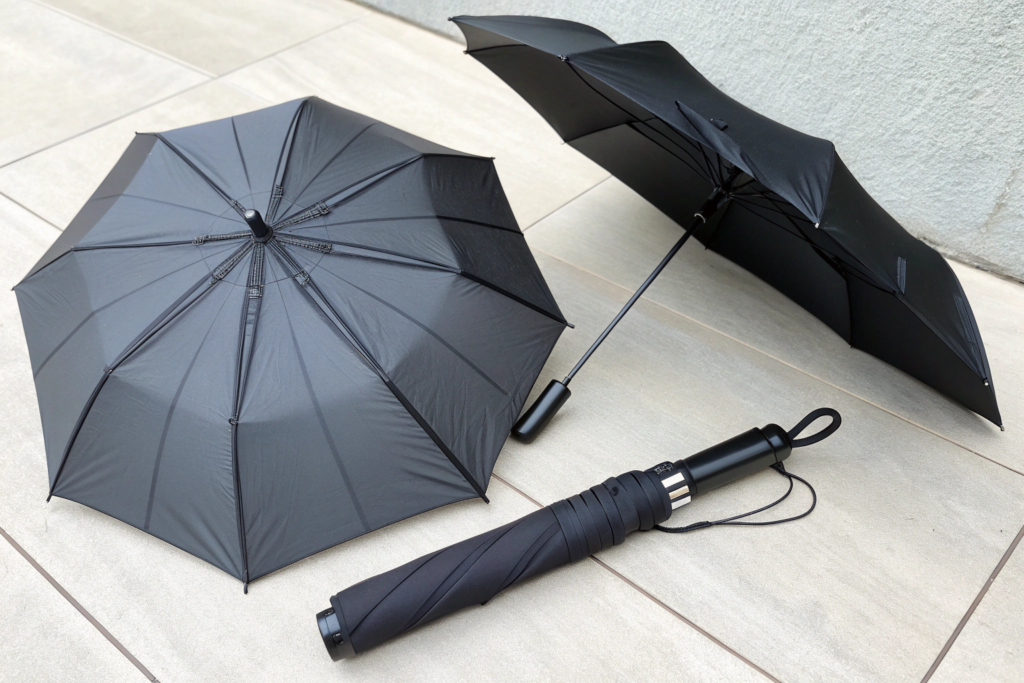
A flat-profile frame is an engineering solution that redesigns the components to be flatter and more rectangular, allowing the closed umbrella to be significantly thinner. This is achieved by using flattened ribs, a non-cylindrical shaft, and a handle that is wide but not deep. The goal is to create an umbrella that can slide easily into a bag or pocket without creating an awkward bulge. It’s about optimizing for space in every dimension.
How are the ribs and shaft flattened?
Instead of using traditional round, U-shaped metal ribs, a flat-profile design uses ribs that are stamped into a flatter, more rectangular shape. This allows them to nest against each other much more tightly when closed. The central shaft may also be non-cylindrical. This design philosophy, focused on minimizing volume, is a key principle in the design of many modern portable electronics and travel goods, as discussed by design publications like Core77.
Why does this matter for travel?
A flat-profile umbrella is a game-changer for packing. It can slide into the side pocket of a backpack, the sleeve of a laptop bag, or a car’s glove compartment with ease. Its shape is more like a book or a tablet than a bulky cylinder, which makes it a much more efficient and convenient item to carry. This focus on "packability" is a major trend in the travel goods industry.
How Does the Handle Design Affect Compactness?
The handle is often the forgotten component in compact design. A buyer can specify a five-fold shaft and a flat frame, but if it’s paired with a big, bulky, traditional handle, all that effort is wasted. The handle can easily add significant length and bulk to the final product.
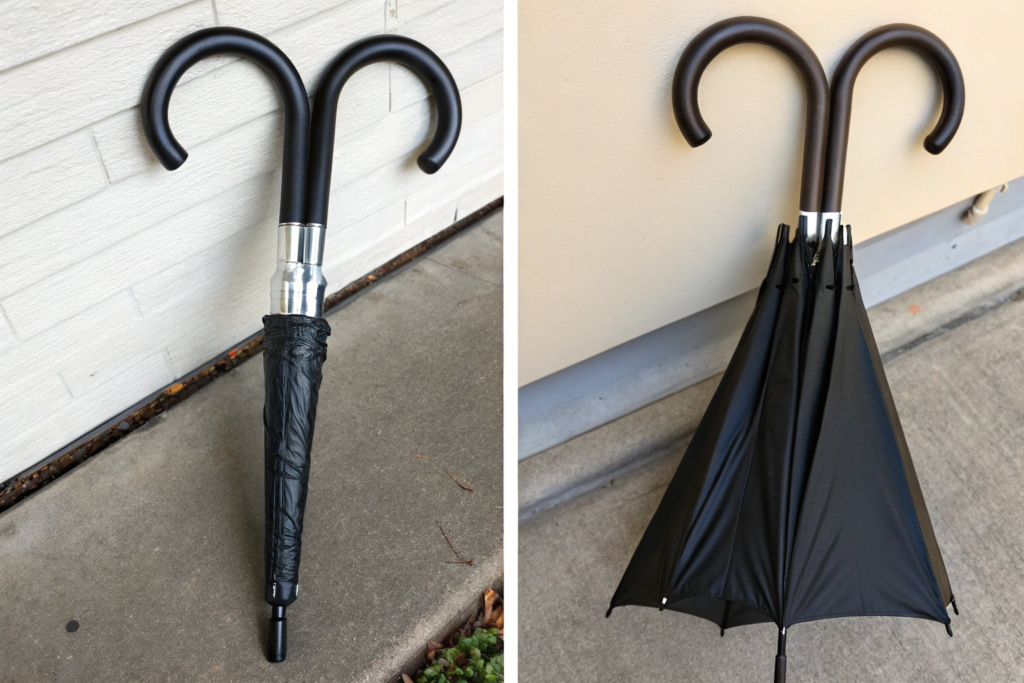
To ensure maximum compactness, the handle must be designed as an integrated part of the overall slim profile. This means avoiding traditional hook or large ball-shaped handles and opting for a minimalist, ergonomic design that is either flat, cylindrical, or integrated directly into the umbrella’s case. The handle should complete the compact form, not disrupt it. This is a detail we at Shanghai Fumao Clothing pay close attention to during the product development phase.
What are the best handle designs for compact umbrellas?
- Flat, Pill-Shaped Handles: These are wide enough to grip comfortably but are very thin, matching the flat profile of the umbrella’s frame. They often have a small cord loop for carrying.
- Small, Cylindrical Handles: A simple, short cylinder is a good compromise. It’s comfortable to hold but doesn’t add much to the overall length or bulk.
- Case-Integrated Handles: Some of the most innovative designs have almost no handle at all. The rigid protective case of the umbrella itself is designed to function as the handle when the umbrella is open.
Is a smaller handle less comfortable?
Not necessarily. Good ergonomics is about the shape, not just the size. A well-designed flat handle that fits the contours of the hand can be very comfortable to hold. The goal is to find the sweet spot between a handle that is large enough to be functional and one that is small enough to be portable. It’s a classic challenge in industrial design.
What is the Role of the Canopy Fabric?
The final element is the fabric itself. A thick, heavy canopy fabric will be bulky when folded, no matter how compact the frame is. It will resist folding into neat pleats and will look messy and wrinkled when packed away.
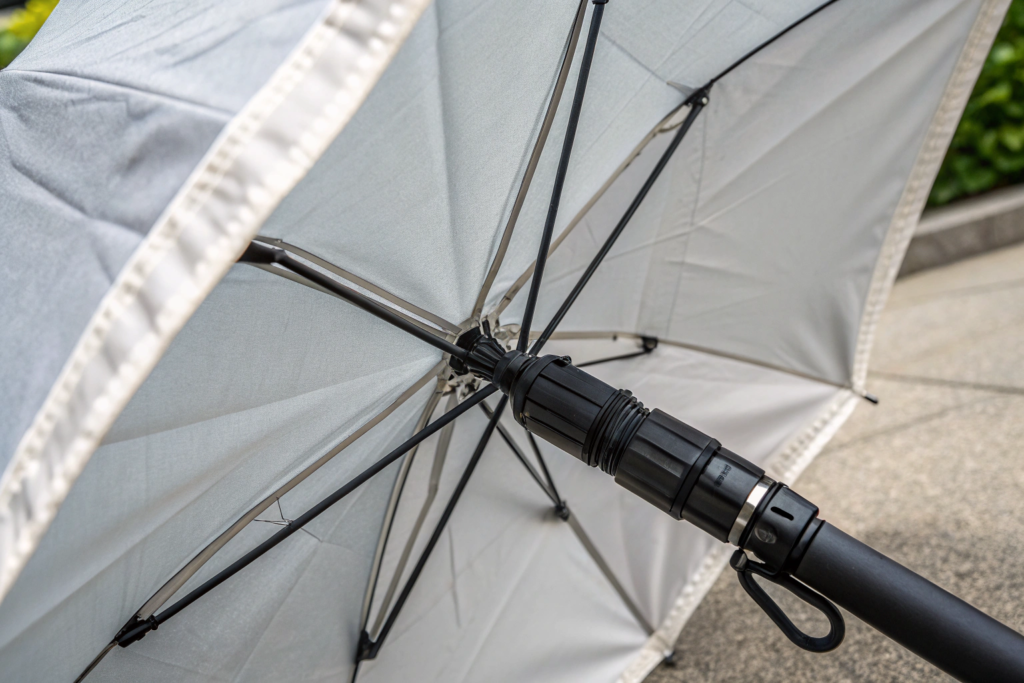
The choice of canopy fabric is crucial for achieving a slim, neat final product. You must use a high-density, lightweight polyester pongee fabric. This type of fabric is strong and waterproof, but it is also thin and crisp, allowing it to be folded into very tight, neat pleats. The fabric should compress down to the smallest possible volume, adding minimal bulk to the frame.
What is Polyester Pongee?
Pongee is a type of fabric woven from very fine polyester threads. It has a higher thread count, or density, than standard polyester. This high density is what makes it waterproof without needing a heavy coating. It’s also what gives it a smooth, crisp feel. When you open and close an umbrella made from high-quality pongee, you’ll notice it makes a satisfying "rustling" sound and the water beads off it easily.
Why does it fold better?
Because high-density pongee is thin and has a "crisp" hand-feel, it holds a crease very well. This means that when the umbrella is closed, the fabric naturally wants to fold along the designated pleat lines between the ribs. A lower-quality, softer fabric will bunch up and wrinkle instead of folding neatly. This ability to hold a pleat is a key characteristic of high-quality shirting and suiting fabrics and is equally important for a premium umbrella.
Conclusion
Creating a truly compact travel umbrella is a masterclass in thoughtful engineering and design. It is not one single feature, but a holistic system where every component is optimized to reduce size and bulk. It requires a multi-fold shaft to achieve a short length, a flat-profile frame to create a slim body, a minimalist handle that integrates seamlessly into the form, and a high-performance canopy fabric that folds away neatly. By specifying each of these four elements, you can move beyond the illusion of "compact" and source a genuinely portable, convenient, and travel-ready umbrella that your customers will appreciate and value.
If you are looking for a manufacturing partner who understands the science of compact design and has the technical capability to execute these details with precision, my team at Shanghai Fumao Clothing is ready to help you build a better umbrella. We believe that the best designs are the ones that seamlessly fit into our lives. Please contact our Business Director, Elaine, at her email: elaine@fumaoclothing.com to discuss your next project.