
As a manufacturer who produces millions of hats a year, I can tell you that one of the most persistent and costly problems for any headwear brand is returns due to poor fit. A customer orders a "Medium" hat online, it arrives, and it’s either perched on top of their head or falling over their ears. This isn’t just a lost sale; it’s a frustrating customer experience that erodes brand trust. The pain point is a fundamental inconsistency in what "Medium" actually means, both for the customer and, too often, for the factory producing the goods.
The industry standard for measuring hat sizes accurately is a multi-step process that combines precise head circumference measurement (in centimeters or inches), conversion to a standardized regional size (e.g., US, UK, or European), and rigorous quality control using calibrated tools like sizing tapes and calipers on the finished product. It is a system of precision, not approximation.
For a buyer like Ron, who is deeply concerned with quality control and logistics, a supplier’s approach to sizing is a critical indicator of their overall professionalism. A factory that is casual about sizing is likely casual about other important details. At Shanghai Fumao Clothing, we have built our reputation on this kind of precision. It’s a science. Let’s demystify the standards and show you how a hat should be measured for a perfect fit every time.
How Is a Head Actually Measured?
The entire system of hat sizing begins with one foundational measurement: the circumference of the head. If this starting point is wrong, everything that follows will be wrong. The pain point for consumers is confusion about where to measure. Many will simply wrap a tape measure around their forehead, which often results in a measurement that is too small.
The correct and standardized method for measuring head circumference is precise and consistent:
- Use the Right Tool: A soft, flexible tailor’s tape measure is essential. A rigid metal tape measure or a piece of string that can stretch will not give an accurate reading.
- Position the Tape Correctly: The tape should be wrapped around the head approximately 1 centimeter (or about 1/2 inch) above the ears.
- Find the Widest Point: From that point above the ears, the tape should cross the mid-forehead and go around the fullest, widest part of the back of the head.
- Ensure a Snug Fit: The tape should be snug, but not tight. It should not indent the skin. The measurement should be taken where the end of the tape meets the corresponding number.
This single measurement, usually in centimeters for global manufacturing, is the "true" size of the head. It is the number that all other sizing systems are based on. When we advise our clients on creating sizing charts for their websites, we always start by instructing them to show their customers this exact method. A well-informed customer is the first step in reducing sizing-related returns.

Why are centimeters preferred over inches in manufacturing?
Centimeters (and millimeters) are the standard unit of measurement in most of the world and are part of the International System of Units (SI). They offer a finer degree of precision without needing to use fractions, which are common with inches (e.g., 22 1/8"). This makes communication between designers, factories, and quality control teams much clearer and less prone to error.
What if a customer doesn’t have a soft tape measure?
A good alternative is to use a non-stretchy piece of string or a ribbon. They can wrap the string around their head using the correct method, mark where it overlaps, and then lay the string flat and measure the distance with a standard ruler. This is a common tip provided on e-commerce product pages to help customers find their fit.
How Do Sizing Systems Differ Globally?
Here lies the biggest source of confusion and the biggest pain point for international brands: there is no single, universal hat sizing standard. A "7 1/4" in the United States is different from a "7 1/4" in the United Kingdom. This is why relying solely on a regional size number is a recipe for disaster.
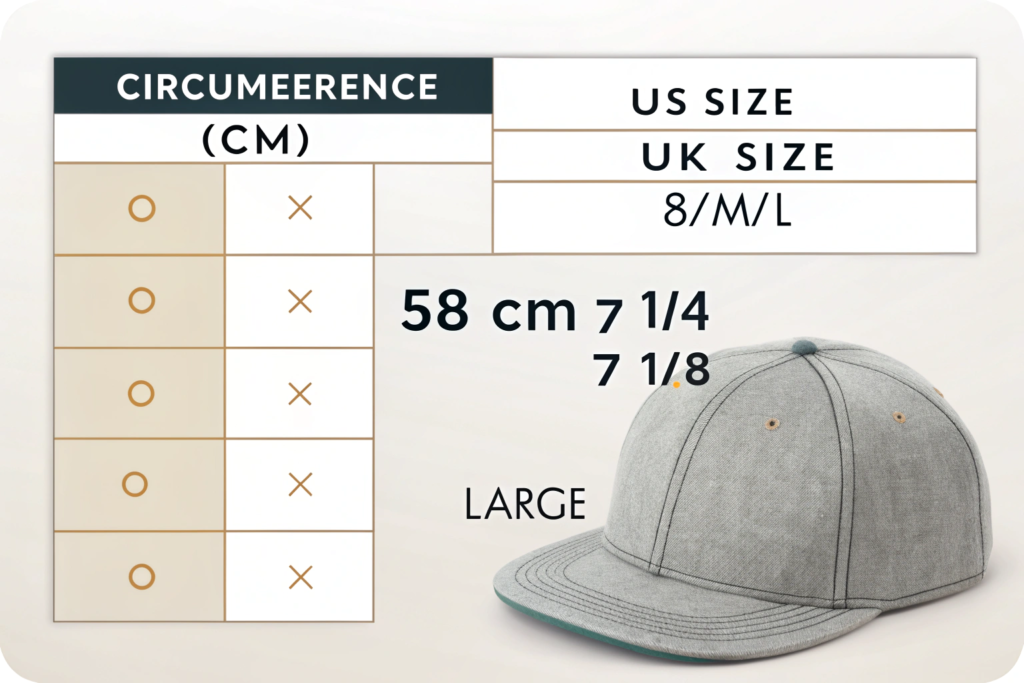
The industry standard is to use the centimeter measurement as the absolute ground truth. The regional sizes are simply conversions from that number. Here’s a simplified breakdown:
- European Sizing: The simplest system. The size is the head circumference in centimeters (e.g., 58 cm = Size 58).
- US Sizing: Based on the diameter of the head in inches. The formula is roughly (Circumference in inches / Pi). So, a 58 cm head (22.8 inches) is approximately a US Size 7 1/4.
- UK Sizing: Similar to US sizing, but the calculation is slightly different, resulting in a size that is typically 1/8 smaller than the US size. A 58 cm head is a UK Size 7 1/8.
- Alpha Sizing (S/M/L): This is a general sizing range. For example, a "Medium" might cover head circumferences from 56 cm to 57 cm.
| Circumference (cm) | US Size | UK Size | Alpha Size |
|---|---|---|---|
| 55 cm | 6 7/8 | 6 3/4 | Small |
| 57 cm | 7 1/8 | 7 | Medium |
| 59 cm | 7 3/8 | 7 1/4 | Large |
| 61 cm | 7 5/8 | 7 1/2 | X-Large |
As a manufacturer, our tech packs and quality control documents always specify the size in centimeters first and foremost. The "Large" or "7 3/8" is secondary information. This eliminates any ambiguity. For our clients, like Shanghai Fumao Clothing, this means we can produce a single batch of hats, measured to a precise 59 cm standard, and they can be confidently labeled as "Large" for the US market or "7 1/4" for the UK market.
What is a "tech pack"?
A tech pack (technical packet) is a detailed document created by a designer or brand that contains all the specifications a manufacturer needs to produce a product. For a hat, it would include details on materials, colors (with Pantone codes), stitch types, logo placement, and, crucially, a detailed sizing chart with measurements in centimeters for every size.
Why are US and UK hat sizes different?
The difference is historical and relates to slight variations in the standard "inch" measurement and the formulas used by hatters in each country centuries ago. While the countries now use standardized measurements, the traditional sizing conventions have persisted, creating a legacy of two similar but frustratingly different systems. It’s a classic example of why relying on a universal standard like centimeters is so important in global trade.
What Is the Role of Quality Control in the Factory?
A perfect design and a perfect sizing chart are useless if the final product doesn’t match the specifications. This is where in-factory quality control (QC) becomes the most critical step. The pain point for many brands is receiving a shipment of 10,000 "Large" hats, only to find that the actual size varies by up to a centimeter from hat to hat.
The industry standard for QC in hat sizing is multi-layered and uses specialized tools:
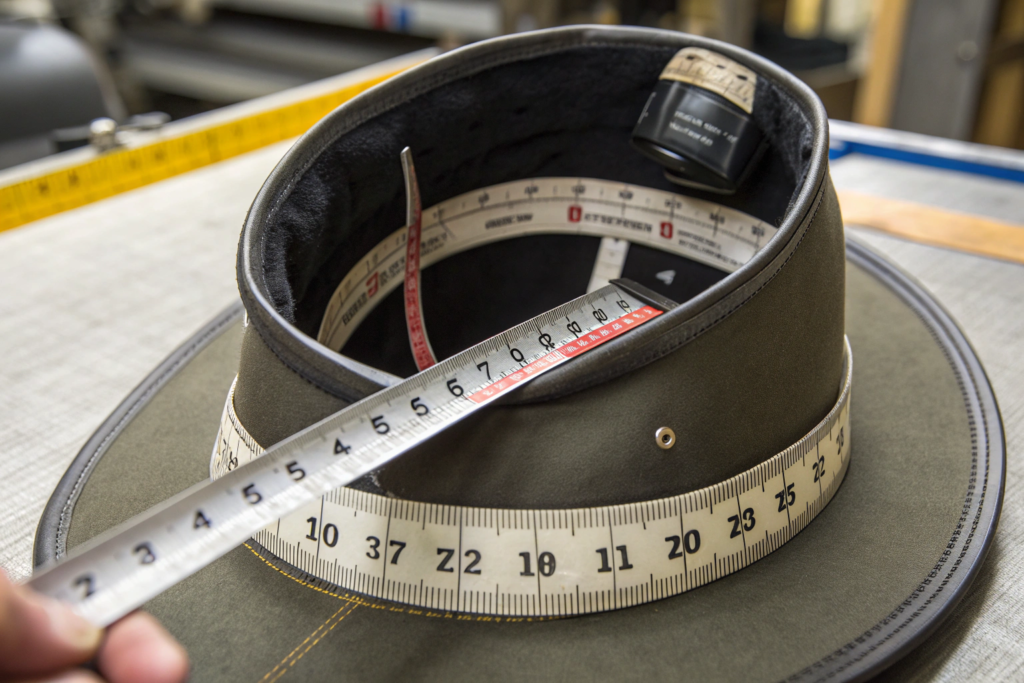
- Calibrated Sizing Tapes: We don’t use soft tailor’s tape for QC. We use specialized, calibrated metal or plastic sizing tapes. These are bands that are placed inside the hat and expanded with a handle until they are snug. The tape then shows the precise inner circumference in centimeters.
- Digital Calipers: For rigid hats or specific components like the brim, we use digital calipers to ensure all dimensions are accurate to the millimeter.
- Statistical Process Control: We don’t measure every single hat. We use a statistical sampling method (like AQL standards) to inspect a certain percentage of hats from each batch. If the number of defects in the sample exceeds the acceptable limit, the entire batch is flagged for a 100% inspection or rework.
This rigorous process ensures that when we label a hat as "58 cm," the inner circumference is truly 58 cm, with a very small tolerance (e.g., +/- 2mm). This guarantees consistency across the entire production run. It’s this commitment to measurable, verifiable quality that gives our clients like Ron the security they need.
What does "AQL" mean?
AQL stands for Acceptable Quality Limit. It is an international standard (ISO 2859-1) that defines the maximum number of defective units that can be considered acceptable during a random sampling inspection of a production batch. It’s a statistical tool that allows a brand and a factory to agree on a clear, objective standard for quality.
What is a "tolerance"?
In manufacturing, tolerance is the permissible limit of variation in a physical dimension. No manufacturing process is perfect, so a tolerance defines the acceptable range. For a 58 cm hat, a tolerance of +/- 2mm means a finished hat that measures anywhere between 57.8 cm and 58.2 cm would be considered acceptable. A tight tolerance indicates a high-precision manufacturing process.
How Do Material and Construction Affect the Final Fit?
The final piece of the sizing puzzle is understanding that the labeled size isn’t the only thing that determines fit. The material and construction of the hat play a huge role in how it feels on the head. A common pain point is when a brand uses the same sizing chart for a rigid fedora as they do for a stretchy beanie, leading to customer confusion.
A good manufacturer must account for the properties of the materials:
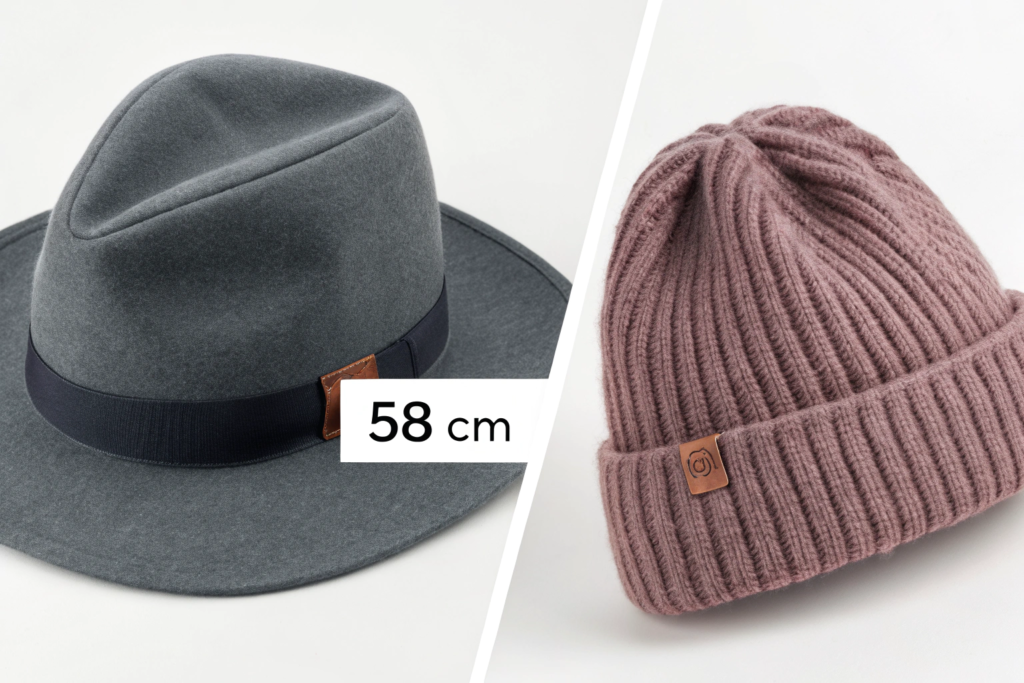
- Structured Hats (e.g., Felt Fedoras, Straw Boaters): These hats have very little to no stretch. The accuracy of the inner circumference is critical. The fit is precise. An adjustable inner band can help provide a small amount of customization for the wearer.
- Soft Hats (e.g., Baseball Caps, Bucket Hats): These have some give. While the target size is still important, there is more flexibility. An adjustable strap on a baseball cap is a key feature for accommodating a range of head sizes within a single "one-size-fits-most" product.
- Knit Hats (e.g., Beanies): These are designed to stretch significantly. A beanie labeled "58 cm" is not 58 cm when lying flat; it is designed to comfortably stretch to fit a 58 cm head. The key measurement here is the "relaxed" circumference and the material’s stretch modulus.
When developing a new hat style, our process includes creating prototypes and conducting fit tests. We don’t just measure the hat; we put it on fit models with different head sizes to see how it actually performs. Does the beanie feel too tight? Does the fedora sit at the right height? This real-world feedback, combining the science of measurement with the art of fit, is essential for creating a successful product.
What is a "one-size-fits-most" (OSFM) hat?
A "one-size-fits-most" hat is typically designed around the average head circumference (around 57-58 cm) and incorporates an adjustable element, like a snapback closure, a leather strap, or an elasticated band. This allows it to comfortably fit a range of sizes, for example, from 55 cm to 60 cm. It’s a strategy to reduce the number of SKUs (Stock Keeping Units) a brand needs to carry.
How does the sweatband affect fit?
The inner sweatband is a critical component. A thick, padded cotton sweatband will make a hat feel tighter than a thin, simple grosgrain ribbon sweatband, even if the outer dimensions are the same. Some modern hats now feature sweatbands with built-in elastic or Velcro adjusters, allowing the wearer to fine-tune the fit by a centimeter or two, which is a great selling feature.
Conclusion
Accurate hat sizing is a chain of precision that starts with the customer and ends on the factory floor. It requires clear instructions for the end-user, a deep understanding of global sizing conversions, a mastery of different material properties, and, most importantly, a rigorous, tool-based quality control process. When these standards are upheld, returns go down, customer satisfaction goes up, and the brand’s reputation for quality is solidified.
This is the level of detail and professionalism we bring to every project. We see ourselves as the guardians of our clients’ brand promises. When your tech pack says "58 cm," you can have absolute confidence that the hats you receive from our facility in Zhejiang will be precisely that. It’s this reliability that turns a simple supplier relationship into a true manufacturing partnership.
If you are looking for a partner who sweats the small stuff and understands that a perfect fit is not an accident but a standard, we are ready to talk. Please contact our Business Director, Elaine, at elaine@fumaoclothing.com to discuss how we can bring this level of precision to your next headwear collection.