You launch a new scarf collection marketed as "organic cotton." The fabric supplier provided an organic certificate from a local testing house. The labels are printed. The marketing copy is written. The shipment arrives at the Port of Hamburg. The German customs officer pulls a random sample, scans the organic claim on the hangtag, and asks for the GOTS certificate. You submit the local testing house certificate. It is rejected. The officer explains that under EU Regulation 2018/848 on organic production and labeling, any textile product sold in the EU with an organic fiber claim must be certified to the Global Organic Textile Standard. Your scarves are impounded, the labels must be destroyed and reprinted, and the shipment misses the spring retail window. The word "organic" on a hangtag in Europe is a legally regulated term, not a marketing suggestion.
European buyers require GOTS certification for organic scarves because GOTS is the only textile-specific organic standard directly referenced and accepted by EU regulatory authorities, major European retail associations, and the German government’s Green Button sustainable textile label. An OEKO-TEX certificate proves chemical safety but says nothing about whether the cotton fiber was grown without synthetic pesticides. A GOTS certificate covers the entire supply chain, from the organic cotton farm through the spinning mill, the dye house, and the stitching floor, verifying that every step meets organic and social criteria.
A scarf labeled "organic" without GOTS certification is a legal liability in the European market. The buyer who sells it faces fines, consumer protection lawsuits, and a damaged reputation with the increasingly eco-conscious European consumer. I want to explain exactly what GOTS covers, how our Zhejiang facility maintains GOTS chain-of-custody certification, what the audit process looks like, and why this single certificate is worth more to a European buyer than ten generic "eco-friendly" claims.
What Is the Global Organic Textile Standard and What Does It Certify?
The textile industry is full of certifications. OEKO-TEX Standard 100. bluesign. Organic Content Standard. Fair Trade. Buyers often confuse these standards or assume they are interchangeable. They are not. GOTS is uniquely comprehensive because it covers both the organic status of the fiber and the environmental and social conditions under which the fiber was processed into finished fabric.
The Global Organic Textile Standard certifies four specific layers of the textile supply chain: organic fiber production, verifying that the cotton was grown without synthetic pesticides, herbicides, or genetically modified seeds; processing and manufacturing, verifying that the spinning, weaving, dyeing, and finishing stages use GOTS-approved chemicals and treat wastewater to a specified standard; social criteria, verifying that workers throughout the supply chain are employed under conditions that meet International Labour Organization core conventions; and labeling, verifying that the final product is accurately labeled with the correct GOTS grade, "organic" for products containing at least 95% certified organic fiber, or "made with organic" for products containing at least 70% certified organic fiber.
A scarf labeled "GOTS Organic" must contain a minimum of 95% certified organic fiber. A scarf labeled "made with X% GOTS-certified organic cotton" must contain a minimum of 70% certified organic fiber. The remaining fiber content must be from a limited list of approved non-organic fibers. This labeling precision is critical for European consumers, who read hangtag fiber composition percentages with a level of scrutiny that far exceeds the average American consumer.
How does GOTS differ from OEKO-TEX Standard 100 in scope?
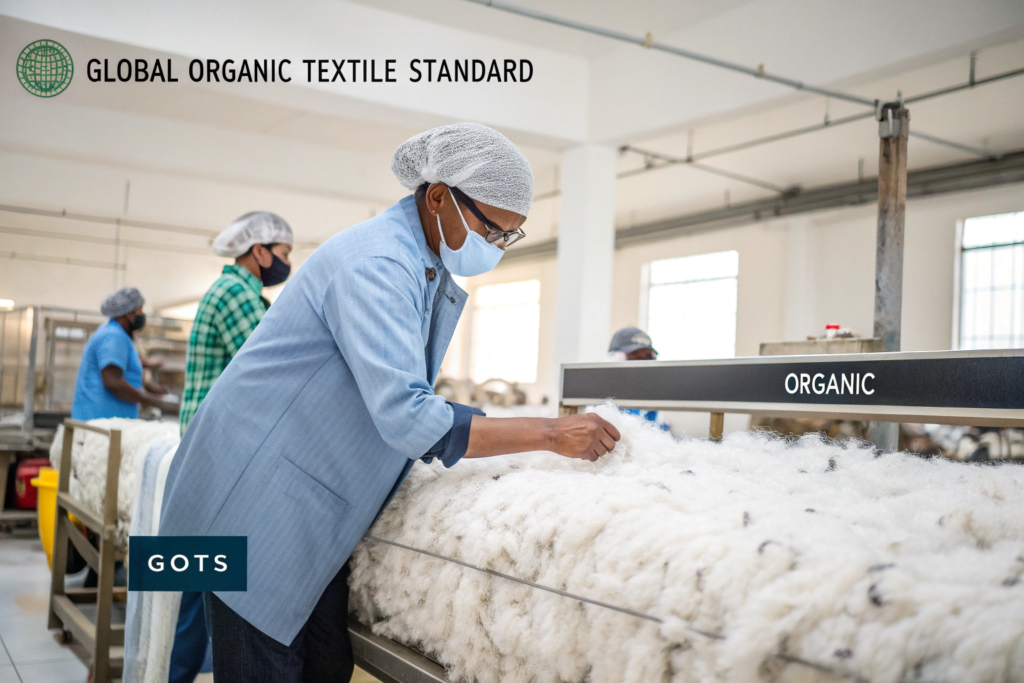
OEKO-TEX Standard 100 tests the finished product for harmful chemicals. It is a product safety standard. It does not verify that the cotton was grown organically. A polyester scarf sprayed with toxic pesticides could, in theory, be chemically washed and pass an OEKO-TEX test. GOTS is an organic standard that starts at the cotton field and follows the fiber through every processing step. A European buyer requesting an organic scarf needs GOTS, not just OEKO-TEX.
What are the GOTS-approved dye classes for an organic scarf?
GOTS restricts the dye classes that can be used on certified organic textiles. Disperse dyes that require carriers classified as hazardous are prohibited. Sulfur dyes that release toxic byproducts during fixation are restricted. The approved dye classes are reactive dyes, vat dyes, and natural dyes, all of which must meet specific biodegradability and heavy metal content limits. Our custom organic scarf production uses GOTS-approved reactive dyes exclusively, and our dye supplier provides a GOTS-compliant chemical input certificate for every dye lot.
Why Can’t a Generic "Organic Cotton Certificate" Replace a GOTS Certificate?
The organic cotton market has a traceability problem. A cotton farmer in India may hold a valid organic farm certificate under a national organic program. The cotton leaves the farm, enters the commodity trading system, and somewhere between the gin and the spinning mill, it is mixed with conventionally grown cotton. The spinning mill buys a blend of organic and conventional cotton, labels the entire yarn bale as "organic," and sells it to a fabric mill. The fabric mill has no way to verify the organic content of the yarn.
A generic organic cotton certificate from a single point in the supply chain cannot replace a GOTS certificate because GOTS requires an unbroken chain of custody. Every entity that handles the fiber, the gin, the spinner, the knitter or weaver, the dye house, the printer, the garment manufacturer, must hold a valid GOTS scope certificate. Each entity must maintain documented procedures for separating organic and conventional fibers, preventing commingling, and tracing every bale of organic fiber through their facility. A single uncertified link in the chain breaks the organic claim.
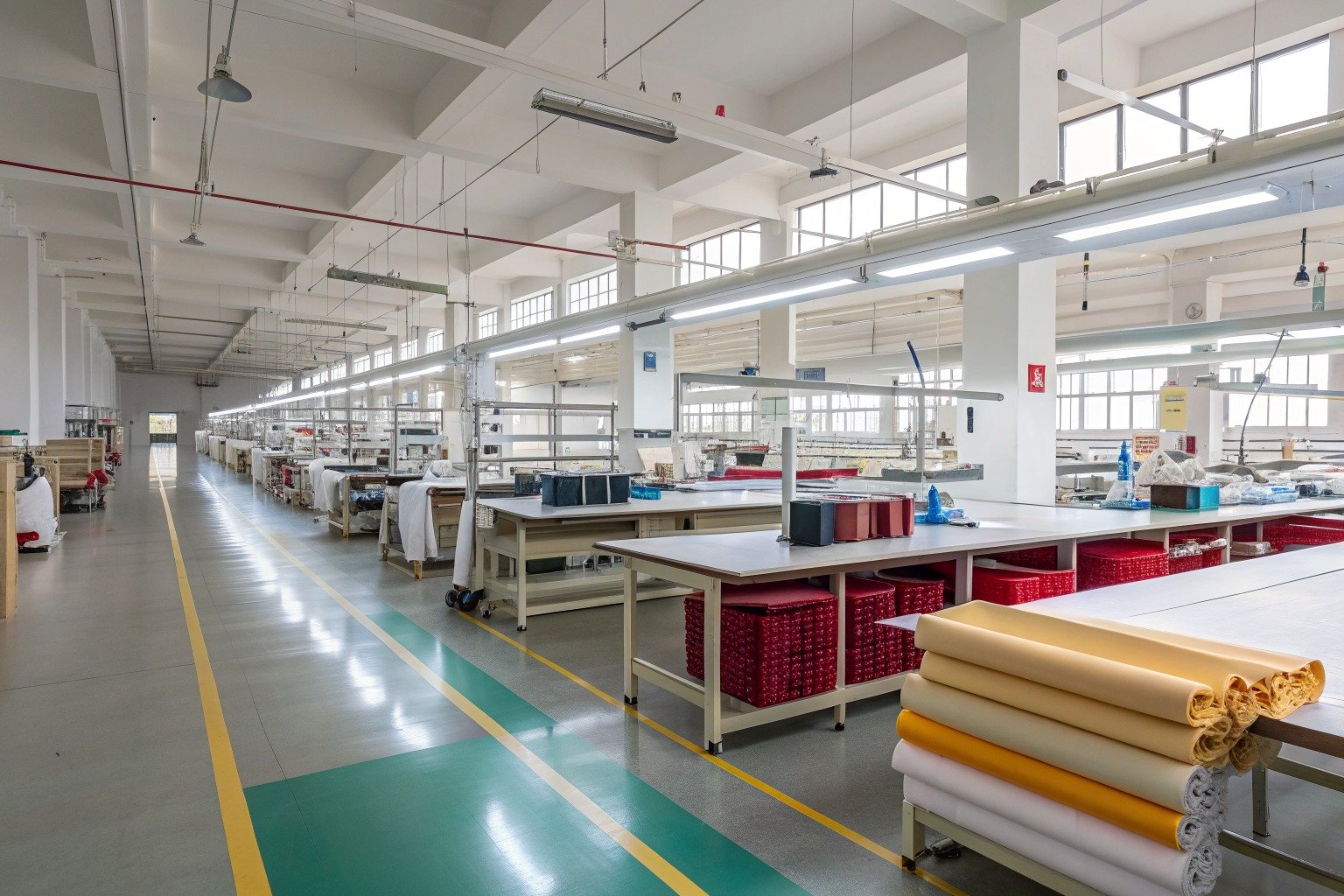
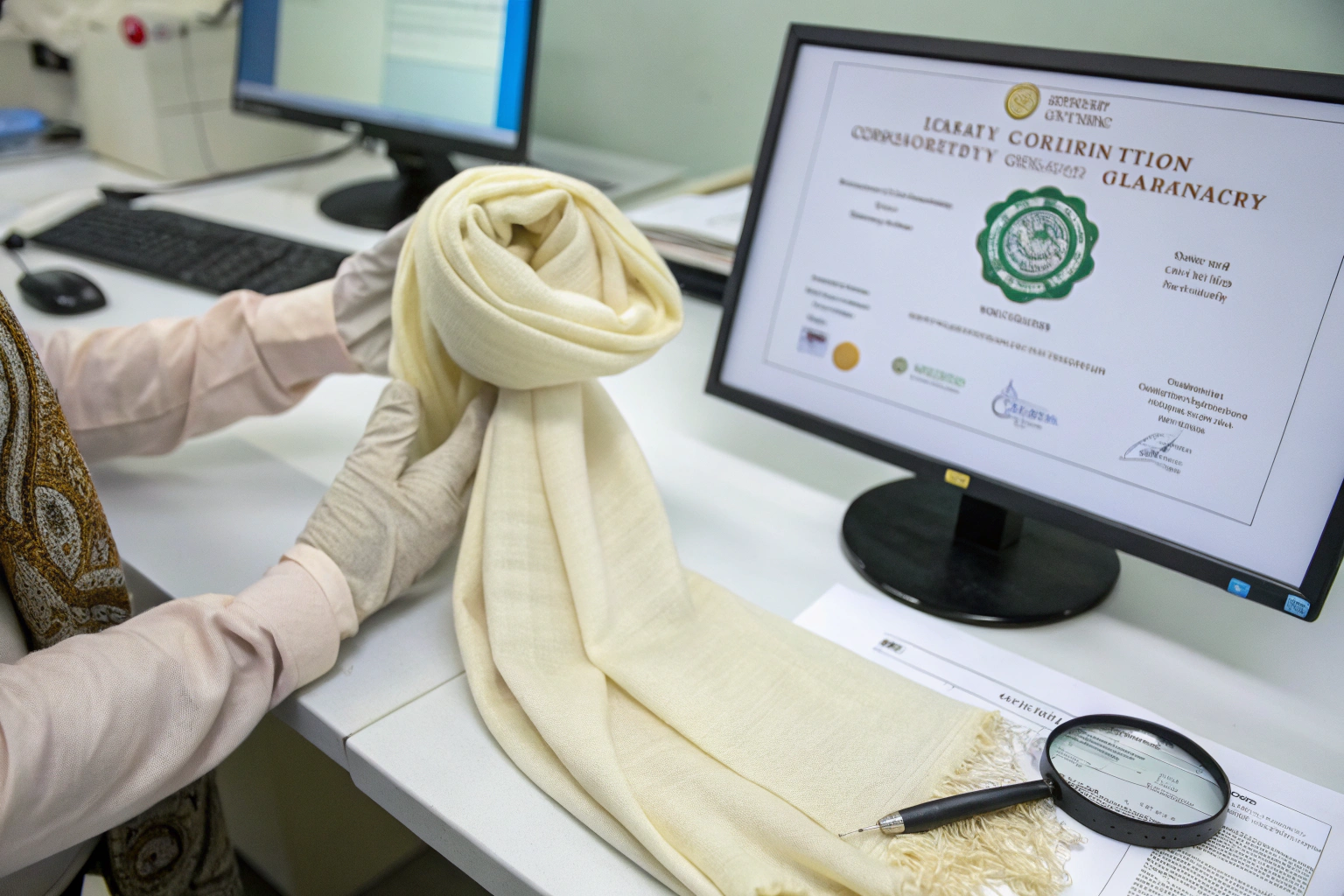
Our Zhejiang facility holds a current GOTS scope certificate. The certifier, an independent third-party certification body accredited by GOTS, audits our facility annually. The auditor traces a specific batch of organic cotton scarves backward through our records: our purchase order for GOTS-certified organic cotton fabric, the fabric mill’s GOTS scope certificate and transaction certificate, the yarn spinner’s GOTS scope certificate, and the cotton gin’s organic transaction certificate. The chain must be complete and unbroken.
What is a GOTS Transaction Certificate and how does it move with the fiber?
A Transaction Certificate is a document issued by the seller’s certification body each time ownership of GOTS-certified goods transfers between certified entities. The TC states the quantity of certified organic fiber, the GOTS grade, and the certifier reference numbers of both the seller and the buyer. The TC follows the fiber from the farm to the finished scarf. When the scarf ships to the European buyer, the final TC provides the legal proof that the organic claim is valid.
How often is a GOTS-certified factory audited?
A GOTS-certified facility undergoes an announced annual audit, plus the possibility of unannounced audits. The auditor reviews physical separation of organic and conventional production lines, chemical inventory against the GOTS positive list, wastewater treatment records, and worker employment contracts and payroll records for social compliance. A major non-conformity, such as commingling of organic and conventional fibers, results in immediate suspension of the certificate.
What Social Criteria Does GOTS Enforce That Other Certifications Skip?
A scarf can be made from pesticide-free organic cotton, dyed with GOTS-approved reactive dyes, and still be produced in a factory where workers are paid below minimum wage, work excessive overtime, and are denied the right to form a union. A European buyer selling to a consumer who cares about organic farming almost certainly also cares about worker welfare. The two values are intertwined in the European ethical consumption mindset.
GOTS enforces social criteria based on the International Labour Organization core conventions. Certified facilities must provide: freely chosen employment, with no forced or bonded labor; freedom of association and the right to collective bargaining; safe and hygienic working conditions; no child labor; payment of a living wage or at least the legal minimum wage, whichever is higher; working hours that comply with national laws and do not exceed 48 hours per week on a regular basis plus a maximum of 12 hours overtime; no discrimination in hiring or employment; and no harsh or inhumane treatment.
Our GOTS auditor interviews workers privately, without management present, during the annual audit. The auditor selects workers randomly from the production floor, asks about their wages, their working hours, and their living conditions. The auditor reviews payroll records, time cards, and employment contracts. This is not a checkbox exercise. A factory that fails the social criteria fails the GOTS audit, regardless of how organic the cotton is.
How does GOTS social compliance differ from a SMETA or BSCI social audit?
SMETA and BSCI are standalone social audits. They are thorough, but they are not linked to an organic fiber claim. A factory could pass a BSCI audit and still use conventional cotton. GOTS integrates social criteria with organic fiber traceability, creating a single certificate that covers both sustainability pillars. For a European buyer, requesting GOTS is simpler than requesting a BSCI audit report plus an organic certificate plus a chemical test report.
What is the Green Button label and how does GOTS relate to it?
The Green Button is a German government-run sustainable textile label. To display the Green Button, a product must meet 26 social and environmental criteria. A product that is GOTS-certified automatically meets the majority of the Green Button criteria, making GOTS a direct pathway to the German government’s official sustainability endorsement.
How Should GOTS Certification Be Displayed on the Scarf and Hangtag?
A GOTS-certified scarf that arrives with an incorrectly labeled hangtag can still be flagged by European customs or by a retail buyer’s quality assurance team. The labeling rules are specific and enforced.
The GOTS labeling requirements mandate that: the GOTS logo must be displayed in its exact registered format, with the correct green color and the certification body’s name and license number printed beneath it; the product label must state the GOTS grade, either "organic" for 95%+ organic fiber or "made with [X]% organic materials" for 70%+ organic fiber; the label must include the fiber composition in descending order of weight; and the label must identify the certification body that certified the final manufacturing stage.
Our labeling team maintains a GOTS logo usage compliance checklist. Every hangtag and woven label design is reviewed against the current GOTS labeling guidelines before printing. The certification body’s logo and license number are verified as current, as certification bodies can lose their GOTS accreditation, rendering their logo invalid.

What happens if a retailer’s own brand label covers the GOTS information?
The GOTS certification information must be accessible to the consumer. If the brand’s own woven label covers the GOTS care label, the GOTS information must be printed on a separate hangtag that the consumer can read before purchase. The information cannot be hidden inside a sealed package.
Can a scarf be marketed as "organic" if it is certified to OCS, the Organic Content Standard?
The Organic Content Standard certifies the percentage of organic material in a product, but it does not certify the processing chemicals, the wastewater treatment, or the social conditions. Under EU organic labeling regulations, OCS alone is not sufficient to label a textile product as "organic" on the retail market. GOTS is the required standard. Brands that have used OCS and attempted to market products as organic have faced regulatory action.
Conclusion
GOTS certification for organic scarves is the single mandatory certificate for any brand selling an organic textile product in the European market. It covers organic fiber traceability from farm to finished scarf, restricts the chemicals used in dyeing and finishing, enforces ILO-based social criteria at every processing facility, and controls the exact labeling language on the hangtag. No other single certificate provides this complete supply chain coverage. A European buyer who requests GOTS is protecting their brand from regulatory risk and aligning with the European consumer’s integrated expectation that an organic product must be both environmentally and socially responsible.
Our Zhejiang facility holds a current GOTS scope certificate, audited annually by an accredited certification body. We source GOTS-certified organic cotton fabric from certified mills, dye with GOTS-approved reactive dyes, maintain the transaction certificate trail, and print the GOTS-compliant labels and hangtags.
If your brand is sourcing organic scarves for the European market and needs a GOTS-certified manufacturing partner, contact our Business Director, Elaine. She will send you a copy of our current GOTS scope certificate, a sample transaction certificate, and a GOTS-compliant hangtag layout for your review. Write to her at elaine@fumaoclothing.com. Let’s certify every fiber of your organic scarf supply chain.