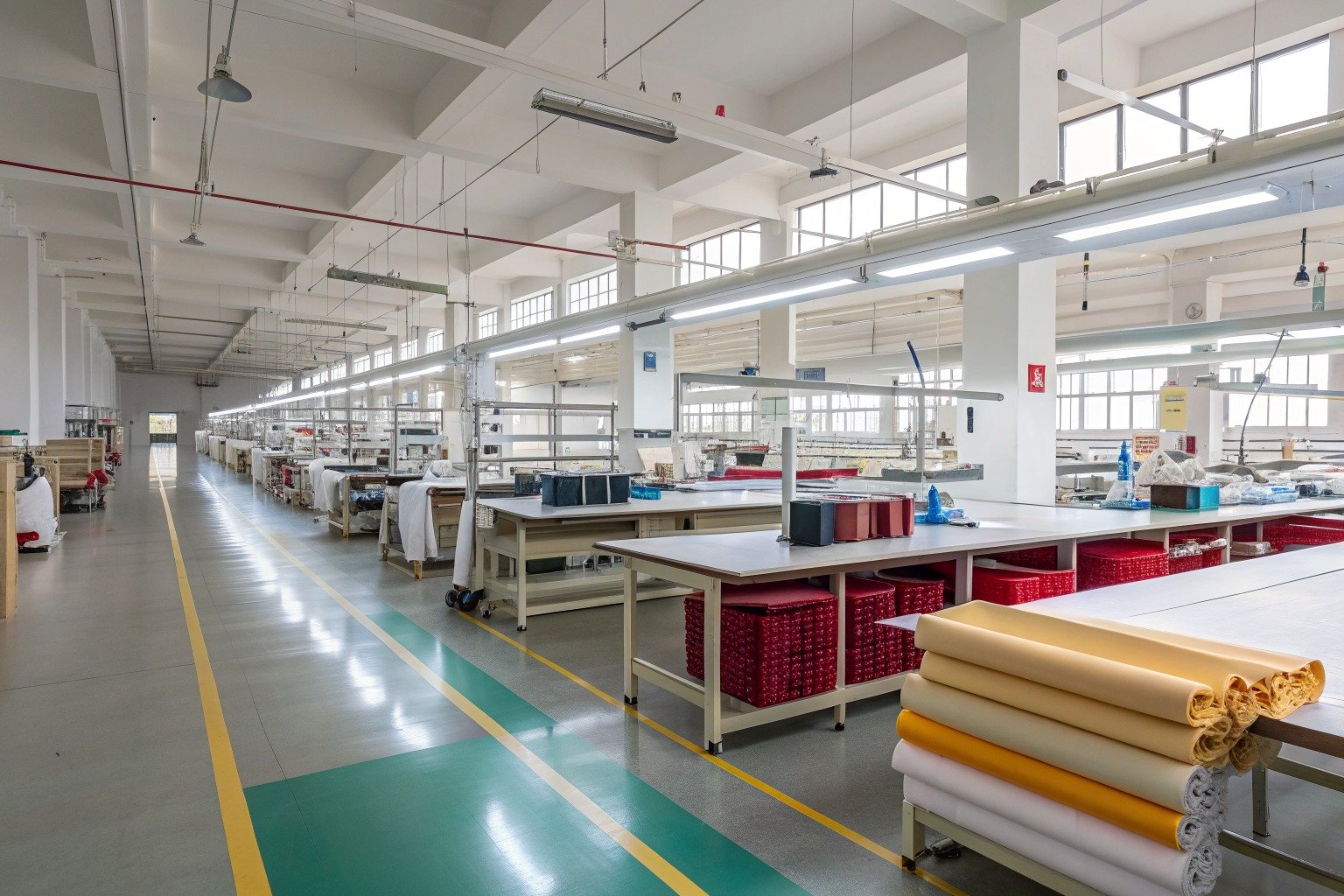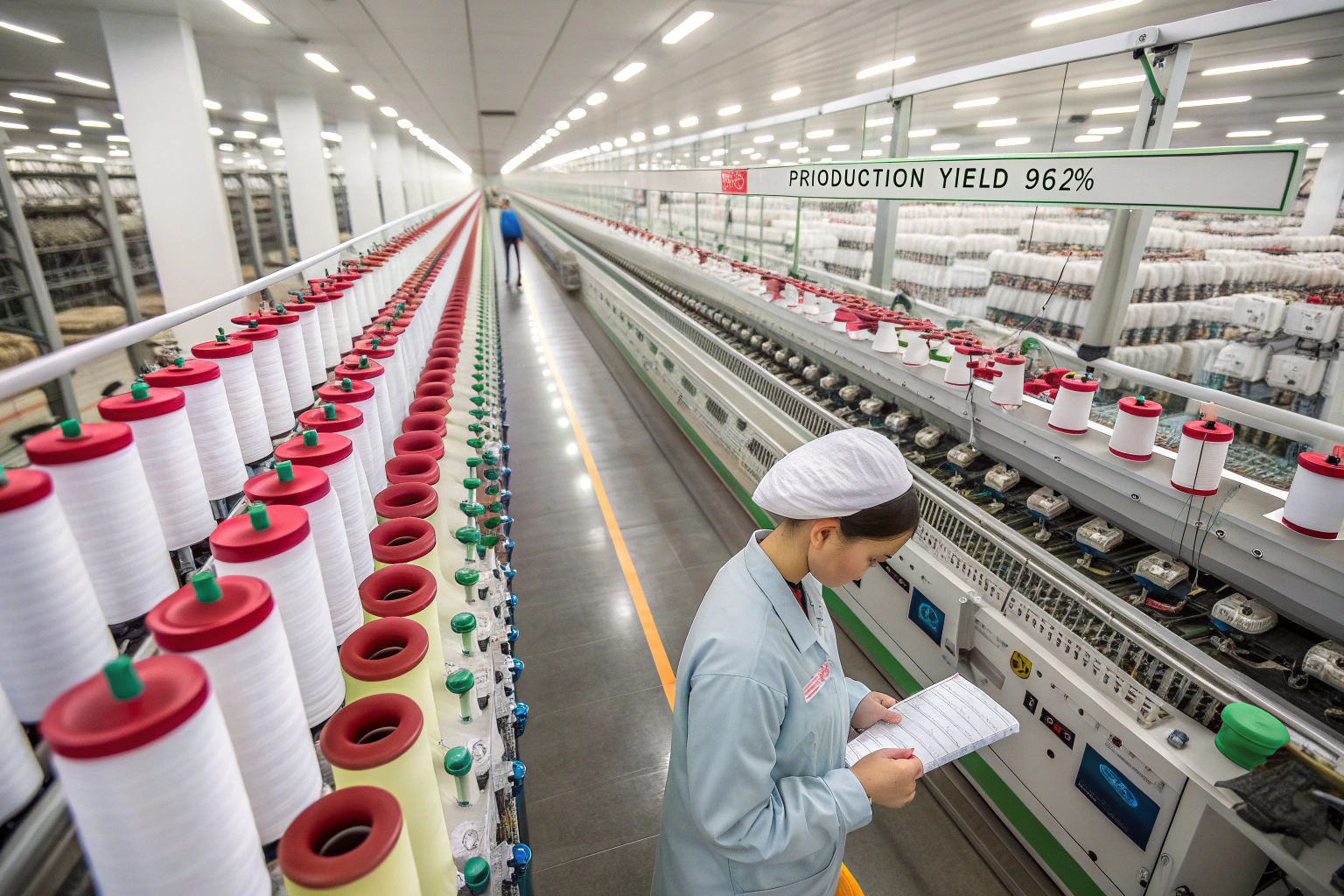
You are comparing two spreadsheets. One from a Vietnamese knit hat factory. One from our factory in Zhejiang. The Vietnamese quote is $0.18 lower per unit, and you are tempted to switch. Then you look at the yield column. The Vietnamese factory reports an 82% yield rate on their last 10,000-unit order. Eighteen percent of the yarn that entered their factory left as waste, overproduction, or defective pieces. Our yield on the same style is 96%. That 14-point gap erases the $0.18 unit cost advantage and adds a hidden $1,200 in wasted raw material to the Vietnamese order. Yield is the invisible margin killer in knit accessory sourcing.
Our production yields are higher than Vietnam for knit hats because of three structural advantages: a fully domestic, vertically integrated yarn supply chain that eliminates the moisture and tension inconsistencies caused by imported yarn acclimatization, a higher density of fully electronic flat knitting machines per square meter of factory floor that reduce human handling errors, and a more experienced workforce with a lower annual turnover rate that maintains consistent stitch tension across long production runs.
Yield is not luck. It is the measurable output of supply chain geography, machine investment, and workforce stability. I want to break down exactly where yield loss occurs in knit hat production, why our specific location in the Zhejiang textile cluster gives us a raw material advantage that Vietnam cannot easily replicate, and why our defect rate on a 50,000-unit beanie order is consistently under 2%.
How Does a Localized Yarn Supply Chain Improve Yield Rates?
The journey of a cone of yarn from the spinning mill to the knitting needle is a critical path that most sourcing managers ignore. They assume yarn is yarn, a commodity that can be shipped anywhere. But yarn is a hygroscopic material. It absorbs and releases moisture from the surrounding air constantly. A cone of wool or acrylic yarn spun in a climate-controlled Chinese mill and shipped to a humid Vietnamese factory undergoes a physical transformation that directly damages yield.
A localized yarn supply chain improves yield by eliminating the "acclimatization shock" that occurs when yarn travels across climate zones. Yarn spun in our local Zhejiang mills is stored in the same ambient humidity as our knitting floor. When a Vietnamese factory imports Chinese yarn, the yarn sits in a shipping container for three weeks, absorbs tropical humidity, swells, and becomes sticky on the knitting needles. This causes needle breaks, dropped stitches, and tension variance that produce defective panels.
Our yarn mills are within a 50-kilometer radius of our factory. The yarn cones leave the spinning mill in the morning, arrive at our receiving dock by afternoon, and are knitting by the next shift. The yarn never experiences a humidity swing of more than 10%. This material stability translates directly into stitch consistency.
What specific yarn defect increases when yarn is shipped long distances?
The primary defect is "yarn hairiness," the microscopic fuzz that rises from the yarn surface when fibers are abraded by vibration during transport. Hairy yarn catches on needle hooks, causing "tuck stitches" where the needle fails to clear the old loop before forming the new one. A tuck stitch creates a visible hole or a tight, distorted stitch in the knit fabric. Our yarn, having traveled 50 kilometers by truck rather than 3,000 kilometers by ship and truck, exhibits significantly lower hairiness.
How does the local dyeing capability reduce batch-to-batch shade variation?
Dye lot consistency is a major component of yield. If two yarn batches arrive with a slight shade difference that is only apparent after knitting, the entire batch of the lighter shade becomes waste or a discounted "irregular" sale. Our dyeing partners are located in the same industrial park, enabling us to order smaller, more frequent dye lots that are matched to the exact order quantity, minimizing the risk of a large, mismatched dye lot being produced.
What Role Do Fully Electronic Knitting Machines Play in Reducing Human Error?
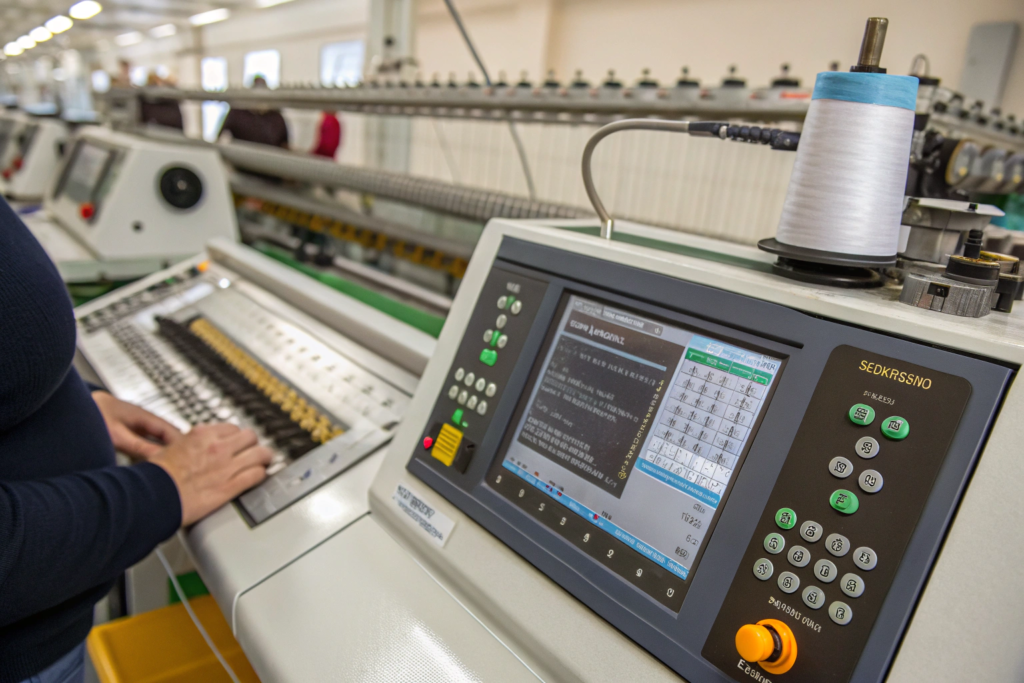
A flat knitting machine can be mechanical, semi-electronic, or fully electronic. A mechanical machine relies on a physical pattern chain and manual stitch cam adjustments. A semi-electronic machine uses digital pattern input but manual tension setting. A fully electronic machine uses servo motors to control every needle movement and stitch length digitally. The difference in yield between these technologies is enormous.
Fully electronic knitting machines reduce human error by replacing manual stitch cam adjustments with digital, programmable stitch length control accurate to 0.1 millimeters. The machine’s onboard computer monitors yarn feed tension 100 times per second and auto-adjusts the take-down roller speed to maintain consistent stitch formation. A mechanical machine requires the operator to "feel" the correct tension and adjust a knob. That manual adjustment drifts over an 8-hour shift as the operator fatigues.
We invested in Shima Seiki and Stoll fully electronic machines over the past six years. Our factory floor runs 200 of these machines. The yarn feed tension data is logged for every single panel, creating a digital record that allows us to identify a drifting tension sensor before it produces a single defective piece.
How does the automatic yarn splicing system prevent a dropped stitch defect?
On a mechanical machine, when a yarn cone runs out, the machine stops, the operator manually ties a knot to the new cone, and restarts. That knot often passes through the needles and creates a thick, hard spot in the fabric. Our electronic machines have an automatic splicer that joins the old yarn end to the new yarn end with a fine, compressed air tangle splice that is nearly invisible in the finished knit. The machine does not stop. The stitch formation continues uninterrupted.
What is the difference in daily output per machine between electronic and mechanical?
A skilled operator on a mechanical machine can manage 4 to 6 machines, producing roughly 20 to 25 panels per machine per shift. A single operator on our electronic floor manages 12 to 15 machines, each producing 35 to 40 panels per shift. The higher machine productivity and lower operator-to-machine ratio mean fewer human-induced errors per panel, directly boosting yield.
Why Does a Stable Workforce Produce Fewer Stitch Defects?
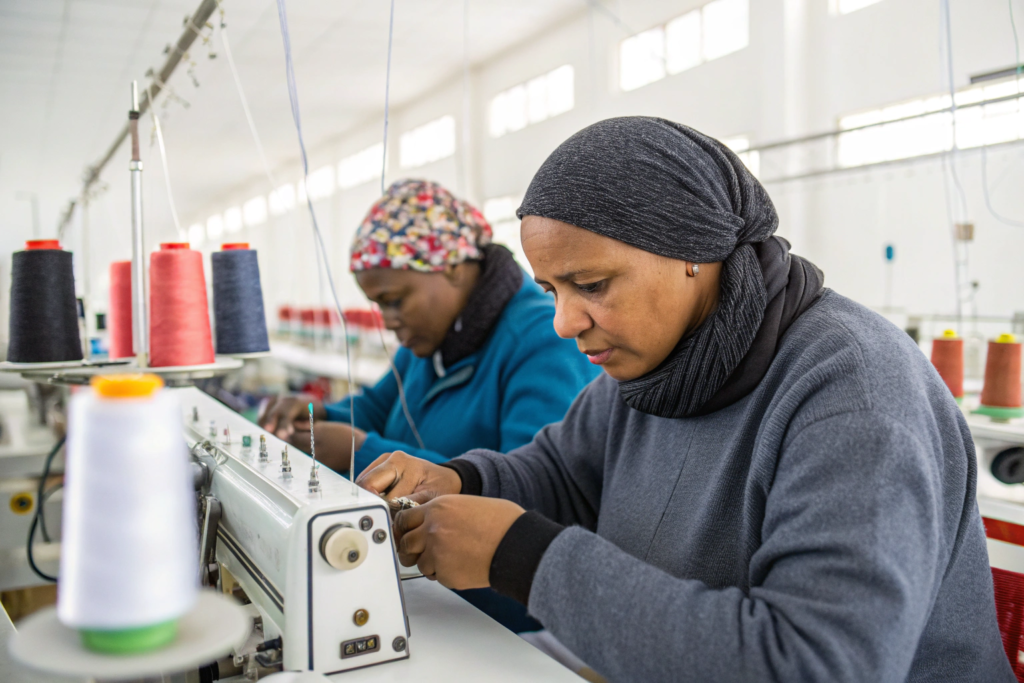
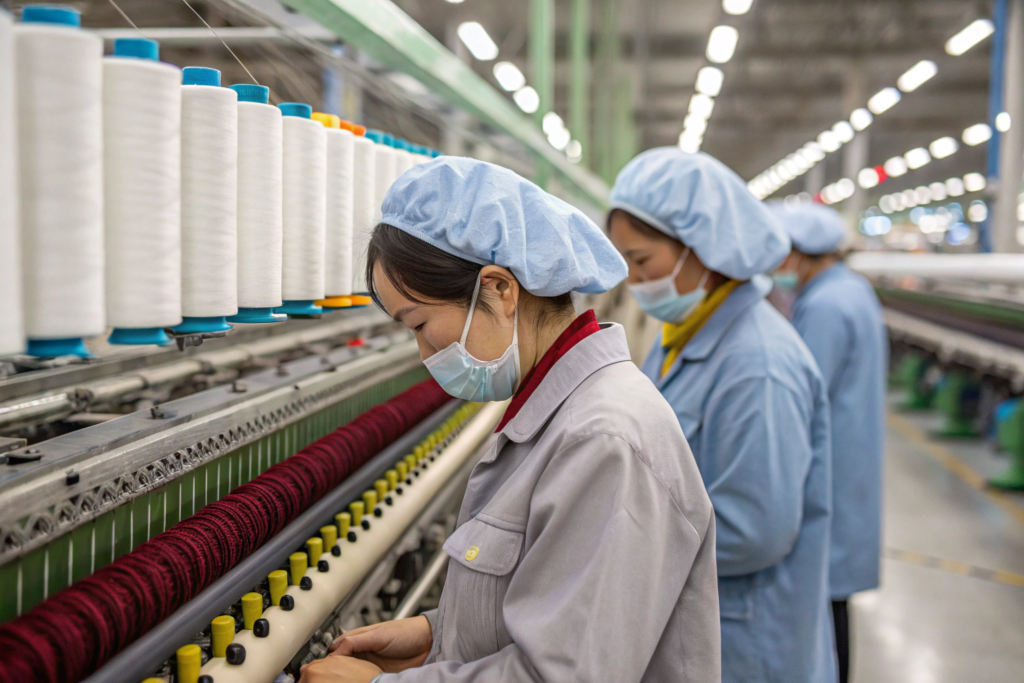
Knitting is a tactile skill. A master knitter hears a needle clicking wrong before she sees the defect. She feels the yarn tension through her fingertips as she threads the machine. This sensory knowledge cannot be trained in a week. It accumulates over years. A factory with a revolving door of newly trained workers is a factory with a high defect rate.
A stable workforce produces fewer stitch defects because experienced knitters develop an intuitive, sensory understanding of correct machine operation. They detect a developing needle hook defect by the subtle change in the machine’s vibration sound. They adjust yarn tension by the feel of the thread between their fingers, a calibration that a digital sensor can approximate but a human hand perfects over a decade of daily practice. Our average knitter tenure is 8 years. Industry average turnover in Vietnam’s rapidly expanding garment sector exceeds 30% annually.
We retain our workforce through year-round employment, competitive wages, and a respectful factory culture. Our knitters live in nearby apartments, not distant dormitories. Their children attend local schools. They are not seasonal migrants who return to rural villages after a two-year factory stint. This stability produces a cumulative skill base that yields a measurable quality advantage.
How does worker tenure correlate with defect rate in knit production?
Our internal quality data tracks defects by operator ID. A knitter in her first year averages a 3.5% defect rate, primarily from tension errors and late detection of broken needles. A knitter with five years of experience averages a 0.8% defect rate. The difference is not diligence. It is the subconscious pattern recognition that only develops with time.
Why does the Zhejiang textile cluster attract and retain a skilled workforce?
Zhejiang has been the center of Chinese textile manufacturing for centuries. The craft knowledge is intergenerational. A daughter learns knitting from her mother who learned from her grandmother. The support ecosystem, machine maintenance technicians, yarn suppliers, pattern programmers, is all located within a short distance. A skilled knitter in Zhejiang can change jobs without uprooting her family, which creates a competitive labor market that rewards workers who build deep expertise.
How Do Our QC Gates Catch Defects That Other Factories Ship?
A defective knit hat can be created in seconds but caught at multiple points before it enters a shipping carton. A factory with a single final inspection gate catches the defect, but the hat is already made. The yarn is already wasted. A factory with inline inspection gates catches the defect at the point of creation and stops the waste before it multiplies.
Our QC gates catch defects at four stages: incoming yarn inspection for hairiness and color consistency before the yarn enters the knitting floor, in-process panel inspection at the machine where a QC roamer checks every 50th panel for stitch integrity, post-linking inspection where the crown seam is checked for skipped stitches, and final AQL 2.5 random sampling before packing. A Vietnamese factory operating on tight margins often reduces to a single final inspection gate, by which time the defective product has consumed all the raw material and labor of the good product.
The yarn inspection gate is the most valuable. We run every incoming yarn lot through a yarn evenness tester that measures mass variation along the yarn length. A lot with a coefficient of variation above 5% is rejected before it touches a knitting needle. This prevents an entire production batch from being knitted with intrinsically defective yarn.
What is a "QC roamer" and how does this role differ from a line supervisor?
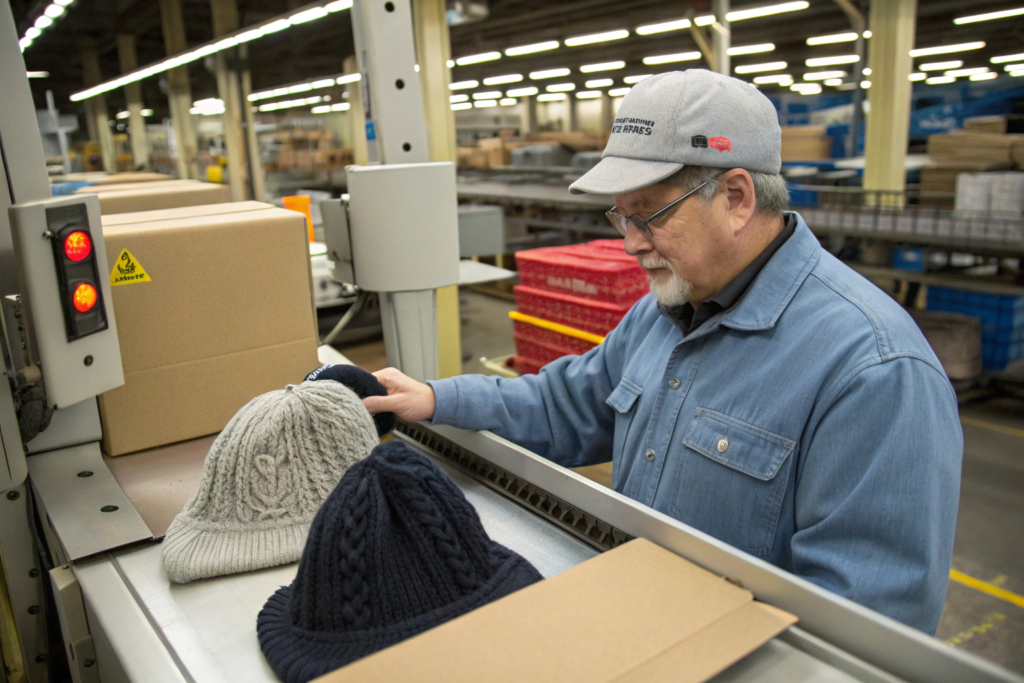
A QC roamer has no production responsibility. They do not care if the line hits its hourly target. They walk the knitting floor continuously with a clipboard and a stitch gauge, pulling panels from the collection bins at random. They measure stitch density against the approved standard and flag any machine whose panel shows a density drift. The line supervisor’s job is to keep the machines running. The roamer’s job is to stop a machine the moment it starts producing defects.
How does the post-linking seam inspection prevent the most common beanie failure?
The linking machine sews the crown seam. A skipped stitch on this seam creates a hole that opens up the first time the beanie is stretched over a head. Our post-linking inspector stretches every single seam over an illuminated inspection cone that backlights any stitch gap. This 100% inspection catches the defect before the beanie moves to steam finishing.
Conclusion
Our higher production yields for knit hats compared to Vietnam are the result of a localized yarn supply chain that eliminates moisture-related stitch defects, a fully electronic machine park that controls stitch length to 0.1mm without operator drift, a stable workforce with an average 8-year tenure that detects machine issues by sound and touch, and an inline QC gating system that catches defects at the point of creation, not the shipping dock. The 14-point yield gap between our 96% and a typical Vietnamese factory’s 82% is worth more than the apparent unit price savings.
Our Zhejiang factory is an integrated knitwear production facility with 200 electronic flat knitting machines, in-house yarn inspection, and a seasoned workforce. We produce knit beanies, scarves, and gloves for North American and European brands that demand consistent quality at volume.
If you are evaluating knit accessory sourcing between China and Vietnam and want a total cost analysis that includes yield, contact our Business Director, Elaine. She will send you a side-by-side yield comparison for your specific beanie style and a factory floor video showing our QC gates in action. Write to her at elaine@fumaoclothing.com. Let’s calculate the true cost per perfect hat.