
You watch a toddler on a playground yank the Velcro strap on his baseball cap. He rips it open, smushes the hat backward, and the strap catches a chunk of his fine hair. He screams. His mother rushes over, untangles the Velcro from his hair, and shoves the hat into the diaper bag. That hat will not be worn again. The Velcro closure was cheap and functional, but it failed on a squirming child in under ten seconds. A children’s hat closure is not just a fit adjuster. It is a safety device, a sensory comfort object, and a frustration trigger all in one.
The 2026 popular closure types for children’s hats are defined by three safety-and-comfort-driven designs: a magnetic Fidlock-style buckle that snaps closed without pinching skin or catching hair, a hidden elastic back panel that provides a continuous, pressure-free stretch fit with no hard components, and an oversized pull-tab hook-and-loop strap with a soft, rounded-edge tab and a "silent" loop fabric that does not produce the aggressive tearing sound that triggers sensory-sensitive children.
The closure is the single most interactive component on a child’s hat. The child and the parent will touch it dozens of times per wear. If it hurts, they remember. If it is confusing, they struggle. If it makes a scary sound, they resist wearing the hat entirely. I want to break down each closure type, the testing we perform to ensure skin safety and durability, and how these designs are winning placement in children’s boutiques across North America and Europe.
Why Are Magnetic Fidlock Buckles Winning Over Traditional Pinch Clips?
The side-release pinch clip, a plastic buckle where two prongs squeeze inward to release, has been the default closure on children’s backpack straps and hat chin straps for three decades. It works. It is cheap. But it has a design flaw that every parent has experienced: the prongs pinch the child’s neck skin when the buckle snaps closed. The resulting yelp creates an instant negative association with the hat.
Magnetic Fidlock buckles are winning because they close automatically and silently with no moving pinch points. The two halves of the buckle contain aligned magnets that guide the parts together from a short distance. The child or parent simply brings the two ends near each other, and the buckle snaps shut with a soft, satisfying click. To open, the user slides the two halves apart laterally, a motion that requires deliberate adult-level dexterity, not a toddler’s random squeeze.
We source these buckles from the German brand Fidlock’s OEM supply channel. The magnetic mechanism is fully enclosed inside a smooth, rounded plastic housing with no exposed metal. The magnet is a sealed neodymium disc that will not corrode from sweat, saliva, or washing machine exposure. The mechanical locking arms engage with a positive click that can support a 15-kilogram pull force, far exceeding the force a struggling child can apply.
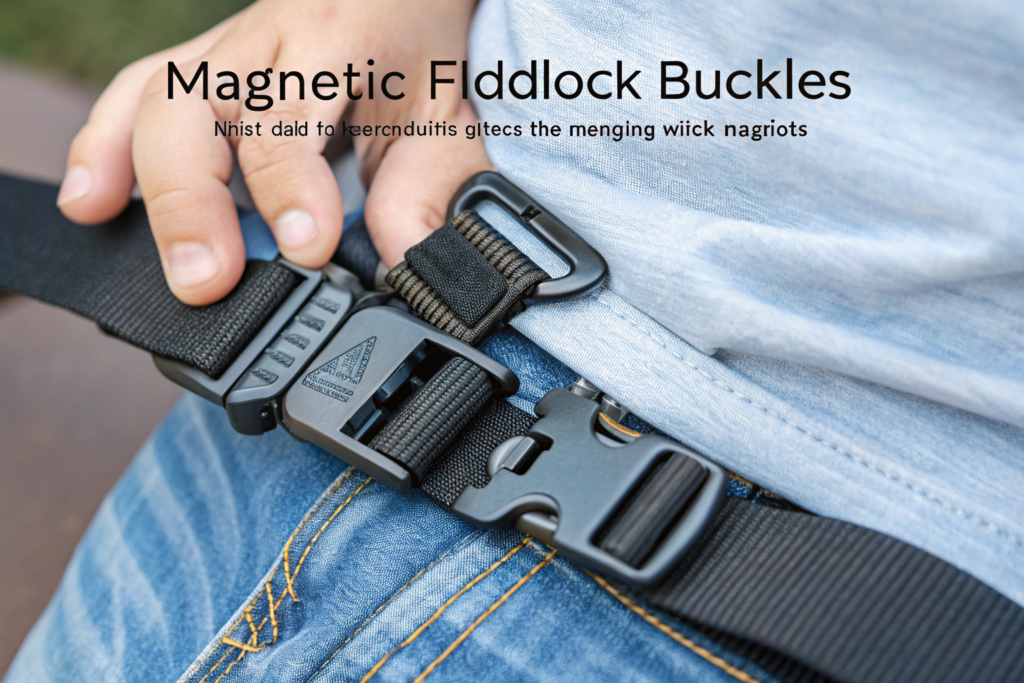
Is the magnetic field safe for a child wearing the hat for hours?
The magnetic field strength from a single Fidlock buckle is under 0.5 Tesla and is fully contained within the buckle housing. The field projects less than 2 centimeters from the buckle surface. It does not penetrate the skin or interfere with any medical device at the head or neck distance. The buckle is compliant with the EU Toy Safety Directive and the US CPSIA for children’s products.
How does the lateral slide-to-open mechanism prevent accidental release?
A standard pinch clip releases when squeezed from the sides, a motion a toddler performs naturally by grabbing the buckle. The magnetic Fidlock releases only by sliding one half laterally against the other, a precise shear motion that a young child cannot perform accidentally. The parent can open it one-handed, but the child cannot.
What Hidden Elastic Back Panels Offer a Seamless, Pressure-Free Fit?
A traditional children’s cap has an adjustable strap at the back, a plastic buckle, a metal slider, or a hook-and-loop tab. These hard components sit directly against the back of the child’s head. When the child leans back in a car seat or a stroller, the hard buckle presses into the skull. This pressure point causes discomfort, fussing, and hat removal.
A hidden elastic back panel eliminates the hard rear buckle entirely. Instead of an open strap, the back of the cap is constructed as a continuous fabric panel with an internal, wide elastic band sewn between the outer fabric and the lining. This elastic panel stretches up to 6 centimeters to accommodate different head sizes, then contracts to provide a gentle, distributed pressure around the entire head circumference with zero localized pinch points.
We construct this panel using a 40-millimeter-wide braided elastic with a soft, brushed cotton casing. The elastic is sewn into a fabric tunnel in the back panel, invisible from the outside. The cap looks like a custom-fitted hat from the rear, with no straps, buckles, or adjustment mechanisms visible.
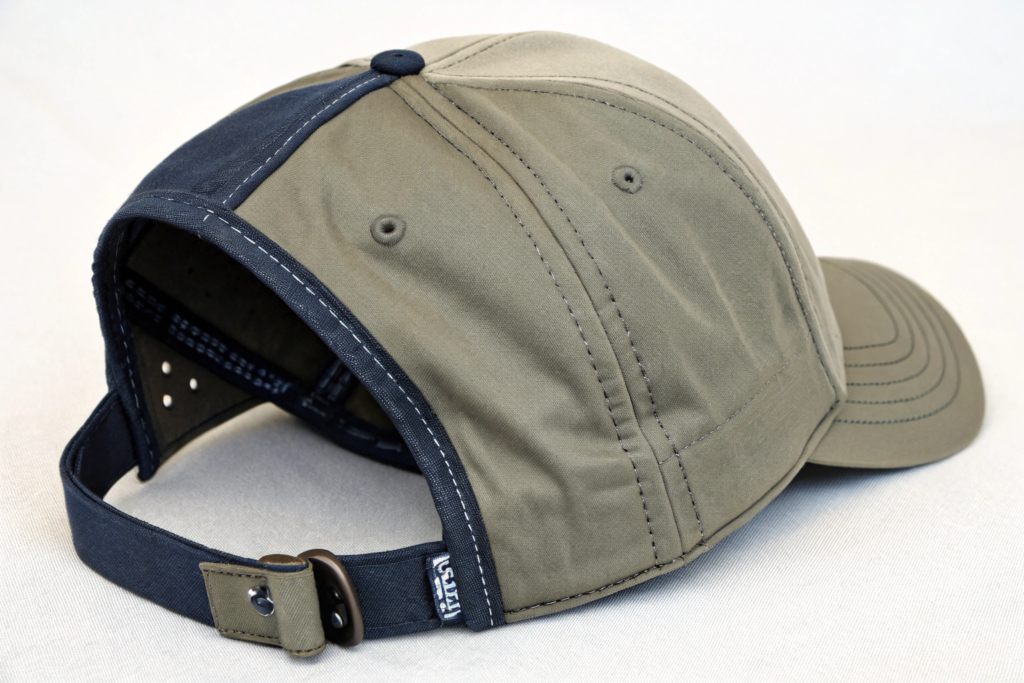
How does the hidden elastic panel handle different head sizes across a wide age range?
We specify the elastic with a moderate stretch modulus that accommodates a 4-centimeter size range. A toddler-sized cap fits head circumferences from 48 to 52 centimeters. A child-sized cap fits 52 to 56 centimeters. The elastic provides a gentle, uniform squeeze rather than the concentrated pressure of a tight strap, making the cap comfortable for a child at either end of the size range.
Does the elastic panel lose its stretch after repeated washing?
We use a high-retention polyester-wrapped rubber elastic core that is tested to survive 50 machine wash cycles at 40 degrees Celsius with less than 8% loss of initial stretch tension. The elastic is fully enclosed in a cotton casing, so it is protected from direct abrasion, detergent, and UV degradation.
What Sensory-Friendly Hook-and-Loop Design Avoids Hair Snagging?
Hook-and-loop tape, commonly known by the brand name Velcro, is the most universal closure in children’s accessories. It is cheap, it is simple, and every child can operate it. But standard hook-and-loop tape is made from stiff, sharp nylon hooks that grab and tangle fine, curly, or long hair. Removing the hat becomes a painful operation.
A sensory-friendly hook-and-loop design replaces the standard sharp nylon hook tape with a molded, mushroom-shaped polypropylene hook that has rounded, smooth heads instead of sharp, cut nylon prongs. This "soft hook" still engages securely with the loop fabric but does not snag hair or skin. The pull tab is oversized, at least 5 centimeters long, and made of a soft, fold-over elastic that a child can grip even with undeveloped fine motor skills.
We source the soft hook tape from a specialist supplier. The mushroom heads are microscopic, 0.3 millimeters wide with a completely smooth, domed top surface. They engage the loop fibers securely but release cleanly from any entanglement. We test the closure by rubbing it against a sample of fine, curly human hair mounted on a test sled. After 100 engagement cycles, the hair must show zero visible damage under 10x magnification.
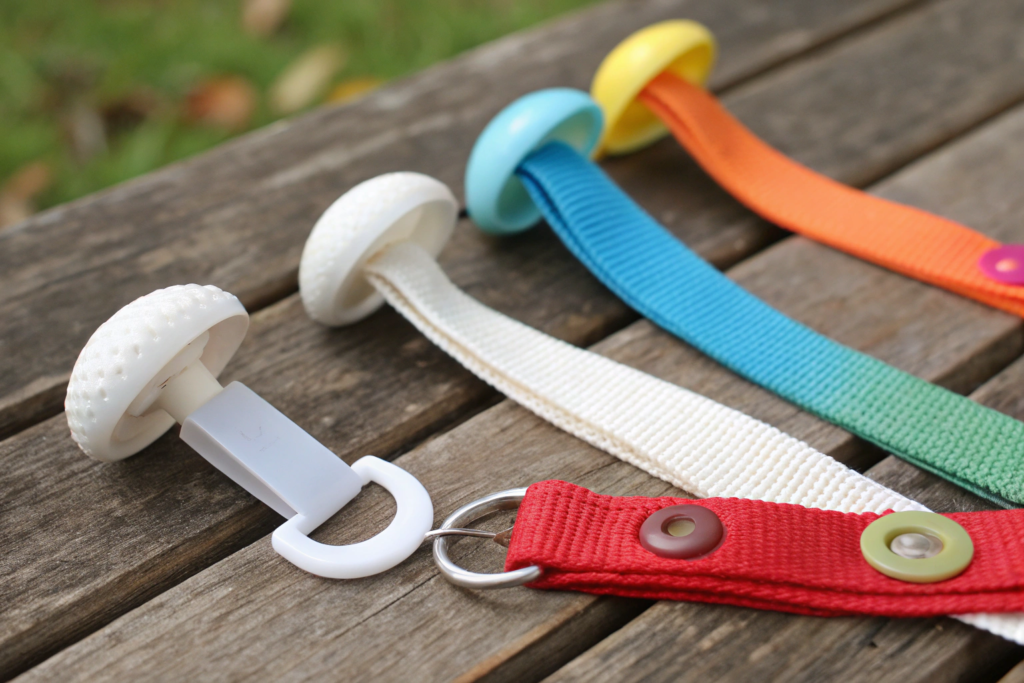
How is the "silent" loop fabric produced?
Standard loop fabric is made from rough, crunchy nylon fibers that produce a loud, aggressive tearing sound when opened. For sensory-sensitive children, often those on the autism spectrum, this sound is physically painful and triggers an immediate negative reaction. Our silent loop fabric is made from soft, brushed polyester microfibers that release with a whisper-quiet "shush" sound, under 40 decibels in a standard pull test.
Why does the oversized pull tab matter for child development?
A standard hook-and-loop tab is 2 to 3 centimeters long and sits flat against the hat crown. A young child’s pincer grip is undeveloped, and they cannot grasp the small tab. An oversized, 5-centimeter tab with a folded shape provides a large, easy target that a child as young as two years old can grasp and pull. This fosters independence, the child can put on and take off their own hat, which is a key developmental milestone.
What Safety Testing Must a Children’s Hat Closure Pass?
A closure that works perfectly in an adult’s hands can be a choking hazard, a laceration risk, or an entrapment danger in a child’s world. Children’s products in the US and EU are subject to specific, legally enforced safety standards that go far beyond general textile testing.
A children’s hat closure must pass four specific safety tests: the small parts test under 16 CFR Part 1501 where the closure is subjected to a torque and tension test to ensure no component breaks free and becomes a choking hazard for a child under three, the sharp point test under 16 CFR Part 1500.48 to ensure no broken or exposed component has a sharp point, the flammability test under 16 CFR Part 1610 for general wearing apparel, and the CPSIA total lead content test ensuring all components contain less than 100 parts per million total lead.
We submit every new closure design to an accredited third-party laboratory, typically SGS or Bureau Veritas, for a children’s product safety test package. The lab report is specific to the closure design, listing every material and component. This report is provided to our brand clients for their own Children’s Product Certificate filing.
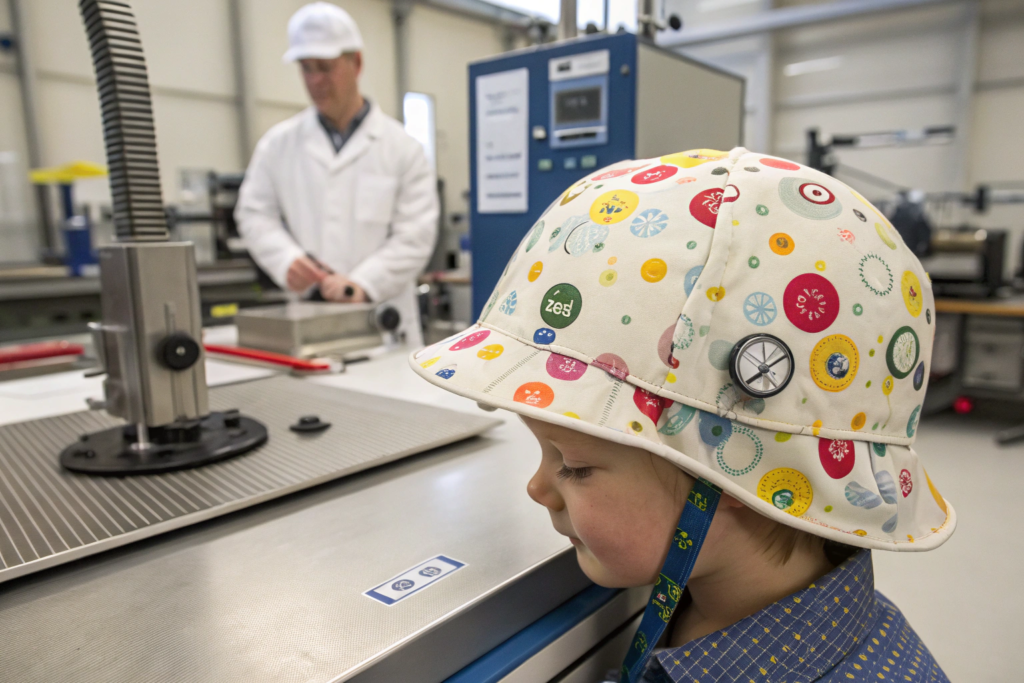
What is the specific torque and tension test procedure?
The lab technician clamps the buckle or closure component in a torque testing device and applies a twisting force of 4 inch-pounds for 10 seconds. Then the component is clamped in a tension tester and pulled with a force of 15 pounds for 10 seconds. Any component that detaches and fits entirely inside a small parts cylinder, a tube 31.7 millimeters in diameter, fails the test and is a reportable choking hazard.
Does the magnetic buckle pass the "magnet ingestion" standard?
The magnet inside the Fidlock buckle is fully enclosed and cannot be accessed without destroying the buckle housing using tools not available to a child. The sealed buckle passes the small parts test with zero detachable components. The magnet size, although not accessible, is specified to be above the small parts cylinder threshold as an additional safety margin.
Conclusion
The 2026 children’s hat closure is a sensory-conscious, safety-engineered component designed to be operated by undeveloped hands and chewed by teething mouths without causing harm. The magnetic Fidlock buckle eliminates pinch injuries and allows one-handed parent operation. The hidden elastic back panel removes all hard rear components for car seat comfort. The soft hook-and-loop with a silent loop fabric prevents hair snagging and sensory distress. All designs pass CPSIA small parts, sharp point, flammability, and lead content testing.
Our Zhejiang factory sources the Fidlock buckles, the soft hook tape, and the high-retention elastic from certified children’s product component suppliers. We maintain the third-party lab reports and provide the full documentation package to our brand clients.
If you are designing a children’s hat line and need closures that parents will love and children will tolerate, contact our Business Director, Elaine. She will send you a sample hat with each closure type and the corresponding safety compliance certificates. Write to her at elaine@fumaoclothing.com. Let’s make a hat closure that disappears from the child’s awareness and gives the parent peace of mind.