You have a brilliant marketing idea. You want to give away custom printed microfiber cleaning cloths as corporate gifts. They are practical, lightweight, and everyone uses them. You can already picture your logo beautifully printed on a soft, vibrant cloth, handed out at a trade show, tucked into a welcome kit, or sent as a holiday thank-you. You contact a supplier and ask for a quote. Their response stops you cold. The minimum order is 10,000 pieces. You only need 500. You are not a mass-market retailer. You are a brand looking for a promotional item. You start to wonder if your clever gift idea is dead before it even launches.
The minimum order for custom printed microfiber cleaning cloths as gifts typically ranges from 100 to 500 pieces for standard sizes with a single-color logo print. If you need full-color sublimation printing, the minimum is usually around 200 to 500 pieces. Some specialized promotional product suppliers offer ultra-low minimums of 50 pieces, but the per-unit price is significantly higher. The key is to find a manufacturer who produces the microfiber cloth in-house and has flexible printing setups that do not require expensive plate charges for small runs.
I run AceAccessory, a factory in Zhejiang, China. We manufacture fabric accessories, including microfiber cleaning cloths, for brands, retailers, and promotional distributors around the world. I have worked with clients who needed 100 pieces for a small corporate event and clients who needed 50,000 pieces for a national retail promotion. I understand the balancing act between minimum order quantities, printing methods, and per-unit costs. Let me walk you through exactly how this works so you can find the right solution for your gift project.
Why do microfiber cloth factories set minimum order quantities?
You might think a factory is being difficult when they quote a high minimum order. You send a polite email asking for 200 pieces. They reply with a 2,000-piece minimum. It feels like they do not want your business. The reality is different. Factories are designed for efficiency. Every order, no matter how small, requires the same amount of paperwork, machine setup, and production planning. A single piece of microfiber cloth costs almost nothing. But the labor to set up the cutting machine, mix the ink, register the screen, and package the goods is fixed. The factory needs a minimum order size to cover these fixed costs and still make a small profit.
Microfiber cloth factories set minimum order quantities because the production process involves several fixed-cost steps that are the same whether you order 100 pieces or 10,000 pieces. The fabric knitting or weaving setup, the dyeing batch, the screen preparation for printing, and the cutting and hemming machine setup all require labor and time. If the order is too small, the unit price would have to be unreasonably high to cover these costs. Most factories find it easier to set a standard minimum and politely decline orders below it.
At our factory, we have invested in flexible production cells specifically for small-batch promotional orders. We understand that a corporate gift order is fundamentally different from a retail stock order. The customer is not reselling the cloths. They are buying a marketing service. Their budget is fixed. Their quantity is driven by their guest list, not a shelf planogram. We have adapted our processes to serve this market profitably without the high minimums that scare away small brands. Let me explain the two main cost drivers, fabric preparation and printing plate setup, that determine where the minimum order line is drawn.
How does fabric preparation affect the minimum order for microfiber cloths?
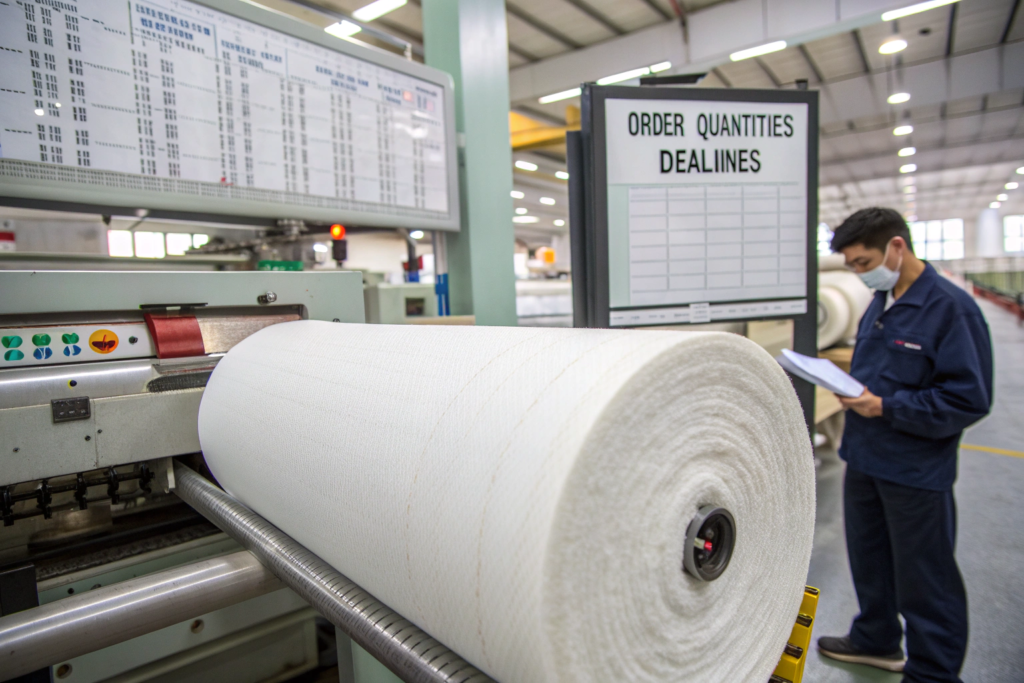
Microfiber fabric starts as a roll of knitted or woven material. The base fabric is produced in large batches on circular knitting machines. These machines run most efficiently with a minimum run of several hundred meters. A small order of 200 cloths might only need 50 meters of fabric. The factory does not knit 50 meters. They take fabric from a larger stock roll. But if you want a specific color that is not in stock, the factory would need to dye a small batch. Dyeing has its own minimum. The dye bath can hold maybe 100 kilograms of fabric. Your small order might only need 5 kilograms. The dyeing cost per kilogram becomes very high. This is why the lowest minimums are usually available on standard white or black microfiber cloths. If you need a custom Pantone-colored cloth, the minimum quantity will be higher to justify the dyeing setup. You can learn more about textile production processes from Textile World, which covers the economics of fabric manufacturing. The American Association of Textile Chemists and Colorists provides technical standards for dyeing and colorfastness that explain why small dye lots are challenging.
What role does the printing method play in setting the MOQ?
The printing method is the biggest driver of minimum order quantities for custom printed cloths. Screen printing requires a physical screen to be made for each color in your design. The screen costs money, typically 30 to 50 dollars per color. This setup cost is amortized over the quantity of cloths printed. If you order 10,000 pieces, the screen cost per piece is fractions of a penny. If you order 100 pieces, the screen cost per piece is 50 cents. That makes the unit price look terrible. Factories set a minimum to make the math work.
Digital printing, or dye-sublimation, eliminates the screen cost. It prints directly from a digital file onto transfer paper, which is then heat-pressed onto the cloth. There is no screen, no plate, and no physical setup. The setup cost is essentially zero. This allows for very low minimum orders, sometimes as low as one piece for a sample. However, the per-unit ink cost is higher than screen printing. For small orders of a few hundred pieces, digital printing is almost always the better choice. For large orders of many thousands, screen printing is more economical. Our factory offers both methods so we can recommend the right one for your quantity. You can explore the technical differences between these printing methods at Specialty Graphic Imaging Association, which provides educational resources on digital and screen printing technologies.
What is a realistic MOQ for different types of custom printing on microfiber cloths?
When a client asks me for the minimum order, I cannot give a single number. The answer depends entirely on what kind of print they want. A simple one-color logo is a different world from a full-color edge-to-edge photorealistic image. The printing technology, the setup cost, and the production speed are different. You need to match your design ambition to your order quantity. If you have a small budget and a small quantity, you should simplify your print requirements. The per-unit cost will stay reasonable, and you will still get a beautiful, functional gift.
For a single-color screen-printed logo on a standard white microfiber cloth, a realistic MOQ is 100 to 300 pieces. For multi-color screen printing, expect a minimum of 300 to 500 pieces per design. For full-color sublimation printing, the realistic MOQ is 200 to 500 pieces. Some promotional product specialists offer sublimation MOQs as low as 50 pieces, but the per-unit price will be significantly higher, often double the price at 500 pieces. For extremely large orders of 10,000 pieces or more, screen printing becomes very cost-effective, and the MOQ is not a concern.
At AceAccessory, we have structured our pricing to be transparent across these quantity bands. We show the client the trade-off curve. At 100 pieces, the unit price might be one dollar. At 500 pieces, it drops to sixty cents. At 5,000 pieces, it drops to thirty cents. The client can see exactly how the setup costs amortize. They can make an informed decision. Perhaps they order 100 pieces for the executive gift bags and pay the premium. Or they order 5,000 pieces for a trade show giveaway and enjoy the volume discount. Let me break down the specifics of screen printing and sublimation printing MOQs, and what to expect for hemming and finishing.
How does the number of print colors change the minimum for screen printing?
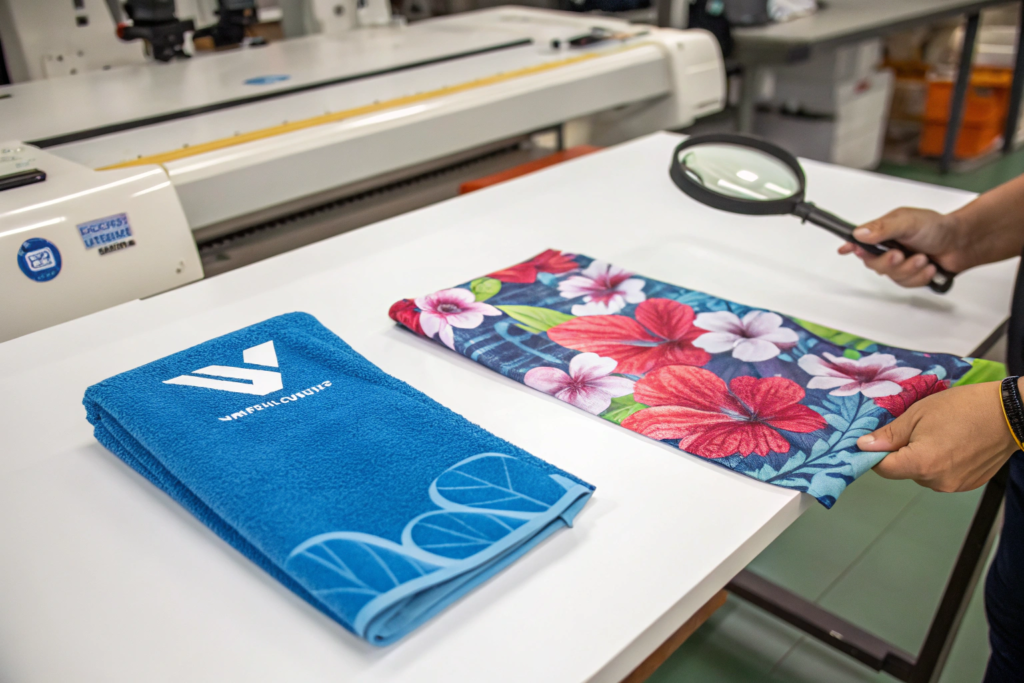
Every color in a screen-printed design requires a separate screen. A one-color logo needs one screen. A three-color logo needs three screens. The setup cost is multiplied by the number of colors. For a small promotional order, I always advise clients to limit their design to one or two colors. This keeps the setup cost low and the MOQ achievable. A single-color print is crisp, professional, and classic. It looks great on a corporate gift cloth.
If your brand logo is naturally multi-colored, you can still use a one-color version for promotional products. Most brands have a simplified single-color variant of their logo for small-scale applications. Ask your marketing team for this version. It will save you money and open up lower MOQ options. If you absolutely must have a four-color process print on 100 cloths, screen printing is not the right method. You should switch to digital sublimation. The MOQ for four-color screen printing is realistically 1,000 pieces or more because of the high setup complexity. The registration of multiple screens on a soft, stretchy microfiber cloth requires skilled labor and time. For more details on screen printing preparation, the Printing United Alliance offers comprehensive guides on screen making and color separation for textiles.
Is there a minimum order for different edge finishes like hemming or laser cutting?
The edge finish is an important quality detail, especially for a gift. A raw-cut edge on a microfiber cloth is functional but looks cheap. For a corporate gift, you want a finished edge, usually a stitched hem or a clean laser-cut seal. The good news is that edge finishing typically does not increase the minimum order quantity significantly. The machines that do overlock stitching or laser cutting are fast to set up and do not require expensive tooling for each design.
A standard overlock stitch around the edge adds a small cost per piece, maybe five to ten cents, but usually has no effect on the MOQ. We do this on our standard sewing lines alongside our other accessory products. Laser cutting creates a sealed, smooth edge that will not fray. The laser machine uses a digital file to cut the shape. There is no physical die to make. This means there is no minimum order for laser cutting shapes. You can order 100 cloths cut into a custom gift shape, like a heart or a circle, for the same setup effort as a square. This is a great way to add a premium feel to a small gift order without triggering a higher MOQ. You can learn about laser cutting technology for textiles from Industrial Laser Solutions, which covers applications in fabric processing.
Can I order a sample before committing to the full gift order quantity?
You are about to place an order for 500 gift cloths. You have seen a digital mockup. It looks great on your screen. But you have a nagging worry. Will the colors match? Will the logo be sharp? Will the cloth feel soft and premium, or scratchy and cheap? You are spending your marketing budget on these gifts. If they arrive looking wrong, you cannot give them away. Your brand reputation is on the line. You need to touch the product, see the print, and approve it before the full batch is produced.
Yes, you can absolutely order a sample before committing to the full gift order quantity. In fact, any reputable manufacturer will insist on sending you a pre-production sample for approval. For digital sublimation printing, a single sample costs between 20 and 50 dollars, including courier shipping. For screen printing, a sample might cost more because the screens must still be made. However, some factories offer a "strike-off" sample on a similar fabric to show the color and placement without making the full screen. You should never skip the sample step, especially for a custom printed product where color matching is critical.
At our factory, the sample process is standard for every promotional order, no matter how small. We send the digital proof first. The client approves the layout. We print one physical sample and ship it by DHL or FedEx. The client receives it in three to five days. They check the print quality, the cloth weight, the edge finish, and the packaging. Only after they email us their formal approval do we begin mass production. This protects both parties. The client knows exactly what they will receive. We know we are producing to an approved standard. Let me explain the difference between a free digital proof and a paid physical sample, and how long sampling takes for a gift project.

What is the difference between a digital proof and a pre-production physical sample?
A digital proof is a computer-generated image showing how your design will look on the cloth. It is free and fast. We usually send it within 24 hours of receiving the artwork. The digital proof is useful for checking the layout, the logo placement, and the overall proportions. However, it cannot show you the true colors, the fabric texture, or the print sharpness. Screens display colors in RGB, which is different from the CMYK colors used in printing. A bright blue on your screen might print as a duller shade on the cloth.
A pre-production physical sample is a real cloth, printed with your design using the exact production method and materials. It shows you the true print quality. You can feel the cloth. You can wash it to test durability. You can see the color under different lighting conditions. This is what you should approve before mass production. We charge a small fee for the physical sample, but we refund this fee if you proceed with the full order. This is a common industry practice. It covers our material and shipping costs but does not profit us. It is an investment in getting the order right. For more on color management between digital and physical printing, you can check resources at Pantone, which sets the standard for color communication in the printing industry.
How long does sampling and production take for a small gift order?
Timeline is a critical factor for promotional gifts. You have an event date. The gifts must be ready before that date. There is no flexibility. A typical timeline for a custom printed microfiber cloth gift order of 500 pieces is as follows. Day one to day three, we prepare the digital proof and the client approves it. Day four to day six, we produce the physical sample and ship it by express courier. Day ten, the client receives and approves the sample. Days eleven to twenty, we complete mass production. Days twenty-one to twenty-four, we ship by air freight. The goods arrive approximately three and a half to four weeks after the initial order confirmation.
If the timeline is very tight, we can expedite. We can produce the sample in 24 hours and ship by the fastest courier service. We can split the production into smaller batches so the first batch ships while the rest is still being made. All of this adds cost, but when the event date is immovable, the cost is worth it. We always ask the client for their "in-hands date" at the very beginning of the conversation. We reverse-engineer the timeline from that date. Clear communication about the deadline prevents disappointment. For international shipping timeframes, you can check express delivery guarantees on the DHL or FedEx websites.
How can I package custom microfiber cloths to look like premium gifts?
The product is only half the gift. The presentation is the other half. A naked microfiber cloth in a plain polybag looks like a utility item, a cleaning rag. A beautifully packaged microfiber cloth looks like a thoughtful brand gesture. You want the recipient to feel valued, not like they just received a freebie. You want them to associate your brand with quality and care. The packaging transforms the perception of the item. This is especially important for corporate gifts given to VIP clients, event attendees, or employees.
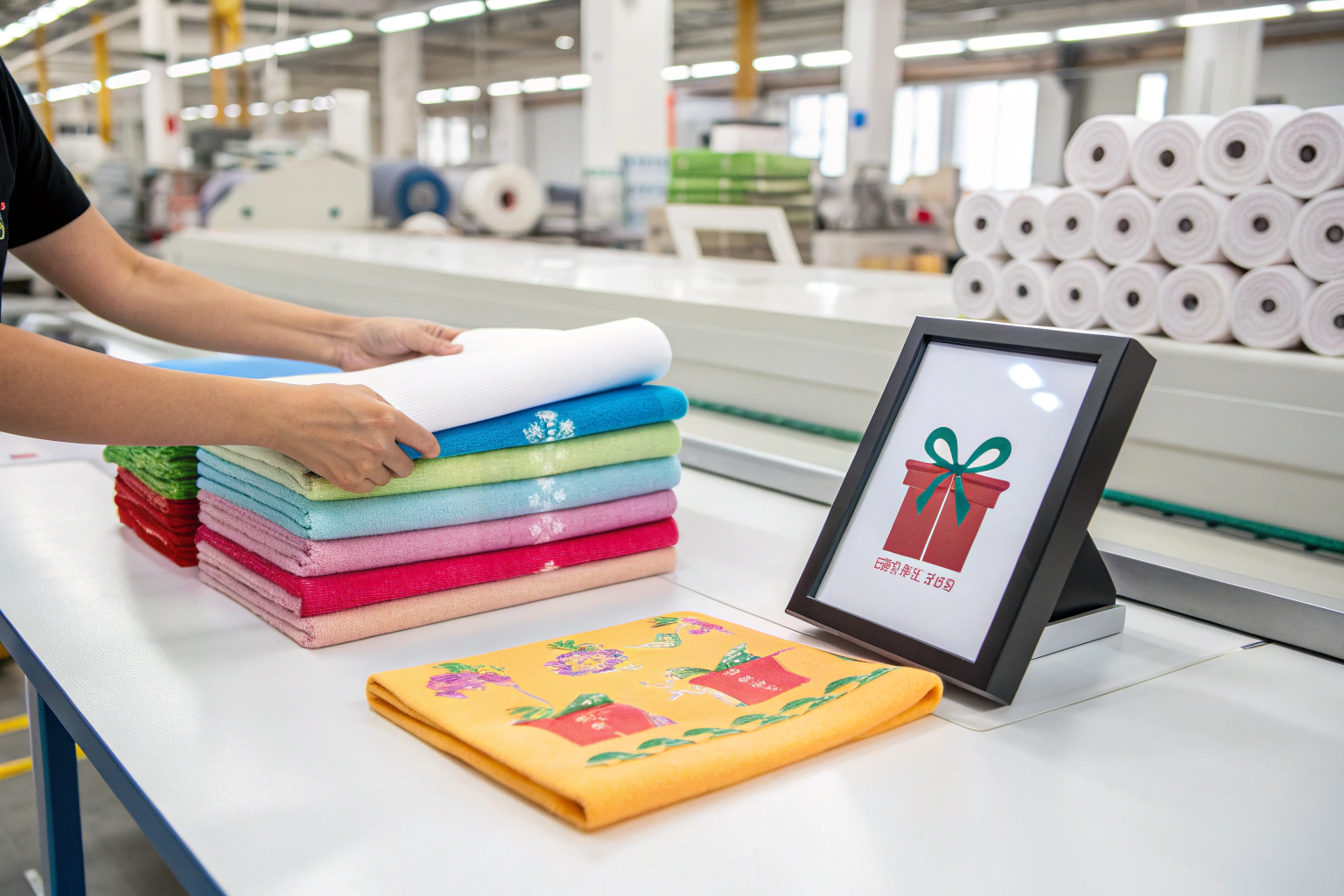
You can package custom microfiber cloths as premium gifts by using rolled-and-ribbon presentation, custom gift boxes with foam inserts, or branded header cards with euro slots for retail-style hanging. A simple and elegant option is to fold the cloth neatly, wrap it in tissue paper with a branded sticker, and place it in a slim, two-piece cardboard box. The box can be printed with a thank-you message. Another popular option for tech accessory gifts is to roll the cloth and place it in a round tube with a branded sleeve. This looks like a premium screen cleaner gift. For a trade show, you can use a branded header card and a clear cellophane bag, so the cloth is visible and the branding is prominent.
At our factory, we offer packaging as a full-service option. We do not just make the cloth and ship it in bulk. We design and produce the complete gift package. Our in-house packaging team can source custom boxes, ribbons, stickers, and insert cards. We can assemble the full gift kit on our packing line. This means you receive a finished product that is ready to hand out, not a box of raw cloths that you still have to package yourself. Let me explain how ribbon bands and header cards work, and how to print a message directly on the cloth for a minimal, elegant look.
How do ribbon bands and header cards add value to a microfiber cloth gift?
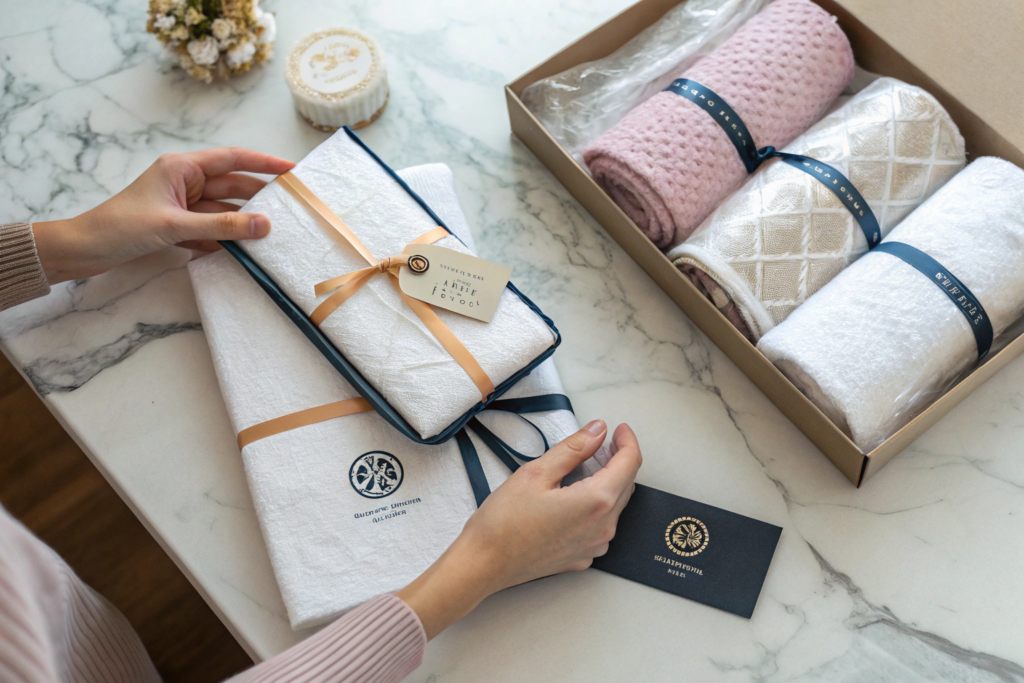
A ribbon band is a simple strip of paper or fabric that wraps around the folded or rolled cloth. It is held in place with a small piece of adhesive or a sticker. The ribbon is printed with your brand name, a short message, or a decorative pattern. It instantly elevates the presentation. The cloth feels like a considered gift, not a bulk item. The ribbon is inexpensive, often costing less than ten cents per piece. But the perceived value it adds is much higher.
A header card is a folded piece of cardstock that is stapled or taped over the top of a polybag. It is the standard packaging for retail accessories like hair clips and belts. For a microfiber cloth, a header card allows you to tell a story. You can print the front with your logo and a beautiful image. You can print the back with care instructions, a brand message, or a list of uses for the cloth. The header card turns a simple cloth into a branded product. It also allows the item to hang on a retail peg if you decide to sell the cloths later. The setup cost for a custom header card is low, usually just the cost of the cutting die. MOQs for header cards are typically 500 pieces, which aligns well with a gift cloth order.
Can you print a personalized thank-you message directly on the cloth itself?
Yes, and this is a beautiful, minimal option. If you want to keep the packaging simple but still convey a personal touch, you can print a short message directly on the cloth. We have done this for wedding favors, where the cloth reads "Thank you for celebrating with us, Sarah & Tom, June 2026." The message is printed in a corner or along one edge. The rest of the cloth is the functional microfiber surface. The recipient gets a useful gift with a permanent personal reminder.
For corporate gifts, the message could be "Thank you for your partnership in 2026" or a simple brand tagline. This approach eliminates the need for extra packaging. The cloth itself is the card. It is eco-friendly because there is no paper waste. It is also foolproof, the message cannot be separated from the gift. The printing cost is the same as printing a logo in the same area. There is no extra setup. It just uses a slightly different artwork file. We have helped many small business clients create these personalized cloths for their customer appreciation events. The feedback is always positive. A practical gift with a personal message feels genuine and memorable.
Conclusion
Ordering custom printed microfiber cleaning cloths as gifts does not require massive quantities. The minimum order quantity depends on the printing method and the level of customization you need. A simple, single-color logo on a standard white cloth can be ordered in batches as small as 100 pieces. Full-color sublimation printing starts realistically at 200 pieces. The key is to work with a manufacturer who has flexible production capabilities and understands the promotional products market. You should always request a pre-production physical sample to check the print quality, the colors, and the cloth feel. Factor in about three to four weeks from order confirmation to delivery. And do not overlook the packaging. A well-packaged cloth transforms from a commodity cleaning rag into a premium brand gift. A ribbon band, a custom header card, a gift box, or a printed personal message on the cloth itself all add significant perceived value for a small additional cost. The goal is to make the recipient feel valued and to associate your brand with quality and thoughtfulness.
If you are sourcing custom microfiber cloths for an upcoming event, corporate gift program, or promotional campaign, we can handle the entire project for you. Our factory in Zhejiang produces the cloth, prints your design, and assembles the complete gift package. We work with small businesses, marketing agencies, and large corporate clients across North America and Europe. We understand that a gift order is about timing and presentation as much as it is about the product itself.
To discuss your custom microfiber cloth gift project, request a sample, or get a quote with packaging options, contact our Business Director, Elaine. Her email is elaine@fumaoclothing.com. Let us help you create a promotional gift that your clients will actually use and remember.