
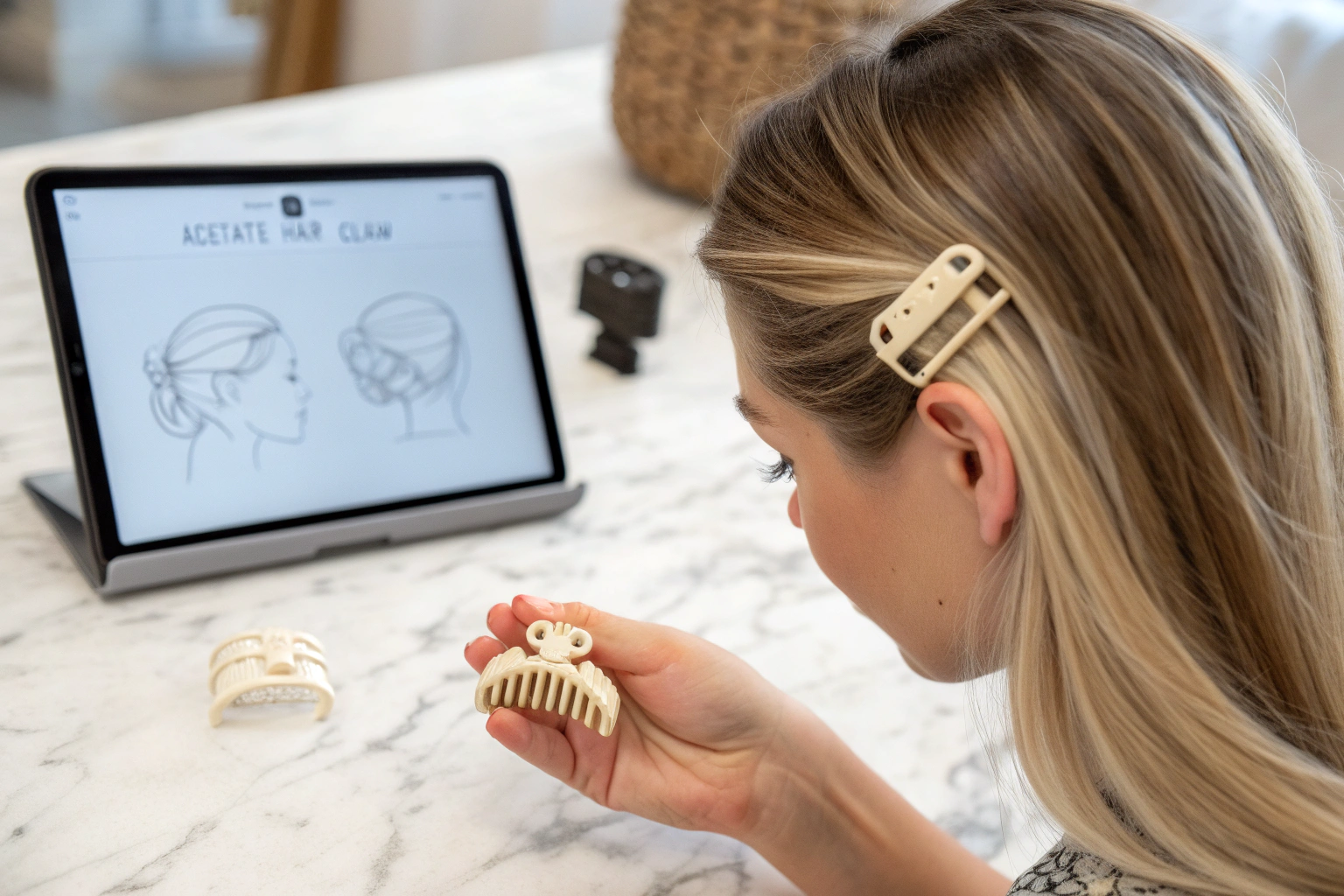
A woman walked into my office three years ago with a simple, profound frustration. She had thick, gorgeous hair, but her daughter had fine, silky hair that slipped out of every hair clip on the market. Standard claws were too heavy, too loose, and too big. They pulled, slipped, and ended up lost on the floor. She asked me if we could design a claw specifically engineered for fine hair, not just a smaller version of an adult claw, but a fundamentally different product. We did, and that design is now one of our best-selling private-label programs.
Yes, our factory can absolutely produce custom shaped hair claws specifically engineered for fine hair. This is not a matter of simply scaling down a standard mold. Fine hair presents a unique set of engineering challenges: the jaw must close with a narrower gap and a softer, more consistent clamping force; the teeth must interlock tightly to grip without requiring heavy tension; and the overall weight of the claw must be minimized to prevent it from dragging itself out of the hair. Achieving this requires a different approach to mold design, spring calibration, and material selection.
At our factory in Zhejiang, we have developed proprietary mold designs specifically for fine hair. I want to explain why fine hair requires a dedicated engineering approach, how we solve the specific problems of slip and weight, and what you need to know to develop a custom claw that actually works for this underserved segment of the market.
Why Do Standard Hair Claws Fail for Fine Hair?
Standard hair claws are designed for the average consumer, and the average consumer has medium to thick hair with some natural texture that helps the claw hold its position. The design assumptions baked into most claw molds—the jaw opening distance, the spring tension, the tooth length, and the overall weight—are all optimized for this average. Fine hair violates every one of these assumptions.
Fine hair has a smaller total diameter when gathered. The individual strands are smoother and have less natural friction against each other and against the plastic teeth of the claw. The hair weighs less, so the claw’s own weight becomes a more significant destabilizing force. A standard claw with wide-set teeth will simply slide out of a fine hair ponytail within minutes because there is not enough bulk to fill the jaw gap, and the smooth hair provides no grip against the smooth plastic teeth. Understanding these failure modes is the first step to designing a claw that works.
How does the jaw gap and clamping pressure affect hold on fine hair?
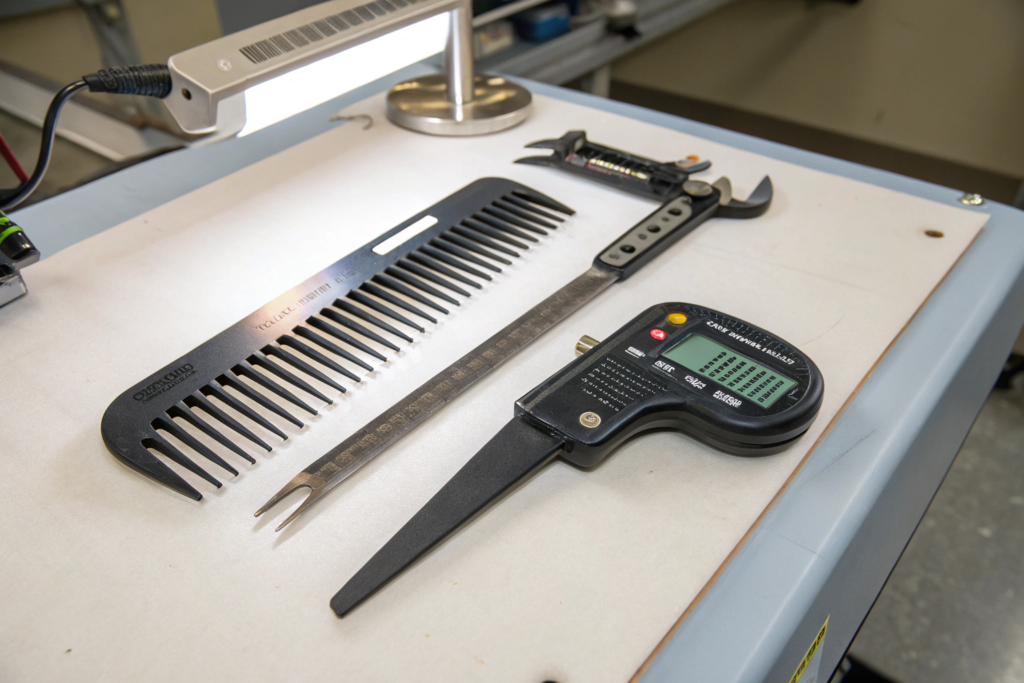
The jaw gap is the distance between the upper and lower sets of teeth when the claw is fully closed. In a standard claw designed for thick hair, this gap may be several millimeters or more, allowing the claw to encompass a large volume of hair. When this same claw is used on fine hair, the gathered hair bundle is much smaller in diameter, so the teeth do not make firm contact with the hair. The claw is essentially clamped around empty space with a few strands loosely touching the teeth. There is no grip. A fine-hair claw must have a significantly narrower jaw gap, so that the teeth close almost completely together, making contact with even a small bundle of hair. Additionally, the clamping pressure—the force exerted by the spring—must be calibrated lower. Too much pressure on a small amount of fine hair causes breakage and discomfort. Too little, and the claw falls out. The calibration of gap and pressure is a precision balance.
Why does claw weight and tooth density matter more for fine hair?
A heavy claw acts like a pendulum. As the wearer moves, the weight of the claw swings and the smooth, fine hair offers little resistance. The claw gradually works itself loose and falls out. For fine hair, the claw material and design must minimize overall weight. This is why we often recommend cellulose acetate over heavier metal alloys, and why we hollow out sections of the claw body in the mold design. Tooth density—the number of teeth per side—also matters. Fine hair requires more teeth, spaced closer together, to distribute the grip across many small points of contact. A standard claw might have four or five teeth per side. A fine-hair claw often has six to eight finer teeth that interlock like a comb. This hair grip mechanics in fine hair research confirms the importance of distributed contact points.
What Are the Specific Mold Design Features for a Fine Hair Claw?
The mold for a fine-hair claw is not a modified version of a standard mold. It is a fundamentally different design that must be machined from scratch. The core design elements that distinguish a fine-hair claw mold are the tooth profile and interlock geometry, the jaw hinge angle and spring seat, and the internal weight-reduction cavities.
The teeth on a fine-hair claw are not simple straight pegs. They have a slight curvature and a tapered profile that narrows toward the tip. When the claw closes, the upper teeth nest precisely between the lower teeth, creating a gentle, wave-like path for the hair that maximizes surface contact without pinching. The jaw hinge is designed to limit the maximum opening angle, preventing the user from overextending the claw and breaking it. The spring seat is machined to hold a lighter-gauge spring than a standard claw would use.
How does a curved, interlocking tooth design improve grip without damaging hair?
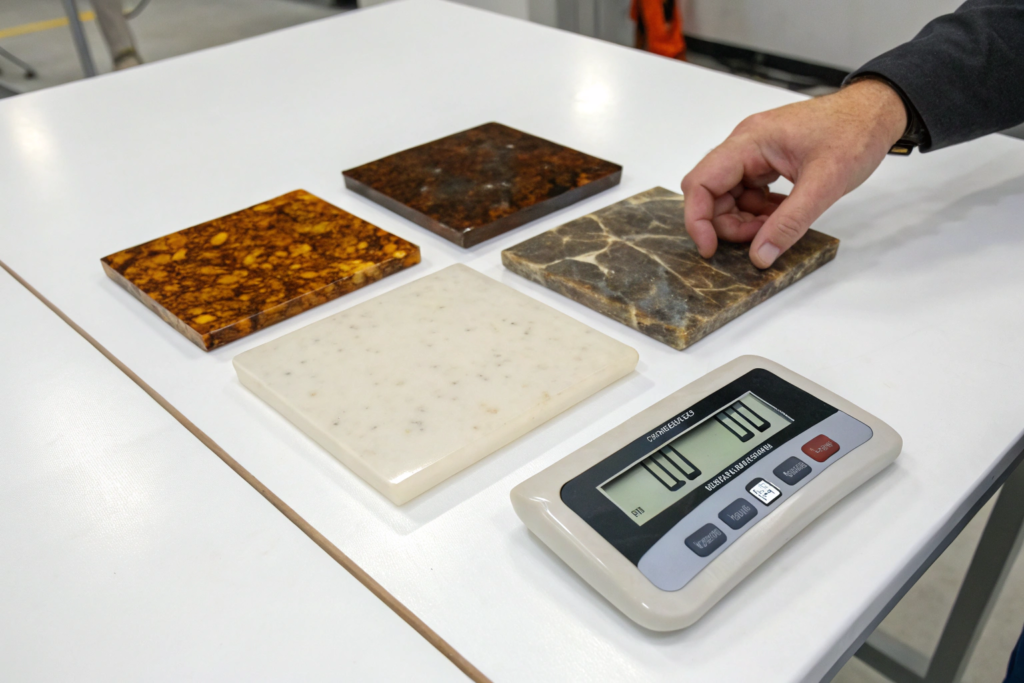
Traditional straight teeth meet tip-to-tip when the claw closes. This creates a pinch point where hair can be caught and snapped. Curved, interlocking teeth pass beside each other rather than meeting tip-to-tip. The hair is guided into a gentle S-curve between the upper and lower teeth. This increases the total surface area of tooth-to-hair contact, which increases friction and grip, without increasing the clamping pressure. The hair is held securely, but the individual strands are not crimped, bent, or broken. This interlocking tooth design for accessories is an established approach for gentle grip applications.
What spring tension calibration is ideal for fine hair security?
The spring is the muscle of the hair claw. A spring that is too strong clamps the hair with excessive force, causing headaches and hair breakage. A spring that is too weak cannot hold the claw closed against the movement of the wearer. For fine hair, the ideal spring force is calibrated lower than the standard. We measure spring force in Newtons at the point of jaw closure. A standard claw might use a spring that exerts a certain force. A fine-hair claw uses a spring with significantly less resistance. The exact specification depends on the claw size and the leverage ratio of the jaw design. Our mold engineers select and test springs from a library of calibrated options, matching the spring to the specific claw geometry. This spring tension in hair accessories is a critical performance variable.
What Material Is Best for Lightweight, Durable Fine-Hair Claws?
The material choice for a fine-hair claw must satisfy two requirements that are often in tension: low weight and high durability. The claw must be light enough to not pull itself out of fine hair, but strong enough to survive being dropped on a bathroom floor, tossed in a handbag, or stepped on by accident. The three materials that best satisfy these requirements are cellulose acetate, high-grade polycarbonate, and recycled PETG.
Cellulose acetate is the preferred material for premium fine-hair claws. It is a plant-based plastic made from wood pulp and cotton fibers. It has a lower density than many petroleum-based plastics, giving it a lighter feel. It can be polished to a glassy, snag-free surface that fine hair slides across without catching. It is also strong enough to flex slightly under pressure without snapping. Polycarbonate offers the highest impact resistance and can be molded with thinner walls, further reducing weight. Recycled PETG provides a sustainable option with good clarity and toughness.
Why is cellulose acetate preferred over injection-molded plastic for premium fine-hair claws?
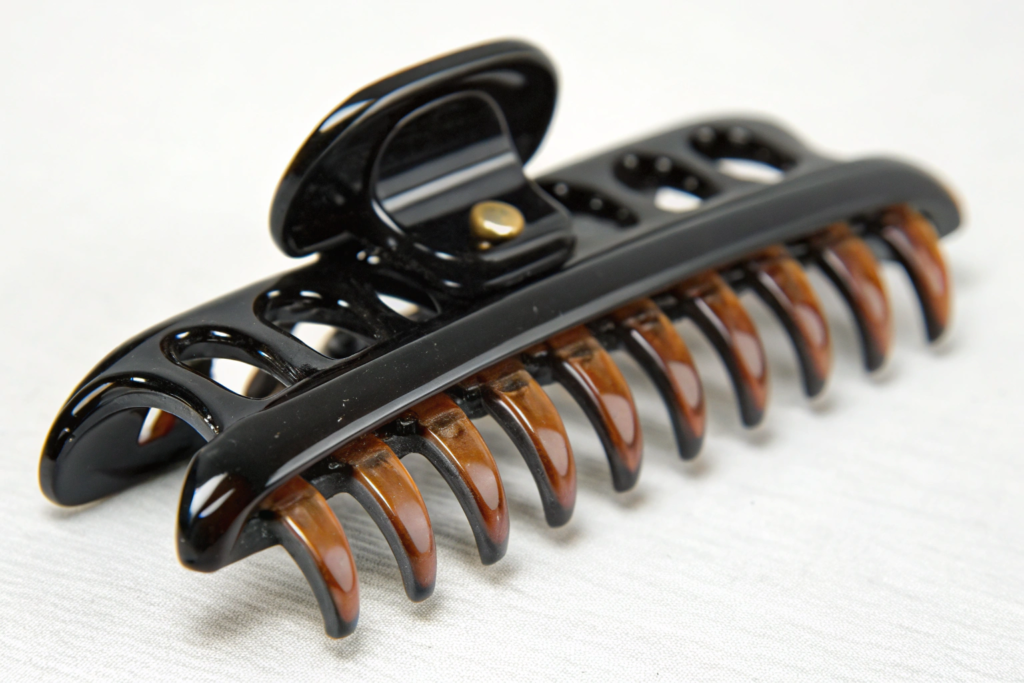
Injection-molded plastic, typically ABS or polypropylene, cools rapidly in the mold. This rapid cooling can create internal stresses and microscopic rough edges along the mold parting line. On fine hair, these micro-abrasions act like tiny saw teeth, snagging and breaking individual strands. Cellulose acetate is machined from a solid, stress-relieved sheet, not injection-molded. There is no parting line. The surface can be hand-polished to an exceptionally smooth, glassy finish that fine hair glides over without any friction or snagging. Acetate also has a lower specific gravity than most engineering plastics, so an acetate claw of the same dimensions is noticeably lighter. This cellulose acetate material properties explain its superior hand-feel.
How does a hollow-core or skeletonized design reduce claw weight?
Weight reduction is not only about the material; it is also about the structure. Our fine-hair claw molds often incorporate a skeletonized or hollow-core design. The internal structure of the claw body is not solid plastic. It is a lattice of thin walls that provide structural rigidity while removing unnecessary material. This can reduce the total weight of the claw by 20% to 30% without compromising strength. The hollow core is created by a complex mold with internal slides that retract after the plastic solidifies, leaving a cavity inside the claw body. This lightweighting through mold design is an advanced technique that requires precision tooling.
How Should a Fine-Hair Claw Collection Be Sized and Branded?
A fine-hair claw collection is not simply a set of small claws. The sizing must be intentional and graduated, and the branding must clearly communicate the functional benefit to a consumer who has likely been disappointed by dozens of products that claimed to work for her hair type but failed. The collection should include multiple sizes because fine hair comes in different lengths and volumes. A woman with fine, shoulder-length hair needs a different claw than a woman with fine, waist-length hair.
The branding and packaging should focus on the specific technical features that make the claw work: the narrow jaw gap, the lightweight design, the smooth finish, and the interlocking teeth. Phrases like "Engineered for Fine Hair," "No-Slip Grip," and "Featherlight Hold" communicate the functional promise. The packaging should also include usage instructions, because many women with fine hair have given up on claws and need to be taught how to use a properly designed one.
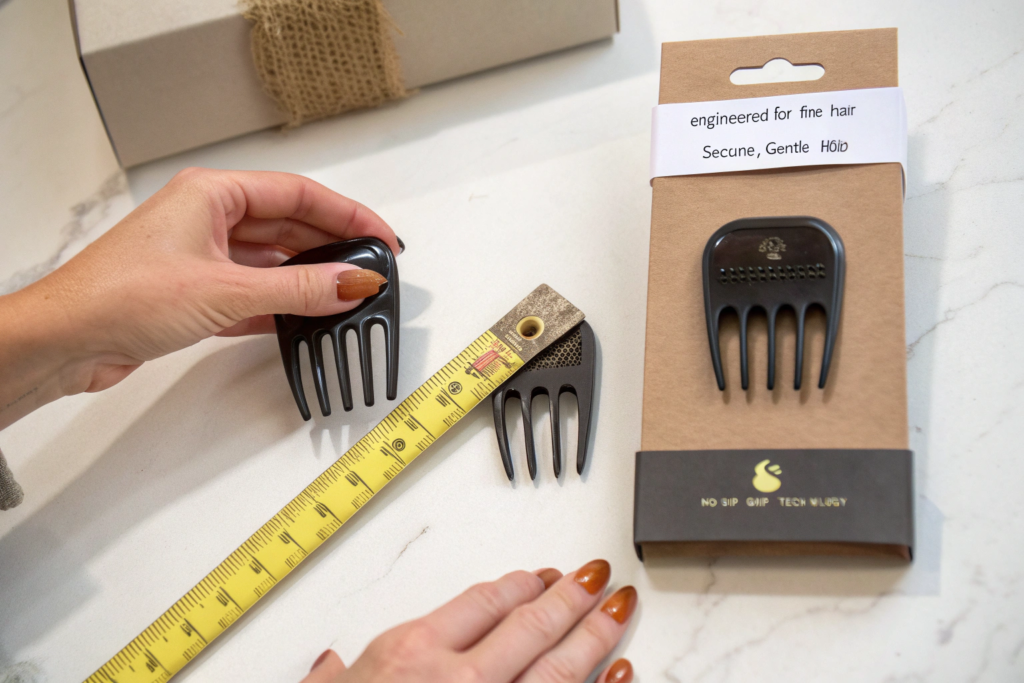
What size range is appropriate for a fine-hair specific line?
A typical fine-hair claw collection includes three sizes: Mini, for half-up styles and bangs, with a body length of approximately 5 to 6 centimeters; Petite, for a full ponytail or a small bun on shoulder-length fine hair, with a body length of approximately 7 to 8 centimeters; and Standard Fine, for a full bun on long fine hair, with a body length of approximately 9 to 10 centimeters. This is not simply a scaled-down version of a thick-hair size run. The jaw gap and spring tension are independently calibrated for each size, because the volume of hair each size will hold differs. This hair claw sizing for different hair types resource provides guidance on consumer expectations.
How should the packaging communicate the technical benefits for fine hair?
The packaging is the salesperson on the shelf. It must answer the consumer’s unspoken question: "Why will this claw work for me when every other one has failed?" The front of the package should state the core benefit in clear, bold language: "For Fine Hair." The back or inside of the package should include a simple diagram showing the interlocking teeth and the narrow jaw gap, with a brief explanation in plain language: "Closer-spaced teeth grip fine hair securely without pulling. Lightweight acetate design stays put all day." The packaging should be compact enough to fit easily in a purse or a stocking, reinforcing the portability of the product. This product packaging for functional benefits approach turns a frustrated consumer into a loyal brand advocate.
Conclusion
Producing custom shaped hair claws for fine hair is a precision engineering challenge, not a simple size reduction. It requires a mold designed from scratch with curved, interlocking teeth, a calibrated light-tension spring, and a narrow jaw gap. It requires a material choice, such as cellulose acetate or polycarbonate, that minimizes weight and provides a snag-free surface. And it requires a branding and sizing strategy that communicates the functional benefits clearly to a consumer segment that has been underserved for decades.
We have walked through the specific failure modes of standard claws on fine hair, the mold design features that address those failures, the material and weight-reduction strategies that make the claw comfortable for all-day wear, and the retail assortment and packaging considerations that connect the product with the consumer who needs it.
If you are interested in developing a custom fine-hair claw collection, we can provide a design consultation, 3D-printed prototypes for fit testing, and a range of material samples for your evaluation. Our Business Director Elaine manages our custom hair accessory development and can coordinate the sampling and mold fabrication timeline. Contact her directly at elaine@fumaoclothing.com. The fine-hair consumer has been waiting long enough for a claw that actually works. Let’s create it together.




