Years ago, I shipped a container of leather-accented hats to a boutique distributor in Hamburg. The hats themselves were perfect. The leather straps on the back of the caps were not. When the container arrived after 32 days at sea, the distributor opened the cartons and found a powdery white and grey fuzz creeping along the edges of the leather. The entire shipment was rejected. I had to fly to Germany to inspect the damage myself. The cause was not bad leather. It was trapped moisture. That failure taught me a lesson I now build into every leather product shipment we send to Europe. Long sea freight is a moisture trap. Leather is a food source for mildew. If you do not control the environment inside the carton and the container, you are gambling with your goods.
To avoid mildew on leather belts during long sea freight to Europe, you must prevent three things from happening simultaneously. Mildew requires organic material, moisture, and warm stagnant air. You cannot remove the organic material because leather is the product. You have limited control over the temperature inside a shipping container crossing the equator. The variable you can control is moisture. Moisture management is the single most effective defense against mildew. This means you must dry the leather to the correct moisture content before packing, you must pack with desiccants and breathable materials, and you must manage the container environment to prevent condensation. Each of these steps is simple on its own. Together, they create a system that keeps leather clean and dry for the four to six weeks a typical China-to-Europe sea freight journey takes.
Leather is hygroscopic. It absorbs water from the air. When the relative humidity inside a closed carton exceeds 65 percent, mold spores, which are present on virtually every surface, begin to germinate. They feed on the proteins and fats in the leather. The result is mildew, a surface fungal growth that stains, weakens, and permanently damages the leather. The smell alone makes the product unsellable. The financial loss is immediate. The solution is systematic moisture control from the tannery to the final delivery.
How Should I Prepare Leather Belts Before Packing to Prevent Moisture Damage?
The battle against mildew begins long before the container is loaded. If you pack leather belts that are too moist, no amount of desiccant will save you. The desiccant will saturate quickly, and the trapped moisture will remain inside the leather, feeding mildew growth from within. The first step is to verify the moisture content of the leather itself.
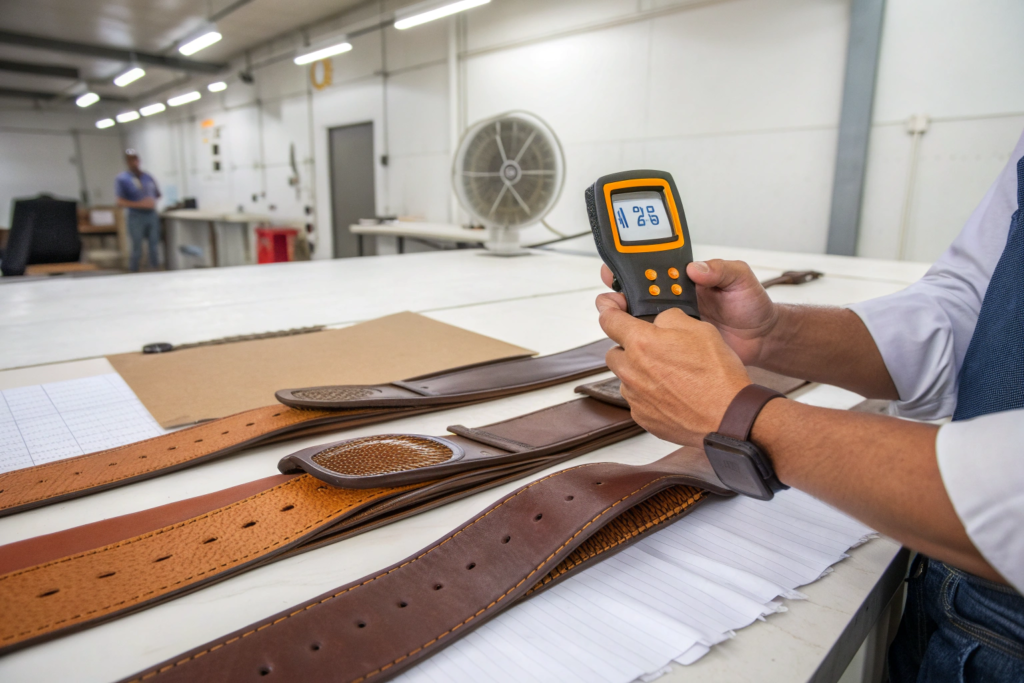
Leather should have a moisture content between 10 and 14 percent for safe long-term storage. This is the equilibrium moisture content for leather at normal room conditions. If the leather feels cool to the touch or damp, it is too wet. Use a calibrated leather moisture meter with a pin probe to measure the moisture content. Measure multiple belts from different parts of the production batch. Do not rely on a single reading. A belt stored near a humid wall or processed earlier in the day may have a different moisture level than one stored in a dry area.
If the leather moisture is above 14 percent, it must be dried before packing. The drying process must be gentle and gradual. Do not expose the leather to direct sunlight or high heat, such as a tumble dryer or a forced-air heater set above 40 degrees Celsius. Rapid drying causes the leather fibers to shrink and stiffen, ruining the belt’s flexibility and feel. Instead, place the belts in a well-ventilated room with a dehumidifier set to 45 to 50 percent relative humidity. Allow the belts to rest for 24 to 48 hours. Check the moisture content again before packing. This slow drying preserves the leather’s natural oils and suppleness while removing the excess water that mildew needs.
In addition to moisture control, consider applying a light anti-fungal treatment to the leather. This does not mean soaking the belts in harsh chemicals. A light application of a leather-safe anti-mildew agent, applied by spraying or wiping, can inhibit spore germination during transit. The product must be specifically formulated for leather and must not leave a visible residue or smell. Test the treatment on a sample belt before applying it to the entire production run. Some brands prefer to avoid chemical treatments and rely purely on moisture control. That is acceptable. But for long sea freight through tropical waters, an anti-fungal treatment adds a layer of insurance.
What Is the Correct Moisture Content for Leather Before Ocean Shipping?
The correct moisture content for leather entering long-term storage is between 10 and 14 percent, measured by a pin-type or contact moisture meter. This range represents an equilibrium with the surrounding air. At 10 percent moisture, the leather is dry enough to resist mildew but not so dry that it becomes brittle and prone to cracking. At 14 percent, the leather is at the upper boundary of safety. Above 14 percent, the free water inside the leather provides a suitable environment for mold spore activation.
The specific moisture level within this range should be influenced by the destination climate and the expected transit conditions. If the belts are shipping to Northern Europe in winter, the air inside the container will cool significantly during the journey, increasing the risk of condensation. In this scenario, a lower moisture content, closer to 10 or 11 percent, provides a greater safety margin. If the belts are shipping to Southern Europe in summer, the temperature inside the container will rise, and the air can hold more moisture without condensing. A moisture content of 12 to 13 percent may be acceptable. The key is to measure and document. Do not guess. A moisture meter designed specifically for leather, not for wood, provides the most accurate readings. Wood meters use different calibration curves and will give misleading results on leather.
Should I Use Anti-Fungal Sprays or Moisture-Absorbing Inserts for Leather Belts?
Anti-fungal sprays and moisture-absorbing inserts serve different but complementary functions. An anti-fungal spray acts on the leather itself. It either kills mold spores on contact or creates a chemical environment on the leather surface that prevents spores from germinating. The spray should be applied after the leather has reached the correct moisture content and before final packing. It must be fully dry before the belts are wrapped, or the wrapping will trap the solvent and create a new moisture problem.
Moisture-absorbing inserts, commonly desiccant bags, act on the air inside the packaging. They absorb water vapor that enters the carton during transit. Desiccants do not treat the leather. They treat the microclimate. A combination approach works best. The anti-fungal spray protects the leather surface where spores would germinate. The desiccant controls the air humidity that activates the spores. Used together, they create a defense in depth.
The type of desiccant matters. Silica gel is the most common and is safe for use with leather. It is inert, non-toxic, and effective across a wide range of temperatures. Clay desiccants, made from montmorillonite clay, are also effective and are often cheaper. Calcium chloride desiccants are more aggressive and can absorb more moisture by weight, but they can release liquid brine when saturated, which could damage leather if the packaging ruptures. For leather belts, silica gel or clay desiccant packets placed inside each polybag and inside each carton are the safest choice.
What Packing Materials Prevent Mildew Growth Inside Leather Belt Cartons?
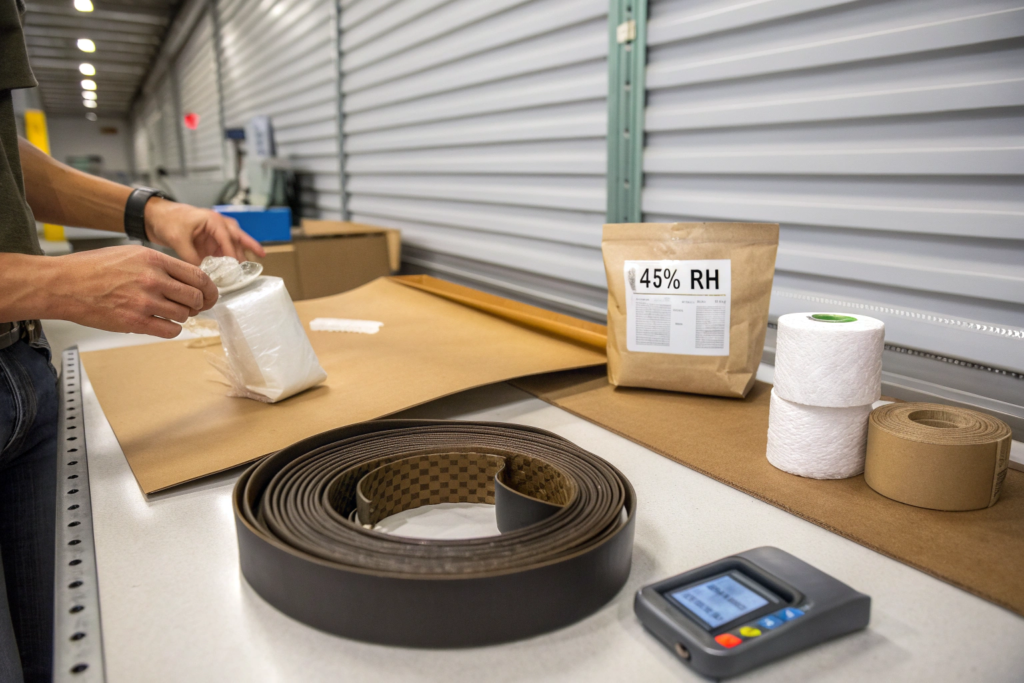
The choice of packing material directly affects the moisture level inside the carton. Plastic is the most dangerous material for long-term leather storage. A sealed polybag traps moisture inside. If the leather is even slightly too moist when packed, that moisture condenses on the inside of the plastic and feeds mildew growth. If the leather is dry, external humidity can still penetrate a poorly sealed bag and become trapped. Breathable packing materials, such as kraft paper or uncoated tissue paper, allow moisture vapor to escape and air to circulate.
Wrap each belt in a sheet of acid-free kraft paper. The paper absorbs any residual moisture on the leather surface and provides a physical barrier against dust and abrasion. Do not use newspaper or recycled paper with ink. The ink can transfer to the leather and the paper can contain acids that accelerate leather degradation. Acid-free tissue paper is a good choice for luxury products. It is soft, breathable, and pH-neutral.
Inside the carton, use desiccant packets placed strategically. A general guideline is to place one 5-gram silica gel packet inside each individual polybag or paper wrap, and one larger 100-gram packet inside the master carton. This creates multiple layers of moisture absorption. The desiccant inside the individual wrap protects the belt from its own residual moisture. The desiccant inside the carton protects against moisture entering through the carton walls. Ensure the desiccant packets do not touch the leather directly. The desiccant material itself is inert, but direct contact can create localized chemical reactions over long periods. Wrap the desiccant in a small paper pouch or place it in the corner of the carton away from the belts.
The carton itself should be double-wall corrugated cardboard. Single-wall cartons are more likely to absorb moisture from the container floor and transfer it to the contents. Double-wall cartons provide better insulation and structural strength. Consider adding small vent holes to the carton sides. Ventilation allows moisture vapor to escape rather than accumulating inside. The vent holes should be small, a few millimeters in diameter, to allow air exchange without letting in dust or pests.
Why Is Breathable Kraft Paper Better Than Plastic Polybags for Leather Ocean Freight?
Plastic polybags are the standard packaging for most textile products. They protect against dirt, water, and handling damage. But for leather goods in long sea freight, plastic is a trap. Leather is a living material that continues to exchange moisture with its environment. When a leather belt is sealed in a plastic bag, any moisture that evaporates from the leather condenses on the inside of the bag. The bag becomes a miniature greenhouse. The relative humidity inside approaches 100 percent. Mold spores germinate within days. The belt emerges from the bag covered in mildew, even if the rest of the carton is dry.
Kraft paper is breathable. Water vapor passes through the paper fibers and disperses into the air inside the carton. From there, the moisture can be absorbed by the carton’s desiccant packets or escape through the carton’s vent holes. The paper also acts as a buffer. If the belt is slightly moister than ideal, the paper absorbs the excess and spreads it over a larger surface area for evaporation. If the environment is dry, the paper releases moisture slowly, preventing the leather from drying out and cracking.
The tactile experience also matters for premium leather products. A belt wrapped in kraft paper feels more substantial and artisanal than a belt sealed in a plastic bag. The paper protects the leather from scuffing and keeps the buckle from scratching other belts. It is a practical and aesthetic upgrade.
How Many Desiccant Packets Should I Place in Each Leather Belt Carton?
The correct number of desiccant packets depends on the carton volume, the initial moisture content of the leather, and the expected transit duration. A basic calculation can be made using the desiccant capacity and the carton volume. Silica gel absorbs approximately 20 to 25 percent of its weight in water vapor under normal conditions. A 100-gram packet absorbs 20 to 25 grams of water. A carton measuring 50cm by 30cm by 20cm has a volume of 30,000 cubic centimeters, or 30 liters. The air inside this carton at 50 percent relative humidity and 25 degrees Celsius contains roughly 0.3 grams of water vapor. Even at 90 percent humidity, the air contains less than 1 gram. This seems like a small amount, but the desiccant is not just absorbing the air’s moisture. It is absorbing the moisture released by the leather and the moisture that diffuses through the carton walls over weeks of transit.
For a carton of this size containing leather belts, a single 100-gram silica gel packet is the minimum. Two 100-gram packets provide a safety margin. The packets should be placed at different corners of the carton to ensure even absorption. If the carton is larger, or if the leather was at the higher end of the moisture range, increase the desiccant quantity proportionally. Over-desiccating is less harmful than under-desiccating. Too much desiccant will not damage the leather. It will simply reach equilibrium at a lower humidity level. Too little desiccant means the humidity inside the carton rises above 65 percent, and mildew risk begins.
How Can I Manage Container Humidity to Protect Leather Belts During Transit?
The container is the largest packaging unit, and its internal environment determines the fate of every carton inside. A shipping container crossing from China to Europe passes through multiple climate zones. It may load in hot, humid Guangzhou, cross the tropical South China Sea, pass through the Indian Ocean, and arrive in cool, damp Rotterdam. Each temperature change creates condensation risk. When warm, moist air inside the container meets the cold steel walls, water condenses on the walls, the ceiling, and eventually, the cargo. This is called container rain. It is the primary cause of mildew on leather goods during sea freight.
Managing container humidity requires a layered approach. The first layer is the container itself. Inspect the container before loading. Check for holes in the roof, gaps in the door seals, and stains on the floor that indicate previous water ingress. A container with a leaking roof will defeat any amount of desiccant. Reject a damaged container and request a replacement.
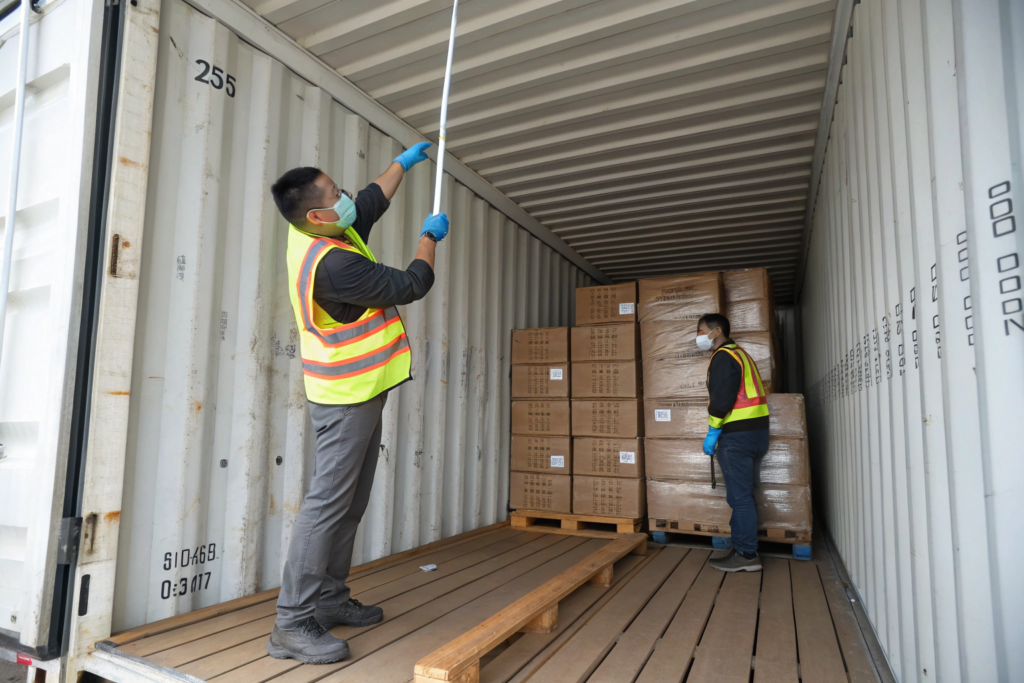
The second layer is container desiccant. Place hanging desiccant poles or blankets inside the container before loading. A standard 40-foot container typically requires 8 to 12 desiccant poles or 4 to 6 desiccant blankets, depending on the product’s sensitivity and the transit duration. These desiccants absorb water vapor from the air throughout the journey, keeping the relative humidity below 60 percent. The desiccant should be placed near the top of the container, where warm, moist air rises.
The third layer is the loading procedure. Line the container floor with a moisture barrier, such as a heavy-duty plastic sheet, before placing the pallets. The wooden container floor can hold significant moisture from previous shipments. This moisture evaporates during transit and rises through the cargo. A floor barrier blocks this source. Leave air gaps between the cartons and the container walls. Air circulation prevents localized humidity buildup. Do not pack the cartons tight against the walls. A 5 to 10 centimeter gap allows air to flow and reduces condensation on the carton surfaces.
What Is Container Rain and How Does It Cause Mildew on Leather Belts?
Container rain is the condensation of water vapor on the interior surfaces of a shipping container. The physics is simple. Warm air holds more water vapor than cold air. When a container loaded in a hot, humid climate moves into cooler waters or a cooler destination, the air inside the container cools. The water vapor capacity of the air decreases. The excess water vapor condenses on the coldest available surface, which is usually the steel container walls and roof. The result is droplets of water running down the walls and dripping onto the cargo.
Leather belts absorb this moisture directly if they are near the walls or if the water drips onto the cartons and soaks through. Even if the water does not directly touch the leather, the increased humidity inside the container pushes the carton environment above the critical 65 percent threshold. Mold spores activate, and mildew grows on the leather surfaces. The process is gradual and often goes unnoticed until the container is opened at the destination. By then, the damage is done.
The worst cases occur when the container passes through significant temperature swings. A container loaded in the heat of a summer afternoon, then crossing the cold North Atlantic, then unloaded into a warm European warehouse, will experience multiple condensation cycles. Each cycle adds more moisture to the cargo. Container desiccants and proper ventilation mitigate this risk.
Should I Use a Vapor Barrier on the Container Floor Before Loading Pallets?
Yes, a vapor barrier on the container floor is essential for any moisture-sensitive cargo. The wooden floor of a shipping container is one of the most underestimated sources of moisture. Container floors are made of thick plywood or bamboo laminate, both of which are hygroscopic. They absorb water from previous cargoes, from humidity in the terminal, and from rain during storage. When the container is sealed and the interior temperature rises during transit, this trapped water evaporates into the container air. The humidity rises, and condensation begins.
A heavy-duty plastic vapor barrier, laid on the floor before the pallets are loaded, blocks this moisture migration. The barrier should be at least 6 mil thickness, approximately 0.15 millimeters, and should extend slightly up the container walls. The pallets are placed on top of the barrier. Any moisture in the container floor stays below the barrier and does not reach the cartons.
For extra protection, place a layer of dry wooden pallets on top of the barrier. The pallets elevate the cartons above any minor water that pools in the floor corrugations. The pallets themselves should be heat-treated and dry. Avoid pallets that show visible water stains or that smell musty. The combination of vapor barrier and dry pallets creates a moisture break that significantly reduces the risk of mildew from below.
What Pre-Shipment Inspection Should I Conduct for Leather Belt Mold Prevention?
A pre-shipment inspection is the final quality gate before the goods enter the shipping container. By this point, you have dried the leather, treated it if necessary, wrapped it in breathable paper, placed desiccants, and prepared the cartons. The inspection verifies that all of these steps have been completed correctly and that no contamination has occurred during packing and staging.
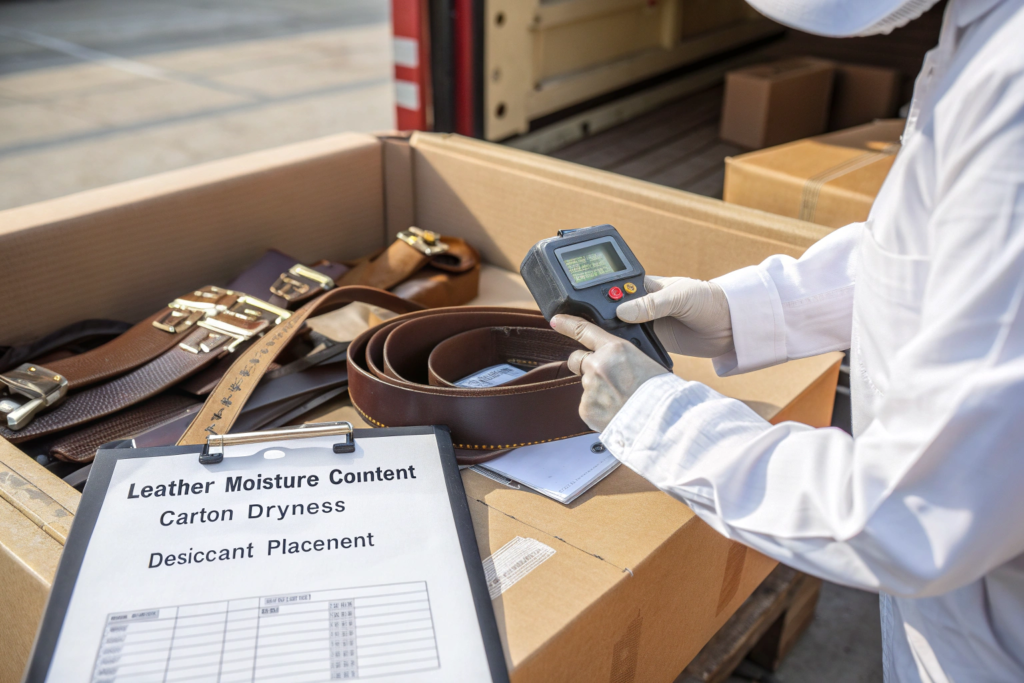
The inspection begins with a visual examination. Open a random sample of cartons, following an AQL sampling plan. Remove several belts from each selected carton and examine them under bright light. Look for any sign of white, grey, or green fuzzy growth on the leather surface, along the stitching, or inside the buckle areas. Mildew at the packing stage is faint and easy to miss. Use a flashlight held at a low angle to reveal surface texture. If any mildew is found, the entire batch is at risk, and the source of the moisture must be identified before shipping.
Next, verify the moisture content of the leather again. Measure a sample of belts from different cartons. The moisture content should still be within the 10 to 14 percent range. If the moisture has risen during staging, the staging area is too humid, and the belts must be re-dried before shipping.
Check the cartons for any signs of water damage. Look for water stains on the carton exterior, soft spots in the cardboard, or a musty smell when the carton is opened. A carton that smells musty is already contaminated and should be rejected. Verify that the desiccant packets are present and properly placed. Check that the carton vent holes are clear and not blocked by tape or labels.
How Do I Check for Existing Mold Spores Before Shipping Leather Belts?
Mold spores are microscopic and cannot be seen with the naked eye. But their presence can be inferred through a combination of visual inspection and laboratory testing. A visual inspection catches active mildew growth. If visible mildew is present, mold spores are certainly present. The visual inspection must be thorough. Examine the leather surface, the edges, the underside, and the areas around the stitching. Mold often starts in hidden areas where moisture accumulates, such as the fold of a folded belt or the inside of a buckle loop.
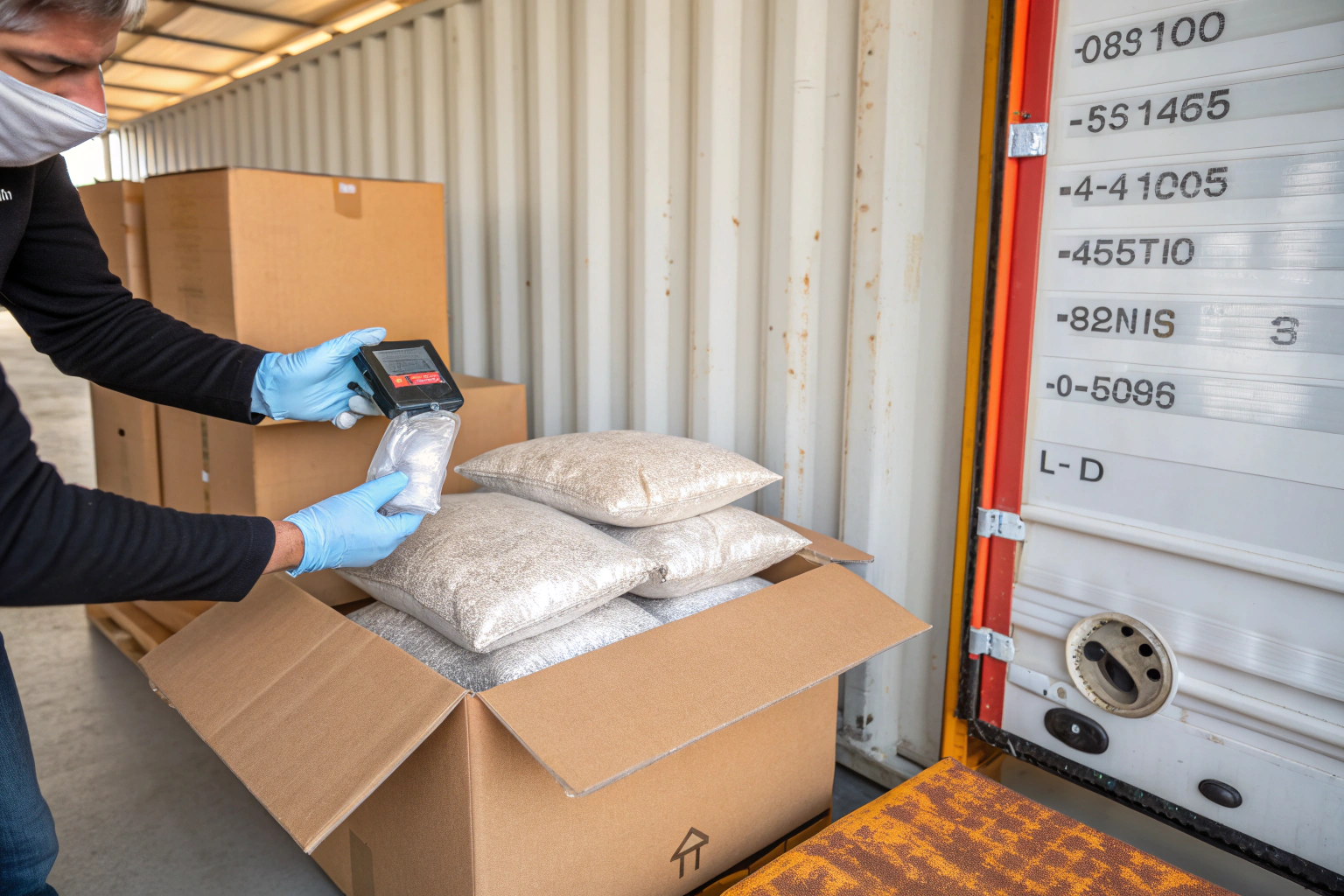
For a more definitive assessment, laboratory testing is available. A surface swab test can be performed on the leather belts. The swab collects any microbial material from the leather surface. The swab is then cultured in a laboratory to determine whether mold spores are present and in what concentration. A result below 10 colony-forming units per square centimeter is generally considered acceptable. A result above 100 CFU per square centimeter indicates a significant mold contamination that requires remediation before shipping.
In most practical situations, a careful visual inspection combined with proper moisture control is sufficient. Mold spores are present on virtually all organic materials, including clean leather. The goal is not to achieve sterility, which is impossible. The goal is to keep the environment dry enough that the spores remain dormant. A belt with no visible mildew and a moisture content below 14 percent will not develop mildew during transit if the packaging and container environment are correctly managed.
Should I Hire a Third-Party Inspection Company for Leather Belt Pre-Shipment Checks?
For high-value leather goods shipping to Europe, a third-party inspection provides an additional layer of confidence and documentation. A third-party inspector from a company like SGS, Intertek, or Bureau Veritas will conduct an independent assessment of the goods and the packing process. They will verify the moisture content, check for visible mold, inspect the cartons, and confirm that the packing materials meet the specifications you provided. They will issue a report with photographs and measurements.
This report serves multiple purposes. It provides evidence to your buyer that the goods were in clean, dry condition when they left the factory. This is critical if a dispute arises later. If the goods arrive with mildew, and you have a pre-shipment inspection report showing clean, dry goods, the responsibility shifts to the shipping line or the destination storage conditions. Without this report, you are in a weak position to argue.
The cost of a third-party pre-shipment inspection is modest relative to the value of a full container of leather belts. It is a form of insurance. The inspector’s presence also sends a signal to the factory that quality standards are being monitored by an outside party. This improves compliance with your packing specifications. I recommend third-party inspection for any leather goods shipment valued above a certain threshold, or for any customer relationship where trust is still being established.
Conclusion
Avoiding mildew on leather belts during long sea freight to Europe is not a single action. It is a system. The system starts with the leather itself, ensuring the moisture content is within the safe range before the belts are packed. It continues with the packing materials, choosing breathable kraft paper over plastic and adding desiccant packets at multiple levels. It extends to the carton design, with vent holes and double-wall construction. It encompasses the container environment, with desiccant poles, floor vapor barriers, and proper loading gaps. And it concludes with a pre-shipment inspection that verifies every step has been executed correctly.
Each of these steps addresses a different point where moisture can enter the product. The leather can start too moist. The packing can trap moisture. The carton can absorb moisture from the air. The container can generate condensation. The inspection catches failures before the goods leave the factory. Together, they reduce the risk of mildew from a near-certainty in humid conditions to a very low probability.
At Global-Caps, we apply these same principles to our leather-accented headwear products. We know that a leather strap on a cap is a premium feature that justifies a higher retail price. We also know that a mildew-stained leather strap destroys the product’s value completely. We have learned these lessons through years of shipping to demanding European markets. Our packing specifications are documented, our loading procedures are standardized, and our quality team verifies moisture content on every leather batch before it enters our warehouse.
If you are planning a leather belt or leather-trimmed hat program for the European market and want to ensure your goods arrive in perfect condition, we can help. Our experience in moisture control, anti-mildew packing protocols, and international freight preparation is available to you. Contact our Business Director Elaine. She can walk you through our leather packing standards and provide recommendations specific to your product type and destination. Reach her at elaine@fumaoclothing.com. We will help you ship leather goods that arrive as clean and beautiful as the day they left our factory.