I was on a video call with a buyer from a Dutch supermarket chain last year when she interrupted my presentation on a new line of hair accessories. She held up a sample of our hair clips in a standard clear plastic polybag. "This packaging is a problem," she said. "Our corporate sustainability directive requires all non-food accessories to be plastic-free by 2027. If you cannot pack these hair clips in compostable material, we cannot list them." I initially thought she was referring to recycled plastic. She clarified. The requirement was not just recyclable. It was compostable. That conversation changed how I think about packaging for the European retail market. It was no longer enough to make a beautiful product. The packaging had to disappear back into the earth.
European supermarkets are requiring compostable packaging for hair clips by 2027 because the European Union’s Packaging and Packaging Waste Regulation, or PPWR, is mandating that all packaging placed on the EU market be recyclable or reusable by 2030, with specific interim targets driving earlier voluntary adoption. Supermarkets, under pressure from regulators, consumers, and their own net-zero commitments, are moving faster than the legal minimum. For small, high-volume items like hair clips, which are often impulse purchases displayed near the checkout, compostable packaging offers a clear waste reduction story. A hair clip is small. Its packaging is often immediately discarded. Compostable material ensures that discarded packaging does not persist in a landfill for centuries. It breaks down into organic matter, water, and carbon dioxide under controlled composting conditions.
The 2027 deadline is not a random date. It aligns with the expected implementation timeline of several EU member state packaging laws and the voluntary commitments made by major retail groups. Supermarkets compete on sustainability. A chain that can advertise "all our own-brand accessories come in home-compostable packaging" gains a marketing edge. But the operational reality is complex. Compostable materials cost more, behave differently in automated packaging lines, and require clear consumer communication to avoid contamination in waste streams. Understanding why this requirement exists, and what it means for product manufacturers, is essential for any company exporting hair accessories to Europe.
What EU Legislation Is Driving the 2027 Compostable Packaging Deadline for Supermarkets?
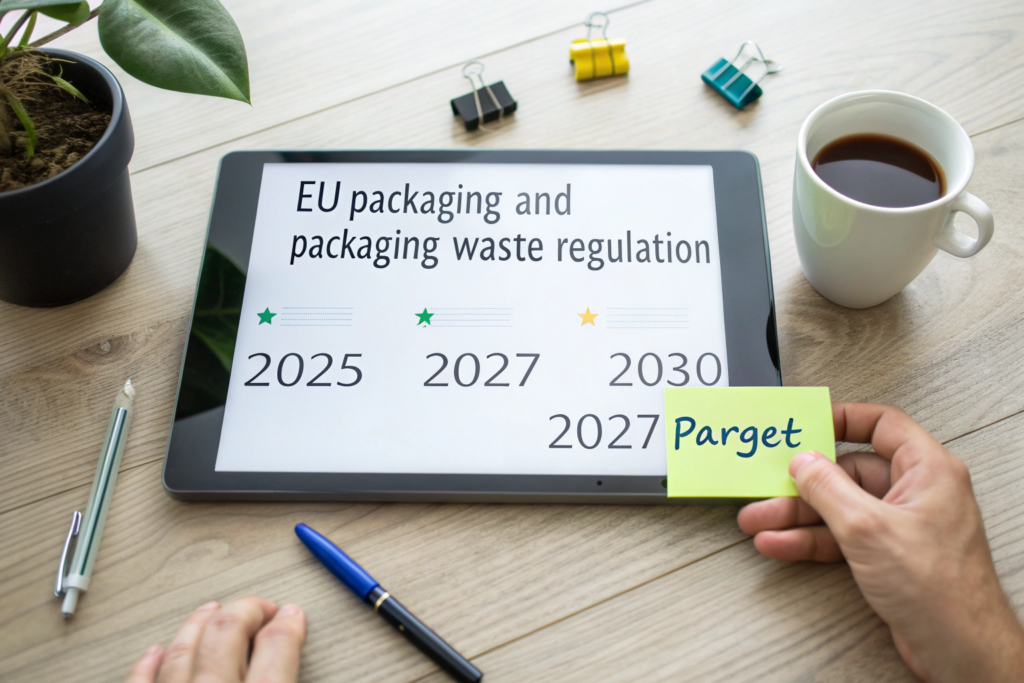
The regulatory engine behind the 2027 compostable packaging requirement is the European Union’s Packaging and Packaging Waste Regulation, commonly known as the PPWR. This regulation was proposed by the European Commission in 2022 and is currently working its way through the European legislative process. It replaces the older Packaging and Packaging Waste Directive, upgrading it from a directive, which member states implement through their own national laws, to a regulation, which applies directly and uniformly across all member states. This change is significant. It means the rules will be the same in every EU country, eliminating the patchwork of national standards that previously confused exporters.
The PPWR sets targets for packaging reduction, recyclability, and recycled content. It requires that all packaging on the EU market be designed for recycling by 2030. It also sets restrictions on certain single-use packaging formats and mandates minimum recycled content levels for plastic packaging. The regulation does not explicitly mandate compostable packaging for hair clips. However, it encourages compostable packaging for specific applications where it offers a clear environmental benefit. Small, lightweight packaging that is difficult to recycle mechanically, such as the thin plastic bags used for hair accessories, is one such application.
The 2027 date emerges from the transition periods built into the regulation and from the voluntary commitments of major retail groups. Many European supermarkets have signed the EU Code of Conduct for Responsible Business and Marketing Practices, which includes commitments to reduce packaging waste ahead of the legal deadlines. They have also set their own corporate targets. Ahold Delhaize, Carrefour, Tesco, and other major chains have announced plastic reduction goals that are more aggressive than the legal requirements. The 2027 date reflects this convergence of regulatory direction and corporate ambition. By 2027, the expectation is that compostable packaging will be cost-effective, widely available, and technically proven for applications like hair clips.
How Does the PPWR Differ From the Previous Packaging Waste Directive?
The previous directive, the Packaging and Packaging Waste Directive from 1994, set broad targets for packaging recovery and recycling. It required member states to transpose its provisions into national law. This created inconsistency. Germany implemented one set of rules. France implemented another. Italy had different definitions. A packaging format legal in one country might be subject to different fees or restrictions in another. This fragmentation made it difficult for manufacturers selling across the European market to comply.
The PPWR is a regulation. It applies directly to all member states without the need for national transposition. The rules are identical across the EU. This is a major improvement for exporters. It means a hair clip packaged in a compostable bag that is compliant in the Netherlands is also compliant in Spain and Sweden. The PPWR also introduces specific, measurable targets rather than broad aspirations. These targets include packaging reduction at the member state level, mandatory reusability quotas for certain transport packaging, and restrictions on unnecessary packaging formats. The regulation also addresses the issue of misleading sustainability claims. Packaging cannot be labeled as recyclable or compostable unless it meets defined criteria and is certified accordingly.
The emphasis on enforcement is also stronger. The PPWR includes provisions for penalties and for extended producer responsibility schemes that require manufacturers to fund the collection and treatment of their packaging waste. Supermarkets, as the point of sale, are directly affected by these schemes. They have a strong incentive to demand compliant packaging from their suppliers. A hair clip in non-compliant packaging becomes a liability for the supermarket, not just a product.
Why Is the Circular Economy Action Plan Relevant to Hair Clip Packaging?
The Circular Economy Action Plan is the European Commission’s policy framework for transitioning the EU economy from a linear model, take, make, dispose, to a circular model, where materials are kept in use for as long as possible. The PPWR is one element of this broader plan. The plan also includes the Ecodesign for Sustainable Products Regulation, the Microplastics Regulation, and various product-specific measures. Together, these policies aim to reduce waste, increase resource efficiency, and eliminate pollution.
Hair clip packaging is relevant to the Circular Economy Action Plan because it is a classic example of low-value, short-lifespan packaging. A hair clip is worn for months or years. Its packaging is discarded within seconds of purchase. The packaging material is so light and so small that it is rarely captured by mechanical recycling systems. It falls through the gaps in sorting machinery or contaminates other waste streams. Under a circular economy model, this type of packaging should be eliminated, replaced with reusable packaging, or designed to biodegrade harmlessly.
Compostable packaging addresses the end-of-life problem. If the packaging is made from a certified compostable material, it can be collected with food waste and processed in an industrial composting facility. The material breaks down into compost, a valuable soil amendment, rather than persisting as microplastic pollution. This is not a perfect solution. Industrial composting infrastructure is not equally developed in all EU countries. But it is a significant improvement over conventional plastic for small, hard-to-recycle items. The Circular Economy Action Plan explicitly encourages compostable packaging for applications where it delivers a clear environmental benefit, including tea bags, fruit stickers, and lightweight bags for small items.
What Are the Compostability Standards That European Retailers Accept for Packaging?
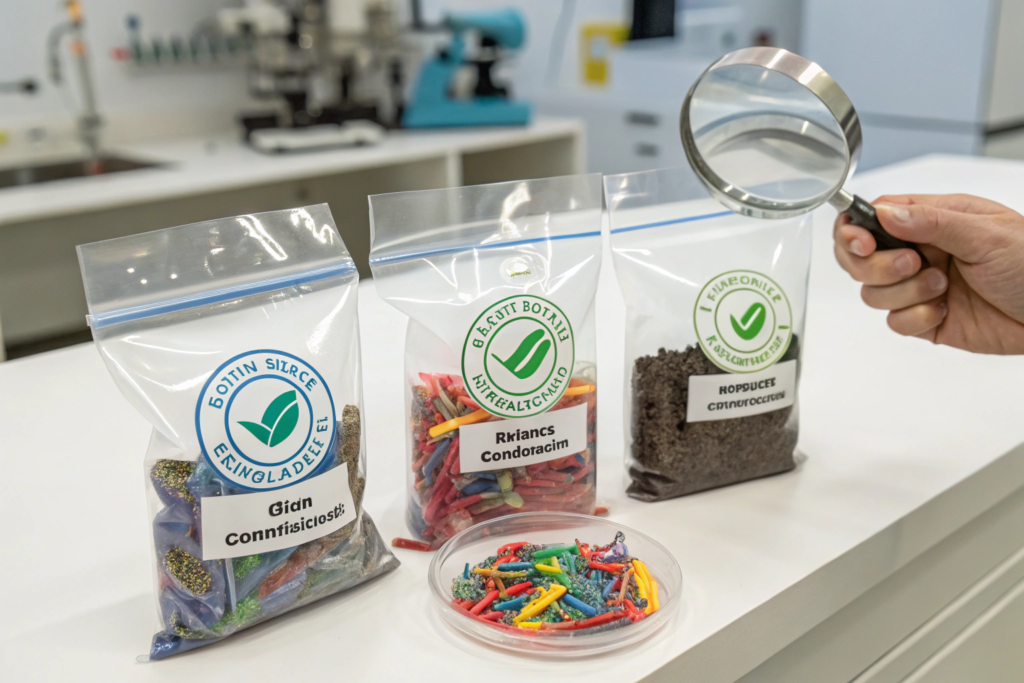
European retailers do not accept vague claims of compostability. They require certification against recognized standards. The two most important standards for compostable packaging are the European standard EN 13432 and the more stringent home composting standard, which is often verified through the TÜV Austria OK Compost Home certification program. A package that carries one of these certifications has been independently tested and verified to biodegrade under specific conditions within a defined timeframe.
EN 13432 is the harmonized European standard for industrially compostable packaging. It requires that the material biodegrade at least 90 percent within 180 days in an industrial composting facility. It also requires that the material disintegrate into fragments smaller than 2 millimeters within 12 weeks and that the resulting compost be free of ecotoxicity. This standard is the baseline for compostability claims in Europe. A bag labeled "industrially compostable" must meet EN 13432.
The home composting standard is stricter because home compost piles operate at lower temperatures and are less controlled than industrial facilities. The TÜV Austria OK Compost Home certification requires biodegradation within 12 months at ambient temperatures between 20 and 30 degrees Celsius. This is the standard that many supermarkets prefer for consumer-facing packaging because the consumer can theoretically compost the package at home. However, home composting infrastructure is not universal, and even certified home compostable packaging may not break down properly in a poorly managed compost pile. Retailers often include disposal instructions on the packaging to guide consumers.
The Seedling logo, managed by European Bioplastics, is another widely recognized certification mark for industrially compostable packaging. It indicates compliance with EN 13432. The combination of the Seedling logo and the TÜV Austria OK Compost logos covers the main certification schemes accepted by European retailers. A supplier offering compostable packaging should provide the certificate number and the testing laboratory’s details for verification.
What Is the Difference Between Industrial Compostable and Home Compostable Packaging?
The difference lies in the conditions required for biodegradation. Industrial composting facilities are professionally managed operations that control temperature, moisture, oxygen, and the mix of organic materials. They maintain temperatures above 55 degrees Celsius for extended periods. These high temperatures accelerate the activity of microorganisms that break down the compostable polymers. An industrially compostable bag will biodegrade in 12 to 24 weeks under these conditions.
A home compost pile is less controlled. The temperature is usually ambient, between 15 and 35 degrees Celsius. The moisture and oxygen levels fluctuate. The microbial community is less diverse and less active than in an industrial facility. A home compostable bag is designed to biodegrade under these harsher, slower conditions. It will typically break down within 6 to 12 months. The materials used for home compostable packaging are often the same base polymers as industrial compostable, such as PLA or PBAT, but the formulation is adjusted to biodegrade at lower temperatures.
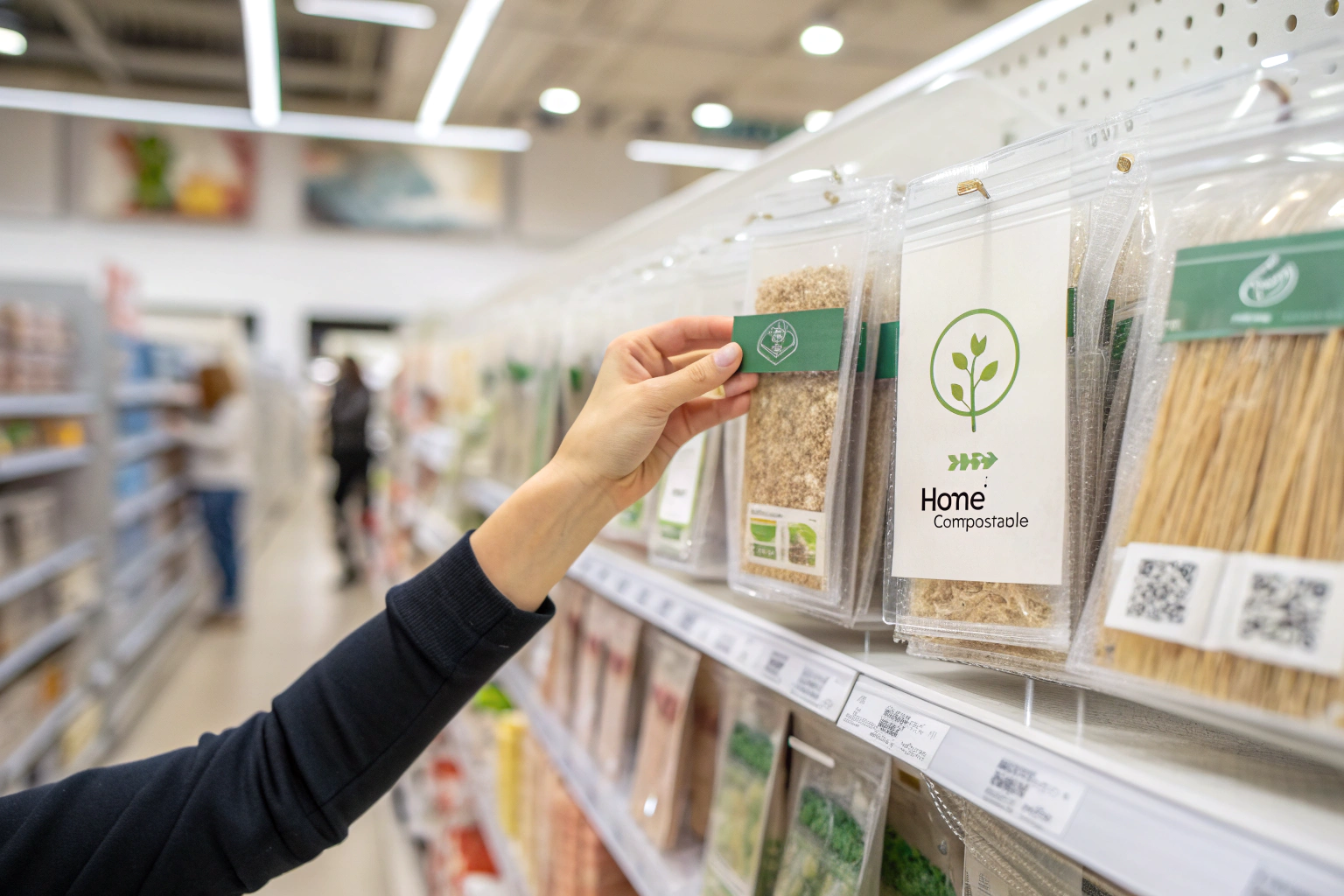
The practical implication for supermarkets is that home compostable packaging is more forgiving for the consumer. If the consumer puts the bag in their garden compost, it will likely break down. An industrially compostable bag might not, because the consumer’s compost pile does not reach the required temperature. For this reason, many supermarkets are specifying home compostable packaging for small items like hair clips. The packaging can be disposed of with food waste in a kerbside collection program, where available, or in a home compost bin. The retailer avoids the risk of a customer complaining that the "compostable" bag they put in their garden did not disappear.
Which Materials Are Commonly Used for Compostable Hair Clip Packaging?
The materials used for compostable packaging are primarily bio-based polymers and biodegradable polyesters. The most common are polylactic acid, or PLA, and polybutylene adipate terephthalate, or PBAT. PLA is derived from fermented plant starch, usually corn or sugarcane. It is clear, stiff, and has good printability. PBAT is a petroleum-derived biodegradable polyester that is soft, flexible, and tears easily. It is often blended with PLA to improve flexibility and toughness. A typical compostable hair clip bag is made from a PLA-PBAT blend that provides the clarity of PLA with the durability of PBAT.
Other materials used include cellulose films, which are made from wood pulp. Cellulose is naturally compostable and home compostable. It has excellent clarity and a natural, premium feel. However, it is less moisture-resistant than PLA and may require a coating to protect the contents. Starch-based bioplastics are also used. They are made from potato, corn, or tapioca starch and are fully biodegradable. They are less clear than PLA but have good breathability, which can be an advantage for products sensitive to moisture.
The choice of material depends on the product characteristics, the packaging line requirements, and the cost targets. A stiff, clear PLA bag works well for a single hair clip displayed on a hanging hook. A softer, opaque PBAT blend bag works better for a set of clips that need to be squeezed into a small pouch. The material must also be compatible with the sealing method used in the packaging line. Some compostable materials require lower sealing temperatures than conventional plastics, which can slow production if the equipment is not properly adjusted.
How Much More Does Compostable Packaging Cost Compared to Conventional Plastic?
The honest answer is that compostable packaging costs more than conventional plastic. The price premium has been shrinking as production volumes increase and more suppliers enter the market, but it remains significant. A standard clear polybag for a hair clip might cost less than one euro cent per unit. A certified compostable bag of equivalent size might cost three to five euro cents per unit. This is a three-fold to five-fold increase in packaging cost. For a high-volume, low-margin product like a hair clip, this premium can have a noticeable impact on the total landed cost.
However, the cost calculation must be viewed in context. The packaging cost is a small fraction of the total product cost. A hair clip that costs 50 cents to manufacture and retails for 5 euros sees a packaging cost increase of a few cents. This is absorbable in many retail price points, particularly in the accessories category where margins are healthy. The cost increase is more challenging for budget product lines where the retail price is very low and the packaging is a significant percentage of the total cost.
The cost premium is also offset by regulatory compliance and market access. A supplier who cannot offer compostable packaging may be delisted by European supermarkets entirely. The cost of losing the sale is far greater than the cost of upgrading the packaging. Additionally, many European countries have extended producer responsibility fees for packaging. Conventional plastic packaging is charged a fee. Compostable packaging may be exempt or charged at a lower rate. This reduces the net cost difference. The bioplastics market data shows continued growth and cost reduction in the sector, suggesting that the premium will narrow further in the coming years.
What Is the Per-Unit Price Difference for a Standard Hair Clip Polybag?
A standard conventional plastic polybag for a hair clip, measuring perhaps 8 by 12 centimeters with a resealable flap or a simple peel-and-seal closure, typically costs between 0.005 and 0.015 euros per unit, depending on the order volume and the material thickness. At a volume of 100,000 units, the cost is usually under one cent.
An equivalent certified compostable bag, made from a PLA-PBAT blend and certified to EN 13432 or OK Compost Home, costs between 0.03 and 0.05 euros per unit at the same volume. The exact cost depends on the material composition, the bag dimensions, the printing requirements, and the certification fees. A plain, unprinted compostable bag at high volume might approach 0.02 euros per unit. A printed bag with a custom logo and multiple colors might exceed 0.05 euros per unit.
The price difference of roughly 0.02 to 0.04 euros per unit translates to 20 to 40 euros per 1,000 units. For a brand selling 50,000 hair clips per year, the annual packaging cost increases by 1,000 to 2,000 euros. This is not trivial, but it is manageable when spread across the retail price and when factored into the margin calculation from the start. The key is to plan the packaging upgrade as part of the product development cycle, not as a last-minute compliance fix, which always costs more.
How Can I Offset the Increased Cost of Compostable Packaging for My Hair Clip Line?
Offsetting the cost increase requires a combination of strategies. The first is volume purchasing. The cost of compostable materials drops significantly with order volume. If you are purchasing packaging for multiple product lines, consolidate your orders with a single packaging supplier to achieve higher volume pricing. Commit to an annual volume rather than ordering per production run. This gives the packaging supplier the certainty they need to offer a better price.
The second strategy is packaging optimization. Reduce the size of the bag to the minimum required to hold the product and the legally required labeling. Use a thinner material grade if the product does not require heavy protection. Eliminate unnecessary features like resealable flaps or tear notches if they are not essential. Print using a single color instead of multi-color graphics. Each reduction in material or complexity lowers the cost.
The third strategy is to pass a portion of the cost on to the consumer through a price adjustment or to absorb it through margin restructuring. A hair clip that retails for 3 euros can absorb a 3-cent packaging increase more easily than a hair clip that retails for 1 euro. The sustainability story also has marketing value. Many European consumers are willing to pay a small premium for products with compostable packaging. This is particularly true in the accessories category, where the purchase decision is driven by aesthetics and values as much as by price.
The fourth strategy is to apply for subsidies or participate in industry programs that support sustainable packaging adoption. Some EU member states offer grants or tax incentives for companies that switch to compostable packaging. Industry associations may offer collective purchasing programs that reduce the cost for smaller brands.
What Are the Performance Challenges of Compostable Packaging for Hair Clips?
Compostable packaging does not behave like conventional plastic. It is more sensitive to heat, moisture, and mechanical stress. A bag that works perfectly in a dry warehouse might become brittle in a cold environment or sticky in a humid one. A bag that seals cleanly on a packaging machine in the morning might fail in the afternoon if the sealing jaws drift out of calibration. These performance challenges must be understood and managed before committing to a compostable packaging program.
The first challenge is moisture sensitivity. Many compostable materials, particularly PLA and starch-based films, absorb moisture from the air. This can cause the bags to become tacky, stick together, or lose their clarity. In a humid warehouse or during sea freight through tropical waters, a carton of compostable bags can arrive at the destination with the bags stuck together in a block. This is a serious problem for automated packaging lines that require individual bags to feed cleanly.
The second challenge is heat sensitivity. Compostable materials have lower melting temperatures than conventional plastics. The sealing jaws on a packaging machine must be set to a lower temperature, and the dwell time must be carefully controlled. If the temperature is too high, the bag melts and creates a weak seal. If the temperature is too low, the bag does not seal at all. This requires adjustment of the packaging equipment and training for the operators.
The third challenge is shelf life. Compostable bags begin to degrade slowly from the moment they are manufactured. Under normal storage conditions, they have a shelf life of 12 to 18 months. This is sufficient for most retail applications, but it requires careful inventory management. A batch of compostable bags that sits in a warehouse for two years may begin to weaken, yellow, or lose its seal strength. The packaging supplier should provide a shelf life specification, and the buyer should plan orders accordingly.
How Does Humidity Affect Compostable Bags During Sea Freight to Europe?
Sea freight containers crossing the tropical oceans experience extreme humidity. The relative humidity inside a closed container can reach 90 percent or higher. Compostable bags exposed to this environment for three to six weeks will absorb significant moisture. PLA and starch-based materials are hydrophilic. They take up water vapor from the air. The absorbed moisture softens the film, reduces its tensile strength, and can cause the bags to stick together.
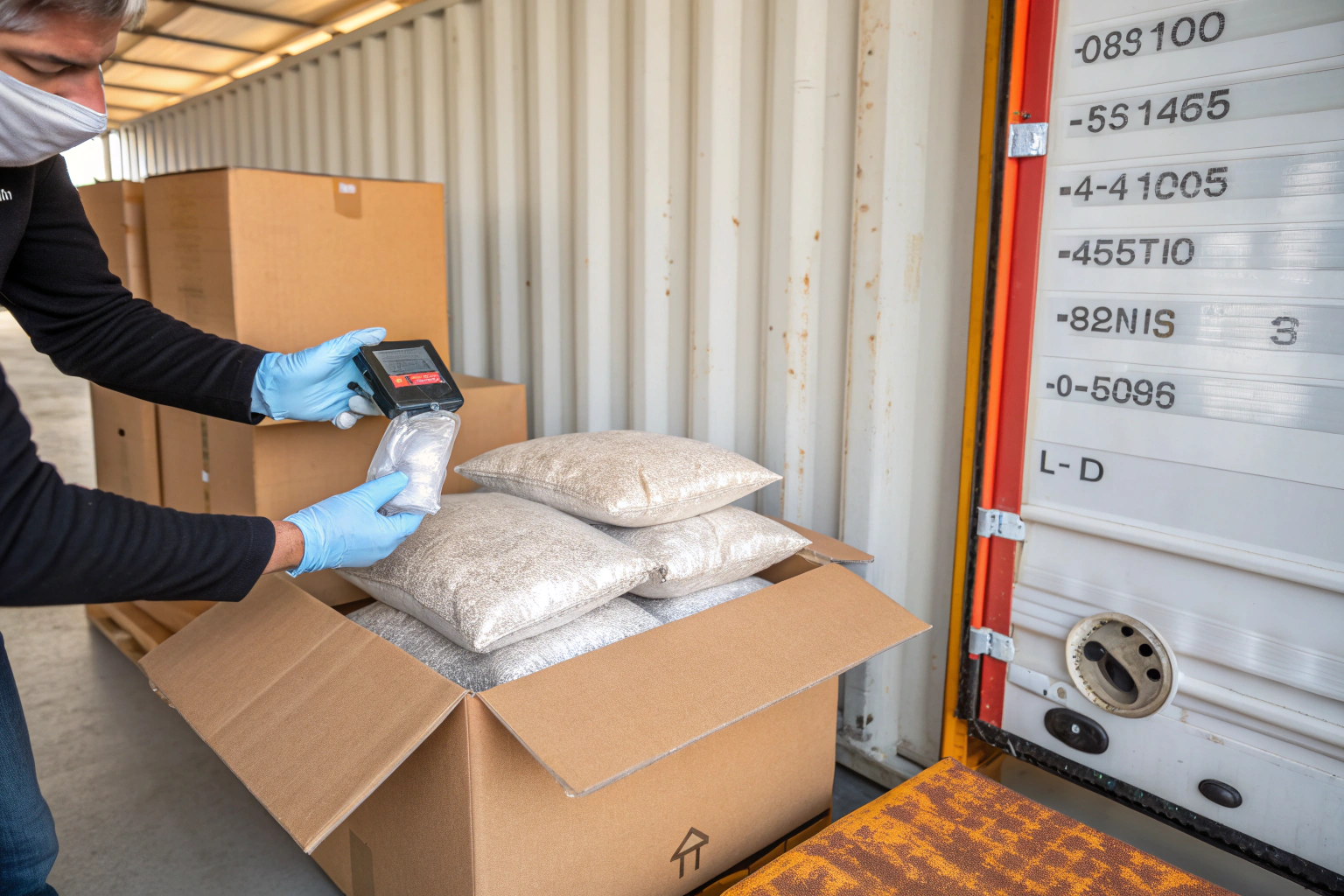
The solution is to protect the bags during transit. The compostable bags should be packed in sealed, moisture-barrier master bags inside the shipping cartons. A desiccant should be placed inside each master bag to absorb any residual moisture and any water vapor that penetrates the barrier. The cartons themselves should be lined with a plastic liner or treated with a moisture-resistant coating. These measures add cost but are essential for protecting the packaging integrity during long sea freight.
The destination warehouse also matters. The bags should be unloaded from the container as quickly as possible and moved to a climate-controlled storage area. Leaving the cartons in a hot, humid container at the destination port for an extra week will undo all the protective measures taken at the origin. The logistics chain must be managed end-to-end.
How Does the Shorter Shelf Life of Compostable Packaging Impact Inventory Planning?
The shelf life of compostable packaging is typically 12 to 18 months from the date of manufacture. This is shorter than conventional plastic, which can be stored for years without significant degradation. The implication for inventory planning is that packaging must be ordered in smaller batches, more frequently. A brand that previously ordered a year’s supply of polybags at once may need to order compostable bags every quarter.
This creates a cash flow consideration. Ordering smaller batches more frequently may reduce the volume discount and increase the per-unit cost. It also requires more frequent quality checks. Each new batch of compostable bags should be tested for seal strength, clarity, and dimensional stability before being released to the production line. A batch that has been stored for too long or exposed to poor conditions should be rejected.
The production planning team must coordinate with the packaging supplier to ensure that fresh material is available for each production run. The supplier should print the date of manufacture and the batch number on each carton of bags. The warehouse team should use a first-in, first-out inventory system to prevent old bags from being used before new ones. With proper management, the shorter shelf life is manageable. Without it, the brand risks using degraded packaging that fails in the hands of the consumer.
How Can I Verify That My Hair Clip Packaging Supplier Provides Genuine Compostable Certification?
The compostable packaging market is growing rapidly, and with growth comes the risk of false claims. Some suppliers label their products as compostable without having the certification to back it up. Others use misleading language like "biodegradable" or "eco-friendly" that sounds similar but does not meet the European standards. Verifying a supplier’s certification is a critical step before placing an order.
The first verification step is to request the certificate itself. A legitimate supplier will provide a copy of the certification document issued by a recognized certification body such as TÜV Austria or DIN CERTCO. The certificate will list the product name, the material composition, the certification number, the date of issue, and the expiry date. It will also reference the standard against which the product was tested, such as EN 13432 or OK Compost Home.
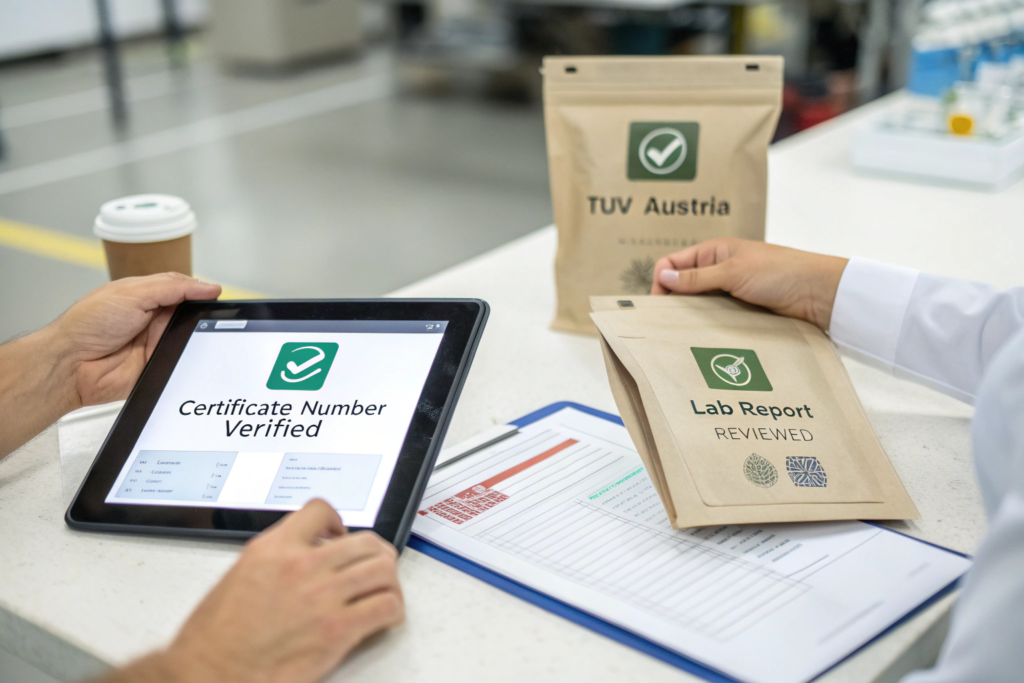
The second step is to verify the certificate number with the certification body. Both TÜV Austria and DIN CERTCO maintain online databases where the certificate number can be entered to confirm its validity. The database search will return the product details and the status of the certification. If the certificate number does not appear in the database, or if the product details do not match, the certificate is likely fake or outdated.
The third step is to request the test report from the independent laboratory that conducted the biodegradation testing. The test report will show the specific test methods used, the results obtained, and the conclusions drawn. The laboratory should be accredited to ISO 17025 for the relevant test methods. The test report should match the product described in the certificate. Cross-check the product name, the material composition, and the test dates.
What Are the Key Certification Bodies for Compostable Packaging in Europe?
The two most important certification bodies for compostable packaging in Europe are TÜV Austria and DIN CERTCO. TÜV Austria operates the OK Compost Industrial and OK Compost Home certification programs. These are widely recognized marks that appear on compostable packaging throughout Europe. The OK Compost Home logo, featuring a small house and a seedling, indicates that the product is suitable for home composting. The OK Compost Industrial logo, featuring a seedling without the house, indicates industrial compostability.
DIN CERTCO is a German certification body that operates under the umbrella of TÜV Rheinland. It offers certification according to EN 13432 and the ASTM D6400 standard for the American market. Its logo, a seedling inside a circle, is also widely recognized. The European Bioplastics Seedling logo is a separate certification mark managed by European Bioplastics and certified through DIN CERTCO or TÜV Austria. It indicates compliance with EN 13432 for industrial composting.
For the UK market, the Composting Association offers the Compostable certification mark. This is relevant for brands selling into the UK after Brexit, as the UK no longer automatically recognizes EU certifications. The certification landscape is complex but navigable. The key is to ensure that the certification body is recognized in the destination market and that the certification is current.
How Do I Test a Compostable Bag Sample to Confirm It Meets EN 13432?
Conducting the full EN 13432 biodegradation test yourself is not practical for most brands. It requires specialized laboratory equipment, controlled composting conditions, and months of testing time. The purpose of the certification is to avoid this burden. The certification body has already conducted the testing and verified the results. Your role is to verify the certification, not to replicate the testing.
However, you can and should conduct basic performance tests on the bag samples to ensure they are suitable for your specific product and packaging line. These tests include seal strength testing, which can be done with a simple tensile tester or even a manual pull test. They include clarity and print quality assessment under standard lighting. They include moisture sensitivity testing by exposing samples to controlled humidity for a short period and observing any sticking or softening. These tests do not confirm compostability. They confirm usability. The compostability confirmation comes from the certification body.
For a more rigorous verification, you can send a sample of the packaging to an independent laboratory for a disintegration test. This is a shorter test than full biodegradation and measures whether the material breaks down into small fragments under composting conditions. A disintegration test provides additional confidence that the material will behave as expected in a real composting facility. This is an optional step for brands that want extra assurance beyond the certification.
Conclusion
The 2027 compostable packaging requirement for hair clips in European supermarkets is a direct result of the European Union’s accelerating push toward a circular economy. The Packaging and Packaging Waste Regulation provides the legal framework. The Circular Economy Action Plan provides the policy direction. European supermarket chains, acting on their own sustainability commitments and competitive positioning, are implementing the requirements ahead of the legal deadlines. For a product as small and impulse-driven as a hair clip, the packaging is often the primary waste stream. Compostable packaging offers a solution that reduces persistent plastic waste and aligns with consumer expectations for responsible retail.
The transition requires investment and attention to detail. Compostable materials cost more than conventional plastic. They require different handling on the packaging line. They have a shorter shelf life and are more sensitive to heat and moisture. The certification landscape requires verification and due diligence. But the cost of non-compliance is far greater than the cost of adaptation. A brand that cannot meet the packaging requirements of European supermarkets will simply be excluded from the market.
At Global-Caps, we have been working with compostable packaging suppliers for our accessories lines serving the European market. We understand the certification requirements, the performance characteristics of compostable materials, and the logistics of shipping moisture-sensitive packaging across the ocean. We build packaging specifications into our product development process from the start, not as an afterthought.
If you are developing hair clips or any accessories line for European supermarkets and need guidance on compostable packaging compliance, we can help. Contact our Business Director Elaine. She can share our experience with certified compostable materials, recommend packaging suppliers, and help you navigate the verification process. Reach her at elaine@fumaoclothing.com. Let’s make your products shelf-ready for the sustainable retail future that Europe is building.