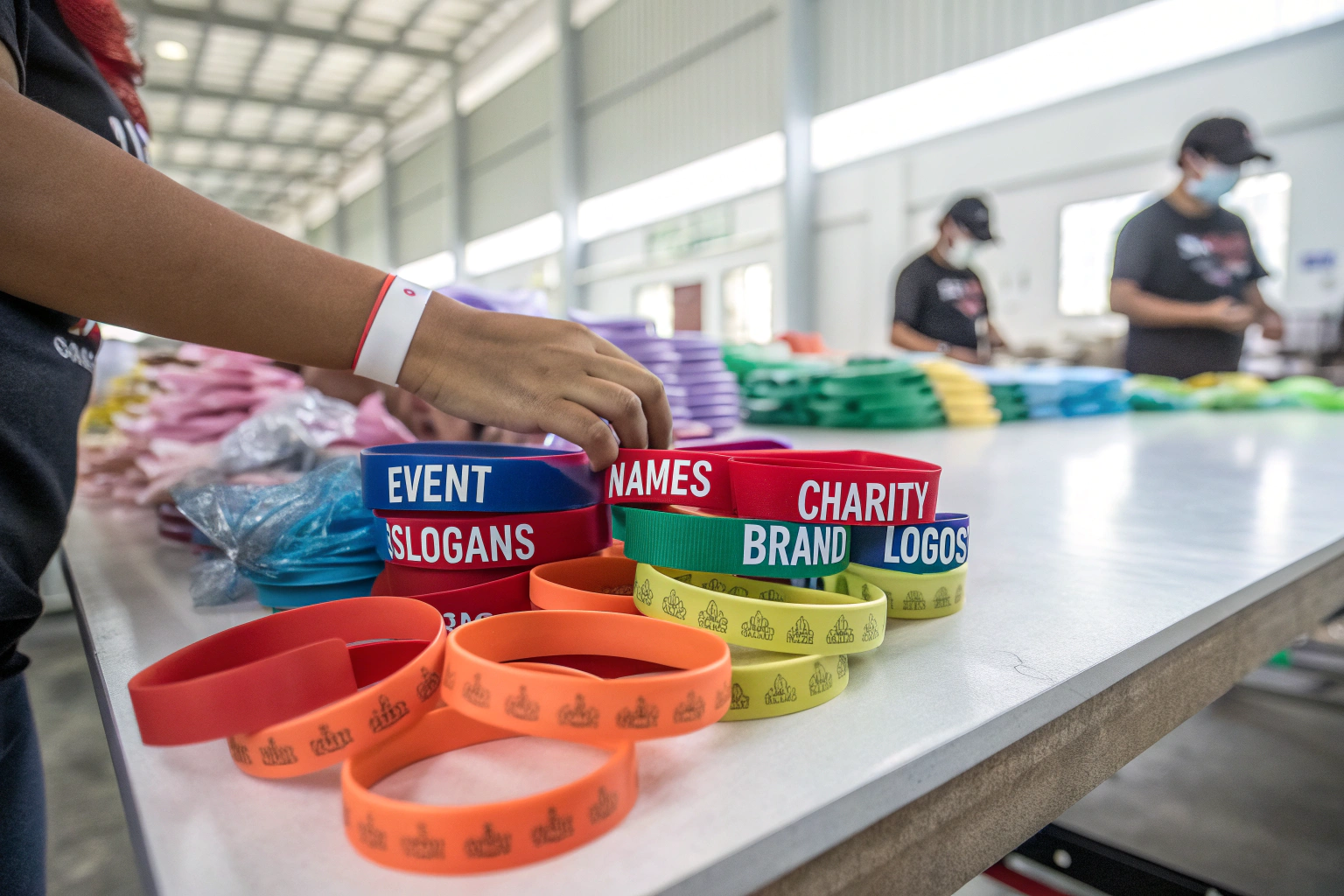
An event planner from Sydney once called me in a complete panic. She needed five hundred custom wristbands for a charity fun run happening in ten days. Her previous supplier had just informed her that their minimum order was five thousand units, and they would not budge. She had already printed the event banners with the wristband design, sold tickets that included a wristband, and promised sponsors their logos would be on every participant's wrist. The supplier's rigid minimum was about to ruin her event. She asked me if we could help, and I told her yes, but she needed to understand the trade-offs.
The minimum order quantity for custom printed silicone wristbands is typically 100 pieces, but the per-unit price drops significantly at 500, 1,000, and 5,000 piece thresholds. The exact minimum depends on the printing method you choose. Debossed and screen-printed wristbands can be produced at 100-piece minimums with a higher unit cost. Debossed and color-filled wristbands often require a 300 to 500 piece minimum due to the additional manual labor involved. Full-color digital printed wristbands have the highest minimum, typically starting at 500 to 1,000 pieces.
At AceAccessory, we have produced custom silicone wristbands for charity runs, music festivals, corporate retreats, school events, and product launches all over the world. I have learned that the minimum order question is never just about a number. It is about choosing the right printing method for your budget and timeline. Let me break down exactly how minimums work for each production method, what drives the cost differences, and how you can get the wristbands you need without ordering thousands more than you can use.
What Are the Different Printing Methods and Their Minimum Order Quantities?
The printing method is the single biggest factor that determines your minimum order quantity. Each method has a different setup process, a different amount of manual labor, and a different cost structure. Understanding these differences helps you choose the right method for your event's budget, timeline, and design complexity. A simple one-color logo for a small corporate retreat has very different production requirements than a full-color sponsor logo for a major music festival.
Why Do Debossed and Screen-Printed Wristbands Have the Lowest Minimums?
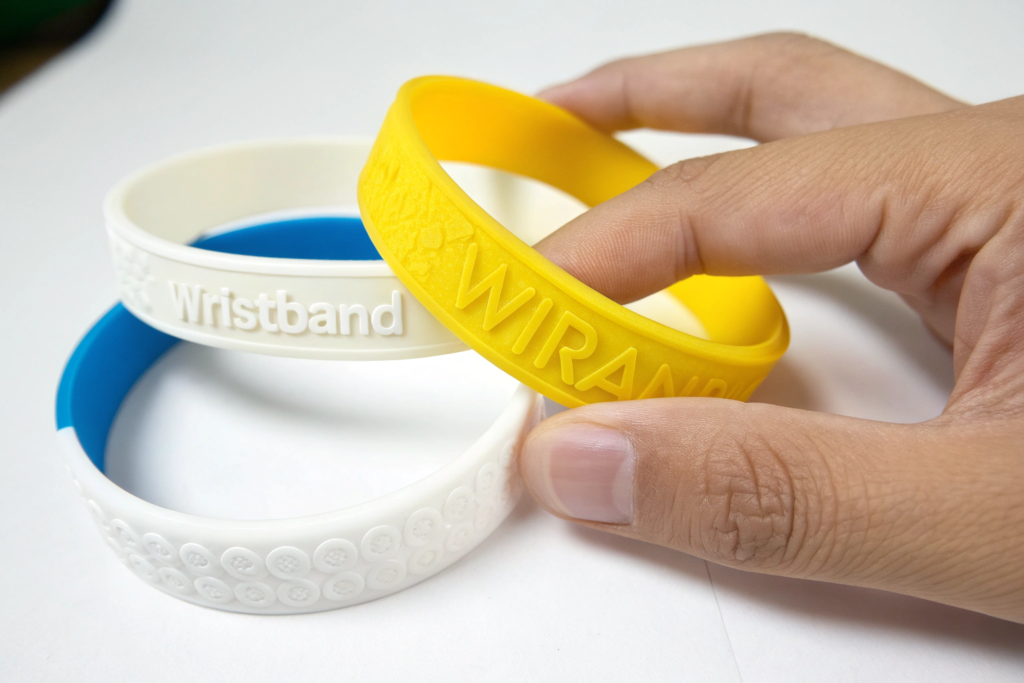
Debossed wristbands are the most economical option for small events. The debossing process uses a heated metal mold to press your text or logo into the silicone band, creating a recessed impression. The mold itself is a one-time setup cost, typically between thirty and fifty dollars. Once the mold is made, the wristbands can be produced quickly with minimal manual labor. This is why we can offer a 100-piece minimum for debossed-only wristbands. Screen-printed wristbands, where ink is applied to the surface of the band through a mesh screen, also have a relatively low setup cost. The screen preparation is similar to the screen printing process for fabric, and it works well for simple, one-color designs on the band surface. The minimum for screen printing is also 100 pieces. The trade-off is that screen-printed text sits on the surface of the silicone and can wear off over time with heavy friction, whereas debossed text is physically part of the band and will last forever. For a single-day event like a fun run or a conference, either method works well. For a wristband intended to be worn for weeks or months, debossed is the better choice.
How Does the Manual Labor of Color Filling Affect Minimum Quantities?
Debossed and color-filled wristbands take the debossed impression and fill it with a contrasting color of liquid silicone ink. After filling, the excess ink is wiped away, leaving the color only inside the recessed text. This step is done by hand for each individual wristband. A technician uses a small spatula or syringe to fill the debossed grooves, then carefully wipes the surface clean without smearing the filled color. This manual process takes time, and the labor cost per unit is significantly higher than a simple debossed or screen-printed band. Because of this manual labor, we set a higher minimum, typically 300 to 500 pieces, to ensure the production run is efficient enough to justify the setup and labor cost. The color-fill option creates a much more premium, professional look. The filled color makes the text or logo highly visible, and it does not wear off because it is protected inside the debossed groove. For a corporate event or a product launch where the wristband is a keepsake, the extra cost and the slightly higher minimum are worth it.
What Is the Minimum for Digitally Printed Full-Color Wristbands?
Full-color digital printed wristbands are the premium option with the highest minimum. This method uses a specialized digital printer that applies a full-color image, including gradients, photographs, and complex multi-color logos, directly onto the silicone surface. The print wraps around the entire band and is then sealed with a clear protective coating. The setup process is more complex than debossing or screen printing because it requires color calibration and print head alignment for each design. The production speed is also slower than debossing. For these reasons, the minimum order for digitally printed wristbands is typically 500 to 1,000 pieces. This method is ideal for large events where sponsors require their full-color logos to be accurately reproduced, or for wristbands that serve as wearable tickets with QR codes or barcodes. The visual impact is unmatched. You can print photographs, detailed illustrations, and vibrant gradients that are impossible to achieve with debossing or screen printing. For more information on silicone printing technologies, you can explore resources from Specialty Graphic Imaging Association.
How Does Order Quantity Affect the Per-Unit Cost of Silicone Wristbands?
The per-unit cost curve for silicone wristbands is steep at the low end and flattens out at higher quantities. This is because the mold setup cost, the screen preparation cost, and the machine calibration time are fixed. They cost the same whether you order 100 wristbands or 10,000 wristbands. The fixed costs are amortized over the total quantity. The more you order, the less setup cost is baked into each individual wristband.
What Is the Cost Breakdown at 100, 500, 1,000, and 5,000 Units?
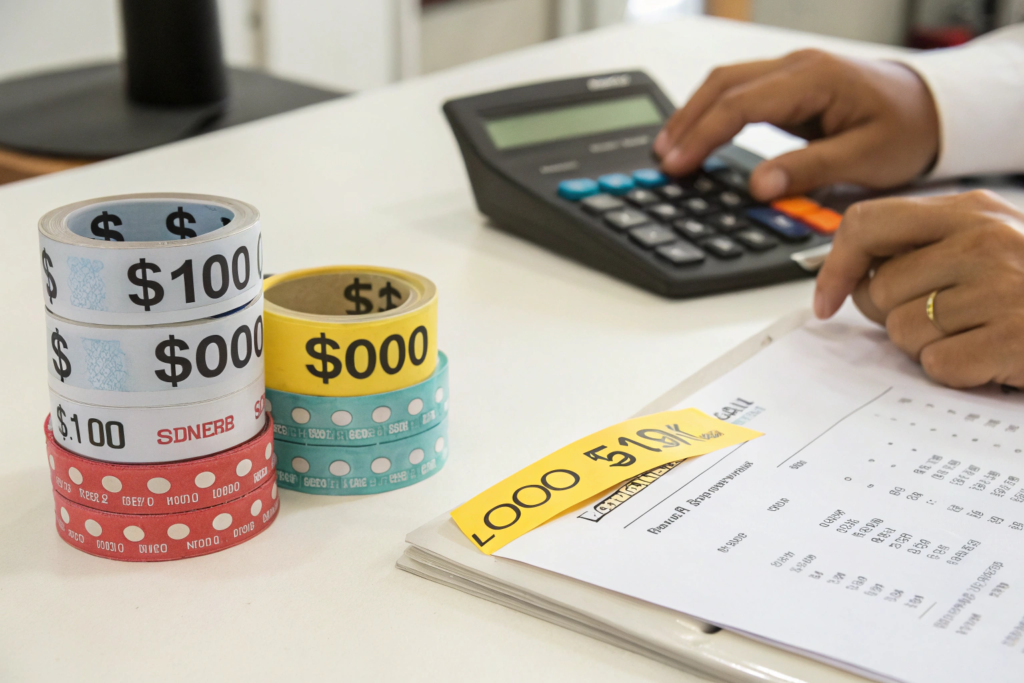
Let me give you a realistic example based on a simple debossed wristband with a one-color fill. At 100 pieces, the per-unit cost might be around one dollar to one dollar and fifty cents. This high cost is driven by the mold setup fee and the small production run inefficiency. At 500 pieces, the per-unit cost drops to approximately sixty to eighty cents. The mold cost is now spread across more units, and the production run is long enough to achieve some efficiency. At 1,000 pieces, the cost drops further to roughly forty to sixty cents per unit. At 5,000 pieces, the cost can fall to twenty to thirty-five cents per unit. The curve is not linear. The biggest cost drop happens between 100 and 1,000 pieces. Beyond 5,000 pieces, the cost continues to decrease but at a much slower rate. The lesson is that if your event needs 400 wristbands, it is often cheaper to order 500 than 400 because the per-unit cost at the 500-piece price break more than offsets the cost of the extra 100 wristbands you may not need immediately.
Should You Order Extra Wristbands Beyond Your Exact Event Attendance?
I always advise event planners to order a buffer of ten to fifteen percent above their expected attendance. Wristbands get lost. They get put on the wrong wrist and need to be cut off and replaced. VIPs and last-minute guests show up. Sponsors request extra wristbands for their own staff. If you order exactly the number you need and run out on event day, you cannot simply produce more. The mold and setup process takes several days even for a rush order. The buffer quantity gives you operational flexibility on the day of the event. It is also smart from a cost perspective. Ordering 550 wristbands when your minimum is 500 may cost the same total amount as ordering 500, because you are still within the same price break. Always ask your supplier what the specific quantity thresholds are for price breaks, and order just above the threshold that gives you the best value.
What Information Do You Need to Provide for a Custom Wristband Quote?
Getting an accurate quote and a fast production timeline depends entirely on the quality of the information you provide upfront. A vague request generates a chain of clarifying emails that can add days to the process. A complete specification allows the factory to generate a quote within hours and begin mold production the same day. I have seen orders delayed by a week simply because the buyer did not specify a Pantone color and we had to send physical swatches back and forth for approval.
What Design and Color Specifications Are Required Upfront?
You need to provide six specific items for an accurate quote. First, the wristband size. The standard adult size is 202 millimeters long by 12 millimeters wide. Youth sizes and extra-large sizes are available but must be specified. Second, the wristband base color. Provide a Pantone color code if possible. Saying "blue" is too vague. There are hundreds of blue silicone pigments. Third, the text or logo content. Provide the exact wording and the font preference. If you have a logo, provide a vector file in Adobe Illustrator or EPS format. Fourth, the printing method. State whether you want debossed, debossed with color fill, screen-printed, or digitally printed. Fifth, the color of the debossed fill or screen print ink. Again, a Pantone code is ideal. Sixth, the quantity you want quoted. If you are flexible, ask for quotes at multiple quantity breaks so you can see the cost difference. A complete specification like this allows our quoting team to respond with a firm price and a production timeline within one business day.
What Artwork Format Prevents Delays in Mold and Screen Production?
The most common cause of delay in custom wristband production is artwork that is not ready for manufacturing. A logo pulled from a website is almost always a low-resolution raster image, such as a JPEG or PNG file. These files cannot be used directly for mold engraving or screen making. They must be manually redrawn as vector artwork, which adds time and cost. The ideal artwork file is a vector file in Adobe Illustrator format, with all text converted to outlines and all colors specified as Pantone references. If you do not have a vector file, we can create one for you, but you must budget an extra one to two days for the artwork conversion process. The mold engraving process requires a clean, high-contrast black and white image. Fine details that are smaller than 0.5 millimeters may not reproduce clearly in debossed silicone. Our design team will review your artwork and flag any details that may cause production problems before we begin mold making. This pre-production review saves time and prevents the disappointment of a finished wristband that does not match your expectations.
How Fast Can Custom Silicone Wristbands Be Produced and Shipped?
Event dates are fixed and non-negotiable. The wristbands must arrive before the event starts, or they are worthless. Production speed is just as important as price and quality. The standard production timeline for custom silicone wristbands is 10 to 15 working days from artwork approval to shipment. Rush orders can be compressed to 5 to 7 working days for an additional fee. Understanding what drives the timeline helps you plan your order with enough buffer to avoid stress and rush charges.
What Is the Standard Production Timeline from Artwork to Delivery?
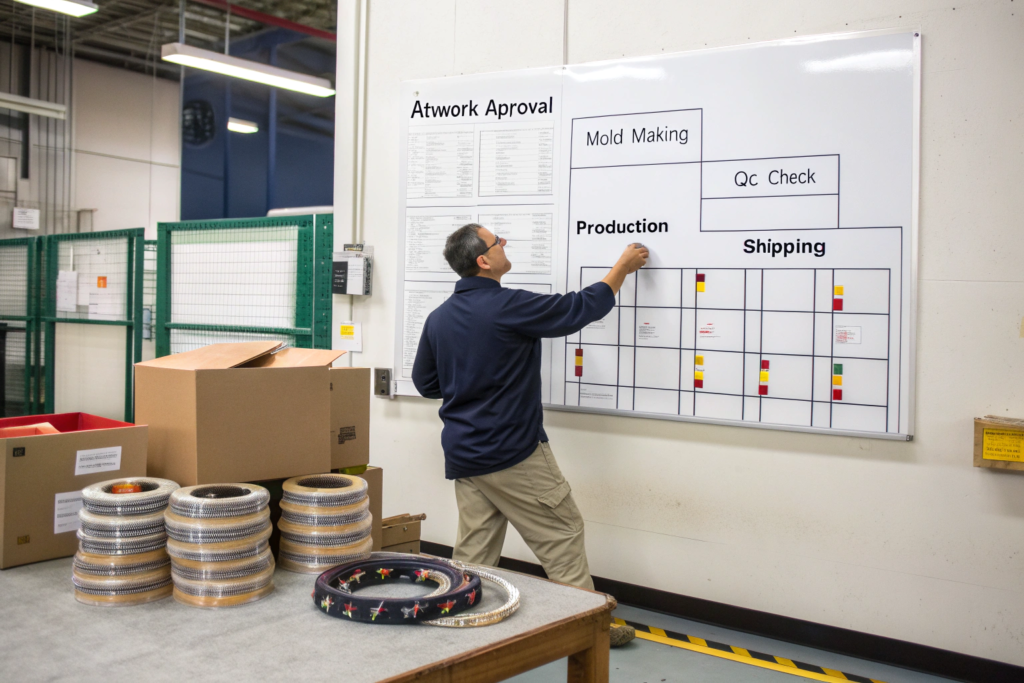
The timeline begins when you approve the digital proof. Mold making takes 3 to 5 working days. The mold is machined from a brass or aluminum block and then polished to ensure a clean impression. Production of the wristbands themselves takes 3 to 5 working days, depending on the printing method and quantity. Quality control inspection, which includes checking color consistency, text clarity, and band dimensions, takes 1 working day. Packing and dispatch take 1 working day. Express international shipping to major US, European, or Australian cities takes 2 to 4 working days. The total door-to-door timeline is approximately 10 to 15 working days. This timeline assumes no artwork revisions, no mold modifications, and no shipping delays. I always recommend that event planners place their wristband order at least four weeks before the event date. This builds in a comfortable buffer for any unexpected issues.
Can a Rush Order Be Completed for a Last-Minute Event?
Yes, but it requires immediate action and a higher budget. A rush order compresses the mold making to 1 to 2 working days by paying overtime to the mold technician. Production is prioritized on the factory schedule, running over a weekend if necessary. QC is performed on the same day as production completion. Shipping is upgraded to the fastest available express courier service. The total rush timeline can be as short as 5 to 7 working days from artwork approval to delivery. The rush fee is typically twenty to thirty percent of the order value, and it must be agreed upon before production begins. The most important factor in rush order success is artwork readiness. If you need a rush order, your vector artwork file must be perfect and approved within hours of placing the order, not days. Any revision cycle during a rush order consumes time that simply does not exist.
Conclusion
The minimum order for custom printed silicone wristbands starts at 100 pieces for debossed and screen-printed designs, rises to 300 to 500 pieces for debossed with color fill due to the manual labor involved, and sits at 500 to 1,000 pieces for full-color digitally printed wristbands. The per-unit cost drops dramatically between 100 and 1,000 pieces, and I almost always recommend ordering at least 500 pieces to hit a reasonable cost point, even if your event attendance is lower. Ordering a ten to fifteen percent buffer above your expected attendance is a smart operational decision that saves stress on event day.
The key to a smooth production process is providing a complete specification upfront. A Pantone color code, a vector artwork file, and a clear printing method choice allow the factory to quote accurately and begin production immediately. The standard timeline is 10 to 15 working days door-to-door, and rush orders can be done in 5 to 7 working days for events with tight deadlines.
At AceAccessory, we have produced wristbands for events of every size, from fifty-person corporate retreats to fifty-thousand-person music festivals. Our project managers understand that an event deadline is absolute. We track every order against the event date and communicate proactively if any issue threatens the timeline.
If you are planning an event and need a quote for custom silicone wristbands, please reach out to us with your design specifications and your event date. We can provide a firm quote and a production schedule within one business day.
To start your wristband order, please contact our Business Director, Elaine. You can email her at elaine@fumaoclothing.com. Let us make sure your attendees are wearing your brand on their wrists.