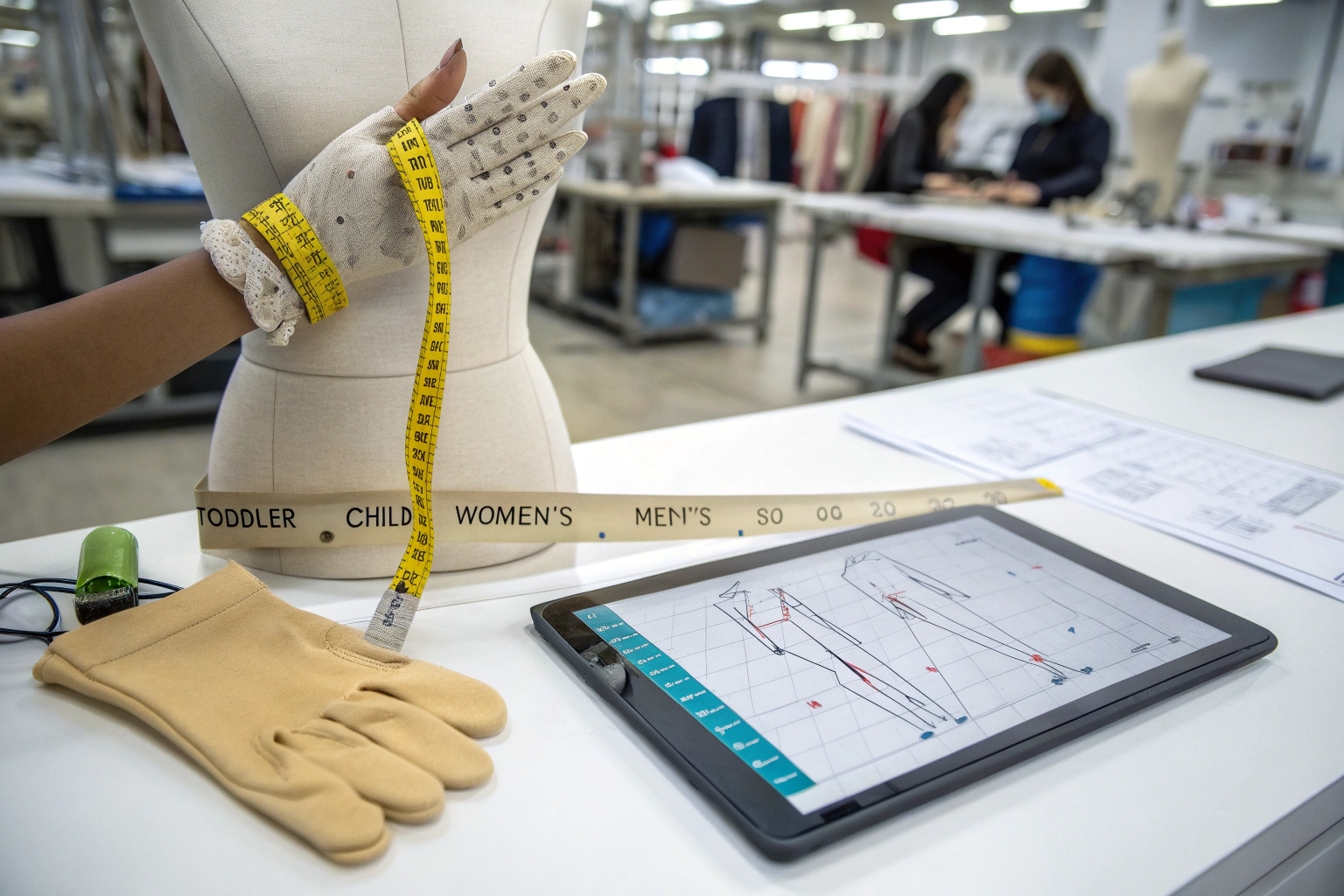
A sportswear brand owner once sent me a purchase order for 8,000 pairs of winter running gloves with a single sentence in the size specification field: "Standard US sizes." I called him the next day and asked for his hand circumference chart. He was confused. "Don’t all factories just know what a medium glove is?" he asked. I explained that a "medium" in his brand’s existing collection might fit a 7.5-inch hand circumference, while the factory’s default medium block was graded for an 8-inch hand. That half-inch difference would have produced 8,000 gloves that felt slightly too loose, generating returns, negative reviews, and a damaged brand reputation. He sent the chart the next morning.
Chinese glove factories request a hand circumference chart before sizing production because glove sizing is not a universal standard. A "medium" glove from a US outdoor brand, a European fashion brand, and a Japanese ski brand can differ by half an inch or more in actual hand circumference. The factory’s default size block, developed from years of experience with a broad range of clients, is a starting point, not an assumption. The hand circumference chart, provided by the brand, locks in the exact anatomical measurements that define each size in that brand’s specific fit philosophy. This data drives the pattern grading, the elastic tension, and the final quality control inspection tolerances.
In our Zhejiang factory, we produce gloves for markets across North America, Europe, and Russia, and each market has distinct hand morphology expectations. I want to explain why the hand circumference chart is the single most important pre-production document, how it connects to pattern grading, and how brands that provide this data achieve measurably lower return rates.
What Is a Hand Circumference Chart and Why Is It the Foundation of Glove Sizing?
A hand circumference chart is a simple table that specifies the exact measurement, in centimeters or inches, of the hand around its widest part, typically the knuckle circumference excluding the thumb, for each size in a glove range. It may also include supplementary measurements such as hand length from the wrist crease to the tip of the middle finger, and wrist circumference. These measurements define the internal dimensions that the finished glove must achieve to fit the intended wearer comfortably and securely.
This chart is not a formality. It is the numerical foundation upon which the entire production pattern is built. The factory’s pattern maker uses these measurements to calculate the dimensions of every pattern piece: the palm panel, the back panel, the thumb piece, and the fourchette strips between the fingers. If the hand circumference input is incorrect, every downstream calculation is incorrect. The chart is the single source of anatomical truth.
How does the factory use the chart to grade patterns from size to size?
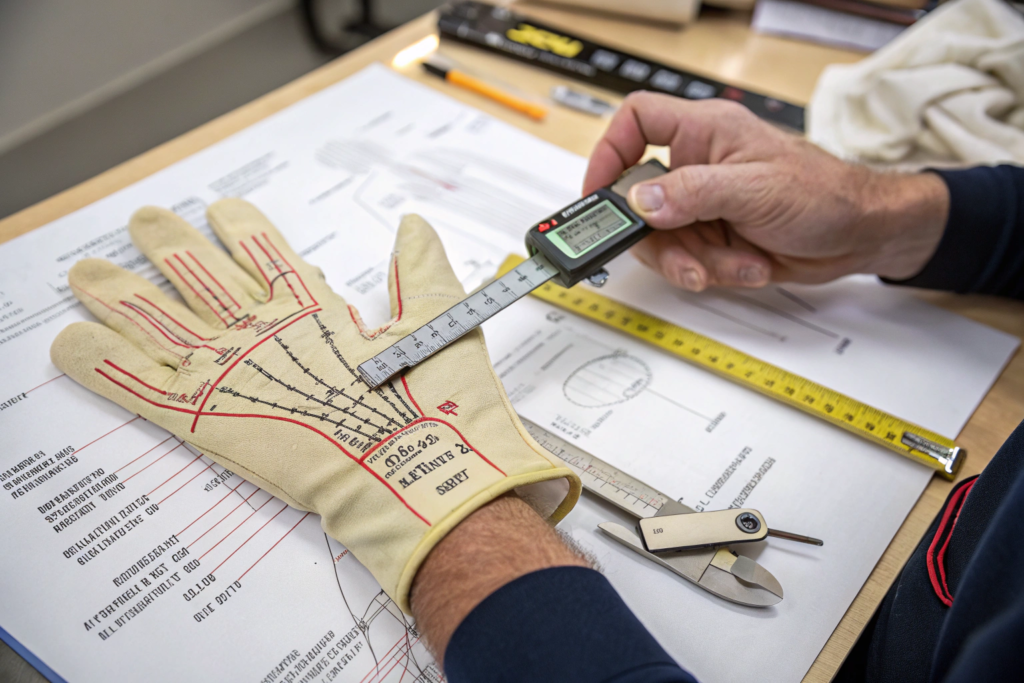
Pattern grading is the process of scaling a base size pattern up or down to create the full size range. The grading rules, how much each pattern piece is expanded or reduced at each grade point, are derived from the hand circumference chart. If the chart specifies that the hand circumference increases by half an inch from size Small to size Medium, the pattern maker calculates the corresponding increase in the palm panel width, the back panel width, and the fourchette length to achieve that internal circumference. This is not a simple uniform scaling. The proportions of the human hand change with size. A child’s hand has shorter fingers relative to palm width than an adult’s hand. The grading must account for these proportional shifts, which is why a generic "scale up by 105%" instruction produces poorly fitting gloves. The pattern grading for apparel and accessories resource explains the technical process.
What are the standard global hand measurement reference points?
To ensure the brand and the factory are measuring the same thing, we provide a measurement guide with the chart request. The primary measurement is hand circumference, measured around the knuckles with the hand flat and the fingers together, excluding the thumb. The tape measure should be snug but not compressing the skin. The secondary measurement is hand length, measured from the wrist crease at the base of the palm to the tip of the middle finger. For gloves with a specific cuff style, wrist circumference measured at the narrowest point above the wrist bone may also be requested. These standardized hand measurement guidelines for gloves ensure that the numbers on the chart correspond to the same physical dimensions regardless of who took the measurement.
Why Do Different Target Markets Require Different Hand Circumference Charts?
Human hand dimensions vary systematically across different populations. Decades of anthropometric research have demonstrated that average hand circumference, finger length, and palm width differ between geographic and demographic groups. A size chart developed for a primarily North American customer base, where average hand dimensions tend toward a certain range, will not fit a Russian customer base optimally, where the distribution may skew differently.
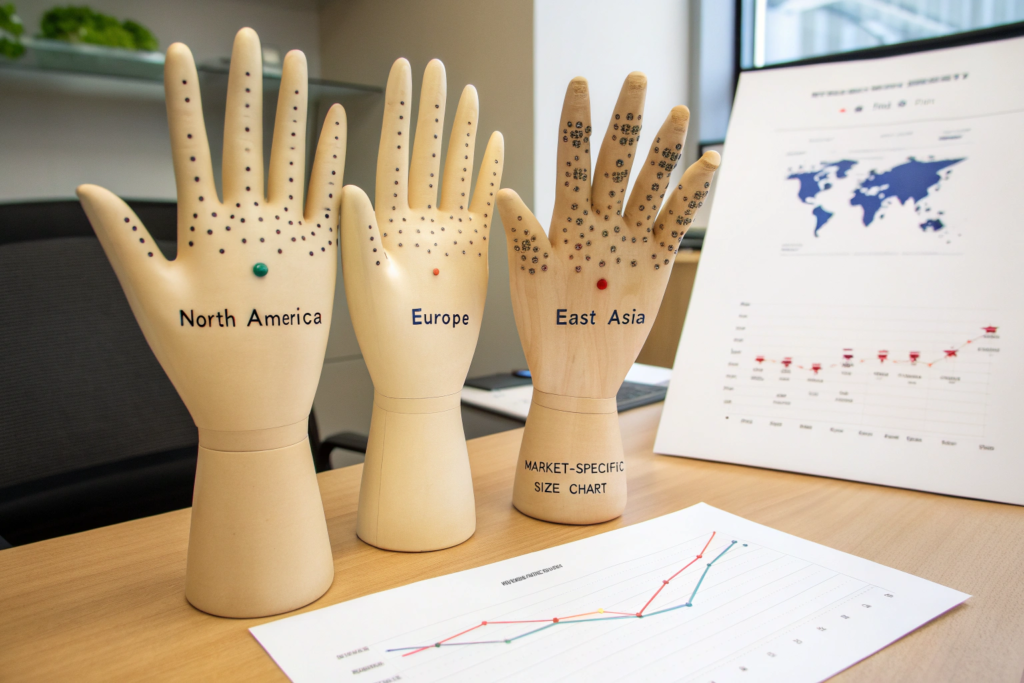
A brand that sells the same glove to a US outdoor retailer and a German ski shop cannot simply use the same hand circumference chart for both markets unless they have verified that their target demographics share the same anthropometric profile. The factory requests the chart to ensure that the gloves produced for a specific order match the hands that will actually wear them, not a generic global average.
How do North American and European hand morphologies typically differ?
Anthropometric data indicates that North American adult hand circumferences, on average, tend to be slightly larger than those of the European population, though there is significant overlap. Beyond circumference, proportional differences matter. A North American hand may have a broader palm and shorter fingers relative to the palm width, while a Northern European hand may have a longer, narrower profile. These proportional differences affect the pattern grading, not just the overall size. A glove that fits a US customer’s palm circumference perfectly might have fingers that are slightly too short or too long for a Scandinavian customer, even if both customers technically measure as a "Medium." The global hand anthropometry research provides the scientific basis for these regional size adjustments.
Why do children’s gloves require a more conservative fit tolerance?
Children’s hands are not simply scaled-down adult hands. They have different proportions, and the fit tolerance is much tighter relative to the hand size. A half-inch excess circumference in an adult glove might be a minor comfort issue. The same absolute difference in a toddler glove represents a much larger percentage of the hand circumference, making the glove unusably loose and creating a safety hazard if the glove slips off during play. Children’s skin is also more sensitive to compression, so a glove that is too tight causes discomfort and resistance to wearing it. These factors combine to require a more precise hand circumference chart with tighter manufacturing tolerances for children’s sizes. We typically recommend a tolerance range for children’s gloves that is significantly tighter than adult standards. This children’s product safety and fit standards resource explains the specific considerations for children’s accessories.
How Does the Hand Circumference Chart Prevent the Most Common Glove Return Reasons?
The most common reason for glove returns in e-commerce and retail is not a manufacturing defect. It is poor fit. A glove that is too tight is uncomfortable and restricts movement. A glove that is too loose feels clumsy and fails to provide warmth because cold air circulates inside the excess space. Both scenarios lead to the customer returning the product, and for the brand, a return incurs shipping costs, restocking fees, and a lost sale that may not be recovered.
The hand circumference chart directly addresses the root cause of fit-related returns by ensuring that the internal dimensions of the manufactured glove match the actual hand dimensions of the brand’s customer base. When the brand provides this data, the factory can produce gloves that fit consistently, reducing the fit-related return rate to a level that is manageable rather than a margin-destroying liability.
What is the relationship between an incorrect elastic tension and a wrong circumference input?
Glove fit is a system, not a single measurement. The elastic tension at the wrist, the back of the hand, or the entire knit structure is set by the factory to achieve a specific finished glove circumference. If the target circumference from the chart is wrong, the tension will be set incorrectly, and the glove will be permanently too tight or too loose. Even if the cut fabric panels are the correct size, incorrect elastic tension during assembly can distort the final fit. The hand circumference chart gives the factory a clear target to calibrate the elastic tension. Without the chart, the factory sets the tension to its default block, which may or may not match the brand’s customer expectations. This elastic tension in apparel manufacturing is a critical process parameter.
How does the chart connect to the Quality Control inspection checklist?
The hand circumference chart is not filed away after the pattern is made. It becomes a direct input into the final QC inspection checklist. Our inspectors measure the internal hand circumference of a random sample of finished gloves using a calibrated measuring tape inserted inside the glove and looped around the knuckle area. This measurement is compared against the tolerance range derived from the brand’s chart. If the measured circumference falls outside the allowed tolerance, the gloves are rejected. This creates a closed-loop system: the brand specifies the target, the factory manufactures to the target, and the QC team verifies against the same target. This quality control inspection for garment sizing methodology is standardized and defensible.
How Should a Buyer Create a Hand Circumference Chart If They Don’t Have One?
Many startup and even established brands do not have a formal hand circumference chart. They have relied on the factory’s default sizing, which has worked adequately in the past but limits their ability to differentiate on fit or expand into new markets. Creating a hand circumference chart is a straightforward process that requires a flexible measuring tape, a few fit models with representative hand sizes, and a systematic recording approach.
The chart does not need to be based on a peer-reviewed anthropometric study of thousands of subjects. For a small to mid-size brand, a well-executed fit session with a small number of representative hand models, combined with some competitive benchmarking, produces a chart that is vastly better than providing no data at all. The factory can work with this chart and refine it over time based on return data and customer feedback.

What is a "fit model" session and how many hand sizes should be measured?
A fit model session for gloves involves recruiting individuals whose hand measurements represent the target customer for each size. Ideally, the brand identifies one person whose hand circumference falls near the middle of the expected range for Small, one for Medium, and one for Large. The brand measures each model’s hand circumference, hand length, and wrist circumference using the standardized method the factory provides. The model tries on prototype gloves in the graded sizes and provides subjective feedback on fit, comfort, and finger length. The combination of objective measurement and subjective fit feedback produces a size chart that is grounded in real human anatomy, not theoretical numbers. This apparel fit model process is adapted here for gloves.
How can you use competitive benchmarking to refine your chart?
If the brand has access to a competitor’s gloves that are known for their excellent fit, they can reverse-engineer a hand circumference chart through careful measurement. Purchase a competitor’s glove in each size. Turn the glove inside out and measure the internal hand circumference at the knuckles using a flexible measuring tape. Measure the hand length from the wrist to the tip of the middle finger. These measurements reveal the hand dimensions that the competitor’s gloves are designed to fit. The brand can adopt these dimensions as a starting point for their own chart and then adjust based on their specific brand philosophy, whether they want a slightly snugger or slightly looser fit. This competitive product analysis for sizing is a practical method for new brands.
Conclusion
The hand circumference chart is the most important pre-production document for a glove order because it converts the subjective concept of "fit" into objective, measurable, and verifiable dimensions. It drives the pattern grading, calibrates the elastic tension, defines the QC inspection tolerances, and directly reduces the fit-related return rate that erodes brand profitability.
We have explored how the chart connects to every stage of production, from the pattern maker’s grading calculations to the final inspector’s tape measure. We have seen how regional hand morphology differences make a one-size-fits-all chart inadequate for global brands. And we have provided a practical method for brands that do not yet have a chart to create one through fit sessions and competitive benchmarking.
If you are planning a glove production order and do not yet have a hand circumference chart, we can provide a measurement guide, a blank chart template, and a set of prototype samples in our default size block for your fit session. We will work with you to refine the chart based on your model feedback until the fit is exactly right. Our Business Director Elaine manages our glove accessory programs and can coordinate the sizing development process. Contact her directly at elaine@fumaoclothing.com. A glove that fits perfectly is never returned. Let’s build your chart.