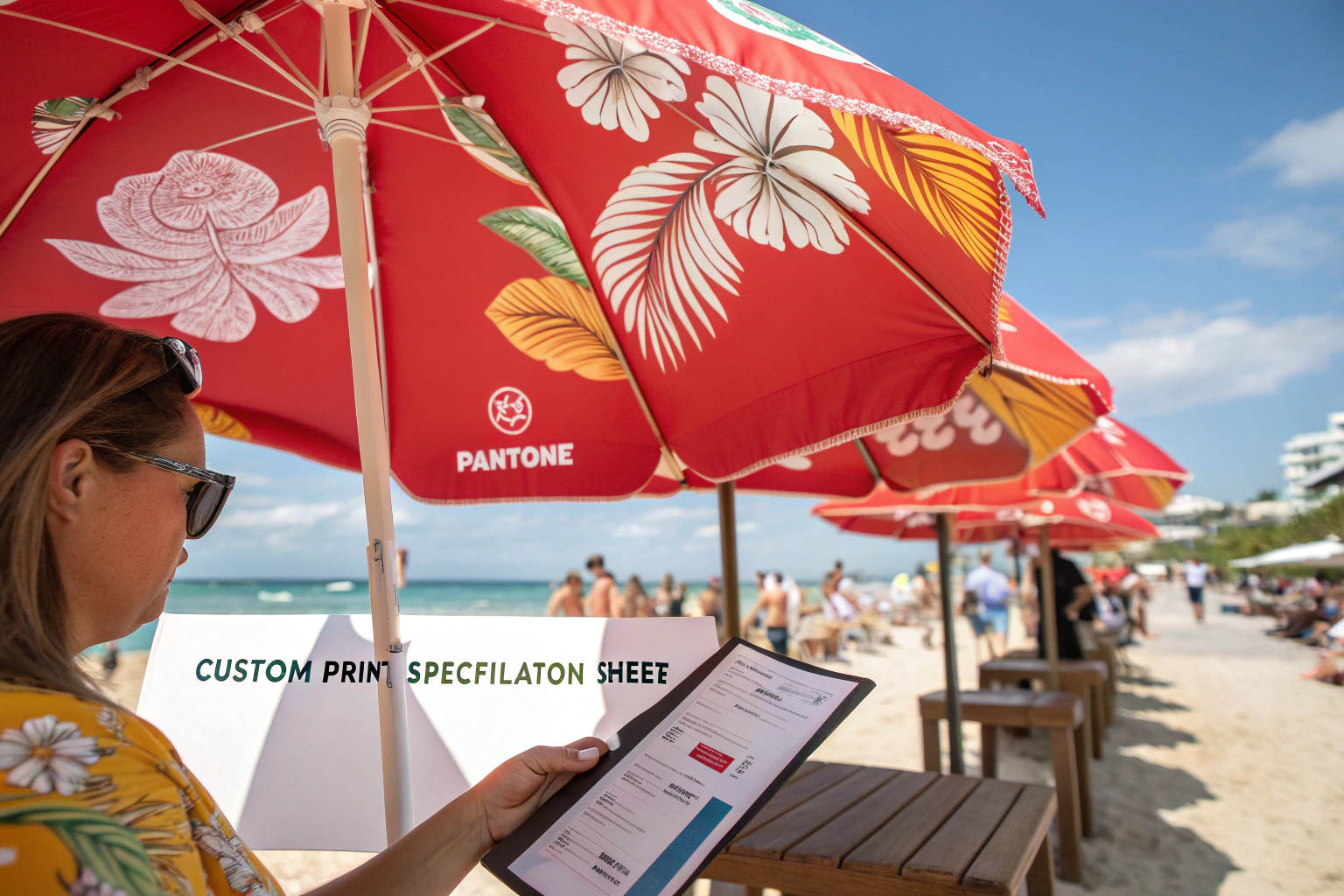
A resort chain owner from the Caribbean once sat across from me with a beautiful watercolor painting of tropical flowers. She wanted that painting printed across 200 beach umbrellas to match her new beachfront villas. She had already been turned down by four factories. They quoted her minimums of 1,000 or 1,500 units, numbers that would have left her storing umbrellas for a decade. When she reached us, I did not say no. I asked what size, what fabric, and whether she could accept a slightly higher unit cost. She got her 200 umbrellas, the beachfront looked stunning, and her Instagram photos brought in more bookings that season than any ad campaign she had ever run.
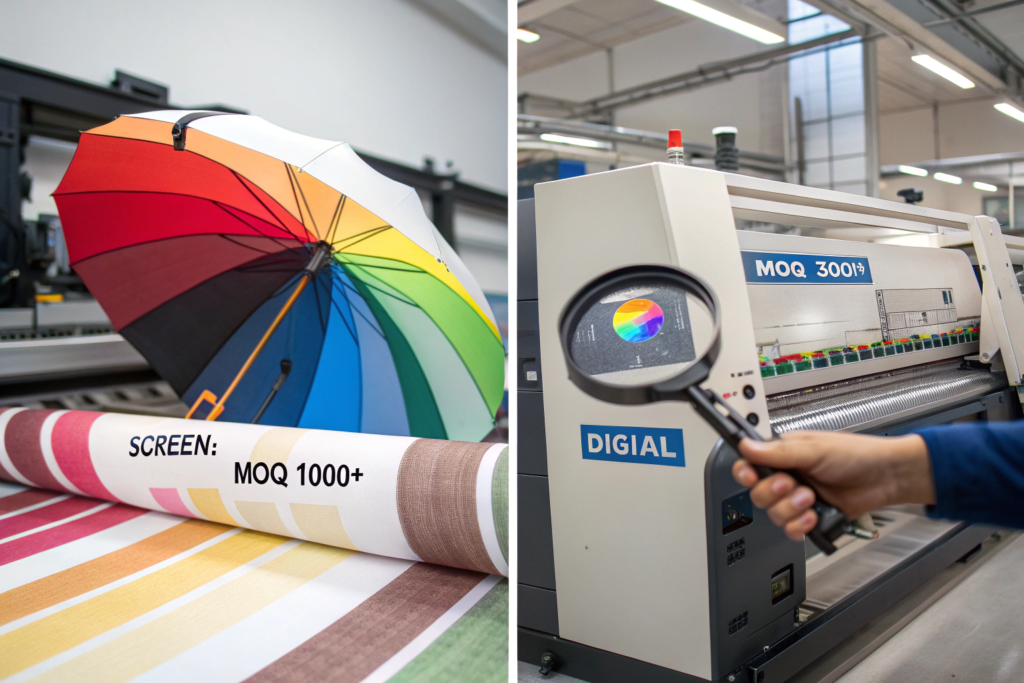
The minimum order quantity for custom printed beach umbrellas typically starts at 300 to 500 pieces per design when using digital printing technology, and 1,000 to 1,500 pieces when using traditional screen printing. The exact minimum depends on three variables: the printing method you choose, the umbrella size and fabric type, and whether you are printing a single large panel or a repeating pattern across multiple panels. A factory that understands these variables can often accommodate smaller orders without sacrificing quality.
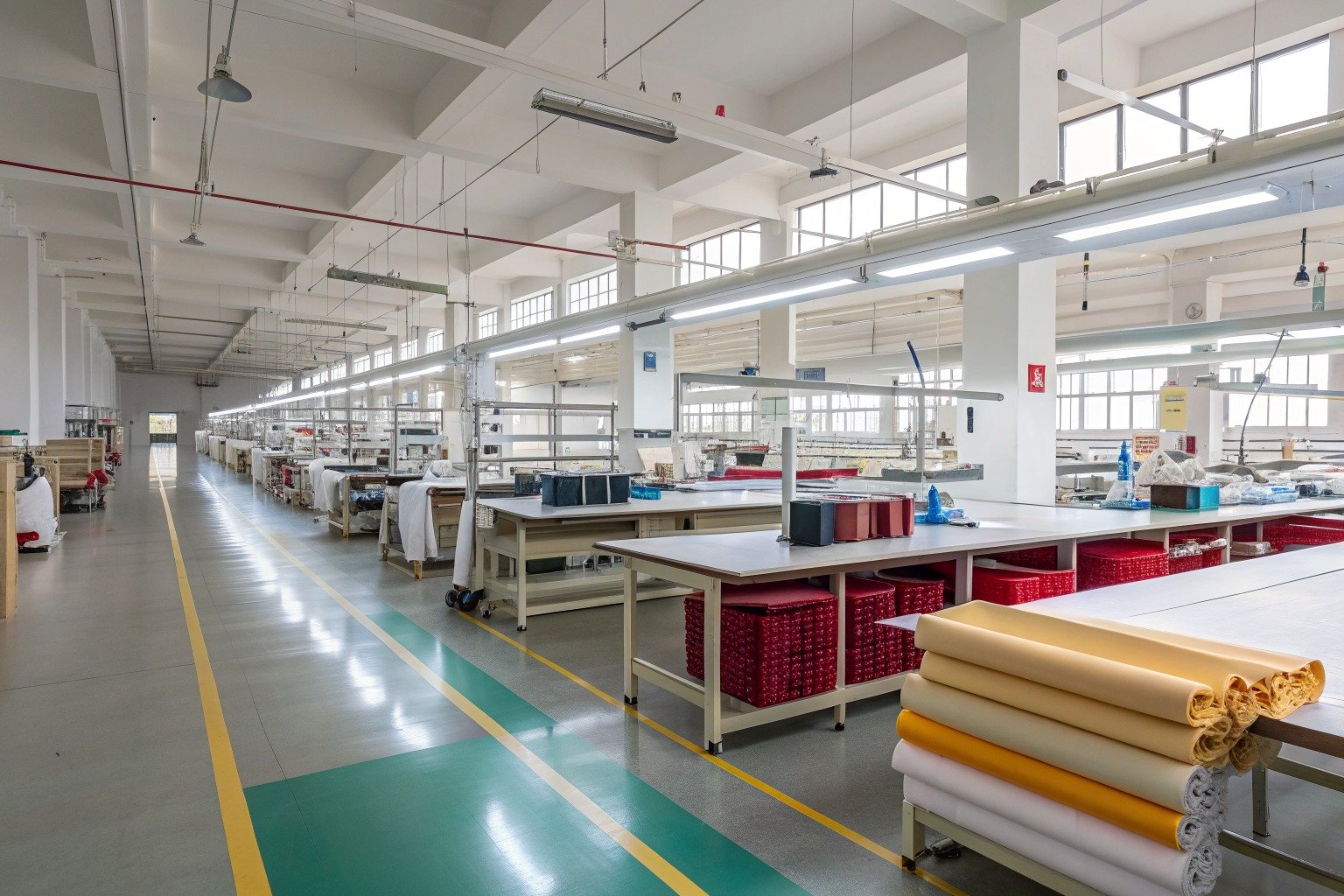
In our Zhejiang factory, we have invested in digital textile printing specifically to serve the growing market of boutique hotels, resorts, and promotional brands that need smaller quantities of highly customized umbrellas. The old model of "one design fits all" and "you must order a full container" is fading. I want to walk you through the printing methods that determine minimums, the size and fabric factors that affect cost, and how to structure your custom order to get exactly what you need without overcommitting.
What Printing Methods Determine the Minimum Order for Custom Beach Umbrellas?
The printing method is the single largest driver of minimum order quantity. The two primary methods for printing on umbrella canopy fabric are traditional rotary screen printing and modern digital fabric printing. These methods have fundamentally different cost structures, and the minimum order quantity is the point at which each method becomes economically viable.
Screen printing involves creating a physical engraved screen for each color in the design. The screen is a metal cylinder with the pattern etched into its surface. As the fabric passes under the rotating screen, ink is forced through the etched holes. Screen printing produces vibrant, durable colors with excellent opacity, but the setup cost for each screen is significant. This fixed cost must be amortized across the total order quantity. Digital printing uses inkjet print heads that spray microscopic droplets of ink directly onto the fabric. There is no screen, no setup cost per color, and the design can be changed instantly between panels. This makes digital printing the preferred method for small quantities and highly detailed designs.
Why does screen printing require a higher MOQ than digital printing?
The economics of screen printing are driven by the fixed cost of screen fabrication. Each color in your umbrella design requires a separate engraved screen. A four-color design requires four screens. The cost of manufacturing these screens, plus the machine setup time to install and calibrate them, is a fixed cost that does not change whether you print 100 panels or 10,000 panels. On a small order, this setup cost per unit is very high. On a large order, it is spread thin. The minimum order quantity for screen printing is the point at which the setup cost per unit becomes acceptable to both the factory and the buyer. For beach umbrellas, this typically falls around 1,000 to 1,500 units per design. If your design has many colors, the screen cost is higher, and the MOQ may increase. This screen printing setup costs resource explains the economic dynamics.
How does digital printing enable smaller custom orders for umbrellas?
Digital fabric printing eliminates the screen entirely. The design file is sent directly from the computer to the print heads. There is zero tooling cost, and the printer can switch from one design to the next with no mechanical changeover. The cost per printed square meter is higher than screen printing at large volumes, but there is no setup cost penalty for small volumes. This makes digital printing economically viable for orders as low as 300 to 500 pieces per design. Digital printing also has no limitation on the number of colors or the complexity of the design. A watercolor painting with hundreds of subtle color transitions prints just as easily as a simple two-color logo. This capability is what made the Caribbean resort owner’s tropical flower umbrella order possible. This digital textile printing for small runs technology has transformed the custom umbrella market.
How Do Umbrella Size and Fabric Type Affect the Minimum Order?
The physical size of the umbrella and the type of fabric you choose directly affect the minimum order quantity because they determine how much raw fabric is consumed per unit and how the fabric is manufactured. A larger umbrella uses more fabric per piece. A heavier fabric requires a larger minimum production run at the textile mill. These material realities cascade into the factory’s MOQ calculation.
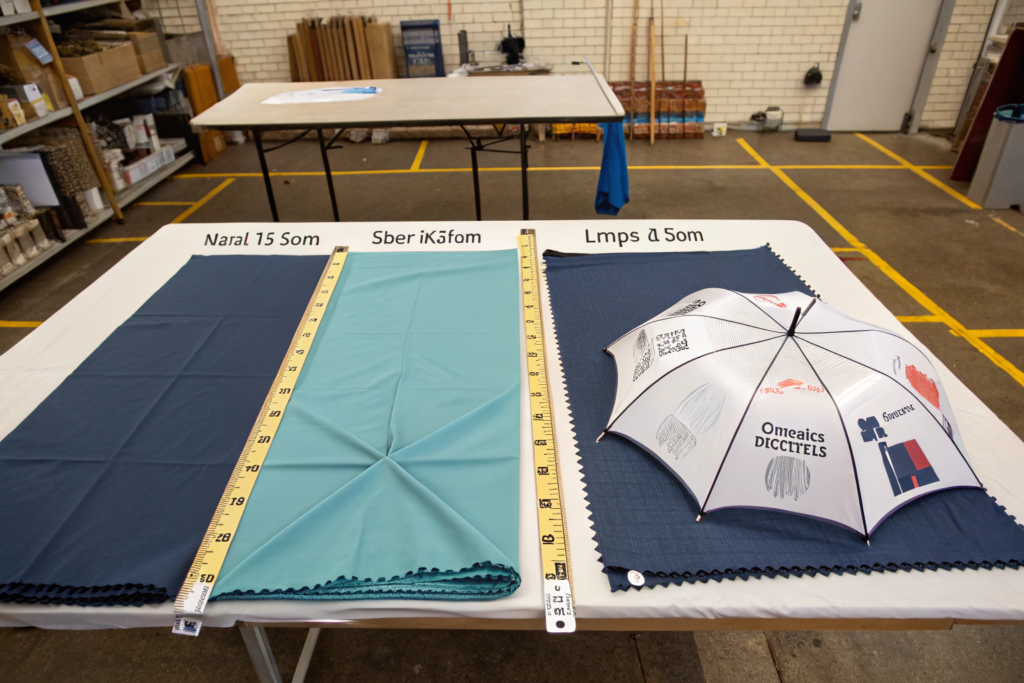
Beach umbrellas range from compact, portable models of about 1.8 meters in diameter to large commercial cabana-style umbrellas of 3.0 meters or more. The canopy of a large umbrella consumes significantly more fabric per unit than a small umbrella. The fabric itself is typically polyester pongee or polyester oxford, with different weights, weaves, and UV-resistant coatings. Custom printing requires the factory to purchase or allocate a specific quantity of blank fabric. The mill that produces this fabric has its own minimum order, often by the roll.
What is the difference in fabric consumption between a small and a large beach umbrella?
A standard beach umbrella with a 2.1-meter diameter canopy has a fabric area of approximately 3.5 square meters per unit, assuming eight triangular panels. A large 2.7-meter umbrella has a canopy area of approximately 5.7 square meters. Fabric consumption increases by over 60% for the larger size. This means that an order of 300 large umbrellas consumes as much fabric as approximately 480 small umbrellas. The factory’s MOQ reflects this difference. A larger umbrella may have a higher piece-count minimum, or more commonly, the factory will accept a lower piece-count minimum for a larger umbrella because the total fabric volume meets the mill’s minimum roll requirement. Understanding this relationship allows you to negotiate the MOQ more effectively. This umbrella canopy fabric calculation provides the technical background.
Why does UV-coated fabric sometimes increase the minimum?
Most beach umbrellas require a UV-resistant coating applied to the polyester fabric to provide sun protection. This coating is applied during the fabric finishing process at the textile mill. The coating machine has a minimum run length. If your custom umbrella order requires a specific UV coating, perhaps a silver-backed coating for maximum reflection or a specific UPF rating, the mill must run your fabric as a dedicated batch. The minimum order must be large enough to consume that entire batch, or the factory must stock the excess coated fabric and hope to use it for a future order. Standard clear UV coating, which we stock routinely, has a lower minimum because we aggregate orders. A specialized coating or a custom color-coated backing may require a higher minimum. This UV protective fabric coatings resource explains the technical options.
What Strategies Can You Use to Order Custom Umbrellas at a Lower Quantity?
If the standard minimum order is still slightly beyond your budget or storage capacity, there are specific strategies you can use to negotiate a lower quantity without compromising the visual impact of your custom umbrella. These strategies are not about asking the factory for a favor. They are about adjusting the order configuration to reduce the factory’s fixed costs, which naturally lowers the MOQ.
The most effective strategies involve accepting stock components for non-visible parts, simplifying the color palette to reduce screen costs, and being flexible on pricing for very low quantities. Each strategy trades one variable, a specific component, a color count, or a unit price, for a lower total quantity. A professional factory will guide you through these options transparently.
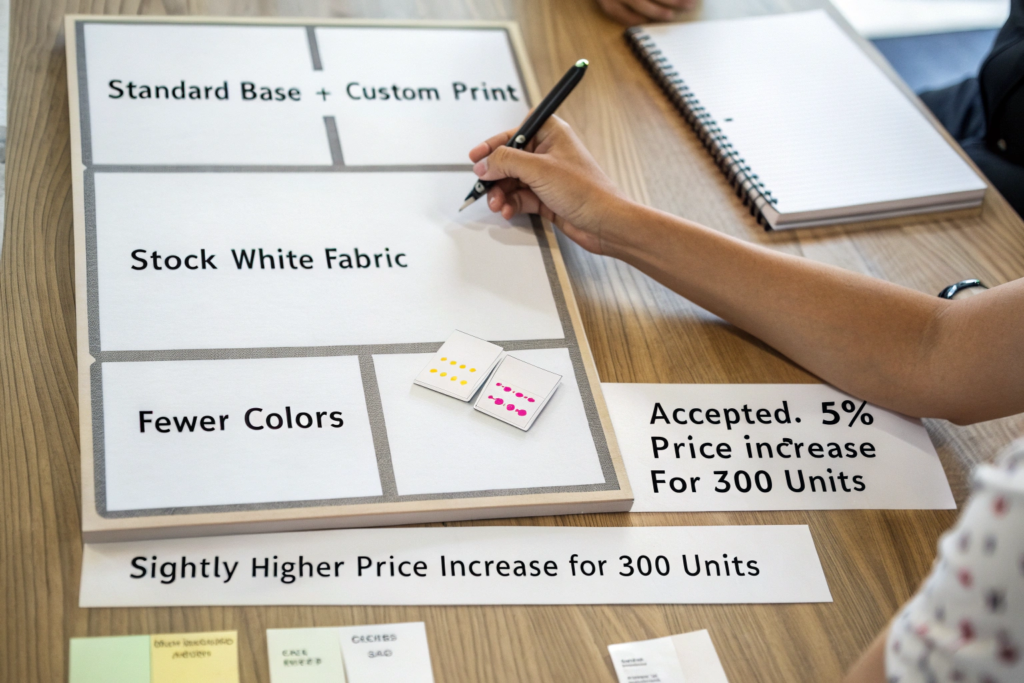
How can accepting a stock frame reduce the total minimum?
A beach umbrella consists of a canopy and a frame. The frame includes the pole, the ribs, the hub, and the tilt mechanism. If you require a custom frame color, a specific wood grain finish, or a unique tilt mechanism, those components must be produced in a dedicated batch, which carries its own minimum. By accepting one of our stock frame options, anodized aluminum in silver or bronze, a standard wood pole, or a standard tilt mechanism, you eliminate the frame minimum entirely. The order becomes a canopy-only customization, which is subject only to the fabric printing minimum. This single decision can reduce the total MOQ significantly. This umbrella frame components standardization resource explains the standard options available.
Why does consolidating to a single-color print lower the screen printing minimum?
If your design aesthetic allows it, a single-color print dramatically reduces the screen printing setup cost. A one-color design requires only one screen instead of four or six. The setup cost is a fraction of the multi-color cost, and the minimum order quantity drops accordingly because less setup cost needs to be amortized. A single-color white or gold logo on a solid-colored canopy fabric can be strikingly elegant and cost-effective at quantities well below the multi-color minimum. This single-color versus multi-color printing cost comparison illustrates the economics.
How Should You Prepare Your Artwork to Ensure the Fastest Turnaround?
The artwork file you submit is not just a picture. It is a technical manufacturing document that directly affects the production timeline and the print quality. A perfectly prepared file moves directly into the printing queue. A file with errors triggers a revision cycle that can add days or weeks to your delivery date. Preparing the file correctly is the most impactful contribution you can make to the speed and accuracy of your custom umbrella order.
An umbrella canopy is not a flat rectangle. It is a series of triangular panels that, when sewn together, form a three-dimensional dome. The artwork must be laid out to fit these specific panel shapes, with the design elements aligned across the panel seams to create a continuous image when the umbrella is open. The print-ready file must meet the dimensional, resolution, and color space requirements of the printing method you have chosen.
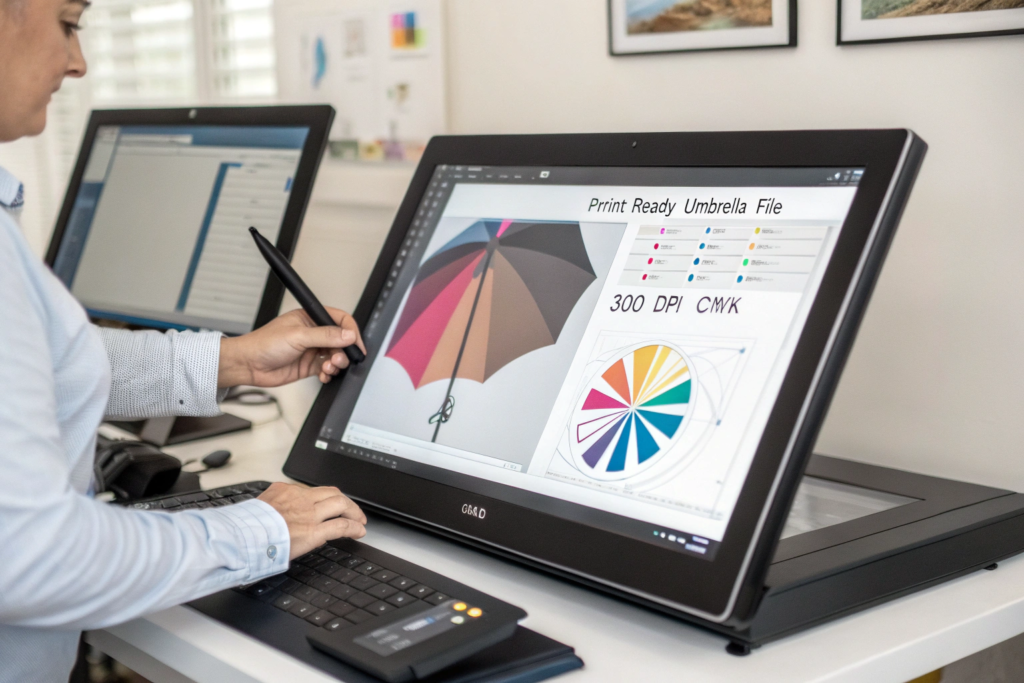
What are the essential file setup specifications for a paneled umbrella canopy?
The factory will provide a template, typically an Adobe Illustrator or PDF file, that shows the exact shape of each canopy panel with the seam allowances and the bleed area. The artwork must be placed within these panel shapes. The resolution must be at least 300 dots per inch at full scale to ensure sharp print quality. The color space must be CMYK, not RGB, to match the ink colors accurately. All text must be converted to outlines so that font substitution errors do not occur. A bleed of at least 5mm beyond the panel edge is required to prevent white slivers at the seams if there is any slight shifting during cutting. This print file preparation for fabric guide explains the essential steps.
Why is a Pantone color reference more reliable than a screen color preview?
A color on a screen is generated by emitting light. A color on fabric is generated by reflecting light. These two color reproduction methods are fundamentally different, and a color that looks perfect on a monitor can look completely different when printed on polyester. A Pantone Solid Coated swatch book provides a physical, standardized color reference. When you specify a Pantone number, we can mix the ink or calibrate the printer to match that exact physical standard. We also recommend requesting a printed strike-off, a small sample of the design printed on the actual umbrella fabric, for your approval before the bulk production begins. This Pantone color matching in manufacturing ensures that the color you see in the swatch book is the color that arrives on your umbrella.
Conclusion
The minimum order for custom printed beach umbrellas is not a single, inflexible number. It is a variable determined by the printing method, the umbrella size, the fabric type, and your willingness to accept standard components or slightly higher unit costs for lower quantities. Digital printing has opened the door to orders of 300 to 500 pieces, making custom beach umbrellas accessible to boutique hotels, small resorts, and promotional brands that were previously shut out of the market.
We have explored the economic differences between screen and digital printing, the material realities of fabric consumption and UV coating minimums, the strategic levers that allow lower-quantity orders, and the artwork preparation that ensures a fast and accurate production run. The key is to discuss your needs transparently with the factory and be open to the configuration adjustments that make smaller orders economically viable.
If you are considering custom printed beach umbrellas for your resort, brand, or event and want to understand the exact minimum for your specific design and size requirements, we can provide a detailed quotation with options for digital or screen printing and a range of frame choices. Our Business Director Elaine manages our custom umbrella programs and can walk you through the artwork templates and material options. Contact her directly at elaine@fumaoclothing.com. Your beachfront should look exactly the way you imagined it. We will help you get there, even if you do not need a thousand umbrellas.