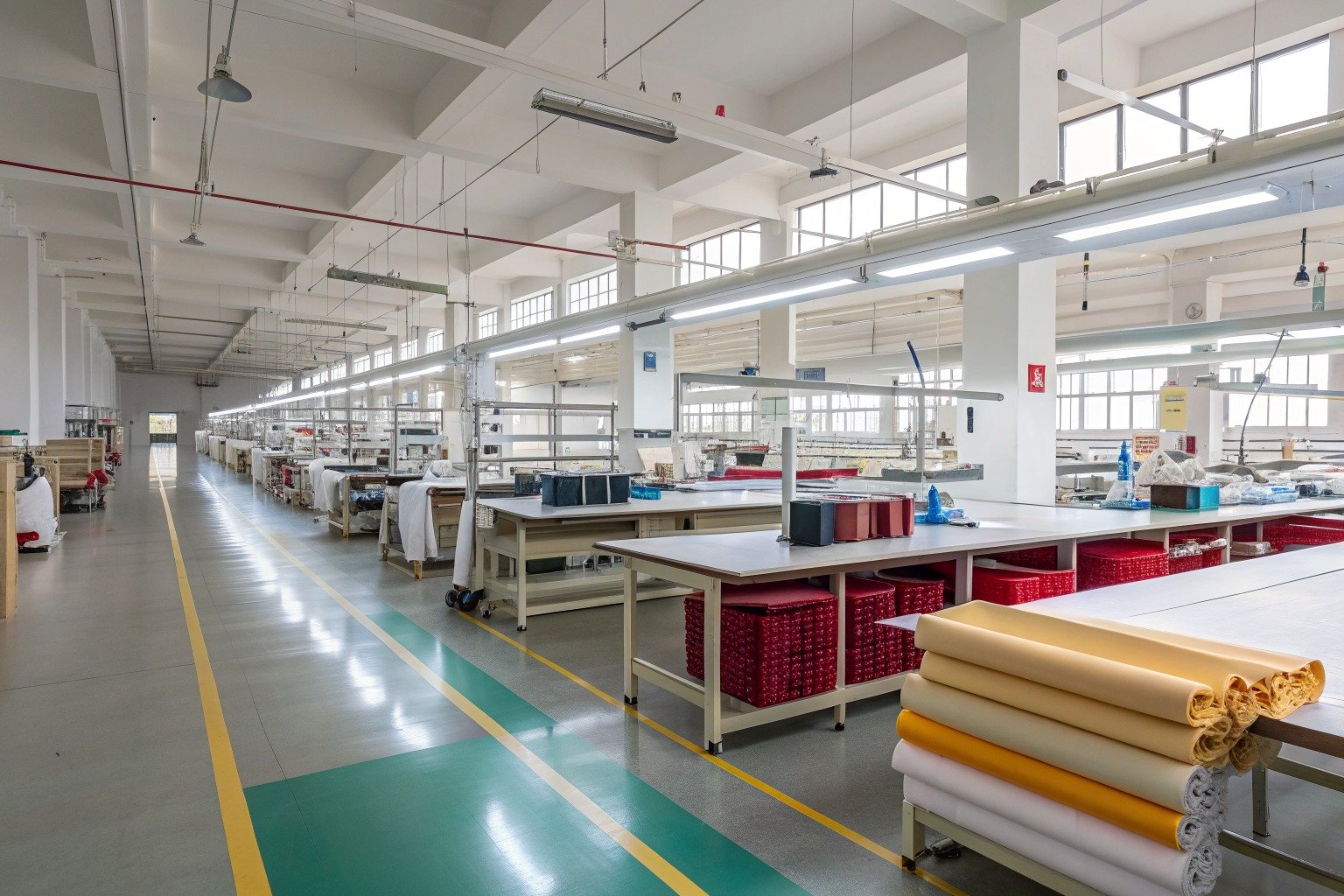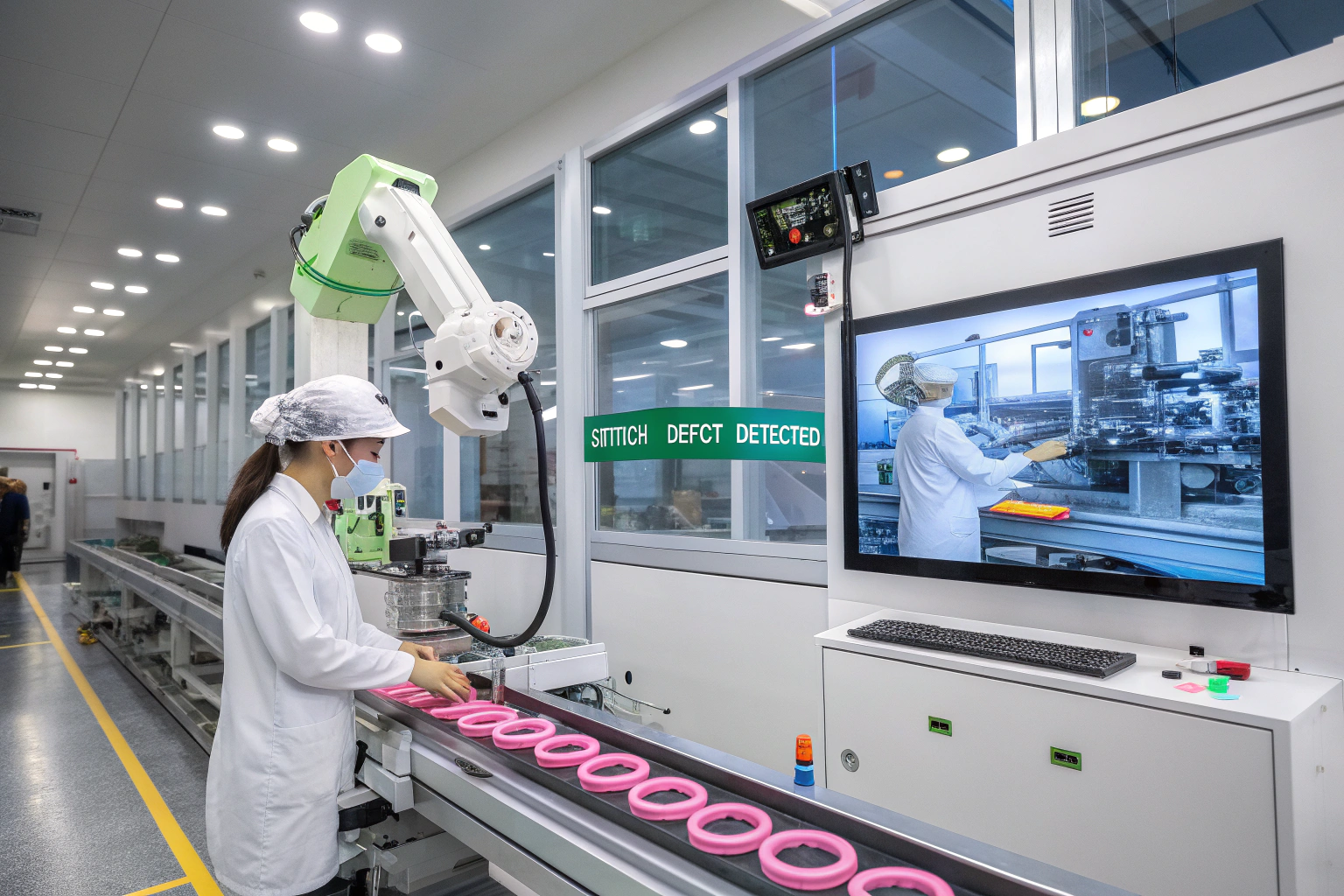
A few months ago, one of our long-time clients, a children’s boutique chain from California, called me with a curious observation. Their return rate on our seamless hair bands had dropped to nearly zero over the past year. They assumed we had simply hired more inspectors. When I told them our inspection headcount hadn’t changed but we had installed AI camera systems on the finishing line, they were fascinated. They had never heard of artificial intelligence being used for something as tactile and flexible as a fabric hair band. But that is exactly where the technology shines.
Our quality control team uses AI cameras to inspect hair bands by combining high-speed industrial computer vision with machine learning algorithms trained specifically on our product defect library. The AI cameras capture multiple images of every single hair band as it passes under the lens. The software analyzes these images in real time, comparing each band against a digital "golden sample" model. It flags any deviation—a loose thread, a missing stitch, a twisted elastic, a color shift—and automatically separates the defective unit from the production stream. This process happens in milliseconds, far faster than the human eye, and it never gets tired, distracted, or bored.
In our factory in Zhejiang, we have embraced AI-powered inspection not to replace our skilled human inspectors but to augment them. The AI handles the repetitive, high-speed defect detection that exhausts human attention, freeing our team to focus on nuanced quality judgments that require touch, feel, and experience. I want to explain exactly how this technology works in practice, what specific defects it catches that humans often miss, and why it represents the future of quality assurance in the fashion accessories industry.
What Specific Defects Can AI Cameras Detect That Human Eyes Often Miss?
The human eye is a remarkable instrument, but it is not designed for industrial consistency. A human inspector working an eight-hour shift on a finishing line experiences fatigue, distraction, and habituation. After looking at thousands of hair bands, the brain starts to accept small defects as "normal" because it is cognitively efficient to do so. This is not a failure of work ethic; it is biological reality. The AI camera experiences none of these limitations. It evaluates the ten-thousandth hair band of the day with the same algorithmic rigor as the first.
The AI system we use is trained to detect specific defect categories that are statistically most likely to escape human visual inspection. These include micro-defects like needle holes smaller than a pinprick, low-contrast defects like a subtle color drift that is invisible under certain factory lighting, structural inconsistencies like a slight twist in the elastic core that affects the band’s stretch behavior, and dimensional variances where the band’s length or width drifts outside the tolerance range by a fraction of a millimeter.
How does the system identify a "missing stitch" in a seamless elastic band?
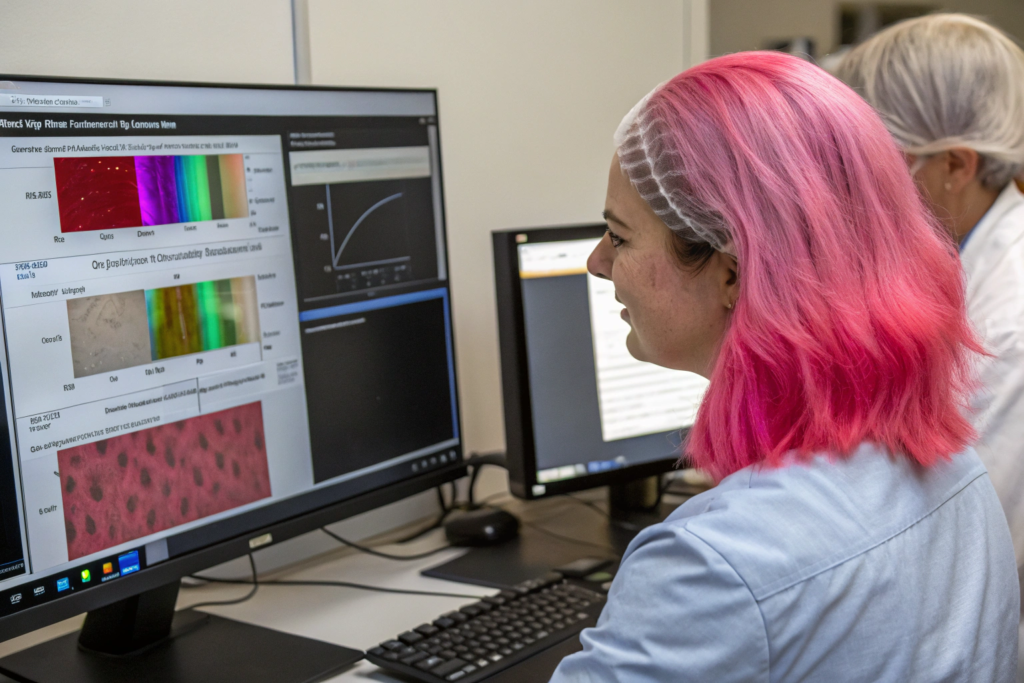
A seamless hair band is constructed from knitted elastic yarn. A "missing stitch" occurs when a needle on the circular knitting machine skips a loop, leaving a tiny gap in the fabric structure. To a human inspector, this gap might be invisible if the surrounding yarn fluffs over it. The AI camera, however, uses a technique called texture analysis. It compares the local knit pattern of every square millimeter of the band to a stored mathematical model of the correct stitch geometry. If the local pattern deviates from the model, even by a single missing loop, the pixel signature changes. The AI flags the deviation, highlights the exact location on the screen, and triggers a puff of compressed air that blows the defective band off the conveyor into a reject bin before it reaches the packaging station. This AI computer vision for textile defect detection technology achieves a detection accuracy rate that significantly exceeds manual inspection.
Why is color consistency checked by a spectrophotometer-grade AI camera?
A human inspector judges color under ambient factory lighting, which can vary in color temperature depending on the time of day, the weather, and the age of the overhead lamps. A color that looks perfectly matched at 10 a.m. under cool fluorescent light might look slightly different at 3 p.m. when warm afternoon sunlight streams through the windows. This is called metamerism. The AI camera solves this by using a calibrated, multi-spectral light source and a sensor that measures color as numerical spectral reflectance data, essentially functioning as an in-line spectrophotometer. It compares the measured color of each production batch to the approved digital standard. If the Delta E value exceeds the threshold, typically set at 1.5 or less for premium accessories, the system alerts the quality supervisor before the batch proceeds further. This ensures that the pink hair bands in March match the pink hair bands in September, regardless of who was on shift or what the weather was like. This spectrophotometric color control in manufacturing technology is integrated directly into our inspection line.
How Is an AI Camera System Trained to Understand Fashion Accessory Defects?
An AI camera system is not born knowing what a "good" hair band looks like. It must be taught. This teaching process is called supervised machine learning, and it requires a large, carefully curated dataset of images that represent the full universe of possible defects for the specific product. At our factory, we spent months building this dataset in partnership with the AI system provider. The process involved both our most experienced QC inspectors and the software engineers who translated human expertise into algorithmic rules.
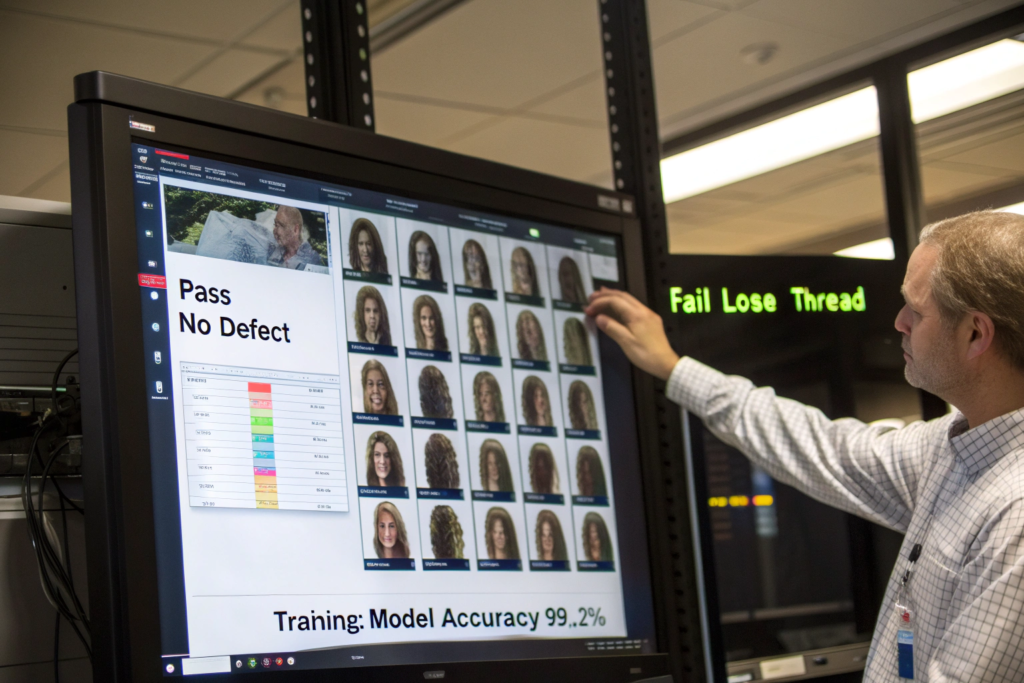
The training dataset contains tens of thousands of images of hair bands. For each defect type—loose thread, uneven seam, color shift, elastic twist, dimensional error—the dataset includes hundreds of examples captured under varying lighting conditions and at different camera angles. The images are manually labeled by our senior inspectors, who draw bounding boxes around each defect and assign a defect classification. This labeled dataset feeds into a convolutional neural network, a type of AI model specialized for image recognition. The model iteratively learns to associate specific pixel patterns with specific defect labels.
What is a convolutional neural network and how does it "learn" a defect?
A convolutional neural network, or CNN, is a type of deep learning algorithm modeled loosely on the visual cortex of the human brain. It processes an image through multiple layers of mathematical filters. The first layer detects simple features like edges and color contrasts. The second layer combines these edges into shapes. The third layer recognizes textures. The deeper layers synthesize all this information into a classification decision: "this pixel pattern matches the labeled pattern for a loose thread." During training, the network makes predictions on the labeled images. When its prediction is wrong, the error is mathematically calculated and fed back through the network to adjust the filters. This feedback loop repeats millions of times until the network’s prediction accuracy exceeds the target threshold. The result is a digital model that can identify a loose thread on a hair band with greater consistency than a human inspector who has been on shift for seven hours. This convolutional neural networks for quality control resource explains the underlying technology.
How do we ensure the AI system doesn’t generate false positives that waste product?
A false positive occurs when the AI flags a perfectly good hair band as defective. If the system generates too many false positives, it wastes product, slows the line, and frustrates operators. We control the false positive rate through a two-pronged approach. First, the AI model is trained with a large number of "borderline" images—bands that are acceptable but near the edge of the tolerance range. This teaches the model the subtle distinction between "acceptable variation" and "genuine defect." Second, any band that the AI flags as defective is diverted to a secondary inspection station where a human inspector makes the final judgment. The AI’s role is to screen and flag with superhuman speed; the human’s role is to adjudicate the borderline cases with nuanced judgment. This human-AI collaboration achieves a defect detection rate higher than either could achieve alone, while keeping the false rejection rate below the threshold where material waste becomes a concern. This human-in-the-loop AI quality control model is the practical reality of AI-assisted manufacturing.
How Does AI Inspection Affect Overall Production Speed and Cost for the Buyer?
Every buyer’s first question about new technology is the same: "Does this make my order more expensive?" The honest answer is that AI camera inspection reduces the total cost of quality, even if the technology investment is significant for the factory. The cost savings are realized through reduced returns, fewer chargebacks from retail partners, faster production throughput, and lower labor costs for rework. These savings translate into a more reliable product and, over time, a more stable unit price for the buyer.
The speed difference between manual and AI-assisted inspection is dramatic. A human inspector can examine a limited number of hair bands per hour and maintain consistent accuracy. An AI camera line can process thousands of bands per hour without any decline in accuracy. This throughput means that the QC stage is no longer a bottleneck in the production process. Orders flow from finishing to packaging without the traditional waiting period for manual inspection, which reduces overall lead time. For the buyer, this means a more reliable delivery schedule and a higher-confidence product.
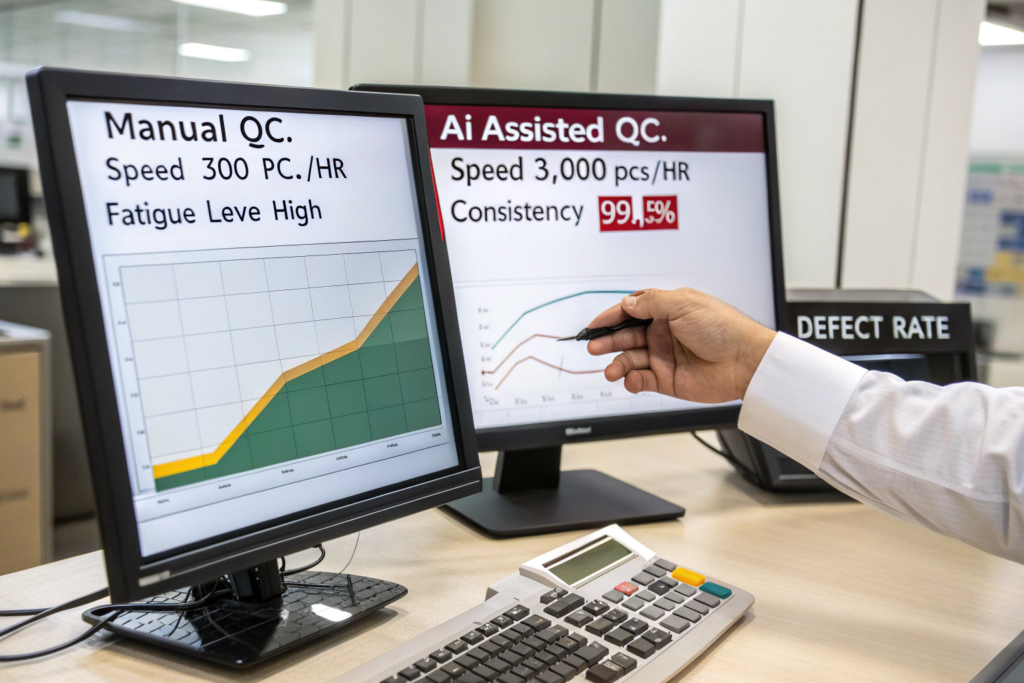
What is the throughput comparison between a manual QC line and an AI-assisted line?
A typical manual QC inspector examining hair bands one by one under a lightbox can thoroughly inspect a certain number of pieces per hour with a detection rate that depends heavily on fatigue levels. An AI camera system mounted over a conveyor can inspect at a rate of several thousand pieces per hour with a consistent detection rate. This is not a marginal improvement. It is an order-of-magnitude shift in inspection capacity. For a large order of 50,000 hair bands, the AI system completes the inspection in a fraction of the time it would take a manual team, allowing the order to ship days earlier. This speed advantage is particularly valuable during peak production seasons when every day of lead time matters. This automated quality control throughput data reflects the real-world performance of modern vision systems.
How does reducing the human error rate translate to lower return rates for the buyer?
Every defective hair band that escapes the factory and reaches a retail customer creates a cascade of cost. The customer returns the product. The retailer processes the return, restocks or discards the item, and potentially issues a chargeback to the brand. The brand’s quality rating with the retailer declines. The brand may need to compensate the customer with a discount or free shipping on a future order. The AI system reduces the escape rate, the percentage of defects that slip through inspection undetected, to a fraction of the manual inspection rate. For a brand selling 100,000 hair bands, a reduction in the return rate translates to thousands of dollars in saved logistics costs, preserved margin, and maintained retailer relationships. This quality cost analysis explains the financial impact of reducing defect escape rates.
Can the AI Inspection Data Help Buyers Improve Their Product Designs?
The AI inspection system does more than sort good product from bad. It generates a continuous stream of structured data about every defect found, categorized by type, location, time, and production batch. This data accumulates into a powerful analytical resource that reveals patterns invisible on the factory floor. The data tells stories about which production steps are generating the most defects, which materials are performing inconsistently, and which design features are inherently prone to failure.
We share this defect data with our brand clients in a summarized monthly quality report. The report includes a defect Pareto chart, which shows the frequency of each defect type ranked from most to least common, a trend chart showing whether defect rates are improving or worsening over time, and specific, actionable recommendations for product design improvements. This transforms the buyer-factory relationship from a transactional inspection gate into a collaborative design partnership.
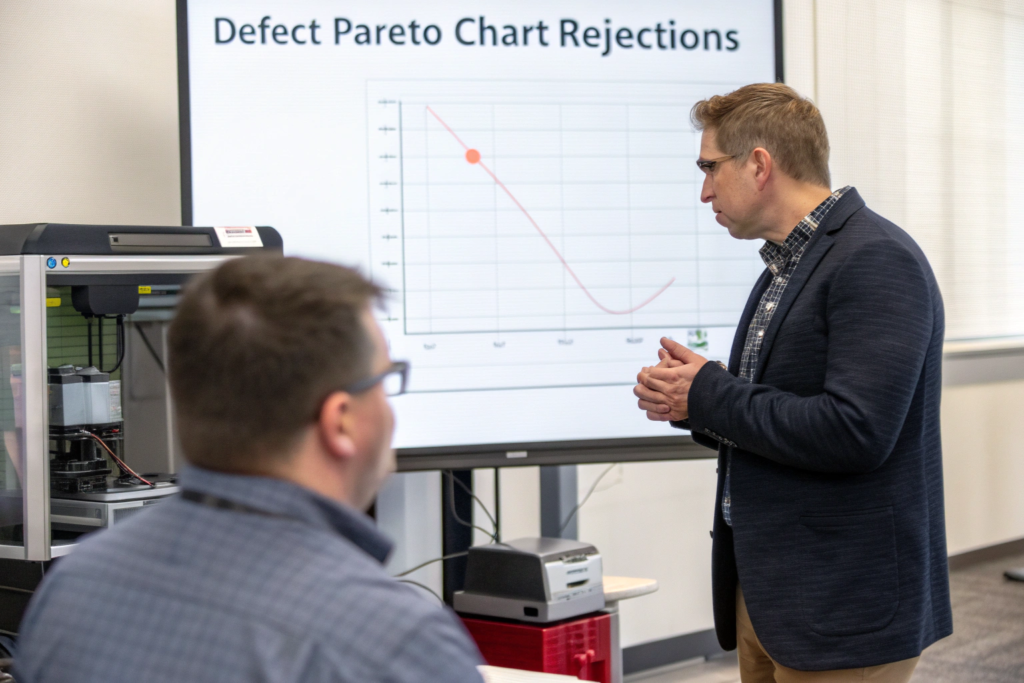
What is a defect Pareto chart and how does it guide design improvements?
A Pareto chart is a bar graph that displays defect categories in descending order of frequency, overlaid with a line showing the cumulative percentage. The principle, based on the Pareto principle, is that roughly 80% of quality problems come from 20% of defect types. The AI system generates this chart automatically from the inspection data. If the chart shows that a loose elastic seam accounts for the majority of all rejections, the buyer and the factory can focus their improvement efforts on that single issue. The solution might be a simple pattern adjustment, a change in thread type, or a modification to the sewing machine settings. Without the AI data, the team might waste time investigating less significant issues while the real problem continues unchecked. This Pareto analysis in quality control is a fundamental quality improvement tool, now supercharged by AI data collection.
How can we use AI trend data to justify a material upgrade to your brand?
Sometimes the defect data reveals that the root cause is not a workmanship issue but a material limitation. For example, if the AI trend chart shows a slow but steady increase in color fading defects over several production batches, and all process parameters are unchanged, the data points to the raw material quality. We can present this trend data to the brand and recommend upgrading to a higher-grade yarn with better colorfastness. The recommendation is not based on our opinion or a supplier’s sales pitch. It is based on statistical evidence that the current material is generating a rising defect rate. This data-driven approach makes it easier for the brand to justify the incremental material cost to their own management, because the cost of the upgrade is weighed against the documented cost of returns and quality failures. This data-driven design for manufacturing feedback loop is the ultimate benefit of an AI-enabled inspection system.
Conclusion
The integration of AI camera systems into our hair band quality control process is not a futuristic experiment. It is a currently deployed, production-proven technology that catches defects invisible to the human eye, maintains perfect attention through thousands of inspection cycles, and generates the data that drives continuous product improvement.
We have explored how the AI detects specific defects like missing stitches and subtle color shifts using texture analysis and spectrophotometry. We have explained how convolutional neural networks are trained on our labeled defect library to achieve a detection accuracy that surpasses manual inspection. We have examined the dramatic throughput advantage and the direct financial benefit of reducing the defect escape rate that causes costly returns. And we have seen how the AI’s defect data, shared transparently through Pareto charts and trend reports, enables a collaborative design improvement partnership between the factory and the brand.
If you are sourcing hair bands or other accessories and want to understand how our AI-assisted quality control reduces your risk and improves your product, we can share sample quality reports and demonstrate the inspection system through a live video tour. Our Business Director Elaine manages our quality assurance partnerships and can arrange a detailed technical briefing for your team. Contact her directly at elaine@fumaoclothing.com. The best quality inspection is the one that happens while you sleep. Our AI cameras never close their eyes.