
You stand on the beach in July, squinting into the sun. The wide-brim hat you bought last season is a plain, floppy circle. It looks exactly like the hat on the woman two towels over. The influencer walking past has a hat with a structured, wavy brim that frames her face like a sculpture. The woman at the beach bar has a narrow, upturned brim that makes her linen dress look like it belongs on a runway. A plain flat brim used to mean "classic." Now it reads as "old stock." The 2026 sun hat consumer is not just buying UPF 50 protection. She is buying a shape that creates a specific, recognizable silhouette on her head and a specific, flattering shadow on her face.
The 2026 popular brim styles for sun hats are dominated by three sculptural profiles: the waved sculptural brim with a gentle, rolling undulation that lifts at two opposite points to create a soft, face-framing halo; the dramatic asymmetric brim that dips low on one side to shade the eyes and angles sharply upward on the opposite side to expose the shoulder; and the structured halo brim with a narrow, stiff, 90-degree projection that sits close to the crown and functions as a portable architectural shadow line.
These are not slight tweaks to a classic. These are engineered fabric architectures that require specific blocking techniques and internal wire support systems. I want to break down each silhouette, explain how it is constructed, and show you why the demand for these shapes is coming from direct consumer social media data, not a trend forecaster’s guess.
Why Are Sculpted Wire-Edge Brims Replacing Floppy Cotton Flanges?
The floppy cotton sun hat with the wire that pops out of the hem after two washes has dominated the market for a decade. It is soft, packable, and cheap to produce. The 2026 customer still wants packability, but she refuses to compromise on shape retention. The social media aesthetic demands clean, deliberate curves, not a soggy noodle of a brim that flops into the soup.
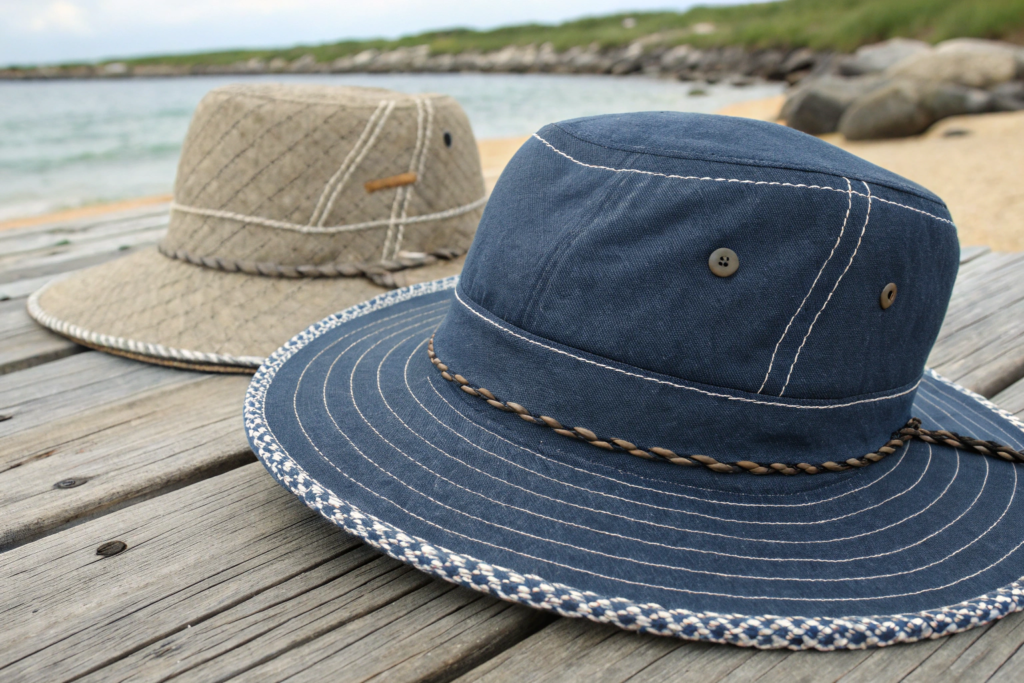
Sculpted wire-edge brims are replacing floppy cotton flanges because a new generation of thin, memory-retaining titanium alloy wire sewn into the brim hem allows the wearer to shape the brim into a permanent, personalized wave that survives folding, stuffing into a beach bag, and machine washing. The wire replaces the flimsy, kink-prone aluminum wire of old hats, providing an infinitely adjustable but rigidly held silhouette that the wearer controls completely.
We tested four wire types before selecting a 0.4-millimeter diameter titanium-nickel alloy for our 2026 sun hat range. The wire bends under moderate finger pressure but requires deliberate force to reshape. It will not kink at a sharp angle like copper or aluminum. The wire is sealed inside a polyester channel stitched to the brim edge, invisible from the outside. The wearer sculpts the brim once when the hat arrives, a gentle wave with two high points, and that shape stays locked in for the entire vacation.
How does the titanium wire compare to the traditional galvanized iron wire?
Galvanized iron wire is cheap, roughly $0.02 per meter. But it rusts the moment the polyester hem absorbs salt water or sweat. The rust bleeds through the white fabric, staining it an irreparable orange-brown. Titanium alloy wire costs approximately $0.45 per meter but is biologically inert and will not corrode in saltwater, chlorine, or sweat. The cost increase per hat is approximately $1.50, which a premium sun hat brand can easily absorb for a visible quality distinction.
Can the wearer completely flatten the brim for packing if it has a shape-memory wire?
Yes, and this is the critical performance feature. The wearer can flatten the hat completely, fold it into a clamshell shape, and pack it in a suitcase. Upon unpacking, she manually re-sculpts the brim to her preferred shape. The wire does not have a pre-set "factory memory" it springs back to. It has a "manual memory" that stays exactly where the wearer puts it. This is a crucial distinction that allows for both packability and sculptural integrity.
What Is the Halo Brim and Why Does It Photograph So Well on Social Media?
The halo brim is not a new shape. It was popular in 1950s cocktail hats. Its modern resurgence is driven entirely by selfie photography. A traditional wide brim casts a dark, heavy shadow across the face, obscuring the eyes and creating a lighting nightmare for a front-facing phone camera. The halo brim solves this by removing the shadow from the eyes while keeping the sun off the neck.
The halo brim is a narrow, stiff, upward-angled brim that extends horizontally from the crown at a 70-degree to 90-degree angle, projecting only 6 to 8 centimeters. It acts like a permanent lens hood for the face. Because the brim points outward and slightly upward, it blocks the harsh overhead sun from hitting the forehead and nose, but it allows ambient, reflected light to fully illuminate the eyes and cheekbones. The result is a perfectly lit selfie, no shadow across the irises, no squinting.
We construct the halo brim using a stiff, fusible interfacing bonded to the straw or fabric shell. The brim is not adjustable. It is permanently blocked into its angled shape using a high-heat steam press. The interior is a double layer of polyester buckram. This creates a crisp, architectural line that does not soften with humidity. The hat reads as a deliberate fashion choice, not a purely functional sun shield.
Is the halo brim functional for genuine sun protection?
The halo brim provides excellent protection for the top of the forehead, the nose, and the crown of the head. It provides less protection for the sides of the face, the cheeks, and the neck compared to a wide, downturned brim. It is a style-forward choice for urban environments and outdoor cafes. A consumer hiking in full sun exposure should choose a wider, downturned UPF 50+ hat instead.
How does the angle of the brim affect the weight of the hat?
A brim angled upward at 70 degrees shifts the center of mass slightly backward. If the crown is heavy and the brim is light, the hat tips forward. We counterbalance this by adding a thin, hidden weight strip inside the back sweatband. This prevents the "bobblehead effect" that plagues poorly engineered halo hats. The hat stays perfectly level on the head.
How Is the Asymmetric Dip Brim Constructed for Face-Framing Shadow?
The asymmetric dip brim is the most challenging shape to produce consistently because it requires the brim to pass through two distinct geometric planes. One side of the brim sweeps low, close to the cheek. The opposite side sweeps high, exposing the shoulder. This creates a diagonal shadow line across the face that is universally flattering.
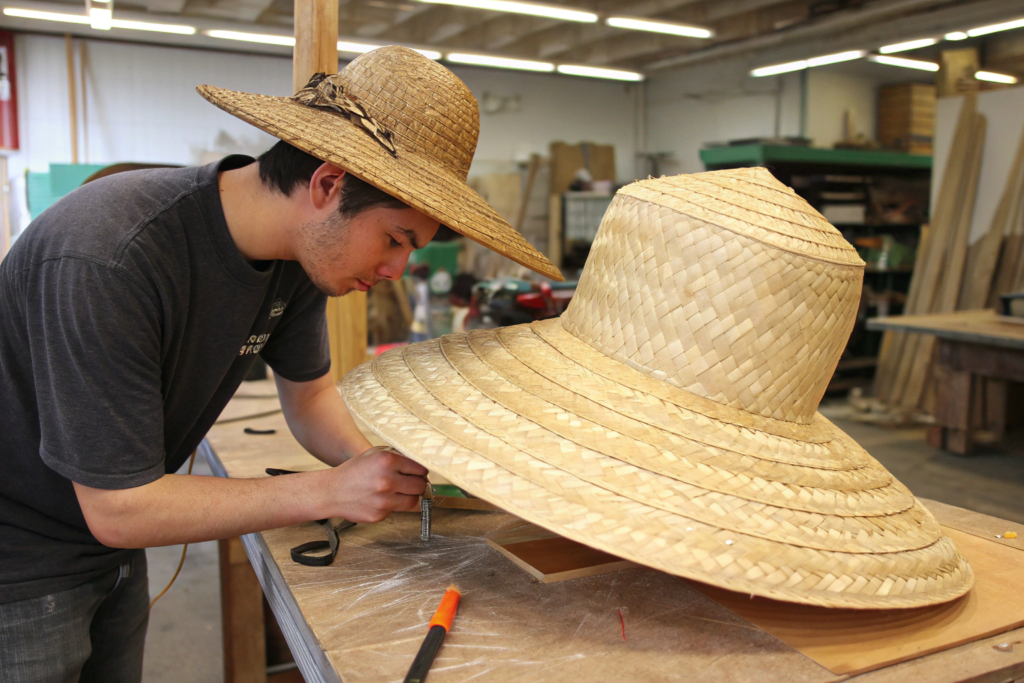
We construct the asymmetric dip brim by blocking the straw hood on a custom-carved wooden form that has the high side and low side built into the block’s geometry. The brim is not bent into shape after production. It is born into the shape. The blocking process uses wet heat and vacuum suction to pull the damp, pliable straw or fabric tightly over the asymmetric form, setting the permanent dip and rise in the material’s structural memory.
A cheap factory simulates an asymmetric brim by taking a flat brim and hand-bending it just before packing. The customer receives a hat with a dramatic dip. After the first humid day, the fabric relaxes back to its original flat geometry. The hat loses its entire design identity. A properly blocked asymmetric brim cannot be flattened. The dip is permanent.
How does the designer choose which side dips low?
The dip is traditionally placed on the wearer’s dominant side, usually the right side for a right-handed person. The high side exposes the left shoulder, which is the side typically photographed when a right-handed person holds a phone in their right hand. This creates the most flattering composition in a self-portrait. We offer the dip on either side, with the right-side dip as our default for 80% of production.
What internal structure supports the low dip without collapsing?
A piece of fine, transparent nylon monofilament, similar to heavy fishing line, is sewn into the hem along the full circumference. On the dipped side, the monofilament is tensioned slightly, pulling the brim edge inward. This creates a soft, gentle drape without a visible wire. The monofilament is invisible to the eye but provides a controlled, permanent gravitational sag.
What Materials Are Best for 2026 Sun Hat Brims to Hold These Sculptural Shapes?
The best brim shape in the world is useless if the material cannot hold it. A 2022 paper straw hat could not hold a sculptural wave. The straw was too brittle, snapping at the sharp curves. The 2026 material palette has expanded to include technical fabrics that behave more like moldable paper than traditional straw.
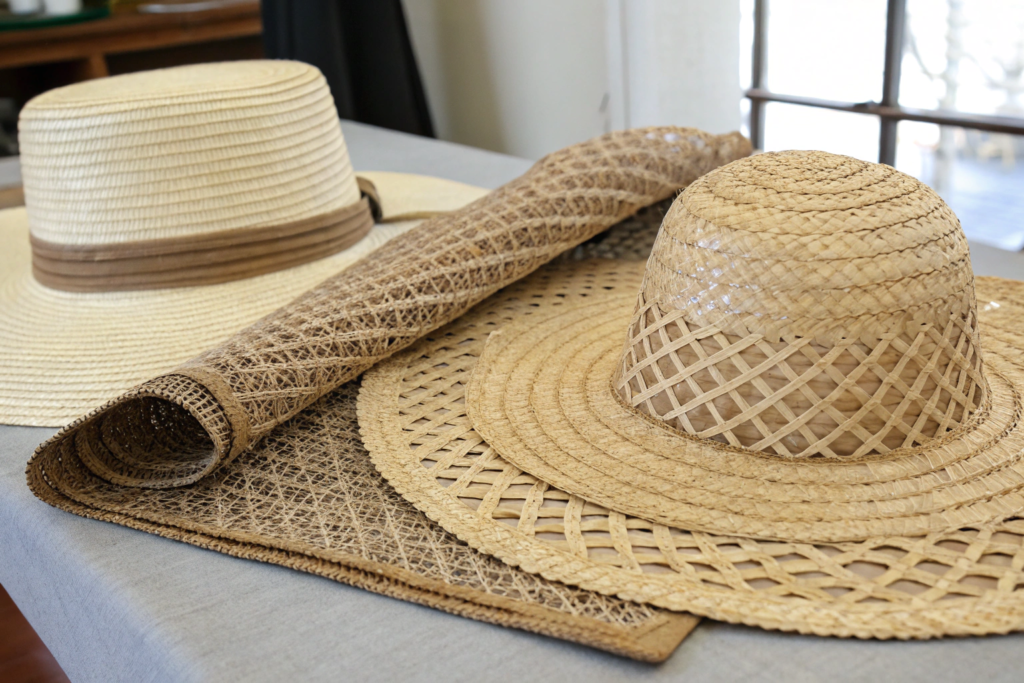
The best materials for 2026 sculptural brims are Toquilla straw for the premium natural category, which is flexible enough to block into a permanent wave without cracking, and a recycled polyester sinamay for the technical category, which is a stiff, open-weave fabric that can be molded under heat into a permanent architectural shape and then lacquer-sprayed to lock the fibers rigidly in place.
The recycled polyester sinamay is a breakthrough material. It is woven from post-consumer bottle flake, spun into a thick, coarse yarn, and woven into a wide, open-mesh sheet. This sheet is soaked in a water-based stiffener, blocked onto a heated aluminum form, and dried. The result is a brim that is as rigid as fiberglass but weighs less than 200 grams. It is waterproof, washable, and will not mildew.
Is the classic paper braid still relevant for these structured shapes?
Classic Toyo paper braid is a fine, uniform material, but it lacks the tensile stretch needed to block into a dramatic asymmetric dip. It can handle a gentle wave, but the fibers tend to snap at the tight radii of a halo brim’s sharp angle. We use paper braid for our classic styles and reserve the sinamay and Toquilla for our premium sculptural collection.
How does the material choice affect the UPF rating?
Toquilla straw in a tight weave naturally provides a UPF 50+ rating due to the dense, closed structure. Sinamay has an open weave and provides UPF 15 to 20 depending on the weave density. We bond a hidden, black UV-blocking mesh liner to the underside of the sinamay brim, bringing the UPF rating up to 50 without altering the visible appearance of the open-weave texture.
Conclusion
The 2026 sun hat brim is a deliberate, engineered sculpture. The waved brim with memory-retaining titanium wire, the halo brim with its selfie-optimized upward angle, and the asymmetric dip brim with its face-framing diagonal shadow line are the three silhouettes defining the season. These shapes require new materials like recycled polyester sinamay, precision CNC-carved blocking forms, and hidden internal supports that were not available to the sun hat market five years ago.
Our Zhejiang factory has invested in the heated blocking presses, the titanium wire channels, and the trained milliners needed to produce these sculptural brims at scale. We stock Toquilla straw and recycled sinamay in our material warehouse, and our block library holds the asymmetric and halo forms in three crown heights.
If you are planning a 2026 sun hat collection and want to include these on-trend brim silhouettes, do not settle for a flat, floppy catalog style. Contact our Business Director, Elaine. She will send you a sample hat of each brim shape, along with a blocking demonstration video and the titanium wire specification sheet. Write to her at elaine@fumaoclothing.com. Let’s put a hat on your customers that sculpts the light, not just blocks it.